

Business
13 banks clear USSD debts as Nigeria shifts to airtime-based billing model

13 banks clear USSD debts as Nigeria shifts to airtime-based billing model
In a development for Nigeria’s digital financial services, thirteen commercial banks have fully settled their outstanding debts for Unstructured Supplementary Service Data, USSD, services owed to Mobile Network Operators, MNOs, paving the way for a new, streamlined billing structure.
The remaining three banks are nearing completion of their payments, having cleared over 95 percent of their respective debts.
The disclosure was made by the Chairman of the Association of Licensed Telecommunications Operators of Nigeria, ALTON, Engr. Gbenga Adebayo, during the ‘ASK the Exec’ virtual session hosted by MTN Nigeria.
This resolution paves the way for a new billing system for USSD banking transactions. Going forward, charges for these services will be debited directly from customers’ airtime accounts.
The update on debt settlements and the upcoming billing model were discussed Thursday, during the ‘ASK the Exec’ online meeting anchored by MTN.
Participants included Lynda Saint-Nwafor, Chief Enterprise Business Officer at MTN, and Engineer Gbenga Adebayo.
According to the ALTON chairman, there has been substantial progress in resolving the long-standing debt issue. “As of January, the outstanding debt from banks to MNOs for USSD services was N180 billion. Of the 17 banks with pre-API outstanding payments (excluding Heritage Bank, which is insolvent), 13 have fully settled their debts, and the remaining three are in the final stages of installment payments, with over 95% of the debt cleared”, he explained to journalists present at the call.
READ ALSO:
- Tension as Iran launches another round of ballistic missiles on Israel
- Nigeria now crime scene, Obi reacts to NNPC N210tn scandal
- Troops foil terrorists’ attempt to establish base in Katsina
This significant clearance of historical debt is crucial as the industry moves to a new operational model. “Banks with outstanding debts will not be excluded from the new system; they can either migrate to end-user billing once their debts are cleared or choose to remain on the old corporate billing model, provided they settle their outstanding obligations”, Adebayo also pointed out.
Since 2021, collaborative efforts between the telecommunications and banking industries, supported by their regulators, have aimed to standardize charges for USSD banking transactions, resulting in a unified fee of N6.98 per transaction.
MTN’s Chief Enterprise Business Officer, Lynda Saint-Nwafor, explained the upcoming change: “The most significant change is the transition to end-user billing, where customers will now be billed for USSD transactions directly from their airtime accounts instead of their bank accounts. This means deductions will no longer occur from bank balances but from airtime balances held with MNOs.”
13 banks clear USSD debts as Nigeria shifts to airtime-based billing model







Auto
26th Abuja Motor Fair: NADDC, BKG Set November 10 Date for Auto Industry Show

26th Abuja Motor Fair: NADDC, BGK Set November 10 Date for Auto Industry Showcase
The National Automotive Design and Development Council and BKG Exhibitions Ltd have unveiled plans for the 26th Abuja International Motor Fair, scheduled to hold from November 10 to 13, 2026, at Eagle Square, Abuja.
The four-day event is expected to bring together major players across the automotive value chain, such as vehicle manufacturers and assemblers, component producers, financial institutions, technology firms, transport operators, logistics companies, development partners, investors and government agencies.
A three-day conference will also feature prominently at the fair, with the theme, “Driving Nigeria’s Automotive Transformation: Policy, Production, and Prosperity.”
A statement on Friday by BKG Exhibitions said the conference would examine key issues shaping the development of Nigeria’s automotive industry, with speakers drawn from various sectors of the industry and related fields.
Chairman of the Organising Committee and Managing Director of BKG Exhibitions, Mr Ifeanyi Agwu, said the conference would feature a keynote address by the Director-General of NADDC, Otunba Joseph Osanipin, alongside presentations and speeches by leading stakeholders in the automotive and transport sectors.
READ ALSO:
- BREAKING: Bloodbath at Pakistan Mosque as Suicide Blast Kills 21, Injures 103
- Xenophobia: FG Brings 33 More Nigerians Home From South Africa
- Falconets Thrash England 3-0, Face Colombia in U-20 World Cup Quarter-Finals
According to him, the fair will provide participants with opportunities to engage industry leaders, investors, government officials and business executives while exploring emerging vehicles, technologies, products and investment opportunities.
Other highlights of the event are the Nigeria Automotive Excellence Awards Night, Abuja Automotive Road Show, Ultimate Test-Drive experience, exotic automobile displays and the Automotive and Future Mobility Arena.
Visitors will also have access to professional advice, technical papers and a showcase of some of Abuja’s finest cuisine.
The Abuja International Motor Fair has, over the years, evolved into one of Nigeria’s major automotive exhibitions and platforms for industry and policy dialogue.
The organisers said this year’s edition would further strengthen the platform’s role in promoting investment, innovation, local production and sustainable growth across Nigeria’s automotive sector.
26th Abuja Motor Fair: NADDC, BGK Set November 10 Date for Auto Industry Showcase
Auto
Replace Fuel Subsidy With Vehicle Credit to Drive Mobility, Jobs,LCCI, Ilekuba tell FG
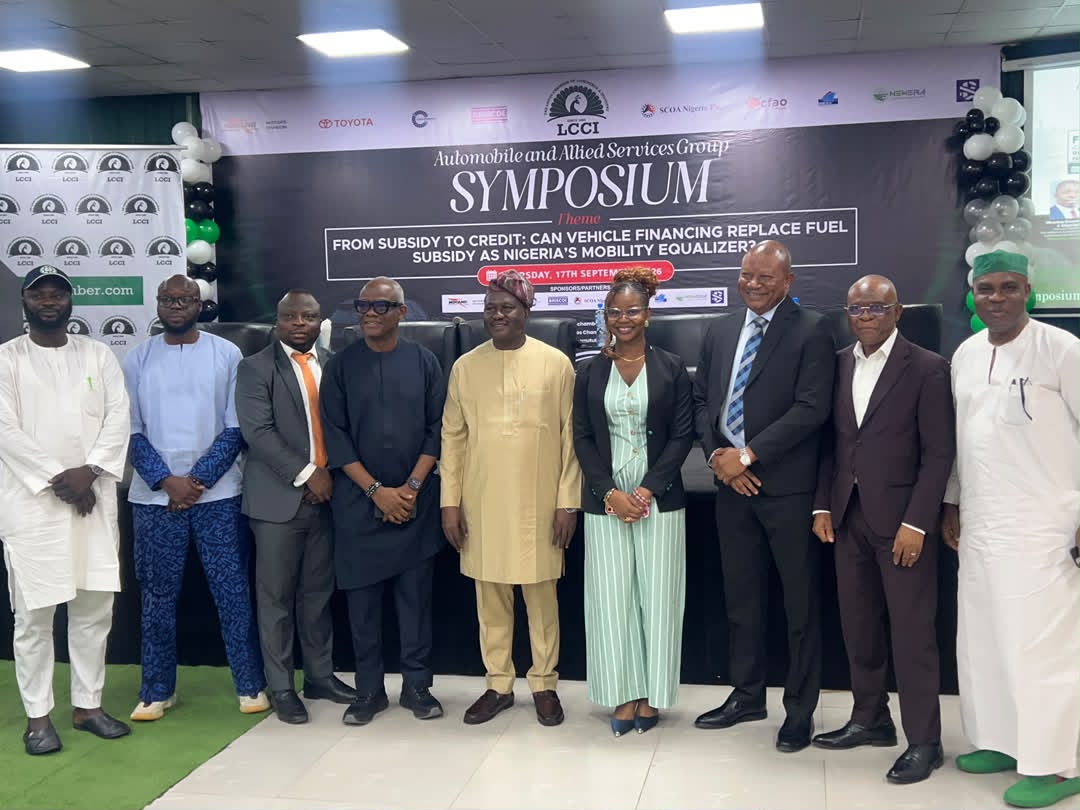
Replace Fuel Subsidy With Vehicle Credit to Drive Mobility, Jobs,LCCI, Ilekuba tell FG
Nigeria’s automotive stakeholders have called for an urgent shift from fuel subsidy to affordable vehicle financing, saying the new model could make vehicle ownership accessible to more Nigerians while driving local production, creating jobs and reducing dependence on imported automobiles.
The call was made on Thursday at the LCCI/National Automotive Design and Development Council Automobile Symposium, themed, “From Subsidy to Credit: Can Vehicle Financing Replace Fuel Subsidy as Nigeria’s Mobility Equalizer?”
Chairman of the LCCI Auto and Allied Sector Group, Dr Femi Eguaikhide, said affordable vehicle credit could restore access to mobility, improve productivity and create a stronger market for Nigeria’s automotive industry.
He said fuel subsidy had for decades effectively functioned as Nigeria’s mobility policy by helping to keep transportation relatively affordable for millions of Nigerians, including commercial drivers, teachers and small-business operators.
However, following its removal in May 2023, Eguaikhide said mobility costs had risen sharply, resulting in higher transport fares and increased prices of goods and services, with knock-on effects on productivity.
“Subsidy made fuel cheap, but cars remained expensive. So only the rich owned productive assets,” he said, arguing that vehicle credit could enable more Nigerians to acquire income-generating vehicles and repay loans from the proceeds.
Eguaikhide called for affordable, preferably single-digit interest rates and longer-tenor lease-to-own schemes for commercial operators using buses, tricycles and motorcycles.
“Can we create a ₦50,000/month plan for a keke driver?” he asked, urging financial institutions to develop financing products around borrowers’ earning capacity rather than conventional lending models.
He also advocated the use of vehicle telematics, tracking systems and cash-flow data to develop “mobility credit scores” that could help lenders assess the repayment capacity of commercial transport operators.
But Eguaikhide warned that vehicle financing must not become a fresh channel for importing used vehicles.
“If we use credit to import more Tokunbo, we’ve solved nothing,” he said, advocating financing for CNG conversions, locally assembled electric and hybrid vehicles, as well as mass-transit buses.
He summed up the proposed policy shift: “Subsidy gave us consumption. Credit can give us production.”
In a special address, Chairman and Chief Executive Officer of Cedric Masters Group, Chief (Sir) Anselm Ilekuba, also canvassed a fundamental shift towards vehicle financing, stressing that such a policy must simultaneously promote Nigeria’s automotive industrialisation.
Ilekuba, who was represented at the event by his Chief Finance Officer and Head of Accounts and Strategy, Christabel Mmesoma Ilekuba, decried the impact of high financing costs, short repayment periods and pressure on household incomes on vehicle ownership, despite strong demand for automobiles.
He urged the Federal Government to seriously consider the proposed National Automotive Bank being championed by NADDC, describing it as a specialised financing institution that could support consumers, vehicle assemblers and component manufacturers.
Ilekuba proposed longer-tenor financing for qualifying locally assembled vehicles, alongside industrial credit for manufacturers and funding for machinery, technology, certification and capacity expansion by component producers.
He also called for stronger localisation of automotive components, citing the proposed National Automotive Components Parts Gateway being developed by ALCMAN with Chinese partners.
According to him, the Automotive Bank and Components Gateway could create a cycle in which increased vehicle purchases stimulate local assembly, boost demand for locally produced components, expand factories and generate jobs, while reducing Nigeria’s exposure to foreign-exchange pressures.
Ilekuba said the success of vehicle financing should therefore not be measured merely by the number of loans disbursed, but also by growth in local vehicle assembly, component production, factory expansion, employment and foreign exchange conserved or earned.
“The old subsidy helped Nigerians consume mobility. The new approach should help Nigerians own mobility—and help Nigeria produce it,” he said.
Auto
Jetour Set to Storm Abuja Show with Rugged Luxury T2

Jetour Set to Storm Abuja Show with Rugged Luxury T2
Abuja is set for a taste of rugged luxury as Jetour Nigeria puts its adventure-ready T2 SUV in the spotlight at the Jetour Experience Abuja from September 22 to 24, 2026, giving motorists in the Federal Capital Territory and neighbouring states an opportunity to test its blend of off-road capability, premium comfort and advanced technology.
The three-day showcase at Maha Event Centre, Area 8, Garki, will feature test drives, live demonstrations and direct interaction with Jetour product specialists, offering prospective buyers a closer look at the T2 and other models in the automaker’s growing Nigerian line-up.
Positioned as a premium SUV combining off-road capability with comfort and advanced technology, the Jetour T2 is designed for motorists seeking a vehicle capable of handling both city driving and challenging terrain.
Jetour Nigeria is distributing the T2 and other models via its seven accredited dealers — Elizade Nigeria Limited, New Era AutoVehicle Services Limited, Germaine Auto Centre, Kojo Motors, Mandilas Autos, R.T. Briscoe Motors and Tab Autos Limited.
The T 2 SUV is powered by a 2.0-litre turbocharged engine producing 254 horsepower and 390 Nm of torque. The engine is paired with a seven-speed dual-clutch transmission and BorgWarner sixth-generation intelligent four-wheel-drive system.
It also features five driving modes — Eco, Sport, Mud, Rock and X Smart — designed to provide improved adaptability across different road and terrain conditions.
Measuring 4,758mm in length, 2,006mm in width and 1,880mm in height, the SUV offers 220mm ground clearance and a 70-litre fuel tank, giving it the capability for extended journeys and off-road adventures.
Inside the cabin, the T2 combines rugged styling with modern comfort, featuring ergonomic seating and a 15.6-inch touchscreen infotainment system with Apple CarPlay, Android Auto and intelligent voice control.
Its safety and driver-assistance features include a 360-degree panoramic camera, rear parking sensors, Lane Departure Warning, Blind Spot Detection, Anti-lock Braking System and Emergency Brake Assist.
The SUV also comes with off-road crawl control as well as push-button and remote-start functions.
The Abuja experience follows Jetour Nigeria’s recent showcase in Lagos as the automaker continues to expand its presence and customer reach across the country.
With its combination of performance, technology, safety and luxury, the Jetour T2 is expected to attract motorists seeking an SUV capable of combining everyday urban mobility with adventure and off-road driving.
-

 metro3 days ago
Niger Mosque Abductions: Terrorists Execute 30 of 500 Captive Muslim Worshippers
-
 Business2 days ago
Fuel Prices Climb to ₦1,500 per Litre Across Nigeria, Sparking Calls for Urgent Action
-

 Entertainment3 days ago
BREAKING: Olu Jacobs Dies at 84, Atiku Mourns Cultural Icon
-

 News3 days ago
Blue Line Rail, Hospitals Get Boost as Lagos Approves ₦200bn Bond and Budget Reordering
-
 News2 days ago
OAU Investigates Death of Final-Year Student as Police Begin Probe
-
 News1 day ago
ECOWAS Biometric Card Expands as Seven Countries Begin Rollout
-

 metro3 days ago
US-Based Nigerian Lawyers Disbarred: Full List of Fraud, Theft and Misconduct Cases
-
 Interview2 days ago
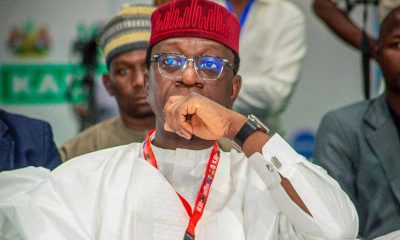
He Does Not Lose Elections”: Abdulmumin Jibrin Predicts 65% Landslide for Tinubu in 2027