

Business
Fuel sells for N175/litre as marketers threaten strike over debt

Some filling stations on Wednesday dispensed Premium Motor Spirit, popularly called petrol, at over N175/litre, higher than the government-approved N165/litre price.
This came as oil marketers insisted on embarking on strike from next week if the government fails to pay them (marketers) what they were being owed.
A report by The Punch said some outlets in Lagos that sold the commodity at N169/litre last week had to adjust their pumps on Wednesday, as they dispensed the PMS to motorists at N175/litre.
Also, queues by motorists at filling stations, which had persisted in Abuja and environs since February this year, gradually resurfaced in parts of Lagos on Wednesday.
Our correspondent also observed that many filling stations, particularly those belonging to members of the Independent Petroleum Marketers Association of Nigeria, were shut due to a lack of products to sell to customers.
Gegu Oil, Eterna and Oando filling stations at the Dutse end of the Kubwa-Zuba Expressway in Abuja, for instance, had remained shut for days for lack of products to sell, despite the heavy queues of motorists in a nearby NNPC retail outlet.
Amidst these concerns, oil marketers under the aegis of Abuja-Suleja IPMAN, stated on Wednesday that their proposed strike would go ahead next week if the government fails to substantially clear the bridging claims for transportation of petrol being owed marketers.
Last week, oil marketers warned that Nigeria could witness “the mother of all queues” soon if the Federal Government fails to pay the 12 months bridging claims being owed operators in the downstream oil sector.
They had also denied being paid N74bn by the Federal Government as bridging claims for the transportation of petroleum products.
READ ALSO:
- LASTMA, police probe traffic extortion, withdraw errant officers
- Yemi Alade groans over butt-induced inconvenience
- Injury knocks out Oshoala from 2022 Women’s Africa Cup of Nations
The Federal Government through its Nigeria Midstream and Downstream Petroleum Regulatory Authority had said last week that it paid N74bn as bridging claims to oil marketers for the transportation of petroleum products across the country in seven months.
But the Secretary, Abuja-Suleja IPMAN, Mohammed Shuaibu, whose unit covers Abuja, Kogi, Niger and parts of Nasarawa and Kaduna, told our correspondent on Wednesday that though some members had confirmed the receipt of payments, a host of others had yet to receive theirs.
“Few of our members have confirmed receiving alerts, but the majority have not been paid and so the decision to embark on the mother of all strike still stands, except we get our payments,” he stated.
Shuaibu added, “Many independent marketers are closing shop and because of these debts. We cannot continue to fold our hands. We are sorry about the hardship, but the government has to pay us, otherwise we will withdraw our services.”
Reacting to the concerns, the spokesperson, NMDPRA, Kimchi Apollo, earlier told our correspondent that the petrol price had not changed from the approved N165/litre price, as he also stated that efforts were on to settle to bridging claims being owed the marketers.
Meanwhile, there were indications that long queues were beginning to resurface in Lagos State and its environs on Wednesday, as findings showed that filling stations were beginning to sell petrol above N175 per litre.
The Federal Government and oil marketers are yet to come to a compromise on how much a litre of petrol should be sold, and marketers are beginning to sell products at prices not approved by the Nigerian Midstream and Downstream Petroleum Regulatory Authority.
The PUNCH on Wednesday, noticed that while most filling stations in Lagos in Ogun state were under lock and keys, long queues were beginning to reappear at few stations with products.
A source close to the matter told The PUNCH that marketers met with Chief Executive, NMDPRA, Farouk Ahmed, in Abuja on Tuesday, where he pleaded with them not to increase the price.
According to our source, Farouk has promised that the N74bn bridging claims owed marketers would be paid any time soon.
Marketers, however, said they could no longer bank on the Federal Government’s promise to pay the claims, while they continue to run at a loss for selling petrol at N165 per litre.
Marketers had held a similar meeting with the NMDPRA two weeks ago, where they aired their grievances on the high costs of running their petrol stations.
Also, the Depots and Petroleum Products Marketers Association of Nigeria had hinted that it would be impossible for its members to keep prices at N165/litre when the landing costs to their stations were already on the high side.






Auto
Jetour Targets Abuja Market with X70 PHEV as Nationwide Expansion Gathers Pace
Jetour Targets Abuja Market with X70 PHEV as Nationwide Expansion Gathers Pace
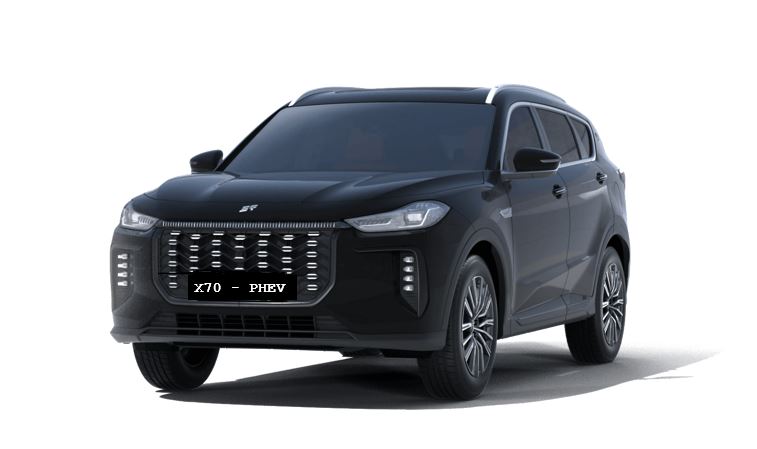
Jetour Nigeria is taking its hybrid SUV offensive to Abuja, with the X70 Plug-in Hybrid Electric Vehicle (PHEV) set to headline the three-day Jetour Experience from September 22 to 24 as the automaker accelerates its drive to expand its footprint and capture a larger share of Nigeria’s fast-evolving mobility market.
The Abuja showcase, coming on the heels of a strong Lagos edition that generated significant consumer interest, test drives and sales enquiries, is designed to bring Jetour’s latest technologies closer to customers in the Federal Capital Territory and neighbouring states.
The event at Maha Event Centre, Area 8, will give prospective buyers and auto enthusiasts the opportunity to test-drive the X70 PHEV and other Jetour models while interacting with product specialists and experiencing their technology, safety features, performance and comfort firsthand.
According to the company, expanding the showcase to the Federal Capital Territory was a direct response to rising demand from residents in Abuja and neighbouring states.
READ ALSO:
- ASUU Crisis Deepens: Lagos Universities Join UNIBEN, Taraba on Indefinite Strike
- Lagos Power Outage: Ikeja Electric Blames TCN as Businesses, Homes Groan
- US Court Blocks Trump Visa Rule Limiting Stay of Foreign Students, Journalists
To bolster buyer confidence, Jetour Nigeria—the country’s sole authorised distributor—backs the X70 PHEV with a five-year or 150,000-kilometre warranty.
The distributor operates through an accredited nationwide dealer network, including: Elizade Nigeria Limited,
New Era Auto Vehicle Services Limited, Kojo Motors, Germaine Auto Centre, Tab Autos Limited, R.T. Briscoe Motors, and Mandilas Autos.
The X70 PHEV pairs a 1.5-litre turbocharged engine with a 19.43kWh battery and a dedicated hybrid transmission. Designed to balance performance with fuel efficiency, the vehicle supports fast, slow, engine, and regenerative braking charging options—reducing reliance on external charging infrastructure.
Jetour’s rapid growth in the Nigerian market has earned both private and corporate patronage, driven by competitive pricing, high specification levels, and an expanding service footprint. The brand was named “Fastest Growing Auto Brand of the Year” at the 2024 Nigeria Auto Journalists Association (NAJA) Awards.
With the X70 PHEV leading the Abuja showcase, Jetour aims to deepen customer engagement and consolidate its position in the local automotive market.
Jetour Targets Abuja Market with X70 PHEV as Nationwide Expansion Gathers Pace
Business
Sanwo-Olu Joins Dangote as Historic N2.15tn Refinery IPO Opens on Nigerian Exchange
Sanwo-Olu Joins Dangote as Historic N2.15tn Refinery IPO Opens on Nigerian Exchange
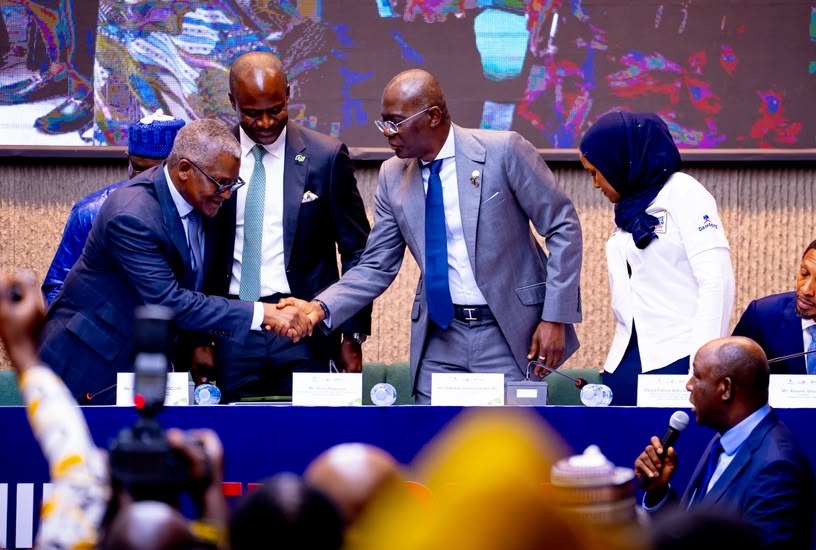
Lagos State Governor, Babajide Sanwo-Olu, on Monday joined business leaders, investors and capital-market stakeholders as the Initial Public Offering of the Dangote Petroleum Refinery and Petrochemicals formally opened on the Nigerian Exchange, NGX, in Lagos.
The landmark transaction, which could raise about N2.15 trillion, marks one of the biggest capital-market transactions in Nigeria’s history and gives Nigerians and other investors an opportunity to acquire a stake in Africa’s largest oil refinery.
Sanwo-Olu attended the opening ceremony at the NGX Group building in Marina, Lagos, where Dangote Industries President and Chief Executive Officer, Aliko Dangote, sounded the gong to formally commence the public offer.
The IPO comprises 4.1 billion ordinary shares priced at N525 each, with investors allowed to subscribe for a minimum of 10 shares, valued at N5,250. The offer will remain open until October 13, 2026.
The development represents a major milestone for Nigeria’s capital market, as the Dangote Refinery becomes the first refinery to be offered for public subscription on the Nigerian stock market in the 66-year history of the NGX.
The ceremony attracted an array of prominent figures from government, business and the financial sector, including NGX Group Chairman Umaru Kwairanga, NGX Group Managing Director and Chief Executive Officer Temi Popoola, Zenith Bank founder Jim Ovia, Coronation Group Chairman Aigboje Aig-Imoukhuede and Ooni of Ife, Oba Adeyeye Ogunwusi.
Also present were senior executives of Dangote Industries and representatives of the capital-market community.
Dangote described the offer as a “people’s IPO”, stressing that its primary objective was to broaden ownership of the refinery and allow ordinary Nigerians and investors across the world to participate in the wealth created by the massive industrial project.
According to him, the public offer was not primarily about raising funds for the Dangote Group, which he said already had substantial capital available for its expansion plans, but about democratising wealth creation.
The refinery is currently designed to process 700,000 barrels of crude oil per day, while Dangote Industries plans to expand its capacity to 1.4 million barrels per day over the coming years. Proceeds from the IPO are expected to support the refinery’s expansion and strengthen its capacity for future growth.
The public offer follows a $2.5 billion private placement earlier in the year, which attracted strong institutional interest. Reuters reported that the refinery is valued at about $47.6 billion, making the IPO one of the most significant equity offerings ever undertaken in Africa.
The refinery has increasingly become a strategic component of Nigeria’s energy security drive, reducing the country’s dependence on imported refined petroleum products while positioning Nigeria as a potential major exporter of refined products.
The opening of the IPO also comes at a time when the Dangote refinery has reported a sharp improvement in its financial performance. Reuters reported that the company recorded a $1.82 billion net profit in the first half of 2026, alongside revenue of more than $13 billion.
Dangote has also sought to make the offer accessible to ordinary Nigerians, with subscriptions available through digital investment platforms and other authorised channels. The minimum subscription of 10 shares means an investor can enter the offer with N5,250.
The NGX has described the transaction as an important development for the Nigerian capital market, particularly in broadening retail participation and deepening the investment culture.
For Lagos, where the refinery is located and where the historic IPO was formally launched, the development further reinforces the state’s position as Nigeria’s dominant commercial and financial centre.
With the offer running until October 13, investors will now determine whether the historic transaction achieves its N2.15 trillion target and establishes a new benchmark for public participation in Nigeria’s industrial sector.
Auto
X90 Plus Leads Jetour’s Abuja Drive for Bigger SUV Market Share
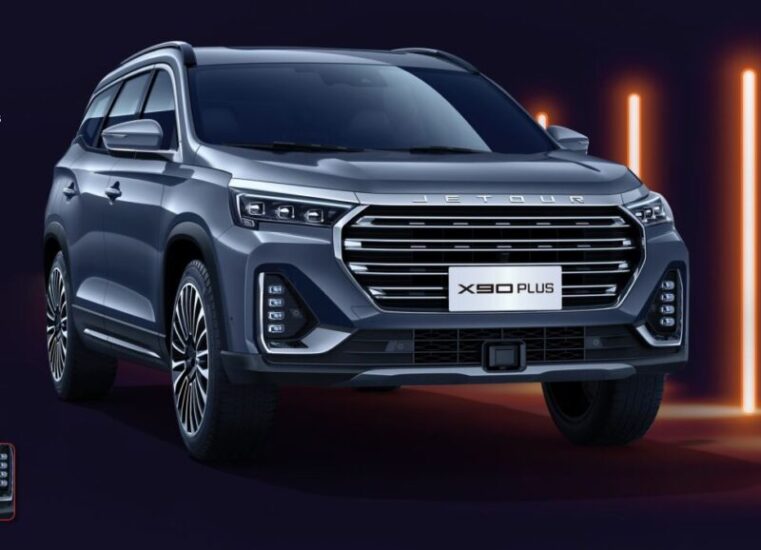
X90 Plus Leads Jetour’s Abuja Drive for Bigger SUV Market Share
Jetour Nigeria is taking its premium SUV battle to Abuja, with the seven-seater X90 Plus set to headline the Jetour Experience Abuja from September 22 to 24, as the automaker moves to capture a larger share of Nigeria’s fast-growing high-end family SUV market.
The three-day motoring showcase will give prospective buyers, families and auto enthusiasts in the Federal Capital Territory and neighbouring states an opportunity to experience the X90 Plus and other models in the Jetour range through test drives and hands-on demonstrations.
The Abuja showcase follows the success of the brand’s earlier Jetour Experience in Lagos, where strong customer interest, inquiries and sales momentum reportedly encouraged the company to take the initiative to the Federal Capital Territory.
Jetour Nigeria said growing demand from customers in Abuja and neighbouring states was a major factor behind the decision to expand the experience to the northern market.
Positioned as a full-sized family SUV, the X90 Plus is designed for executives and families seeking a combination of space, technology, performance and comfort without the price tag associated with some luxury SUVs.
The model is offered with 1.6-litre and 2.0-litre turbocharged engines paired with a seven-speed dual-clutch transmission. The powertrain produces up to 254 horsepower and 390Nm of torque.
Inside the cabin, the X90 Plus features a 12.3-inch LCD touchscreen infotainment system, panoramic sunroof, Sony premium audio system and wireless charging.
Its safety and driver-assistance features include a 360-degree panoramic camera, Forward Collision Warning, Lane Departure Warning and electronic stability systems.
Jetour’s growing profile in Nigeria has also earned the brand recognition from the Nigeria Auto Journalists Association (NAJA), which named it Fastest Growing Auto Brand, while it was also recognised as Auto Brand of the Year at the Nigeria Transport Lecture.
To support its expanding customer base, Jetour Nigeria, the sole authorised distributor, operates through seven accredited dealer partners across the country: Elizade Nigeria Limited, Mandilas Autos, R.T. Briscoe Motors, Germaine Auto Centre, Kojo Motors, Tab Autos Limited and New Era Auto Vehicle Services Limited.
The Abuja Experience is expected to provide Jetour with another platform to engage potential customers and reinforce its position in Nigeria’s increasingly competitive SUV market.
-
 News3 days ago
SERAP Threatens Legal Action Over ₦126bn INEC Electoral Funds
-
 Politics1 day ago
2027: Northern Lecturers Back Tinubu, ASUU Disowns Endorsement
-
 Opinion3 days ago
‘Tinubu Will Win Again in 2027’ — Charismatic Bishops’ Secretary
-

 metro3 days ago
Mother ‘sold daughter’s abuse videos for $300’: Nigeria child pornography case shocks nation
-

 News3 days ago
Petrol Subsidy: Presidency Rejects Atiku’s Plan, Says No Going Back
-

 Sports1 day ago
‘I Was Never the Chosen One’ — Dembele Responds to Mbappe
-
 News2 days ago
Nwifuru Dismisses Cubana Chief Priest as ‘Attention-Seeker’
-

 metro3 days ago
DSS warns Osun churches, mosques, markets over alleged terrorist attack plot ahead of 2027