

metro
Killer Soldier: What Yobe Cleric Asked Me Before I Pulled The Trigger

Lance Corporal John Gabriel, a soldier with registration number N/A13/69/1522, has opened up on how he tricked Sheik Goni Aisami-Gashua, a prominent cleric in Yobe State, before killing him.
Daily Trust had reported how the cleric was shot dead after he offered lift to his killer on Friday night.
Aisami was headed for Gashua from Nguru when his killer who was in mufti pleaded to join him to Jaji-Maji.
As they proceeded on the journey, he tricked the cleric who alighted from his vehicle but never made it back again as Gabriel snuffed life out of him.
Speaking when he was paraded by the police on Wednesday, the killer soldier who was attached to 241 Recce Model Battalion, Nguru, said the Sheik asked him two questions before he pulled the trigger.
“We were approaching Jaji-Maji and the windows were wound down, so I told him (the victim) that I was hearing a sound under his vehicle and he said he was suspecting something under it and he wanted to park and check. After he parked by the roadside, he alighted and I followed him. After checking, he found out that it was not what he suspected.
READ ALSO:
- 2023: My support is for APC candidates only, says Buhari
- Lagos lawyer arraigned for trafficking 11-year-old girl
- Police arrest ‘one-chance’ gang in Lagos
- EFCC arraigns Cubana manager over $164,000 fraud
“”Meanwhile, I had removed my rifle and fixed the magazine when he was under the vehicle. When he didn’t find anything under the vehicle, I told him to check the back tyre, but as he was about doing so, I pointed my rifle at him and he asked me, ‘What did I do to you?” And I responded, you did not do anything to me. He asked further, ‘Do you want to kill me?’ And I said, ‘No I don’t want to kill you.’ So, he kept quiet and I fired a warning shot, thinking he would be scared and run away. But he didn’t run away. However as he made to enter his vehicle, I fired directly at him.”
The death of the Islamic scholar had sparked a nationwide outrage, with many demanding immediate prosecution.
In an interview with BBC Hausa Service, the National Chairman of Islamic propagation group, Izala Movement, Sheikh Abdullahi Bala Lau, had said the manner in which he was murdered showed its terrorism against the Muslim Ummah.
“We condemn the assassination and we call on the Federal Government to quickly prosecute the assassins; let’s probe the motive of the killing. If it had happened that a Muslim killed a pastor, the story would have been different, we won’t let this go, we won’t keep quiet anymore,” he had said.




metro
₦8.7bn Erosion-Control Budget Gap Raises Questions as Anambra Gullies Expand
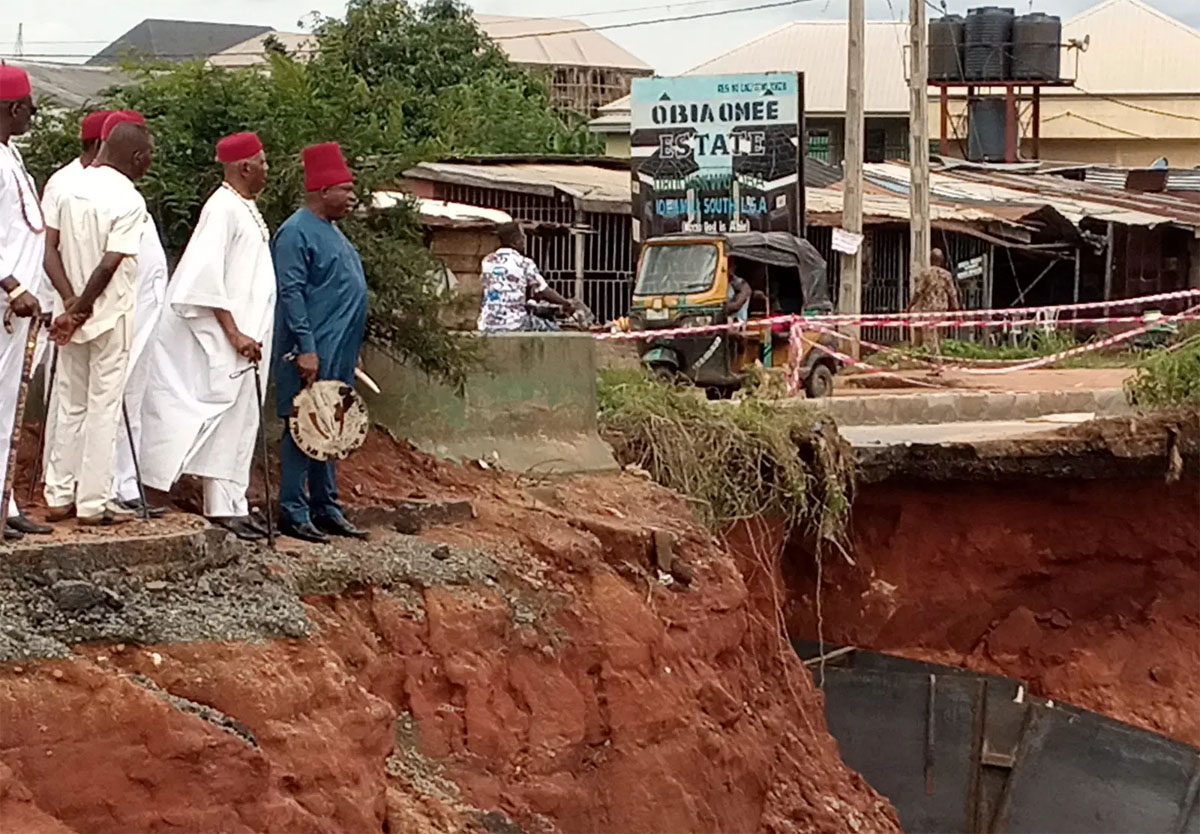
₦8.7bn Erosion-Control Budget Gap Raises Questions as Anambra Gullies Expand
Anambra State Government recorded just ₦1.181 billion in spending on erosion and flood control against a cumulative budget of ₦9.890 billion between 2023 and June 2026, as expanding gullies and flooding continue to threaten homes, roads, farmlands and communities across the state.
The spending gap emerged from an investigation published by The Whistler on October 12, 2026, which examined ecological fund allocations, state budget implementation reports and financial statements.
The investigation also found that the Anambra State Government and its 21 local government areas received a combined ₦11.623 billion in ecological fund allocations during the period. However, this figure represents allocations to the state and local councils combined, not the amount specifically budgeted for erosion and flood control.
According to the investigation, the state government received ₦6.371 billion in ecological allocations recorded in Federation Account Allocation Committee (FAAC) disbursement data, while the 21 local government areas collectively received ₦5.251 billion.
Separately, the state government’s financial statements recognised ₦10.287 billion in ecological fund revenue over the same period, creating a difference of approximately ₦3.916 billion between the FAAC allocation figures and the revenue recognised in the state’s accounts.
The difference requires reconciliation and does not, by itself, establish that funds are missing. Differences in accounting periods, adjustments or revenue-recognition methods could affect the figures, but the available information does not establish the specific reason.
READ ALSO:
- Fuel Subsidy May Ease Hardship Today, But Could Cripple Nigeria’s Economy Tomorrow — FG
- Petrol Price Hike Hits Abuja as MRS, AA Rano, Others Raise Rates Despite FG’s Discount Plan
- Kano Police Explain Blockade of ‘Tinubu Must Go’ Meeting
The more immediate spending concern relates to the state’s erosion and flood-control budget, which recorded low expenditure despite the scale of the environmental challenges facing communities.
Between 2023 and June 2026, Anambra budgeted ₦9.890 billion for erosion and flood control but recorded expenditure of only ₦1.181 billion. This represents approximately 11.94 per cent of the cumulative budget, leaving ₦8.709 billion of the provision unspent during the period under review.
The unspent amount refers to the difference between the budget and recorded expenditure. It should not be interpreted as money confirmed to be available in government accounts or as proof that the funds were deliberately withheld.
In 2023, the state appropriated ₦1.182 billion for erosion and flood control but spent ₦348.153 million. In 2024, it budgeted ₦1.375 billion and recorded expenditure of ₦248.767 million.
The 2025 budget provided ₦2.213 billion for the same purpose, while recorded spending stood at ₦448.182 million.
For the first half of 2026, the state earmarked ₦5.120 billion for erosion and flood control but recorded expenditure of only ₦135.705 million by June 30.
The first-half spending represented approximately 2.65 per cent of the full-year allocation, leaving a difference of about ₦4.984 billion between the 2026 budget provision and recorded expenditure at the end of June.
The financial figures do not establish why spending fell below budgetary provisions. Information on fund releases, procurement, contract awards, project execution and outstanding obligations would be needed to determine whether the gap resulted from administrative delays, funding constraints or other factors.
Nevertheless, the low recorded expenditure raises questions about budget implementation, environmental investment and public accountability, particularly as residents continue to face damage from erosion and flooding.
The investigation also examined ecological allocations to local governments, which collectively received ₦5.251 billion between 2023 and June 2026.
An analysis of 11 councils showed that Idemili North received ₦339.138 million, followed by Aguata with ₦325.774 million, Anaocha with ₦266.396 million and Nnewi South with ₦251.964 million. Allocations among the councils examined ranged from approximately ₦202 million to ₦339 million.
READ ALSO:
- Xenophobia: Nigeria Evacuates 111 More Citizens From South Africa as Returnees Hit 2,037
- Russia-Ukraine Truce in Doubt as Zelenskyy Questions Trump’s Ceasefire Announcement
- Djibouti Boat Disaster: 139 Migrants Dead, Dozens Missing
However, the investigation reported difficulties in obtaining detailed explanations from local government authorities about how the allocations were managed and spent.
A senior government official, who spoke anonymously, said ecological fund receipts were not always separately identified in monthly allocations received by councils. The official also described an arrangement under which local government funds were pooled to support salaries, pensions, security and administrative expenses.
The account raises questions about the visibility of ecological allocations in council finances and the ability of residents to track expenditure on environmental projects. A complete assessment of local government spending would require detailed financial records showing the amounts received, transfers made, expenditure incurred and projects completed by each council.
Idemili North Local Government Area Mayor Standley Nkwoka argued that the allocations available to councils were insufficient to finance some of the area’s most expensive erosion-control projects.
Nkwoka said a single flood-control site in Idemili North had cost the state government at least ₦9 billion, while another phase of intervention was expected to cost about ₦15 billion.
He maintained that the council’s ecological allocation could not independently finance projects of that scale. He also identified sanitation enforcement, regular drainage cleaning, proper waste disposal and household stormwater catchment systems as measures that could help reduce flooding and erosion.
The financial scrutiny comes as Anambra continues to battle a longstanding gully erosion and flooding crisis. On August 27, 2026, Governor Chukwuma Soludo declared a state of emergency on the environment, warning that erosion, flooding and land degradation posed serious threats to the state.
Reports on the declaration said Soludo estimated that more than 30 per cent of Anambra’s landmass had been affected by erosion. He identified blocked drainage channels, construction on waterways, uncontrolled runoff, deforestation and sand mining among the factors contributing to the crisis.
The effects are felt in communities where expanding gullies threaten residential buildings, roads, farmland and other public infrastructure. Flooding can also displace households, disrupt transport and commerce, destroy agricultural livelihoods and increase the financial burden on affected residents.
The state government has called for greater community participation and stricter compliance with environmental regulations. Measures highlighted by the administration include drainage cleaning, waste evacuation and action against activities that obstruct waterways.
The government has also emphasised proper waste disposal, drainage maintenance and construction practices that prevent uncontrolled runoff.
However, community participation alone cannot resolve the crisis without adequate infrastructure, effective enforcement and sustained investment in environmental protection.
Anambra has previously benefited from the Nigeria Erosion and Watershed Management Project, a World Bank-supported programme designed to reduce vulnerability to erosion through gully rehabilitation, watershed management and community-based interventions.
A 2024 research paper reviewing the programme’s interventions in Anambra reported that 13 major gully sites had been treated, covering a combined length of approximately 32.5 kilometres. The programme included rehabilitation works and support for communities affected by erosion.
The reported interventions demonstrate the role of coordinated engineering and environmental management in addressing gully erosion. However, the figures do not establish the current condition of every rehabilitated site or the performance of projects financed through separate state budgets.
The continuing crisis highlights the need to maintain completed infrastructure, identify vulnerable locations early and prevent new gullies through effective drainage design and watershed management.
For residents in erosion-prone communities, the priority remains practical and lasting interventions that protect lives, homes, roads and livelihoods.
The latest financial figures have placed renewed focus on whether Anambra’s ecological allocations are translating into effective environmental projects. Reconciling the differences between FAAC allocation data and state revenue records would help clarify the financial position, while publishing project-level expenditure and implementation reports would improve public understanding of how funds are being used.
The state government and local councils could also strengthen accountability by publishing project locations, contract values, implementation timelines and completion reports. Such disclosures would help residents assess whether spending is addressing the most urgent environmental risks.
With billions of naira allocated to ecological challenges and erosion continuing to threaten communities, the central question is whether public spending is being translated into timely and durable protection for the people most affected.
₦8.7bn Erosion-Control Budget Gap Raises Questions as Anambra Gullies Expand
metro
Kano Police Explain Blockade of ‘Tinubu Must Go’ Meeting

Kano Police Explain Blockade of ‘Tinubu Must Go’ Meeting
The Kano State Police Command has explained why it stopped a planned meeting of the “Tinubu Must Go” movement, citing security concerns, uncertainty over the expected participants and the need to prevent a possible breakdown of law and order.
The state Commissioner of Police, Ibrahim Adamu Bakori, said the command intervened because it did not have sufficient information about the gathering, which organisers expected to attract about 700 people.
Bakori, speaking in an interview with DCL Hausa, acknowledged that the organisers had the right to assemble but maintained that notifying the police would have helped the command make arrangements to protect participants and residents.
His explanation followed complaints by Abba Hikima, a lawyer and one of the movement’s conveners, who accused police officers of preventing members from accessing a privately hired venue in Kano on Sunday, October 11, 2026.
Hikima alleged in a live video posted on his verified Facebook page that about 10 Mobile Police vehicles had been deployed around the event centre to stop the gathering from taking place.
The convener said the group had paid for the venue and intended to hold a peaceful meeting to discuss its campaign against President Bola Ahmed Tinubu’s administration ahead of the 2027 general elections.
He argued that the gathering was protected by the constitutional rights to personal liberty, freedom of expression and freedom of association.
READ ALSO:
- Xenophobia: Nigeria Evacuates 111 More Citizens From South Africa as Returnees Hit 2,037
- Russia-Ukraine Truce in Doubt as Zelenskyy Questions Trump’s Ceasefire Announcement
- Djibouti Boat Disaster: 139 Migrants Dead, Dozens Missing
According to Hikima, Bakori contacted him on Saturday to discuss the planned meeting and advised him to inform the police about the gathering. He said he explained that the event would take place in an enclosed venue and would be peaceful.
The lawyer insisted that the movement did not require police permission to hold its meeting, adding that the group would continue its activities despite the intervention.
Bakori, however, said he contacted Hikima after learning about the planned gathering on social media and asked him to postpone the programme and meet with the command to discuss its arrangements.
The commissioner said Hikima indicated that he would consult other members of the movement but did not subsequently respond to his calls.
Bakori explained that the anticipated attendance of about 700 people made it necessary for the police to understand the arrangements, including the identities of participants and where visitors would stay.
He also referred to an incident in Sabon Gari about two weeks earlier, when police reportedly recovered weapons from some individuals who claimed to have travelled to Kano for political activities. He said arrests had been made and the matter remained under investigation.
The commissioner cited the incident as part of the security concerns informing the command’s response to another large gathering whose arrangements, he said, had not been established.
He denied that the intervention was politically motivated, insisting that the police were concerned about protecting the organisers, other participants and residents of Kano State.
Bakori added that the command had previously provided security for activities organised by Hikima when the police were informed in advance.
The movement, however, maintained that its meeting was a lawful exercise of civic rights. Hikima accused the police of obstructing the gathering and said the group would return to hold meetings, protests and demonstrations.
He also alleged that an officer had objected to participants wearing clothing bearing the “Tinubu Must Go” inscription, although the commissioner’s reported explanation focused on security arrangements and the need for information about the event.
The movement describes itself as a non-partisan platform seeking to mobilise Nigerians to vote Tinubu out of office in 2027. Its campaign is based on opposition to the administration’s policies, which its members blame for worsening economic hardship.
The confrontation has raised questions about the balance between the police’s responsibility to maintain public order and citizens’ constitutional rights to peaceful assembly and political expression.
While the police commissioner said advance communication would have enabled the command to provide security, Hikima maintained that the group did not need police permission to convene a peaceful meeting.
The disagreement over the blockade and the conditions under which the gathering could proceed remained unresolved in the reports available on Sunday.
The police said its intervention was intended to prevent security problems, while the movement insisted that it had a right to meet and express its political views without obstruction.
Kano Police Explain Blockade of ‘Tinubu Must Go’ Meeting
metro
Fake Drugs Allegation: NANS Demands Probe Into Ex-SUG President’s Death at NYSC Camp

Fake Drugs Allegation: NANS Demands Probe Into Ex-SUG President’s Death at NYSC Camp
The death of Etimbuk Daniel, the immediate past Students’ Union Government (SUG) president of Akwa Ibom State University (AKSU), at a National Youth Service Corps (NYSC) orientation camp in Enugu State has sparked calls for a thorough investigation into allegations that he was given fake medication and did not receive prompt medical attention.
The National Association of Nigerian Students (NANS) disclosed the circumstances surrounding Daniel’s death in a statement issued by its president, Akinteye Babatunde Afeez, on Sunday, October 11, 2026.
According to NANS, Daniel reportedly complained of a headache while participating in the orientation programme and was given medication by medical personnel at the camp.
His condition allegedly deteriorated after he took the drugs, prompting him to request that he be taken to a hospital for further treatment.
However, NANS claimed that approval for his transfer was delayed and that he died before he could be taken to a hospital.
The student body also said it was informed that a doctor subsequently identified the medication administered to Daniel as fake.
READ ALSO:
- Xenophobia: Nigeria Evacuates 111 More Citizens From South Africa as Returnees Hit 2,037
- Russia-Ukraine Truce in Doubt as Zelenskyy Questions Trump’s Ceasefire Announcement
- Djibouti Boat Disaster: 139 Migrants Dead, Dozens Missing
“We were further informed that the doctor later identified the drugs administered to him as fake. These are deeply troubling allegations that require a thorough investigation to establish the circumstances surrounding his tragic death,” Afeez said.
The claims concerning the medication and the alleged delay in transferring Daniel to a hospital have not been independently verified. The precise medical cause of his death has also not been publicly established in the reports available.
NANS expressed shock over the death, describing it as a painful loss to the Nigerian student community. It extended its condolences to Daniel’s family, friends, former colleagues and the entire AKSU community.
The association also raised concerns about the dangers posed by fake drugs and the importance of ensuring that people who fall ill receive appropriate medical attention without unnecessary delays.
Afeez said NANS was mourning the former student leader and would communicate further actions and its official position on the matter in due course.
Daniel’s death has raised questions about the availability of medical care at NYSC orientation camps and the procedures for referring corps members to external hospitals when their conditions require urgent attention.
A comprehensive investigation would be needed to establish the medication Daniel received, whether it was counterfeit, the medical assistance provided to him and the circumstances surrounding the reported delay in transferring him to a hospital.
The NYSC authorities and relevant health agencies have an important role in clarifying the incident and determining whether any procedural failures occurred.
For now, the allegations remain subject to investigation, and the findings of the relevant authorities will be crucial in establishing what happened during Daniel’s final hours.
The tragedy has left members of the student community mourning a former representative while calls grow for answers and measures to prevent similar incidents at orientation camps.
Fake Drugs Allegation: NANS Demands Probe Into Ex-SUG President’s Death at NYSC Camp
-

 metro3 days ago
[UPDATED] Lagos Train Crash: 55-Year-Old Motorist Survives as Honda Car Is Wrecked at PWD Crossing
-

 metro24 hours ago
Tension in Kano as Phone Traders Confront Chinese Sellers Over Cheaper Phones
-
 Health2 days ago
NAFDAC Raises Alarm Over Toxic Pesticides in Beans, Seizes ₦800m Banned Chemicals
-

 Business3 days ago
NNPCL: We Introduced ₦66 Fuel Discount Before FG’s Announcement
-

 metro2 days ago
2027: Ekiti Driver Takes ₦3.5m Loan to Back Tinubu’s Re-election Bid
-

 metro2 days ago
Police Launch Manhunt After Fresh Attacks, Kidnappings Rock Four Nigerian States
-

 metro2 days ago
EFCC Wins ₦132m Money Laundering Case as Court Orders Forfeiture of Lagos Properties
-

 metro3 days ago
MTN Network Outage Hits Lagos, Abuja, Four Other Areas as NCC Reports Service Restoration