

Politics
Abia gov chief of staff suspended for spraying cash on Odumeje
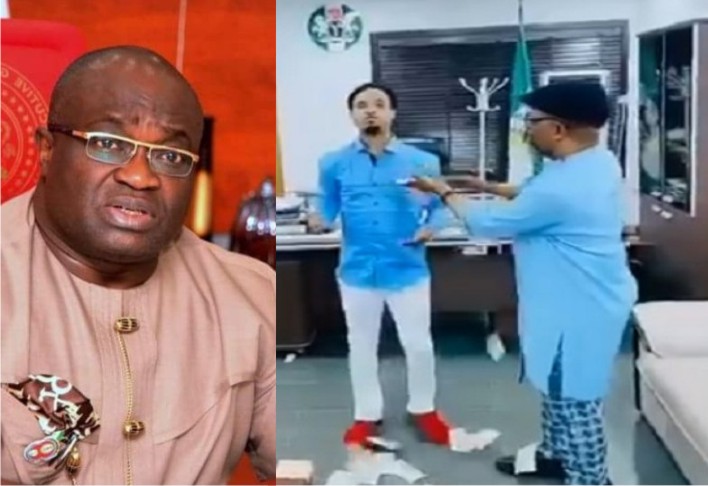
For spraying cash on Prophet Odumeje, the Abia State Governor’s Chief of Staff, Anthony Agbazuere, has been suspended.
A video of Agbazuere spraying money on Odumeje, who calls himself the ‘Indaboski dahose’ the ‘liquid metal’, is currently trending online.
In the video shared on Twitter, Agbazuere is seen spraying naira notes on a dancing controversial Onitsha-based clergyman, Chukwuemeka Ohanaemere, better known as Odumeje.
The video appears to have been in Agbazuere’s office but it is not dated.
In a short statement on Sunday, Secretary to the State Government, Chris Ezem, announced that the CoS had been suspended immediately.
He said, “Abia State Governor, Dr Okezie Ikpeazu, has directed the immediate suspension from office of the Chief of Staff to the Governor, Dr ACB Agbazuere.”
Odumeje became popular in 2019 when he described himself as ‘the liquid metal’, ‘the war’, and ‘the indaboski’.







Politics
“I Won’t Slap Wike’s Son, I Won’t Kick Seyi Out — But Tinubu MUST Go!” Fayose Explodes
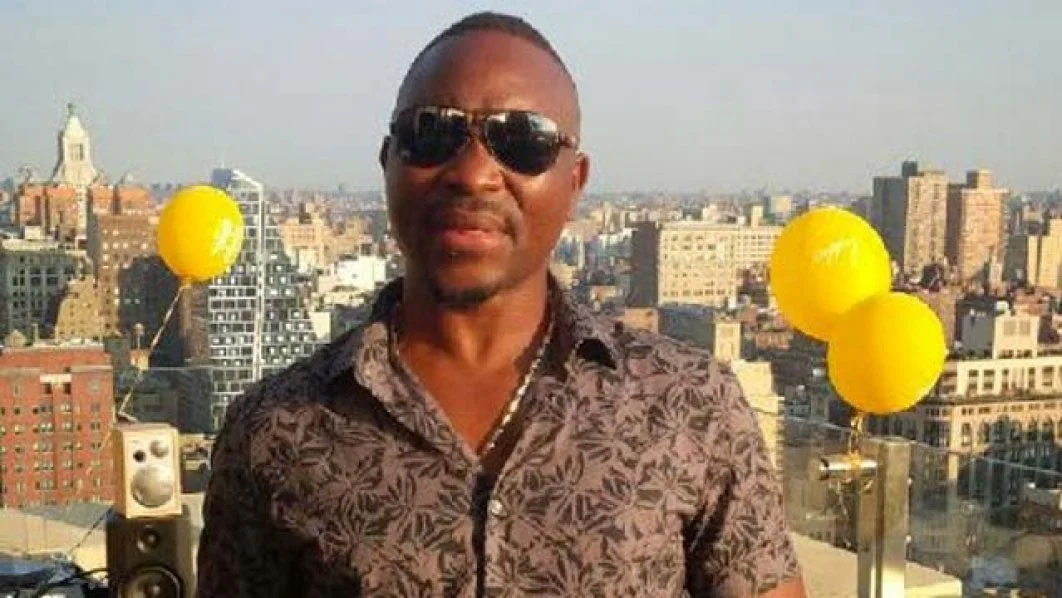
“I Won’t Slap Wike’s Son, I Won’t Kick Seyi Out — But Tinubu MUST Go!” Fayose Explodes
Abuja — Isaac Fayose has fired back at critics in dramatic fashion, declaring he will neither slap Nyesom Wike’s son nor kick President Bola Tinubu’s son Seyi out of his presence — but insisting with equal fury that the President must be voted out in 2027.
The businessman and younger brother of former Ekiti State Governor Ayodele Fayose ignited a firestorm after photos surfaced of him hanging out with Seyi Tinubu and Joaquin Wike, son of the FCT Minister. Critics immediately accused him of betraying the Nigeria Democratic Congress (NDC) and its presidential candidate, Peter Obi.
Fayose, however, refused to back down. In a video posted on his Facebook page, he threw a rhetorical punch at his accusers: “Tinubu must go. Wike is a land grabber. That doesn’t mean that Wike’s son will come and greet me and I will slap him. Or President Bola Tinubu’s son, Seyi, will come and greet me and I will kick him.”
He doubled down on his loyalty to Obi, declaring: “I campaigned for Obi. Do you know how much I spent on the last election? I still support Peter Obi. I still want Tinubu out of power.”
The controversy exploded after Fayose posted a photograph with Joaquin Wike, calling the minister’s son his younger brother. The image set social media ablaze, with users questioning why a self-proclaimed “101% Obidient” supporter would be seen with the family of a top APC figure.
It is not the first time Fayose has faced such backlash. In July 2026, a video showed him alongside Seyi Tinubu and socialite Cubana Chief Priest at an Abuja gathering where prayers were offered for the President and Nigeria. Fayose dismissed the meeting as a private social visit, not a political endorsement.
The latest storm underscores the fever-pitch sensitivity in opposition circles as political actors jostle for position ahead of the 2027 presidential contest. Fayose insists he is drawing a clear line — political allegiance on one side, personal courtesy on the other — but his critics are not buying it.
As of press time, neither the NDC nor Peter Obi’s camp has issued an official statement.
“I Won’t Slap Wike’s Son, I Won’t Kick Seyi Out — But Tinubu MUST Go!” Fayose Explodes
Politics
‘They Created Hunger, Poverty’: Tinubu Fires at Opposition as 2027 Re-election Campaign Begins
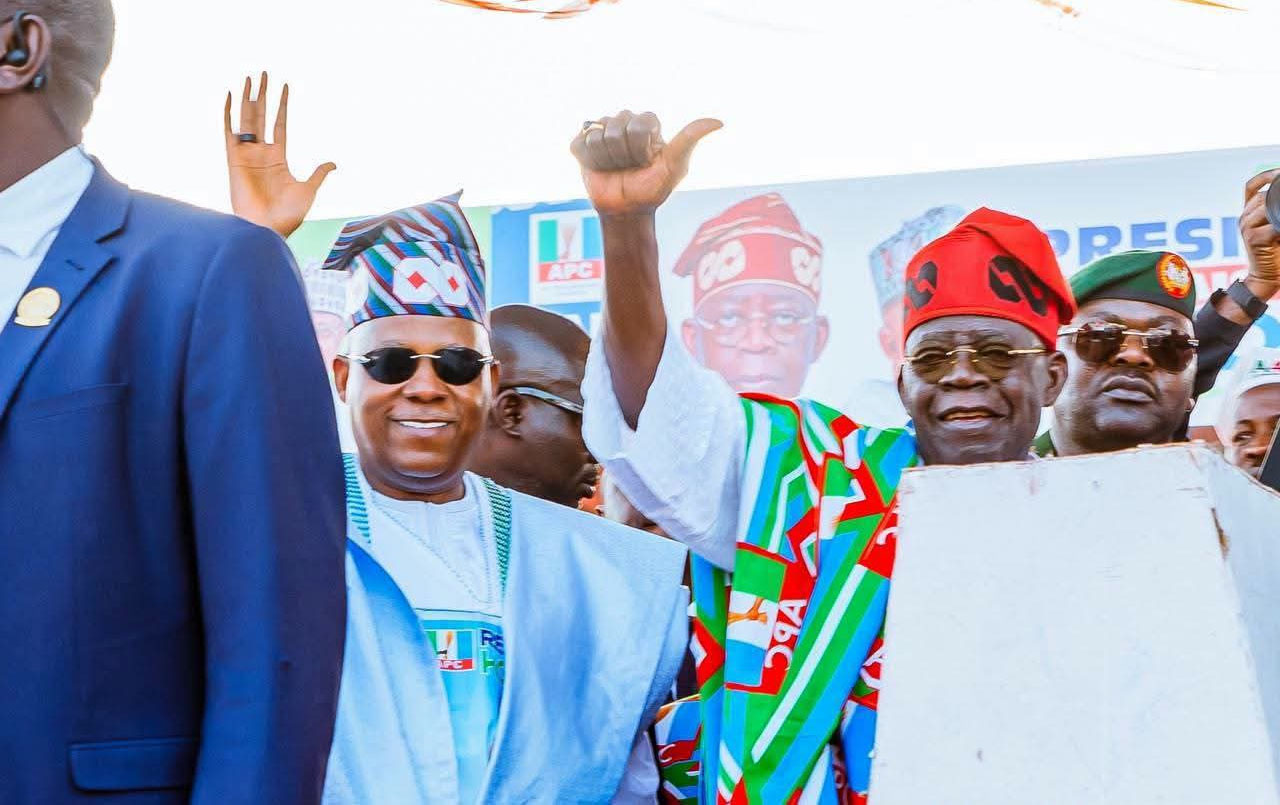
President Bola Ahmed Tinubu has blamed opposition politicians for the hunger and poverty confronting Nigerians, insisting that his administration is working to address the economic challenges as he formally launched his campaign for a second term in office.
Tinubu made the remarks on Saturday, October 24, 2026, during the All Progressives Congress (APC) presidential campaign flag-off rally at the Kaduna Township Stadium, where he urged Nigerians to renew his mandate in the 2027 presidential election.
The President’s comments come amid persistent public concerns over rising food prices, petrol costs, transportation expenses and declining purchasing power, with the economy expected to remain a major issue in the contest for the presidency.
Addressing supporters at the rally, Tinubu challenged opposition politicians who have criticised his administration over hunger and poverty, arguing that they were responsible for creating the problems they now accuse his government of failing to resolve.
“I hear my opponents talking about hunger and poverty. Who created it? They did. They created hunger, they created poverty. We are trying to eradicate them,” the President said.
Tinubu defended his administration’s economic policies, maintaining that his government was taking steps to improve the country’s finances, promote development and create conditions for greater prosperity.
He also commended APC governors for their efforts in their respective states and promised Nigerians improved economic opportunities if he secured a second term.
“To you, the children of our country, we promise prosperity in our second term. You will not regret going to the polls,” he told the gathering.
The President urged eligible voters to obtain their Permanent Voter Cards (PVCs) and participate in the forthcoming election. He also called on APC supporters to vote for the party’s candidates at the presidential, governorship and legislative levels.
READ ALSO:
- Bill Clinton condemns anti-Muslim prejudice, cites Qur’an’s message of coexistence
- MURIC Applauds Army as Mogadishu Cantonment Mosque Reopens After Week-Long Closure
- Atiku Condemns Attack on Edo Comedian Over Refusal to Support Tinubu
Tinubu further defended his administration’s decision to remove the petrol subsidy, insisting that the country would not return to the previous arrangement.
“Fuel subsidy is in our past: no more corruption, no more falsification of invoices, no more lies, no more smuggling of fuel,” he said.
The removal of the petrol subsidy, announced shortly after Tinubu assumed office in May 2023, remains one of the most consequential and controversial economic decisions of his administration.
The government has argued that the policy would reduce public expenditure, eliminate distortions in the petroleum market and free up resources for development. However, the increase in petrol prices following the reform has contributed to higher transportation and distribution costs, putting additional pressure on households and businesses.
The administration’s economic reforms, including changes to the foreign exchange system, have also generated debate over their long-term benefits and immediate effects on living standards.
Opposition politicians have repeatedly questioned the government’s management of the economy, arguing that the reforms have imposed significant hardship on Nigerians without delivering sufficient relief.
Former Vice-President Atiku Abubakar, the presidential candidate of the African Democratic Congress (ADC), criticised Tinubu’s attempt to blame opposition parties for the country’s economic difficulties.
Atiku argued that the APC had governed Nigeria since 2015, first under former President Muhammadu Buhari and subsequently under Tinubu, and should therefore accept responsibility for the country’s economic conditions during its period in power.
He maintained that Nigerians were experiencing significant hardship under the current administration and urged the President to address the concerns of citizens rather than blame political opponents.
The exchange highlights the growing political contest over responsibility for hunger, poverty and the cost-of-living crisis as parties position themselves ahead of the 2027 elections.
At the Kaduna rally, Vice-President Kashim Shettima also urged Nigerians, particularly voters in the North, to support Tinubu’s re-election bid.
Shettima recalled Tinubu’s previous support for northern presidential aspirants, including Atiku in 2007, Nuhu Ribadu in 2011 and Muhammadu Buhari in the 2015 and 2019 elections. He argued that Tinubu had demonstrated political support for northern interests and called on voters to reciprocate.
Kaduna State Governor Uba Sani also appealed to northern voters to back the President, pointing to federal infrastructure projects, education initiatives and security interventions.
The rally attracted prominent APC figures, including Senate President Godswill Akpabio, House of Representatives Speaker Tajudeen Abbas, APC National Chairman Nentawe Yilwatda, campaign Director-General Abdulaziz Yari, ministers, lawmakers and governors.
The event marked the beginning of Tinubu’s campaign for another presidential term, with the President asking Nigerians to give his administration additional time to pursue its economic and development agenda.
However, the debate over the causes of Nigeria’s economic hardship is likely to remain central to the election campaign. While the APC is defending its reforms and promising improved prosperity, opposition parties are demanding greater accountability for the impact of government policies on food affordability, employment, household incomes and living standards.
As the 2027 election approaches, voters will have to assess the competing claims of the ruling party and the opposition against their own experiences of the economy and the policy proposals presented by the candidates.
‘They Created Hunger, Poverty’: Tinubu Fires at Opposition as 2027 Re-election Campaign Begins
Politics
2027: Shettima Urges North to Repay Tinubu’s Support With Re-election
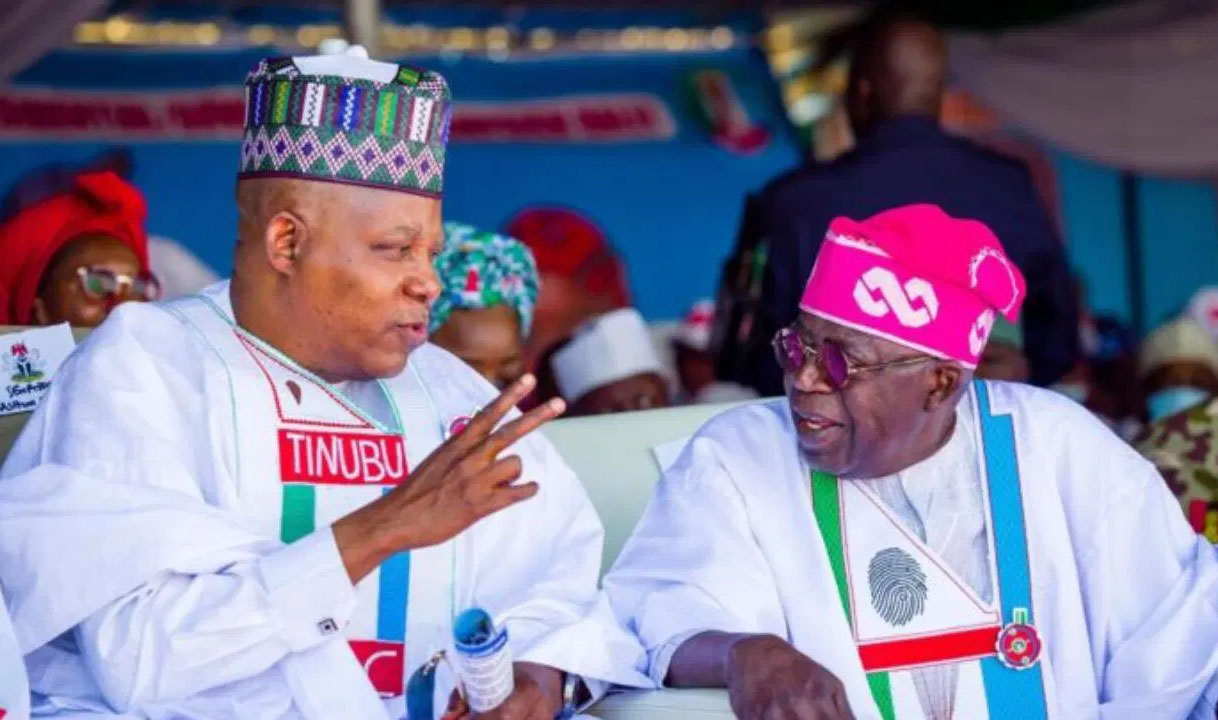
2027: Shettima Urges North to Repay Tinubu’s Support With Re-election
Vice-President Kashim Shettima has called on northern voters to rally behind President Bola Tinubu’s re-election bid in 2027, arguing that the region owes the President a political debt for his longstanding support for northern leaders, including the late President Muhammadu Buhari.
Shettima made the appeal on Saturday at the All Progressives Congress presidential campaign launch in Kaduna, where he urged voters to support Tinubu and other APC candidates across the country in the forthcoming general elections.
According to the Vice-President, Tinubu’s political history demonstrates a consistent willingness to support leaders from the North, making it imperative for the region to reciprocate by backing his administration for another four-year term.
“We have come to ask you to renew a second time for the APC from top to bottom,” Shettima said.
He cited Tinubu’s role in supporting political figures from the North, including former Vice-President Atiku Abubakar, whom he said the President had provided a platform to contest the presidency in 2007 following his departure from the Peoples Democratic Party.
Shettima also recalled Tinubu’s support for Buhari during the 2015 and 2019 presidential elections, describing the former Lagos State governor’s loyalty as evidence of honour and political commitment.
“And you can bear witness that in 2015 and 2019, President Tinubu stood solidly behind the late President Muhammadu Buhari, throughout his first and second term victories. This is a mark of honour and our faith in a man of honour,” he said.
Beyond appealing to the North on the basis of political loyalty, Shettima defended the Tinubu administration’s performance, highlighting projects and institutional developments he said demonstrated its commitment to national growth and the development of Kaduna State.
He said the administration had promised to restore Kaduna’s status as a leading centre of learning and pointed to the establishment of the Federal University of Applied Sciences in Kachia, the transition of the institution in Zaria to a federal university of education and the establishment of a state vocational institute in Rigachikun as evidence of progress.
The Vice-President also listed major infrastructure projects, including the Ajaokuta-Kaduna-Kano gas pipeline, the Kano-Maradi railway, the Lagos-Kano rail corridor and the Abuja-Kaduna-Kano road, as part of the administration’s development agenda.
He further highlighted ongoing work on the Sokoto-Badagry highway, describing the project as a strategic investment that could expand agricultural production and unlock economic opportunities across the country.
According to Shettima, the highway would improve connectivity, open up agricultural communities and strengthen the movement of goods and services, with potential benefits for farmers and businesses.
His appeal in Kaduna combined a call for political reciprocity with a defence of the administration’s record, as the APC seeks to consolidate its support base ahead of the 2027 general elections.
The Vice-President urged northern voters to consider Tinubu’s past political alliances and the administration’s stated achievements in deciding whether to renew the President’s mandate.
-
 News2 days ago
EFCC Opens Recruitment for Nigerians, Sets Age Limits for Four Job Categories
-
 News2 days ago
41 Days in Bandits’ Den: Five Islamic Clerics Still Held After Tinubu Re-Election Prayer Trip
-
 Politics2 days ago
2027: Remi, Seyi Tinubu Reportedly Differ Over APC Youth Mobilisation
-
 Politics2 days ago
Igbo Presidency: Soludo Tells South-East to Back Tinubu for Future Power Shift
-
 Politics1 day ago
2027: APGA Chairman Says South-East Must Back Tinubu to Secure Igbo Presidency
-
 metro2 days ago
Police Arrest Suspect Eight Months After Retired Teacher’s Killing in Ogun
-
 metro1 day ago
Borno: Troops Kill 15 Terrorists in Midnight Air Strike
-

 Sports2 days ago
Kane Beats Yamal to Win Major Football Award Ahead of Ballon d’Or Ceremony
You must be logged in to post a comment Login