

metro
Police rescue five kidnap victims in Enugu

Police rescue five kidnap victims in Enugu
Five kidnap victims have been rescued in Enugu, police said on Wednesday.
It was gathered that they were rescued by a joint operation carried out by police operatives serving at 9th Mile Police Division of the command and troops of the Nigerian Army on 07/08/2023 at about 5pm.
They were rescued in a forest at Umulumgbe in Udi Local Government Area, according to a release by the state police Public Relations Officer, DSP Daniel Ndukwe.
- Bandits posing as women wearing hijabs kidnap gold merchant in Zamfara
-
No Federal University allowed to charge tuition fees – FG
-
Niger Coup: Nigeria can deradicalise Niger within 24 hours – Security expert
The rescued victims were kidnapped on their way back from a traditional marriage at Ukehe community in Igbo-Etiti LGA, Ndukwe said, adding that ‘an intense manhunt operation is ongoing to fish out the fleeing suspects’ that abducted them.
In another development, police operatives serving in Udenu Area Command of the state command, on 08/08/2023 at about 3.30pm, arrested one Chinemerem Ugwueze (male), aged 23, of Imilike-Enu in Udenu LGA, and recovered one locally made double-barreled pistol from him.
Ndukwe stated that the case was undergoing investigations at the Firearm Section of the State CID, Enugu.
Police rescue five kidnap victims in Enugu











metro
MURIC petitions Oyo police over 2019 murder of Muslim cleric in Fiditi

MURIC petitions Oyo police over 2019 murder of Muslim cleric in Fiditi
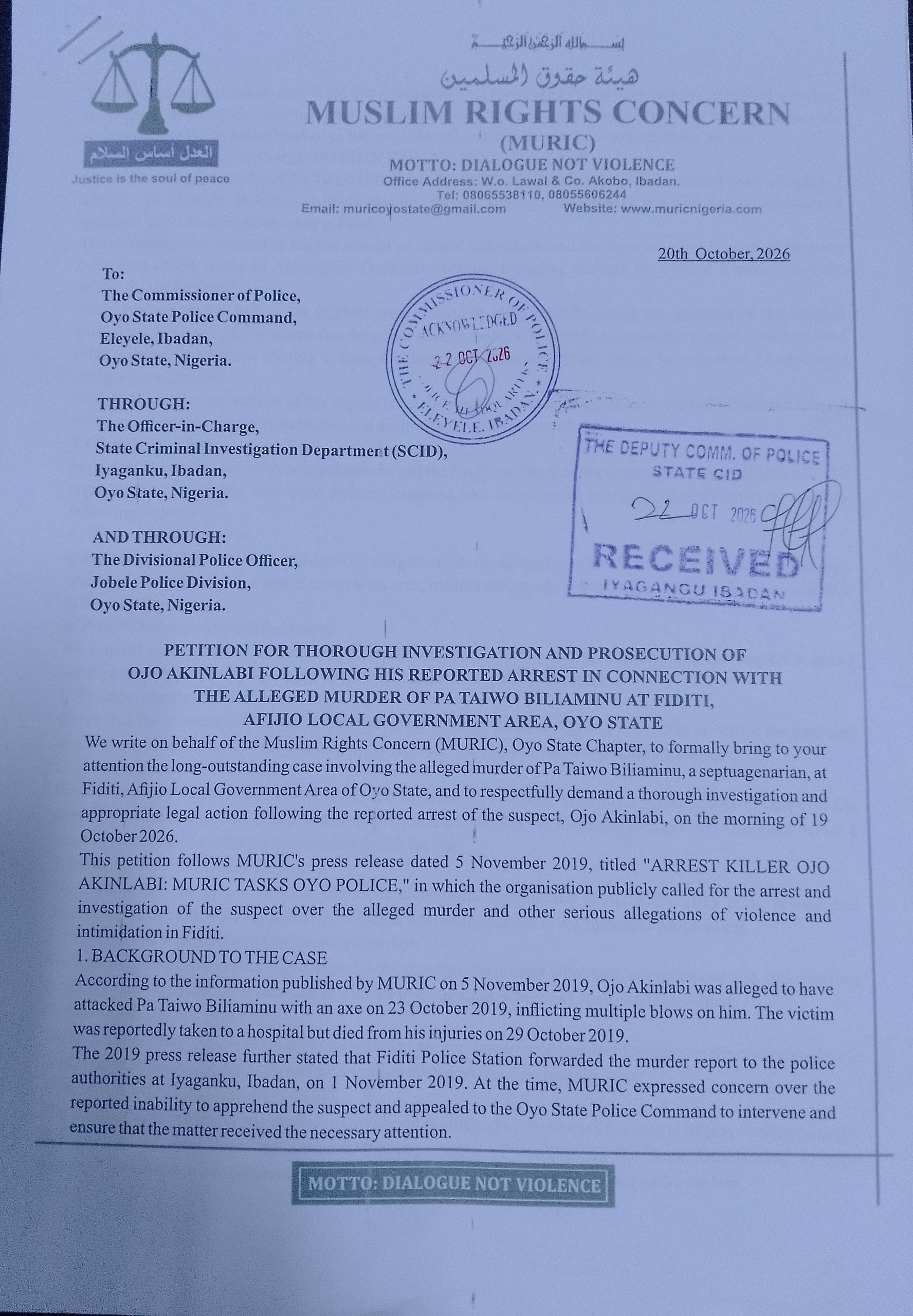
The Muslim Rights Concern (MURIC), Oyo State Chapter, has petitioned the state Commissioner of Police, demanding a thorough investigation into the alleged murder of Pa Biliaminu Taiwo in Fiditi, Afijio Local Government Area of Oyo State, in November 2019.
The organisation also called for appropriate legal action against Ojo Akinlabi, following his reported arrest in connection with the killing.
In a press release dated October 23, 2026, MURIC said the petition was submitted to the Commissioner of Police on October 22 and acknowledged by the commissioner and the Deputy Commissioner of Police in charge of the State Criminal Investigation Department (SCID), Iyaganku, Ibadan.
According to the organisation, Pa Taiwo was allegedly hacked to death inside a mosque in Fiditi in November 2019.
MURIC urged the police to conduct a comprehensive investigation into the case and ensure that anyone found culpable was prosecuted in accordance with the law.
The group also called on the authorities to ensure that the case was handled in a manner that would prevent justice from being frustrated.
“Murder is not a bailable offence,” the organisation said, urging the police to ensure that the suspect was brought before a court of competent jurisdiction and that any decision concerning his custody or release complied with the law.
MURIC further alleged that Akinlabi had a history of violent attacks, including incidents involving the use of knives allegedly coated with poison. However, the organisation did not provide supporting details of the alleged incidents in the statement.
The group described the allegations as a matter of concern and called for appropriate action by the relevant authorities.
Reaffirming its commitment to the protection of human rights and the rule of law, MURIC said allegations of criminal conduct should receive the attention of law enforcement agencies and be subjected to due process.
The statement was signed by Mallam Ibrahim Agunbiade, Secretary of MURIC in Oyo State.
The organisation concluded its appeal with the declaration: “Justice delayed must not become justice denied.”
As of the time of the statement, MURIC had not provided further details about the circumstances surrounding the reported arrest or the current status of the police investigation. The allegations against Akinlabi have not been independently verified, and any determination of criminal responsibility remains a matter for the courts.
MURIC petitions Oyo police over 2019 murder of Muslim cleric in Fiditi
metro
Police Arrest Man Over Fake Presidency Number Plate in Abuja
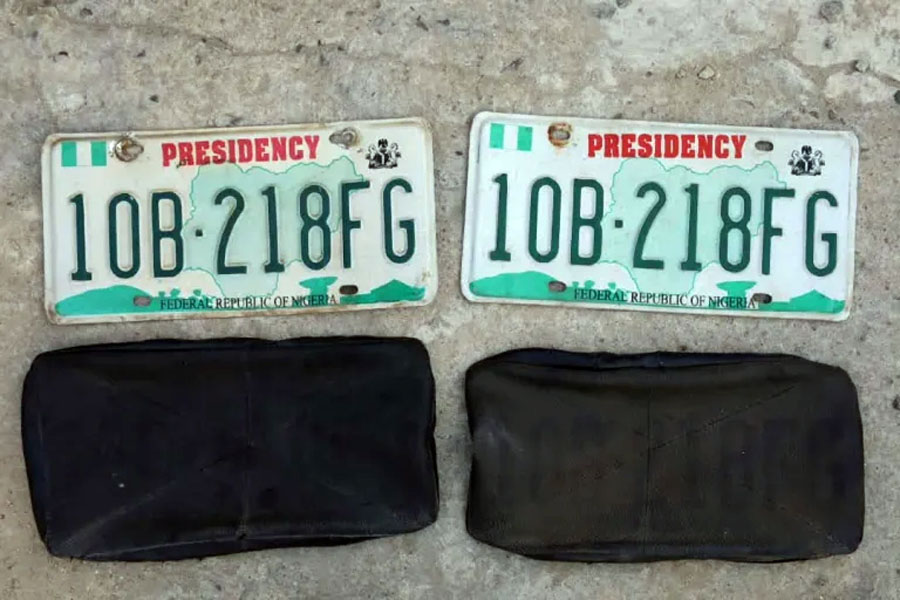
ABUJA — The Federal Capital Territory (FCT) Police Command has arrested a man accused of impersonating a permanent secretary in the Office of the Secretary to the Government of the Federation (SGF) after he was allegedly caught using a forged number plate bearing the inscription “PRESIDENCY”.
The suspect was arrested on October 20, 2026, after police operatives intercepted a Lexus LX570 sports utility vehicle (SUV) in Maitama District, Abuja, at about 8pm.
According to the police, the concealed number plate carried the registration number 10B218 FG.
The command’s spokesperson, SP Josephine Adeh, disclosed that preliminary investigations revealed that the documents presented to support the registration were allegedly forged.
READ ALSO:
- Shettima Blasts States Over Power Woes, Says Govs Must Stop Waiting for Abuja
- Fourth Gas Leak in Six Months: Over 100 Ogun Pupils Hospitalised, Schools Shut as Parents Panic
- Nigerian Journalist Sentenced to 4 Years Over Facebook Post Criticising Police
Adeh said the suspect had claimed to be the legitimate holder of the number plate, prompting further investigations that reportedly uncovered the alleged fraud and impersonation.
“The vehicle and its occupant were promptly arrested for investigation and subsequent prosecution,” the police said.
The command added that investigations were ongoing and that the suspect would be charged to court upon their conclusion.
The police urged residents to remain law-abiding, cooperate with security operatives and report suspicious activities to the nearest police station.
The arrest comes amid concerns over the unauthorised use of official government and diplomatic number plates in the FCT. Police authorities have previously raised concerns that such plates could be used by unauthorised individuals to evade scrutiny or facilitate criminal activities.
The suspect’s identity has not been publicly disclosed, and the allegations remain subject to the outcome of the police investigation and any subsequent court proceedings.
Police Arrest Man Over Fake Presidency Number Plate in Abuja
metro
Woman Arrested for Torching Ex-Boyfriend’s Home in Fit of Jealous Rage

Woman Arrested for Torching Ex-Boyfriend’s Home in Fit of Jealous Rage
Accra, Ghana — A routine breakup escalated into a catastrophic act of arson this week, leaving a young man homeless and his former girlfriend in police custody. The Ghana Police Service has arrested a young woman accused of deliberately setting her boyfriend’s rented apartment on fire after he ended their relationship. The shocking trigger for the split? The woman had answered a phone call on his mobile device without his permission.
According to preliminary police investigations, the couple became embroiled in a volatile and heated argument over the breach of privacy. The confrontation spiraled rapidly out of control when the boyfriend, reportedly furious that she had answered his phone, decided to end the relationship on the spot. Rather than accepting the breakup, the woman’s anger reportedly boiled over into a dangerous and premeditated rage.
In the aftermath of the breakup, authorities allege that the woman intentionally ignited a fire inside the man’s rented home in an act of vengeance. Eyewitnesses described a scene of sheer chaos as flames rapidly consumed the residence, forcing neighbors to flee and local fire services to be summoned to battle the inferno. Dramatic images from the scene reveal a landscape of utter devastation, with the apartment reduced to a pile of charred debris and twisted metal. While no casualties have been reported, the property damage is extensive, and the young man has effectively lost his home and belongings.
The Ghana Police Service acted swiftly following the incident, apprehending the young woman who is now in police custody facing potential charges of arson and destruction of property. Local neighbors have expressed profound shock at the severity of the attack, with one bewildered resident telling reporters, “It is just a phone call. To burn down a whole apartment because you were broken up with? It is a very sad day for us here.” The suspect is expected to be arraigned in court in the coming days as the police finalize their case, serving as a chilling reminder of the dangerous consequences of unchecked anger.
Woman Arrested for Torching Ex-Boyfriend’s Home in Fit of Jealous Rage
-

 metro3 days ago
Army Major, Soldiers Killed in ISWAP Ambush in Yobe State
-

 metro3 days ago
Breaking: Afenifere Leader Pa Fasoranti Dies at 100
-

 metro2 days ago
Atiku: US Lobbying Firm Raises Alarm Over Alleged Assassination Plot
-

 metro2 days ago
Five Arraigned Over Kidnapping of 20 Prospective NYSC Members in Imo
-

 metro3 days ago
‘We Don’t Know What Else to Do’ — Mother Begs for Release of Abducted Children
-

 metro3 days ago
‘I Never Asked Them to Abandon Loved Ones’ — Obi Clarifies Diaspora Remarks
-

 Auto3 days ago
Beyond the Showroom: Why After-Sales Service Will Define Auto Industry Winners
-

 Auto2 days ago
Happening now: Hyundai unveiling of Mufasa and Grand Creta