

International
Iran TV journalist stabbed in ‘murder plot’
Iran TV journalist stabbed in ‘murder plot’
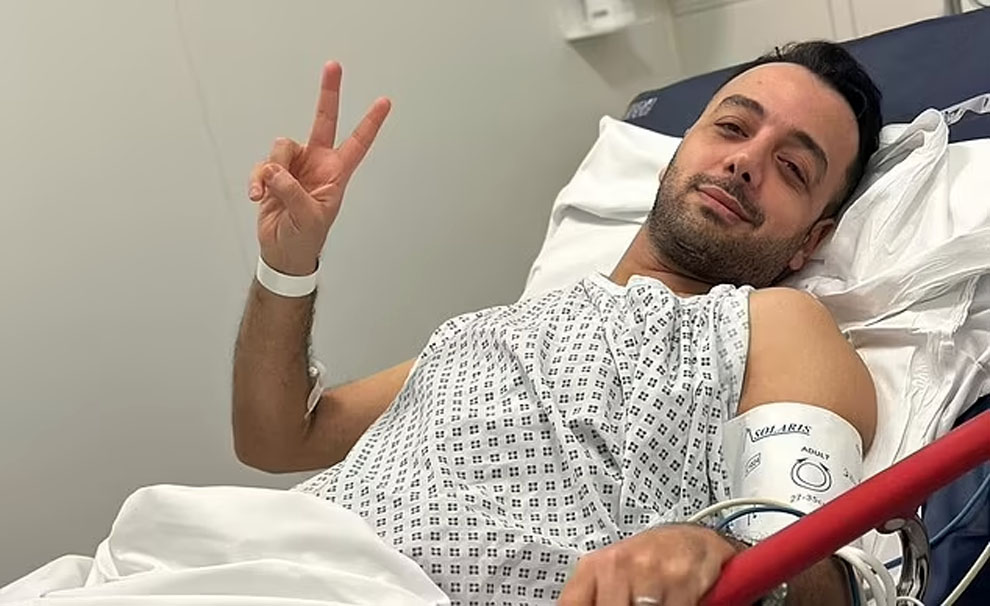
An Iranian TV journalist who was stabbed outside his flat in southwest London in an apparent murder plot has vowed to return to work as he shared a defiant photo from his hospital bed.
Pouria Zeraati, 36, flashed a victory sign while dressed in a hospital gown as he recovers after being knifed by a two-man team in Wimbledon.
He was rushed to hospital after the stabbing on Friday, where he is in a stable condition. He is said to be doing ‘very well’ and bravely smiled in an Instagram snap he shared to reassure his 619,000 followers.
The prominent dissident journalist, who works for the Iran International TV channel, has been repeatedly targeted by Tehran as the media organisation is openly critical of the government’s regime.
It is believed his attackers were either agents working directly for the Iranian government or a criminal gang hired by Tehran targeted Mr Zeraati, who hosts the high-profile Last Word show in London.
They escaped the scene in a waiting car, counter terror police investigating the attack has said. MI5 is also supporting officers in the hunt for the knifemen.
According to The Times, initial indications suggest one of the gang asked Zeraati for cash and then held him in a bear hug while the second operative approached and stabbed the opposition journalist in the leg.
Mr Zeraati’s wife, Oldouz Rezvani, 37, was inside their home as her husband was knifed on the street outside as he made his way to work.
His work colleague Adam Baillie spoke to the couple in hospital yesterday, according to The Sunday Times, who said his wife was touched by all the messages of support and was ‘very happy that he’s still alive’.
‘Pouria says he is feeling a lot better and is really looking forward to getting back to work, but we don’t know when that is likely to be,’ he said.
READ ALSO:
- Newcastle beat West Ham in seven-goal thriller
- Borno: Yathabalwe, most wanted Boko Haram commander surrenders
- Airfares drop as foreign carriers unleash low-priced tickets
A neighbour who was walking with a friend down Queensmere Road, where the attack took place, and witnessed the aftermath, has told the Evening Standard that they saw the alleged assailants flee the scene.
He said: ‘It’s a very quiet suburban road and we saw two young men sprinting towards us, about 20 yards away and then got into a car. They sped off.
‘It felt odd. The two men were laughing, quite clearly laughing. I looked two of them in the eye – they were no more than a cricket pitch length away from me.’
He said they took down the number plate seconds before they came across a man who was trying to flag them down in need of assistance.
‘We tried to give first aid and take his jeans off. He had been stabbed, I think four times. He had his jeans on and he had a pool of blood on his leg. It was [awful] to see.’
The unnamed neighbour, who does not know Mr Zeraati personally, went on to say that the stabbing was ‘really out of character for the area,’ and that he believed ‘It was targeted, not a random attack.’
In December, it was revealed that Iranian officials plotted to kill two of Zeraati’s colleagues, Sima Sabet and Fardad Farahzad.
Ex-BBC journalist Ms Sabet said that following the attack on Mr Zeraati, police warned her to leave her home.
‘The Metropolitan Police’s Counter-Terrorism Unit last night urged me to immediately leave my residence following a knife attack on [Mr Zeraati], and stay elsewhere until further notice,’ she posted on X today.
She described the attack on Mr Zeraati as a ‘serious warning and an extremely troubling act for all journalists and opponents of the Islamic Republic in Britain and other Western countries’.
Speaking to the BBC yesterday, she said she was ‘outraged’ by the attack and slammed the government, suggesting it was not taking the threat ‘seriously’.
‘We should feel safe, this is our country, this is our home, we are UK nationals being threatened at our home,’ she said.
‘If the UK government were taking this seriously, if the UK government had met with me… we have to have a channel of being communicated to, being heard by the government.’
As the threat to Ms Sabet and her colleague came to light at the end of last year, Magomed-Husejn Dovtaev was jailed for spying on journalists at Iran International on behalf of Tehran.
The station admitted they have been regularly targeted by Iran’s revolutionary guards.
The London-based dissident channel aims to provide independent coverage of Iran, but the Tehran regime has declared it a terrorist organisation.
The Islamic Revolutionary Guards Corps (IRGC) has been targeting journalists and their families, Mr Baillie said.
Iran’s charge d’affaires in the UK Mehdi Hosseini Matin said ‘we deny any link’ to the incident.
Mr Baillie told BBC Radio 4’s Today: ‘We can’t say. The fact that counter-terrorism is leading the investigation probably speaks for itself.
‘Along with our colleagues at BBC Persian, Iran International has been under threat, very heavy threats, for the last 18 months since the IRGC said ‘we’re coming for you‘, which they have consistently repeated.’
He said the IRGC ‘get in touch through proxies, they don’t leave a paper trail’.
‘No one’s going to call up from the IRGC and go ‘hey, it’s us’, but families have been taken in for questioning and threatened.’
He added: ‘The scale of that has increased dramatically over the last few months, and the scale and the type of questioning is more aggressive, ‘tell your relatives to stop working for this channel’ and so on.’
The Met said in a statement the motivation for the attack was not yet clear, his occupation coupled with recent threats towards UK-based Iranian journalists meant the probe was being led by specialist counter-terrorism officers.
Commander Dominic Murphy, Head of the Met’s Counter Terrorism Command, said: ‘While we are keeping an open mind, given the occupation of the victim and our publicised concerns about the threat to employees of that organisation, the investigation is being led by the Counter Terrorism Command.
‘I must stress that, at this early stage of our investigation, we do not know the reason why this victim was attacked and there could be a number of explanations for this.
‘While we continue to assess the circumstances of this incident, detectives are following a number of lines of inquiry and our priority at this time is to try and identify whoever was behind this attack and to arrest them.
‘I appreciate the wider concern this incident may cause – particularly amongst others in similar lines of work, and those from Iranian communities.
‘We continue to work closely with the victim’s organisation and as a precaution we’ll have additional patrols in the Wimbledon area as well as other sites around London to provide reassurance over the coming days to those affected and concerned.
‘Finally, I would urge anyone in the Wimbledon area who may have seen anything or anyone acting suspiciously today to get in touch with us.’
Since 2022, a number of plots to either kidnap or kill British or UK-based individuals perceived as enemies of the Iranian regime have been disrupted by police, it is understood.
Iran TV journalist stabbed in ‘murder plot’
dailymail









International
Trump Tells Supporters to ‘Cheat Like Hell’ Ahead of US Election

Trump Tells Supporters to ‘Cheat Like Hell’ Ahead of US Election
US President Donald Trump has made an unusual appeal to his supporters ahead of the November 3 election, telling them to turn out with their families and friends while declaring that he would “cheat like hell.”
Trump made the comments during a Republican gathering in Dallas, Texas, where he led attendees through a mock pledge intended to encourage them to support him and participate in the election.
After asking the crowd to raise their right hands and repeat after him, Trump urged his supporters to help bring their relatives and friends to the polls.
READ ALSO:
- MURIC fires back at Peter Obi: Forget Sallah ceremony, free Nigerian Muslims
- Fani-Kayode Condemns Fresh Killing of Two Nigerians in South Africa
- FG Targets 2 Million Creative Jobs by 2030
He then made the controversial remark while discussing voter registration, saying he was unconcerned about whether he was registered and accusing his political opponents of being bigger “cheaters.”
Trump went on to encourage supporters to vote either on November 3 or before election day, ending the pledge with an appeal to God.
The president also joked that supporters who failed to vote could face divine punishment, telling the crowd they would “go to hell” if they did not turn out.
The remarks came as Trump sought to energise Republican voters ahead of the election, in which control of Congress is also at stake.
His comments are likely to attract attention because of the language he used during an event aimed at mobilising voters, particularly his reference to cheating and his claims about the conduct of his opponents.
Trump Tells Supporters to ‘Cheat Like Hell’ Ahead of US Election
International
France Train Derailment Injures 44, 18-Year-Old Woman in Critical Condition

France Train Derailment Injures 44, 18-Year-Old Woman in Critical Condition
At least 44 people were injured after a passenger train carrying 186 people derailed in northwestern France on Friday evening, with an 18-year-old woman among those injured and reported to be in critical condition.
The Rouen-Caen regional train derailed at about 7:45 p.m. local time near Cléon, in the Seine-Maritime department of Normandy, while travelling between the cities of Rouen and Caen.
The incident triggered a major emergency response, with authorities deploying about 130 firefighters, five medical teams and 80 emergency vehicles to the scene.
A mass-casualty emergency plan was activated to coordinate the rescue operation and treatment of those injured.
According to Rouen prosecutor Sébastien Gallois, 44 passengers were injured in the France train derailment, including the 18-year-old woman who was airlifted to Rouen University Hospital in critical condition.
The other 43 injured passengers were treated for less serious injuries.
The initial estimate of the number of injured passengers was lower, but the figure was revised to 44 after emergency teams completed their assessment of passengers at the scene.
Transport Minister Philippe Tabarot said the train was travelling between Rouen and Caen when the accident occurred.
A passenger identified as 24-year-old Louis described the moments before the train accident in France as frightening.
He said the train first experienced several jolts before the movement became increasingly violent.
“Suddenly there were a few jolts, and then after about three seconds it got stronger and stronger,” he told ICI Normandie radio.
READ ALSO:
- Ondo Herbal Drink Tragedy: Survivor Vows Never to Drink Again as Death Toll Tops 30
- Sokoto Cleric Stabbed Twice in Neck After Juma’at Prayer, Attacker Killed
- Woman disguises as Muslim woman in Niqab to steal in Ado-Ekiti market, video sparks outrage
“I couldn’t stay in my seat any more. The windows partially shattered; the stones from the track came into the carriage. It was really shocking. I’m still shaking,” he said.
A police source said the train may have struck an unidentified object shortly before it derailed. However, authorities have not established whether the object was responsible for the accident.
The cause of the Cléon train derailment therefore remains under investigation.
The Rouen prosecutor said drug and alcohol tests conducted on the train driver were negative.
Police and railway investigators have begun examining the train, the railway infrastructure and the circumstances surrounding the derailment to determine what caused the accident.
The railway operator, SNCF Réseau, suspended traffic on the affected line and switched off electricity to the tracks to allow emergency workers to operate safely.
“The priority is to care for the passengers and then to restore safe operating conditions,” SNCF Réseau said.
The disruption affected rail services along the Rouen-Caen route, while other services connecting Caen with Le Havre were also affected.
Rail authorities worked to arrange alternative transport for passengers whose journeys were disrupted while emergency and investigative operations continued at the accident scene.
Passengers who were not seriously injured were moved away from the crash site as emergency teams attended to those requiring medical attention.
The prefecture urged members of the public to stay away from the affected area to allow rescue workers and investigators to carry out their duties.
The accident caused significant disruption to rail services across the region, with authorities prioritising the safety of passengers and the restoration of the affected railway line.
The investigation is expected to establish whether the train’s contact with the unidentified object, a problem with the railway infrastructure or another factor contributed to the derailment.
As of the latest reports, there were no fatalities recorded in the accident, while the 18-year-old woman remained in critical condition and the other injured passengers were receiving medical attention.
Authorities said investigations into the France train accident were continuing.
France Train Derailment Injures 44, 18-Year-Old Woman in Critical Condition
International
Five Dead After Coach Carrying Dutch Tourists Overturns in Switzerland

Five Dead After Coach Carrying Dutch Tourists Overturns in Switzerland
A holiday trip in Switzerland has ended in tragedy after a coach carrying 45 Dutch adults overturned in the eastern part of the country, killing five people and injuring the remaining passengers.
The crash occurred on Thursday afternoon on the road linking Susch and Zernez in the Graubünden region. Police said the vehicle went off the roadway while passing through an area where construction work was taking place before overturning.

Three of those injured are in serious condition, while another 37 people sustained less severe injuries. The driver, who is also Dutch, survived the crash but was among those taken for medical treatment.
READ ALSO:
- Yari: God Chose Me to Lead Tinubu’s 2027 Campaign
- Iran’s President Seeks End to War as US Tightens Economic Pressure
- Woman disguises as Muslim woman in Niqab to steal in Ado-Ekiti market, video sparks outrage
Authorities have begun investigating the incident and are working to establish what caused the coach to leave the road.
Tour operator Oad said the company was devastated by the deaths and described the incident as a deeply shocking tragedy.
The crash took place close to Zernez, a popular gateway to Switzerland’s National Park, a large Alpine nature reserve in the Engadine valley.
Five Dead After Coach Carrying Dutch Tourists Overturns in Switzerland
-

 metro1 day ago
Woman disguises as Muslim woman in Niqab to steal in Ado-Ekiti market, video sparks outrage
-

 metro3 days ago
Police Arrest Woman Over Fake OPay Shutdown Notice
-

 Politics3 days ago
Amaechi will be caged politically, Wike shouldn’t bother about Ikwerre votes — Wihioka
-

 Politics3 days ago
Remi Tinubu Appeals To South-East Voters, Says She Wants To ‘Enjoy Nigeria’ In Old Age
-
 metro3 days ago
Residents Cry Out Over Poorly Constructed Entrance of Ademola Abiola Street, Demand Urgent Intervention
-
 Politics3 days ago
Breaking the Cycle of Collective Guilt: When a Ruling Party Voice Backs Peter Obi
-

 Business16 hours ago
Dangote: ₦525 Refinery Shares Could Rise to ₦10,000
-

 News1 day ago
AI on the Roads: LASTMA Turns to China to Fix Lagos Traffic