

International
Biden unveils Israeli proposal to end Gaza war
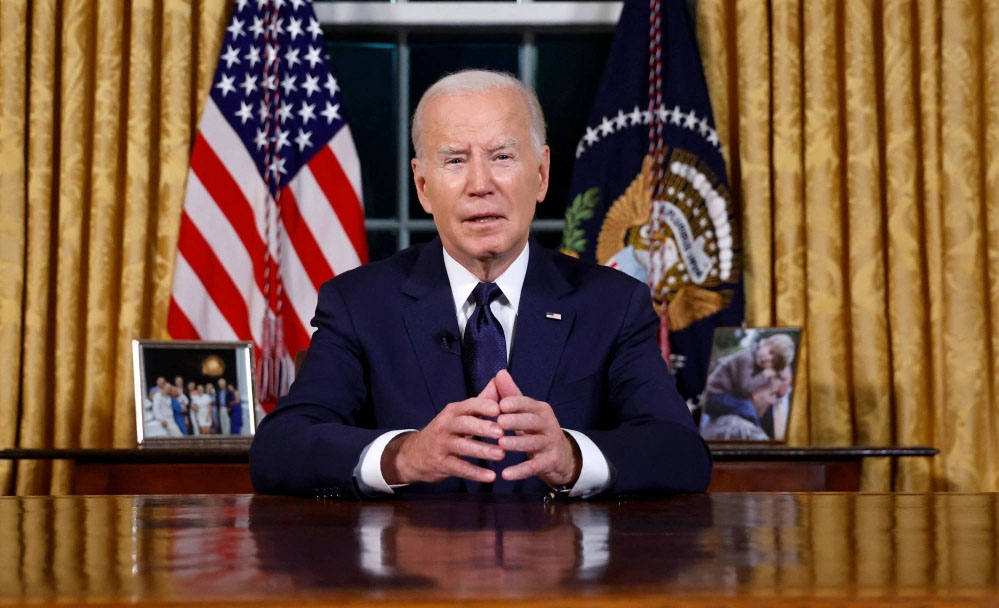
Biden unveils Israeli proposal to end Gaza war
US President Joe Biden has urged Hamas to accept a new Israeli proposal to end the conflict in Gaza, saying that “it’s time for this war to end”.
The three-part proposal would begin with a six-week ceasefire in which the Israel Defense Forces (IDF) would withdraw from populated areas of Gaza.
There would also be a “surge” of humanitarian aid, as well as an exchange of some hostages for Palestinian prisoners.
The deal would eventually lead to a permanent “cessation of hostilities” and a major reconstruction plan for Gaza.
Hamas said it views the proposal “positively”.
Speaking at the White House on Friday, Mr Biden said that the first phase of the proposed plan would include a “full and complete ceasefire”, the withdrawal of IDF forces from populated areas and the exchange of hostages for Palestinian prisoners.
“This is truly a decisive moment,” he said. “Hamas says it wants a ceasefire. This deal is an opportunity to prove whether they really mean it.”
The ceasefire, he added, would allow more humanitarian aid to reach the beleaguered territory, with “600 trucks carrying aid into Gaza every single day”.
READ ALSO:
- Sad, Lagos APC chieftain dies in auto crash + Photos
- Trump reckless, saying hush-money trial was rigged – Biden
- Aisha Yesufu under fire for ignoring new national anthem
The second phase would see all remaining living hostages returned, including male soldiers. The ceasefire would then become “the cessation of hostilities, permanently.”
Among those who have urged Hamas to agree to the proposal was UK Foreign Secretary David Cameron, who said on X that the group “must accept this deal so we can see a stop in the fighting”.
“We’ve long argued a stop in the fighting can be turned into a permanent peace if we are all prepared to take the right steps,” Lord Cameron added. “Let’s seize this moment and bring this conflict to an end.”
UN Secretary General Antonio Guterres also welcomed the development in a post to X, formerly known as Twitter. He said the world had “witnessed too much suffering [and] destruction in Gaza” and said it was “time to stop”.
“I welcome [President] Biden’s initiative [and] encourage all parties to seize this opportunity for a ceasefire, release of all hostages, guaranteed unhindered humanitarian access [and] ultimately a durable peace in the Middle East,” he added.
In his speech, Mr Biden acknowledged that negotiations between phases one and two would be difficult.
As recently as a few days ago, Israeli Prime Minister Benjamin Netanyahu was letting it be known that he was implacably opposed to agreeing to end the war as part of a ceasefire deal – making Mr Biden’s reference to the war’s end particularly significant.
While the plan includes many of the details from previous, ultimately failed rounds of talks, the US calls for a permanent ceasefire appear to be a significant concession designed to try and draw Hamas back to negotiations on terms they have already said they would agree to. A permanent ceasefire has been one of the group’s key demands.
The third phase of the proposal would see the final remains of any deceased Israeli hostages returned, as well as a “major reconstruction plan” with US and international assistance to rebuild homes, schools and hospitals.
READ ALSO:
- Ogun set for oil exploration, receives FG delegation
- Michelle Obama’s mother, Marian Robinson, dies at 86
- BREAKING: Organised Labour declares indefinite strike over minimum wage
- Otti places N25m bounty on killers of soldiers in Aba
In his remarks, Mr Biden acknowledged that some Israelis – including officials within Israel’s government – would likely be opposed to the proposal.
“I’ve urged the leadership in Israel to stand behind this deal,” he said. “Regardless of whatever [political] pressure comes.
The US president also directly addressed the Israeli people, telling them that “we can’t lose this moment”.
Notably, Mr Biden said that Hamas has now been degraded to the extent that it can no longer repeat an attack such as that which its fighters conducted on 7 October – a likely signal to the Israelis that Washington sees the war as done.
In a statement, Prime Minister Netanyahu insisted that the war would not end until its objectives were achieved, including the return of all hostages and the elimination of Hamas’ military and governing capabilities. He said the latest plan would allow Israel to uphold these principles.
Hamas, for its part, said that it views the proposal “positively” because of its call for a permanent ceasefire, the withdrawal of Israeli forces from Gaza, reconstruction and the exchange of prisoners.
The group said it was ready to “deal positively and constructively” to any proposal centred on a permanent ceasefire, provided that Israel “declares its explicit commitment to that”.
Another Palestinian official familiar with the negotiations who has seen the new Israeli proposal said that the document did not include a guarantee that the war will end, nor that IDF troops would withdraw from Gaza completely.
The proposal has been transmitted to Hamas through mediators based in Qatar.
Meanwhile, US Secretary of State Antony Blinken called his counterparts in Jordan, Saudi Arabia and Turkey to try to build a wider support for the proposal.
READ ALSO:
- JUST IN: 40 directors fail permanent secretary qualifying exam
- Police eventually cleared Sanusi to lead the prayer
- BREAKING: Court Grants Chioma Okoli N5m Bail
Mr Blinken “emphasized that Hamas should accept the deal and that every country with a relationship with Hamas should press it to do so without delay,” state department spokesman Matthew Miller said on Friday night.
Faced with mounting civilian casualties in Gaza, President Biden has faced growing domestic criticism over the level of US support for Israel, and calls to do more to encourage the warring sides to negotiate.
Earlier this week, however, the White House said that it does not believe that Israeli operations in Rafah amount to a “major ground operation” that could cross a red line and trigger a possible change in US policy.
The statement came after an Israeli air strike and resulting fire killed at least 45 Palestinians on Sunday.
In a separate announcement on Friday, US lawmakers from both sides of the political spectrum formally invited Mr Netanyahu to address Congress in Washington.
It is unclear when the address would take place.
More than 36,000 have been killed across Gaza since the start of the conflict, according to the Hamas-run health ministry.
The war began in October when Hamas gunmen launched an unprecedented attack on Israel, killing about 1,200 people and taking 252 back to Gaza as hostages.
Biden unveils Israeli proposal to end Gaza war
BBC





International
Trump Warns Iran: Open Hormuz or Get ‘Hit Very Hard’ as 48-Hour Deadline Looms
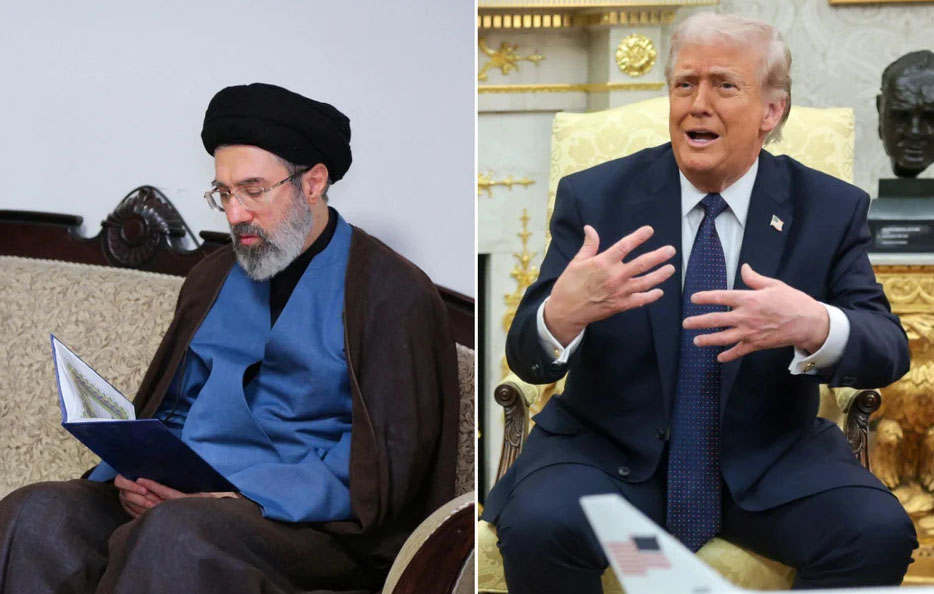
Trump Warns Iran: Open Hormuz or Get ‘Hit Very Hard’ as 48-Hour Deadline Looms
United States President Donald Trump has warned Iran it will be “hit very hard” unless the Strait of Hormuz is reopened “very soon,” while insisting that talks between the two sides were ongoing despite Tehran flatly denying any direct negotiations were taking place. Speaking in an interview with Fox News on Tuesday during a visit to California, Trump said he preferred a diplomatic resolution but left no doubt about the consequences of failure. “The strait is going to be open very soon, or they are going to get hit very hard, and then the strait’s going to be open,” he said. “If they back out again, they are going to get hit really hard. They know that. They understand that. I have no choice.” The president also described the planned military operation as extensive and still on the table despite his decision to pause it over the weekend. “It’s very tough to do what we have planned, still planned. We’ll see what happens,” he said, adding that he was “very proud” of giving Iran a chance to negotiate before launching what he suggested would be a large-scale assault. “We hit them very, very hard. But the hard hit is yet to come, and hopefully we won’t have to use it.” Trump simultaneously accused Iran of duplicity for publicly denying it was in talks with Washington. In a post on Truth Social, he wrote: “Iranian Leadership is unbelievably duplicitous! They ask for a meeting, some would say ‘beg,’ talks begin, with more scheduled in the immediate future, and they say, openly and proudly, that they’re not having any discussions, that nothing is being talked about, and they’re only dealing with ‘Oman’.” He added that “nothing gets through to Iran, unless we want it to, and nothing will get through, unless a Deal, or Total Surrender, is accomplished.”
Iran’s Foreign Ministry flatly rejected Trump’s characterisation. Spokesperson Esmaeil Baghaei said Tehran was not holding direct discussions with the United States and was only engaged in talks with Oman regarding a temporary safe route through the strait. “Discussions are currently focused on a possible navigation corridor for two-way vessel traffic. That initiative is unrelated to negotiations on fully reopening the strait. It is a separate issue,” Baghaei said. Baghaei added that all Iranian negotiators were currently in the country, with Foreign Minister Abbas Araghchi on a religious pilgrimage in Iraq and unavailable for negotiations at least until the end of the week. The only exception, he said, was the ongoing bilateral discussions with Oman as the two coastal states responsible for the waterway.
READ ALSO:
- Primate Ayodele Predicts Obi, Kwankwaso Will ‘Go Nowhere’ in 2027
- Police Probe AIG Jimoh Over VeryDarkMan’s Corruption Allegations
- N78 Million Solar Inverters, 410 Cattle, 10 Guns Recovered as Kaduna Police Arrest 25 Suspects
According to Axios, which cited unnamed regional and US officials, the United States, Iran, and Oman are nearing an interim agreement to reopen the Strait of Hormuz, with Washington hoping to announce the deal as early as Wednesday. The proposed arrangement would be a 60-day agreement for safe passage in the strait between Iran and Oman, with negotiators working on final details. Under the reported framework, ships entering the Persian Gulf would travel north through Iranian territorial waters, while outbound vessels would travel south through Omani waters in coordination with Tehran. The agreement would not involve the collection of transit fees or tolls, and the parties would clear mines from the central shipping lane within 30 days. A US official and one regional source told Axios that Iranian leadership had completed the approval process for the agreement on Tuesday. While US Secretary of State Marco Rubio confirmed that progress had been made in discussions with Iran, he noted that talks had not yet been finalized but that the White House was “hoping” for an agreement “in the very near future.”
Iran’s senior officials have taken a defiant stance, warning the United States against any adventurous actions. The Iranian Foreign Ministry reiterated that Tehran views Hormuz as a crucial source of strategic leverage that it cannot afford to surrender, while Washington insists that Iran must not be allowed to control an international waterway. Iran continues to insist that any agreement must leave it in control of the Strait of Hormuz. Regional officials told The Associated Press that any agreement to reopen Hormuz would also require the removal of the current US blockade on Iranian ports. Meanwhile, Iranian military sources have denied Trump’s claim that Tehran asked Washington to call off its strikes, calling his remarks “a new lie,” according to Iran’s semi-official Mehr news agency.
The diplomatic confusion was underscored when another cargo vessel was attacked near the strait’s Omani coast on Tuesday. The United Kingdom Maritime Trade Operations Centre (UKMTO) reported receiving multiple reports that a tanker had been struck by an unknown projectile approximately eight nautical miles east of Oman’s Limah. The tanker’s crew abandoned the vessel and boarded a lifeboat, with the vessel’s main engine disabled and a bunker tank on fire. The UKMTO did not identify the ship or its owner, and authorities are investigating. Separately, Iran’s Revolutionary Guards said on Tuesday that two oil tankers had caught fire after explosions while attempting to transit the southern route of the strait, though Reuters could not independently verify the Guards’ statement.
The disruption of the Strait of Hormuz has sent oil prices soaring and placed heavy pressure on Trump to stop the fighting, partly because of the effect rising energy prices could have on American voters ahead of the November congressional midterm elections. Treasury Secretary Scott Bessent had earlier told CNBC that a deal to reopen the strait could come as early as Tuesday or Wednesday, saying there were “hundreds if not 1,000 ships sitting in there waiting to go out,” including tankers carrying oil, fertiliser, refined products and industrial gases. Trump has vowed that Iran will not be permitted to collect transit fees in the strait, declaring, “If anyone is allowed to collect fees, it will be us. We have complete control.” The president had previously said he expected to know by Tuesday how the talks were going, “one way or the other,” but insisted that the path forward is clear. As the 48-hour window unfolds, the world watches to see whether the negotiations will yield a breakthrough or whether Trump will follow through on his threat to unleash a devastating military campaign. “If they don’t make a deal, it’s going to be too bad. And we have much more on Iran coming up,” Trump said. All parties remain on high alert, with the potential for a catastrophic escalation in West Asia now greater than at any point since the conflict began.
Trump Warns Iran: Open Hormuz or Get ‘Hit Very Hard’ as 48-Hour Deadline Looms
International
Iran Denies US Talks After Trump Announces Negotiations as War Enters Sixth Month
Iran Denies US Talks After Trump Announces Negotiations as War Enters Sixth Month
Tehran rejects Washington’s claim of imminent talks, says discussions with Oman over Strait of Hormuz are separate and ongoing
Iran has firmly denied that it is currently holding negotiations with the United States, contradicting President Donald Trump’s announcement that talks would begin on Monday afternoon. The conflicting claims come amid heightened tensions over the Strait of Hormuz and Iran’s nuclear program, with the war between the two countries now in its sixth month. The war began on February 28, 2026, when the United States and Israel launched surprise strikes against Iran, targeting key leadership, air defence capabilities, missile sites, and the Islamic Revolutionary Guard Corps (IRGC) Navy. The opening salvo included an attack on a leadership meeting in Tehran that killed Supreme Leader Sayyid Ali Khamenei, Iran’s defence minister, the chief of staff of the armed forces, and the commander of the IRGC. Since then, months of on-off diplomacy have led to periods of relative calm, though fighting has continued to flare.
Iranian Foreign Ministry spokesman Esmaeil Baqaei stated during a televised press conference on Monday that “Iran is not currently holding talks with the United States”. He elaborated that Tehran has no plans to host or send delegations, and members of Iran’s negotiating delegation remain inside the country. Baqaei clarified that Iran’s current discussions are focused exclusively on Oman regarding a temporary safe route through the Strait of Hormuz. He emphasized that reaching an agreement with Oman would not mean the reopening of the strait, as the situation would remain unchanged while US “aggression” continued. “So long as the United States continues to violate its commitments, the situation in the Strait of Hormuz will not change,” Baqaei told his weekly press conference. The spokesman also warned Gulf states against allowing the United States to use their territory for attacks on Iran, urging countries in the region not to facilitate US military action.
READ ALSO:
- NiDCOM confirms release of Nigerian girls detained in Mauritius
- Power Struggle Threatens Peter Obi-Kwankwaso Alliance Ahead of 2027 Polls
- Gumi: Clerics who join politics are better than those praying for politicians
On Sunday, President Trump told reporters aboard Air Force One that negotiations with Iran would begin Monday afternoon. He claimed that the talks would cover the Strait of Hormuz and ultimately the denuclearisation of Iran. “The deal is imminent, having to do with the Hormuz Strait and also, ultimately, the denuclearization of Iran,” Trump said. Trump stated that he had been asked by Iran as well as US partners Saudi Arabia, the United Arab Emirates, and Qatar to hold off on strikes, which he claimed would have been “the biggest attack since World War II”. In a post on Truth Social, Trump wrote: “Based on this request, I have agreed, for the future benefit of the WORLD and, likewise, the survival of a successful and prosperous Iran, to cancel the attack, subject to being able to rapidly make a DEAL”. However, Iranian media has denied that Tehran asked Trump not to strike. Trump has repeatedly predicted that a negotiated settlement is within reach, although previous diplomatic efforts have been followed by renewed exchanges of military strikes.
While denying US talks, Iranian officials confirmed progress in discussions with Oman over a new shipping route through the Strait of Hormuz. Iranian Foreign Minister Abbas Araghchi said negotiations with Oman on a mechanism for ships to transit the waterway were “nearing completion and in their final stages,” according to Iranian state media. The talks have been ongoing for months between Tehran and Muscat, the two littoral states bordering the strait, with discussions continuing at both the technical and political levels. Baqaei told state television that a deal was close with Oman over a new route through the strait, describing it as “one path with entry and exit lanes” that would respect the sovereign rights of both sides. The route under discussion will be temporary, he said, and through it, Iran will ensure safe navigation. Baqaei emphasized that Iran and Oman, as coastal states of the strait, are required to cooperate to ensure the safe passage of vessels through the waterway and reach a defined mechanism. He noted that Tehran needs to ensure that the Strait of Hormuz would not be exploited by the parties that have carried out aggression against Iran, adding that “this requires us to adopt a mechanism in which Iran’s sovereign rights are fully respected”.
The conflicting claims come against the backdrop of a war that has significantly disrupted global energy markets. Before the war, the Strait of Hormuz served as a conduit for approximately 20% of the world’s oil and liquefied natural gas. Iran has largely closed the strait, causing energy prices to rise and stoking broader inflation. On June 18, Iran and the United States signed a memorandum of understanding (MoU) on ending the conflict, under which the two countries were scheduled to hold negotiations within a 60-day period to reach a final agreement. Under the understanding, Iran agreed to allow fee-free maritime transit through the Strait of Hormuz for a period of 60 days. However, the talks’ fate has been uncertain due to recent military escalation. The US attempted to undermine Iran’s sovereignty by establishing an unsafe corridor near Omani shores, prompting Iran’s firm response to re-impose restrictions on the strait.
Iranian President Masoud Pezeshkian posted on X that “We must strive to compel the enemy to remain committed to what it has signed”. He expressed belief that the MoU would be the focal point of Iran’s foreign relations in the future. Baqaei also revealed that over the past 24 hours, “we have received numerous calls from the United Kingdom, Bulgaria, and Ukraine stating that they will not be part of the war against Iran”. Iranian lawmaker Hassan Ghashghavi, spokesman for the parliament’s national security commission, said on Sunday that mediators were trying to revive the US-Iran memorandum of understanding that was agreed in June. That agreement was not intended as a final peace deal, but as a stepping stone to negotiations on a comprehensive agreement, though it did include provisions on Hormuz. “They know that the main issue and, in fact, the key to the matter right now is the issue of the Strait of Hormuz, so yes, there is an exchange of views,” Ghashghavi said.
Trump’s announcement had immediate market effects, with oil prices falling at the opening of Asian trade. The president said he had been asked by Iran as well as US partners Saudi Arabia, the United Arab Emirates, and Qatar to hold off on further strikes. Eli Cohen, Israel’s energy minister and a member of Prime Minister Benjamin Netanyahu’s security cabinet, said there was close security and intelligence coordination between Israel and the US on everything happening in the region. However, he added: “With or without an agreement, and regardless of any external commitments, if Iran attempts to renew its nuclear programme or advance its ballistic missile industries, we will be there. We will take action, and we will strike”. In his call with Trump, Saudi Crown Prince Mohammed bin Salman stressed the “necessity of prioritising dialogue to de-escalate tensions” in the Middle East, according to Saudi Arabia’s state news agency. Many observers have expressed skepticism about the latest diplomatic push. Vali Nasr, an Iran expert at Johns Hopkins University, stated there was “no clear path” for Trump to achieve his goals, noting that “He is trying his hand now at a diplomatic solution to avoid military escalation. But there’s no clear path, either diplomatically or militarily, to get Trump to a place where he can declare victory”.
Iran Denies US Talks After Trump Announces Negotiations as War Enters Sixth Month
Additional reporting by Reuters, AFP, Ynetnews, and The New Arab
International
Oil Prices Slide as Trump Announces Fresh Iran Talks, Easing Supply Fears

Oil Prices Slide as Trump Announces Fresh Iran Talks, Easing Supply Fears
Global oil prices fell sharply in early Asian trading on Monday after United States President Donald Trump announced fresh negotiations with Iran, raising hopes of easing tensions in the Middle East and restoring normal shipping through the strategically vital Strait of Hormuz.
Brent crude, the international oil benchmark for September delivery, dropped 4.69 per cent to $83.81 a barrel as of 2250 GMT on Sunday, while the US benchmark, West Texas Intermediate (WTI), declined 4.67 per cent to $80.72.
The decline followed Trump’s announcement on Sunday that Washington would resume diplomatic engagement with Tehran instead of pressing ahead with major military strikes against the Islamic Republic.
READ ALSO:
- Political Realignments: Kwankwaso Receives APC Defectors into NDC in Kano
- DSS, Vigilantes Ambush, Kill Notorious Bandit Kingpin Idi Abasu Aiki, Over 60 Fighters in Katsina
- Nigeria Shines in Commonwealth Games, Tops Africa with 10 Gold Medals
“Now what we’re doing is we’re talking to them in the form of a negotiation. It begins tomorrow afternoon,” Trump said, without disclosing the venue or those expected to participate in the talks.
Oil markets have remained highly volatile since the conflict between the United States, Israel and Iran escalated in late February, disrupting traffic through the Strait of Hormuz—a critical maritime corridor for global crude oil and liquefied natural gas exports.
The renewed diplomatic push has fuelled optimism that the waterway could soon reopen fully, reducing the risk of prolonged disruptions to global energy supplies.
Adding to the positive sentiment, Iran said on Sunday that it was close to reaching an agreement with Oman on establishing a new shipping arrangement through the Strait of Hormuz, a development that could further stabilise oil exports from the region.
Oil Prices Slide as Trump Announces Fresh Iran Talks, Easing Supply Fears
-

 News2 days ago
Oloyede clears air on JAMB’s ₦36m ‘snake swallowed money’ controversy
-

 News2 days ago
475 Police Officers Recalled After Controversial Retirement, Ordered for Mandatory Induction
-

 metro2 days ago
MURIC Hails Oloyede as ‘Game Changer,’ Says He Proved Muslims Can Excel in Public Office
-

 Sports2 days ago
Nigeria Shines in Commonwealth Games, Tops Africa with 10 Gold Medals
-

 Auto2 days ago
Lanre Shittu Motors Leads Drive to Steer Lagos Students Away from Crime, Donates books to public Schools
-

 Education2 days ago
UNIOSUN ranks third among state universities in latest Webometrics ranking
-

 Auto2 days ago
FRSC Boss: Tinubu’s CNG, EV Drive Creating Jobs, Attracting Investment
-

 metro2 days ago
DSS, Vigilantes Ambush, Kill Notorious Bandit Kingpin Idi Abasu Aiki, Over 60 Fighters in Katsina