

International
British mum who poisoned her husband in £2m plot speaks from death row

British mum who poisoned her husband in £2m plot speaks from death row
A British mum who poisoned her husband and slit his throat with her lover in a £2million life insurance plot said she’s “in hell” caged on death row.
Ramandeep Kaur Mann was convicted of brutally murdering her husband of 11 years, Sukhjit Singh, in his sleep as their nine-year-old son watched in horror.
Mann and her lover, Gurpreet Singh, began their sordid affair a year before they carried out the barbaric crime while staying with family in Basantapur, Uttar Pradesh, in 2016.
The horrors that unfolded were a complete shock to the people who knew them from their Derby home.
The 38-year-old and her accomplice, who was Sukhjit’s childhood best friend, laced their victim’s Biryani with sedatives, smothered him with a pillow, bludgeoned him with a hammer and finally slit his throat.
And, the evil murder was tragically witnessed by the couple’s eldest son, Arjun, who was just nine at the time.
Arjun’s mum had put sedatives in his curry to stop him from walking in on their gruesome plan.
However, they hadn’t taken affect before his dad was killed in front of his eyes.
The traumatised little boy later told police: “My dad was great but my mum was bad and I don’t want to see her face ever because she killed my dad in front of my eyes.
“She kept a pillow on my dad’s face and asked Gurpreet to slit his throat.”
The sick pair are said to have brutally taken Sukhjit’s life for a £2million life insurance policy as well as property in both the UK and India.
Mann was quickly arrested and sentenced to death by hanging, while Singh was given life in prison and a £260,000 fine.
The killer mum now waits caged in one of India’s most overcrowded prisons with 55 other female prisoners and 1,300 male inmates – official capacity for the lock up is just 511.
READ ALSO:
-
Missing 17 year old girl found in a hotel in Port Harcourt
-
Nollywood Actress, Queeneth Hilbert mocks her colleague who undergo Brazilian butt lift procedure
-
BREAKING: Ohinoyi of Ebiraland dies at 95 in Abuja hospital
She is the only foreign prisoner and the only one on death row in Shahjahanpur District Jail.
Speaking to the MailOnline, Mann claimed she is barely surviving in a “living hell”.
“It’s horrendous, it’s like being in hell- both this prison and the bigger situation that I find myself in,” she said.
“It’s the worst thing that has happened to me. I feel so alone, I haven’t made any friends in here and I just keep myself to myself.”
The death row inmate also complained about the “awful” food and how she spends her days crying.
She claimed her conviction was a “miscarriage of justice” and still insists from behind bars that her husband’s family framed her.
The twister killer alleged they carried out the unthinkable murder after he revealed plans to sell 21 acres of land.
“There’s nobody helping me, I’m all alone here. I can’t begin to tell you how horrendous this whole thing is,” she added.
“I’m not good at all. Please, somebody help me.”
Mann begged the British High Commission to fly out and see her to review the case.
The mum-of-two also said she has not heard or seen from either child since her arrest.
Jail Superintendent Mijaji Lal told MailOnline: “We are doing our best to look after her because we understand that things must be very difficult for Mann.
“We’re encouraging her to take up a sport like badminton or run English classes for the other inmates.”
Mann, who grew up in Slough, Berkshire met Sukhjit in 2002 when she was just 17 and he was 20.
They married in 2005 and after running a pizza restaurant in Carshalton, Surrey, moved to Derby to raise their two boys.
A pal of the couple previously told MailOnline Sukhjit “worshipped the ground” his wife walked on.
They added: “[He] waited on her hand and foot. I got the impression she always got what she wanted.”
It wasn’t until 2015 that Mann and Gurpreet sparked their affair when the couple took their sons on holiday to Dubai to visit him.
One year later, Sukhjit, who gifted his wife with “nice clothes and jewellery”, was discovered dead in his own mother’s home.
British mum who poisoned her husband in £2m plot speaks from death row
(SUN UK)









International
Ninth Body Discovered in South Africa: Nigeria Issues Urgent Safety Alert to Nationals

Ninth Body Discovered in South Africa: Nigeria Issues Urgent Safety Alert to Nationals
Police cordon off Kempton Park and post a $56,000 combined bounty as the Nigerian Consulate warns citizens to exercise heightened vigilance.
South African police recovered the body of a ninth woman on Thursday along a roadside in Dawn Park, intensifying public alarm and prompting the Nigerian Consulate-General in Johannesburg to issue an emergency safety advisory to its citizens.
In response to the discoveries, law enforcement teams placed Kempton Park in the Ekurhuleni municipality under lockdown and established roadblocks to inspect vehicles and restrict suspect movement.
Deputy Police Chief Tebello Mosikili declared during a press conference that authorities will deploy specialized investigative units to track down those responsible.
To accelerate breakthroughs, police offered a 400,000 rand ($25,000) reward for credible tips, while South Africa’s Democratic Alliance provided an additional $31,000, establishing a combined bounty of $56,000.
Detectives are now evaluating forensic evidence to determine whether one perpetrator committed the murders or whether independent offenders copied earlier attacks.
Meanwhile, the Nigerian Consulate-General urged Nigerian residents, especially women and young people who commute, exercise, or study around Ekurhuleni, to take deliberate personal precautions.
The mission advised community members to travel in groups, stay clear of isolated trails, and share real-time travel details with trusted family members.
Furthermore, diplomatic officials emphasized that safety precautions must not shift the burden of crime prevention onto women, calling on South African authorities to ensure thorough investigations and justice for every victim.
Ninth Body Discovered in South Africa: Nigeria Issues Urgent Safety Alert to Nationals
Health
Fiji Declares National HIV Emergency as Diagnoses Surge Sixteenfold
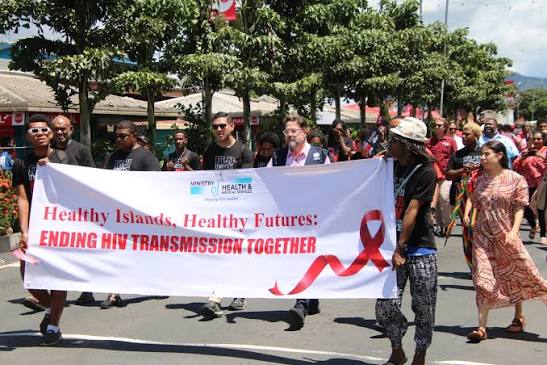
Fiji Declares National HIV Emergency as Diagnoses Surge Sixteenfold
Authorities launch a multi-agency public health campaign to expand free testing, treatment, and harm-reduction services
Fiji has announced a nationwide health response to address a significant rise in HIV cases and ensure that all residents can access essential medical care.
On Wednesday, Health Minister Dr. Atonio Lalabalavu shared the emergency declaration, explaining that national agencies are joining forces to provide rapid medical support, expand testing, and protect community well-being across the islands.
Official reports indicate that about one in every 60 adults in Fiji currently lives with HIV, following an increase in new infections over recent years. Health specialists explain that the virus spreads primarily through intimate sexual contact and shared needles among individuals using illicit substances.
Additionally, routine screenings revealed that two out of every 100 expecting mothers carry the virus, highlighting an urgent need for early maternal healthcare to protect newborns from infection.
To safeguard public health, authorities are delivering free daily treatments, distributing protective preventive medications, and setting up clean needle programs to stop infections before they start.
Furthermore, global partners, including Australia, New Zealand, India, and United Nations health bodies are providing financial resources and medical supplies to back the local effort.
By encouraging open community conversations and delivering accessible healthcare without judgment, health workers aim to ensure that everyone receives the care and dignity they deserve.
Fiji Declares National HIV Emergency as Diagnoses Surge Sixteenfold
International
Kim Yo-jong: Only ‘Idiots’ Think North Korea Will Give Up Nuclear Weapons

-

 International2 days ago
Islamic Council Condemns Attempted Attack on Holy City of Mecca
-

 News2 days ago
Keep Politics Out of My Office — Ogbomoso Grand Chief Imam Warns Politicians, Bloggers
-

 metro2 days ago
Niger Mosque Abductions: Terrorists Execute 30 of 500 Captive Muslim Worshippers
-

 Entertainment2 days ago
BREAKING: Olu Jacobs Dies at 84, Atiku Mourns Cultural Icon
-
 metro3 days ago
Fatal NURTW Leadership Clash in Osun Leaves Two Dead; State Orders Park Shut Down
-

 Business1 day ago
Fuel Prices Climb to ₦1,500 per Litre Across Nigeria, Sparking Calls for Urgent Action
-

 News2 days ago
Blue Line Rail, Hospitals Get Boost as Lagos Approves ₦200bn Bond and Budget Reordering
-

 News1 day ago
OAU Investigates Death of Final-Year Student as Police Begin Probe