

metro
JUST IN: We will pay Heritage Bank customers within one week – NDIC MD

JUST IN: We will pay Heritage Bank customers within one week – NDIC MD
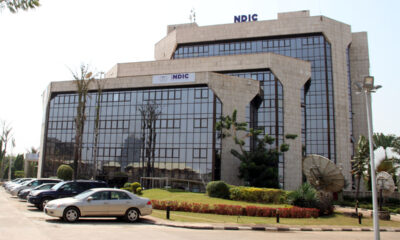
The Nigerian Deposit Insurance Corporation (NDIC) has assured depositors of Heritage Bank it was already in the process of paying them.
The Managing Director of NDIC, Bello Hassan, stated this at a briefing where he outlined the processes of repayment, insisting that the corporation will not take 30 days as stipulated by law but will settle customers within one week.
The Nation reported that the Central Bank of Nigeria (CBN) on Monday, June 4, revoked the banking licence of Heritage Bank.
READ ALSO:
- Linda Ikeji clarifies son’s surname amid social media frenzy
- Police invite Premium Times journalist over yet-to-be-published report
- Police grill Mohbad’s dad over petition by Lagos monarch
According to the CBN, the decision was due to the bank’s inability to improve its financial performance.
“The Board and Management of the bank have not been able to improve the bank’s financial performance, a situation which constitutes a threat to financial stability,” the CBN said.
However, the apex said Heritage Bank had not improved and “has no reasonable prospects of recovery”, thereby making revoking the licence the next necessary step.
JUST IN: We will pay Heritage Bank customers within one week – NDIC MD








metro
South African Woman Jailed 25 Years for Smuggling 5.75kg Heroin into Nigeria
South African Woman Jailed 25 Years for Smuggling 5.75kg Heroin into Nigeria
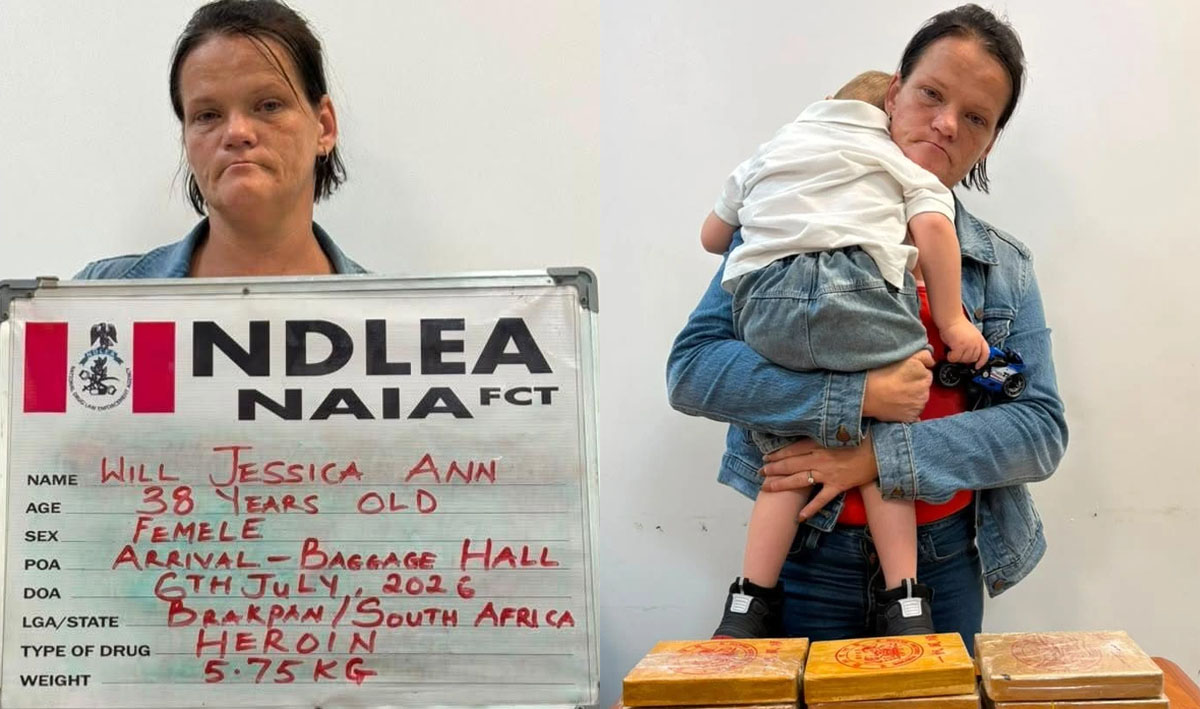
A Federal High Court in Abuja has sentenced a 38-year-old South African woman, Will Jessica Ann, to 25 years in prison for importing 5.75 kilogrammes of heroin into Nigeria through the Nnamdi Azikiwe International Airport, Abuja.
Justice Obiora Egwuatu handed down the sentence after Ann pleaded guilty to charges brought against her by the National Drug Law Enforcement Agency (NDLEA).
The defendant was sentenced to 15 years on the first count and 25 years on the second count, with both terms ordered to run concurrently. This means she will serve a maximum of 25 years, rather than 40 years.
The case dates back to July 6, 2026, when NDLEA operatives intercepted Ann during the inward clearance of passengers arriving on Qatar Airways Flight QR1433 from Doha at the Abuja airport.
Ann was travelling with her three-year-old son when she was stopped by anti-narcotics officers.
READ ALSO:
- Adunni Ade Reveals Christian Fans Unfollowed Her After Publicly Identifying as Muslim
- Jetour Set to Storm Abuja Show with Rugged Luxury T2
- 25 Universities, Teaching Hospitals Get Solar Power Under REA Programme
According to details presented in court, the NDLEA said Ann initially denied having any checked-in luggage. However, operatives reportedly established that two suitcases containing the illicit substance carried baggage tags corresponding with the claim tags attached to her passport.
The agency said the two suitcases contained 14 large blocks of heroin, weighing a total of 5.75kg.
Ann reportedly admitted ownership of the luggage and told investigators that she had travelled from Cambodia through Doha before arriving in Abuja.
During the proceedings, the prosecution also told the court that Ann had admitted to conspiring with Jan Coenraad De Jager, a South African man who remains at large.
She was subsequently arraigned on a two-count charge bordering on conspiracy and unlawful importation of heroin under the relevant provisions of the law.
Ann pleaded guilty to the charges in August, prompting the prosecution to present the facts of the case before the court proceeded to sentencing.
The court was told that the seized heroin had an estimated street value of about ₦103.5 million, based on an estimated value of approximately ₦18 million per kilogramme.
Ann pleaded for leniency, expressed remorse and promised not to engage in drug trafficking again. She also told the court that she did not know there were illicit drugs in the bags.
After considering the facts of the case, Justice Egwuatu sentenced her to 15 years on Count One and 25 years on Count Two, directing that the sentences run concurrently.
The court also ordered that the seized heroin should be destroyed if the convict does not appeal within the period prescribed by law.
The case is part of the NDLEA‘s efforts to intercept illicit drug consignments being brought into Nigeria through international airports and other entry points.
The seizure at Abuja airport, followed by the defendant’s guilty plea and conviction, has resulted in the 25-year custodial sentence imposed by the Federal High Court.
South African Woman Jailed 25 Years for Smuggling 5.75kg Heroin into Nigeria
metro
Kaduna Troops Rescue Two-Year-Old Boy From Kidnappers, Search for Mother Continues

Kaduna Troops Rescue Two-Year-Old Boy From Kidnappers, Search for Mother Continues
A two-year-old boy is back with his family after troops rescued him from suspected kidnappers in Kaduna State.
Jafaru Baba was abducted with his mother from Ungwan Nungu village in Sanga Local Government Area. Troops later recovered the child after tracking the kidnappers to an area around Tayu Village.
The rescue followed intelligence received by security forces about the movement of the abductors and their victims.
According to security sources cited by security analyst Zagazola Makama, troops launched the operation at about 4pm on Wednesday, September 16.
READ ALSO:
- Gaza Building Collapse Kills 21, Including Eight Children
- Niger Mosque Abductions: Terrorists Execute 30 of 500 Captive Muslim Worshippers
- OAU Investigates Death of Final-Year Student as Police Begin Probe
They searched Tayu High Grounds, Tayu Village and surrounding parts of Sanga LGA. The operation later brought the troops into contact with the suspected kidnappers.
A gunfight followed, forcing the abductors to retreat into the bush. In the process, they left the toddler behind.
The troops quickly secured Jafaru and later handed him over to his father.
Security sources said the troops fired 17 rounds of 7.62mm ammunition during the confrontation.
Meanwhile, the search has not ended. Security personnel are still combing the area for the child’s mother, who remains in the kidnappers’ custody.
They are also pursuing the suspects who fled after the encounter, as efforts continue to rescue the woman and bring those responsible for the abduction into custody.
Kaduna Troops Rescue Two-Year-Old Boy From Kidnappers, Search for Mother Continues
metro
Niger Mosque Abductions: Terrorists Execute 30 of 500 Captive Muslim Worshippers
Niger Mosque Abductions: Terrorists Execute 30 of 500 Captive Muslim Worshippers
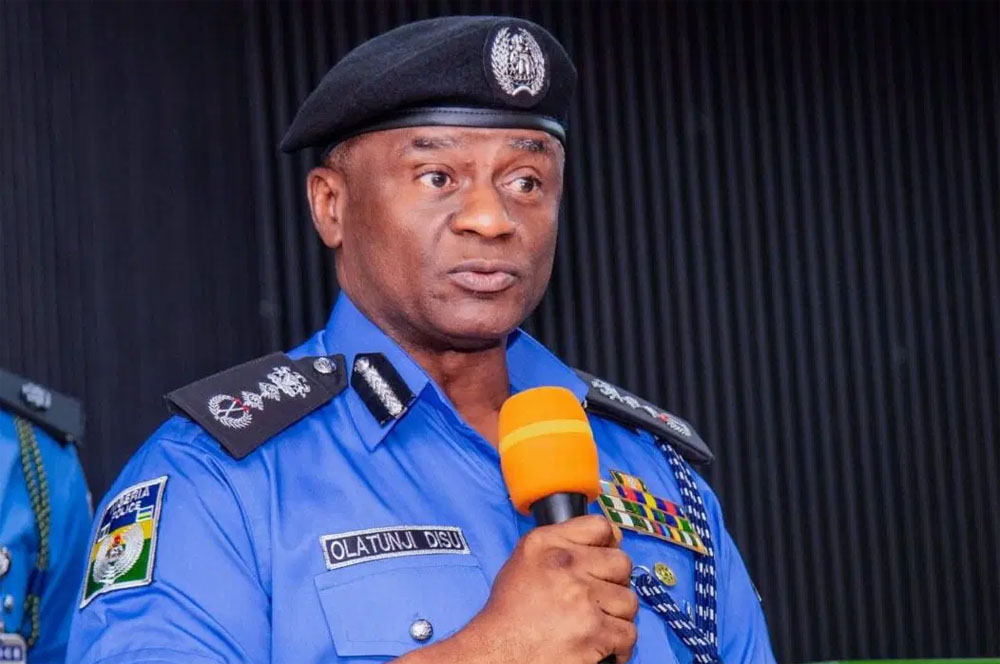
MINNA, NIGERIA – The mass abduction of worshippers from mosques in Niger State has escalated dramatically, with armed terrorists reportedly executing some of the hundreds of captives seized during Friday prayers. The Inspector-General of Police, Olatunji Disu, travelled to Niger State on Saturday to assess the security situation and ordered reinforced rescue operations.
The attacks occurred on Friday, 21 August 2026, at approximately 2pm. Police spokesperson Wasiu Abiodun confirmed that armed men simultaneously attacked mosques in four communities – Dekara, Kpenya, Sabon-Gida and Gidan-Zana – in the Borgu Local Government Area, while Muslims were observing Friday prayers. Witnesses described scenes of chaos. A Dekara resident, speaking on condition of anonymity, said the terrorists surrounded the mosque shortly after prayers began. “As soon as the imam said ‘Assalamualaikum’, the bandits surrounded the mosque and took people away.” Local residents estimate that more than 60 people were abducted from Dekara Central Mosque alone. In Gbezhin community, no fewer than 100 people remained unaccounted for as of Sunday evening. The terrorists later released a video claiming to hold approximately 500 captives, including women and children, with the sound of children crying audible in the footage.
On Saturday, the terrorists issued a warning to surrounding communities, ordering residents to vacate their homes within 30 minutes and threatening: “We will kill anyone we meet when we return.” Those threats appear to have been carried out. A Dekara resident told Daily Trust: “We received information that some of the abducted worshippers have been killed, but we do not know the exact number. Soldiers and vigilantes have moved to recover the bodies, but all routes accessible to security personnel have been planted with improvised explosive devices.” The Niger State chapter of the Christian Association of Nigeria (CAN), through its chairman, Bishop Bulus Dauwa Yohanna, confirmed that approximately 30 worshippers who attempted to flee were shot dead by the gunmen. This figure corresponds with reporting by NPO Reports.
READ ALSO:
- OAU Investigates Death of Final-Year Student as Police Begin Probe
- 57-Year-Old Man Arrested Over Sexual Abuse of Stepdaughter in Edo
- US-Based Nigerian Lawyers Disbarred: Full List of Fraud, Theft and Misconduct Cases
The continuing violence and execution threats have triggered mass displacement. Resident Usman Musa told journalists that more than 200 residents from Gbezin had fled to neighbouring Benin Republic for safety. Another resident added that approximately 230 residents from Gidan-Zana and Sabon-Gida were taking refuge in Gawungi, inside Benin, while others had fled to Kwara State to stay with relatives.
Among those abducted are several prominent community figures. According to Ismaila Yahaya, the 90-year-old village head of Ka’ada was among those taken. He is the biological father of the District Head of Dekara and had only recently been released from a previous kidnapping. The violence in Borgu Emirate has not been confined to the mosque attacks. The Niger State Government confirmed that Alhaji Ahmed Yusuf, the village head of Galla, was killed by armed men at his residence. Governor Mohammed Umaru Bago expressed condolences, describing the killing as evidence of the bandits’ “extreme arrogance”.
Amid the escalating crisis, Inspector-General of Police Olatunji Disu visited Niger State on Saturday, 29 August, meeting with Deputy Governor Yakubu Garba at the Government House in Minna. He conveyed his condolences to the families of the victims and pledged that “the safe rescue of the kidnapped victims and bringing the perpetrators to justice remains the focus of current operations”. Disu has ordered the deployment of elite reinforcements to Niger State, including counter-terrorism units, tactical squads and the police air wing. Assistant Inspector-General of Police Victor Olaiya of Zone 7 has been dispatched to coordinate rescue efforts. Addressing officers at the Niger State Police Command, the Inspector-General said: “Nigerians are watching to see the police do what is right. I am not here for ceremony, but to bring a strong message of support to officers and soldiers working under difficult conditions.”
The Nigerian Supreme Council for Islamic Affairs (NSCIA) described the attacks as “heinous and barbaric”, calling on the Federal Government to “move beyond sporadic rescue operations” and establish a permanent, intelligence-driven and community-centred security architecture. The Christian Association of Nigeria’s Niger State chapter urged the government to provide adequate security at places of worship nationwide, stressing that “an attack on any place of worship is an attack on the sanctity of worship and a threat to the wider community”. Amnesty International also urged Nigerian authorities to secure the safe release of the abducted worshippers, noting that at least 1,100 people were abducted in the country between January and April 2026, with the actual figure likely to be far higher.
As of press time, the Niger State Government said it had not received any contact or demands from the kidnappers. Information Commissioner Obed Nuhu, speaking in a television interview, said the attacks were suspected to have been carried out by Lakurawa and Boko Haram elements, though the exact number of victims remained unverified.
Niger Mosque Abductions: Terrorists Execute 30 of 500 Captive Muslim Worshippers
-

 Sports3 days ago
‘I Was Never the Chosen One’ — Dembele Responds to Mbappe
-

 International2 days ago
Islamic Council Condemns Attempted Attack on Holy City of Mecca
-

 metro2 days ago
Lagos Power Outage: Ikeja Electric Blames TCN as Businesses, Homes Groan
-

 Education3 days ago
JAMB Moves 2027 UTME Time — Here’s What Candidates Need To Know
-
 News2 days ago
Keep Politics Out of My Office — Ogbomoso Grand Chief Imam Warns Politicians, Bloggers
-
 Politics2 days ago
2027: APC Governors Reject Wike’s Rainbow Coalition, Insist on Party Loyalty
-

 News3 days ago
I Wanted to Disgrace Tinubu — Omokri Reveals What He Discovered at Chicago Varsity
-

 metro2 days ago
A Son Wouldn’t Have Done Better — Dangote Speaks on Daughters, Succession