

metro
2027 Hajj: Nigeria Secures 10,000 Extra Slots, Allocation Hits 60,000

2027 Hajj: Nigeria Secures 10,000 Extra Slots, Allocation Hits 60,000
Nigeria has secured an additional 10,000 Hajj slots from Saudi Arabia, raising the country’s total allocation for the 2027 Hajj pilgrimage from 50,000 to 60,000 pilgrims.
The National Hajj Commission of Nigeria (NAHCON) announced the development on Thursday, October 1, 2026, saying the additional allocation followed sustained engagements between the Federal Government and Saudi Arabian authorities.
Of the additional 10,000 slots, 7,500 have been allocated to State Muslim Pilgrims Welfare Boards, Agencies and Commissions, while the remaining 2,500 slots have been assigned to seven lead licensed private tour operator companies.
The additional allocation represents a 20 per cent increase over Nigeria’s previously approved 50,000-slot quota for the 2027 Hajj.
Before the increase, Nigeria’s allocation stood at 50,000 pilgrims, comprising 35,000 slots for government-sponsored pilgrims and 15,000 for licensed private tour operators.
The latest approval followed an earlier decision by Saudi Arabia to reject Nigeria’s request for additional slots. NAHCON had announced in September that the request was turned down due to capacity limitations, structural constraints at the holy sites and the Kingdom’s policy of adhering to approved country quotas.
Further engagements between Nigerian officials and the Saudi authorities subsequently resulted in the additional allocation.
NAHCON Chairman and Chief Executive Officer, Ambassador Ismail Abba Yusuf, expressed appreciation to the Federal Government and Saudi authorities for the additional slots.
Yusuf also acknowledged Saudi Arabia’s Minister of Hajj and Umrah, Dr Tawfiq bin Fawzan Al-Rabiah, and Deputy Minister Dr Abdul Fattah bin Sulaiman Mashat, for the Kingdom’s cooperation.
READ ALSO:
- [UPDATED] Imo Highway Attack: 10 Rescued as Gunmen Abduct NYSC Prospective Members
- Workers to Begin Nationwide Warning Strike Over Petrol Price, Wage Award
- Nigeria at 66: MURIC Urges Unity, Peace, Justice Ahead of 2027 Elections
The NAHCON chairman said the development reflected the longstanding relationship between Nigeria and Saudi Arabia, particularly their cooperation in facilitating the Hajj pilgrimage for Nigerian Muslims.
He assured intending pilgrims and other stakeholders that the additional slots would be administered transparently and judiciously, in line with Nigerian and Saudi Arabian regulations and operational requirements.
NAHCON also reiterated its commitment to making Hajj accessible and affordable to Nigerians, while maintaining standards in service delivery, accountability and operational efficiency.
The commission said it would work with state pilgrims’ welfare boards, agencies and commissions, as well as licensed private tour operators, to implement the expanded allocation.
The increase comes as preparations for the 2027 Hajj are already underway. NAHCON had earlier required the biometric data of intending pilgrims to be uploaded to the designated Nusuk-Masar platform in line with requirements from the Saudi Ministry of Hajj and Umrah.
The additional allocation means NAHCON and relevant state and private pilgrimage operators will now have to incorporate the extra beneficiaries into the existing operational arrangements.
The precise breakdown of the additional 7,500 state-controlled slots among individual states was not contained in the commission’s announcement.
The new allocation is expected to provide additional places for Nigerian Muslims seeking to undertake the 2027 Hajj, following strong demand from intending pilgrims and requests for increased allocations.
NAHCON said it would continue working with Saudi authorities and other stakeholders to ensure a well-coordinated 2027 Hajj exercise and protect the welfare of Nigerian pilgrims.
With the latest approval, Nigeria’s 2027 Hajj allocation now stands at 60,000 pilgrims, comprising the original 50,000 slots and the newly approved 10,000 additional places.
2027 Hajj: Nigeria Secures 10,000 Extra Slots, Allocation Hits 60,000








metro
ADC Leadership Crisis: Why Two Federal High Court Judgments Do Not Conflict – Obono-Obla

ADC Leadership Crisis: Why Two Federal High Court Judgments Do Not Conflict – Obono-Obla
By Newstrends Correspondent
A former Special Assistant to the President and legal practitioner, Okoi Obono-Obla, has dismissed claims that two recent Federal High Court judgments on the leadership crisis rocking the African Democratic Congress (ADC) are conflicting, insisting that the cases involved different plaintiffs, legal issues and reliefs.
Obono-Obla said the reaction of the ADC National Publicity Secretary, Mallam Bolaji Abdullahi, to the judgment delivered by Justice Peter Lifu on November 5, 2026, had introduced what he described as a misleading narrative into the public domain.
In a legal commentary titled “No Conflict of Judgments: Setting the Record Straight on the Two Federal High Court Decisions on ADC Leadership,” Obono-Obla argued that the judgment in the suit filed by Nafiu Bala Gombe against the ADC and four others was fundamentally different from an earlier ruling delivered by Justice Musa Liman.
The controversy followed a statement by the ADC, titled “Lifu Judgment: APC Wants to Set Nigeria on Fire,” in which the party reportedly questioned the latest judgment on the grounds that another Federal High Court had previously ruled on the party’s leadership dispute.
However, Obono-Obla maintained that the two cases were separate legal proceedings and should not be treated as contradictory decisions.
He explained that the first case, Suit No. FHC/ABJ/CS/1637/2025, was instituted by Hon. Leke Joseph Abejide, a serving member of the House of Representatives, who challenged the emergence of Senator David Mark and Ogbeni Rauf Aregbesola as the ADC National Chairman and National Secretary, respectively.
According to him, Justice Liman, in his judgment delivered on July 2, 2026, dismissed Abejide’s suit for lacking merit, holding that the matter concerned the internal affairs of the political party.
Obono-Obla said the second case, Suit No. FHC/ABJ/CS/1819/2025, was instituted by Nafiu Bala Gombe, who was the ADC’s elected National Deputy Chairman (North-East).
He explained that Gombe’s argument was based on the party’s constitution, particularly the succession procedure following the resignation of its former National Chairman, Chief Ralph Nwosu.
According to Obono-Obla, Gombe contended that the ADC constitution provided a mechanism through which he should have assumed the position of Acting National Chairman following Nwosu’s resignation.
He said Gombe consequently challenged the process that produced a caretaker committee led by Senator David Mark, describing it as unconstitutional and unlawful.
Obono-Obla noted that the Independent National Electoral Commission (INEC) was also joined in the suit because of its role in recognising and maintaining records of political party leadership.
He said Justice Lifu, after hearing the parties, found merit in Gombe’s arguments and declared the Mark-led caretaker committee illegal, while nullifying actions taken under it.
Explaining why the two judgments could not be regarded as conflicting, Obono-Obla said the legal principles governing res judicata and conflicting judgments required the parties, issues and reliefs involved in the cases to be substantially the same.
He argued that these requirements were absent in the ADC leadership cases because Abejide’s challenge was different from Gombe’s claim of a constitutional right to succeed the former party chairman.
He further maintained that the evidence and reliefs presented before the two judges were also different.
The former presidential aide also argued that judges of coordinate jurisdiction, such as two judges of the Federal High Court, were not bound by one another’s decisions in the same way that lower courts were bound by decisions of superior courts.
According to him, Justice Lifu was therefore not legally obligated to follow Justice Liman’s earlier decision, particularly as the two cases involved different facts and legal questions.
“To therefore claim that the judgment of 5th November 2026 conflicts with the judgment of 2nd July 2026 is to misunderstand the doctrine of precedent,” Obono-Obla stated.
He advised the ADC to pursue an appeal if it was dissatisfied with Justice Lifu’s decision, rather than relying on political statements questioning the circumstances surrounding the judgment.
Obono-Obla further cautioned against statements capable of creating the impression that the judiciary was being intimidated, insisting that the appropriate legal avenue for challenging a court decision was the appellate process.
He maintained that the Federal High Court had not contradicted itself, but had simply determined two different cases based on their peculiar facts and circumstances.
“The narrative of conflicting judgments should be discarded,” he added.
Obono-Obla, who writes from Abuja, is a legal practitioner and former Special Assistant to the President.
ADC Leadership Crisis: Why Two Federal High Court Judgments Do Not Conflict – Obono-Obla
metro
Niger Police Arrest Five Over Alleged Plot to Sacrifice Biological Children for Wealth
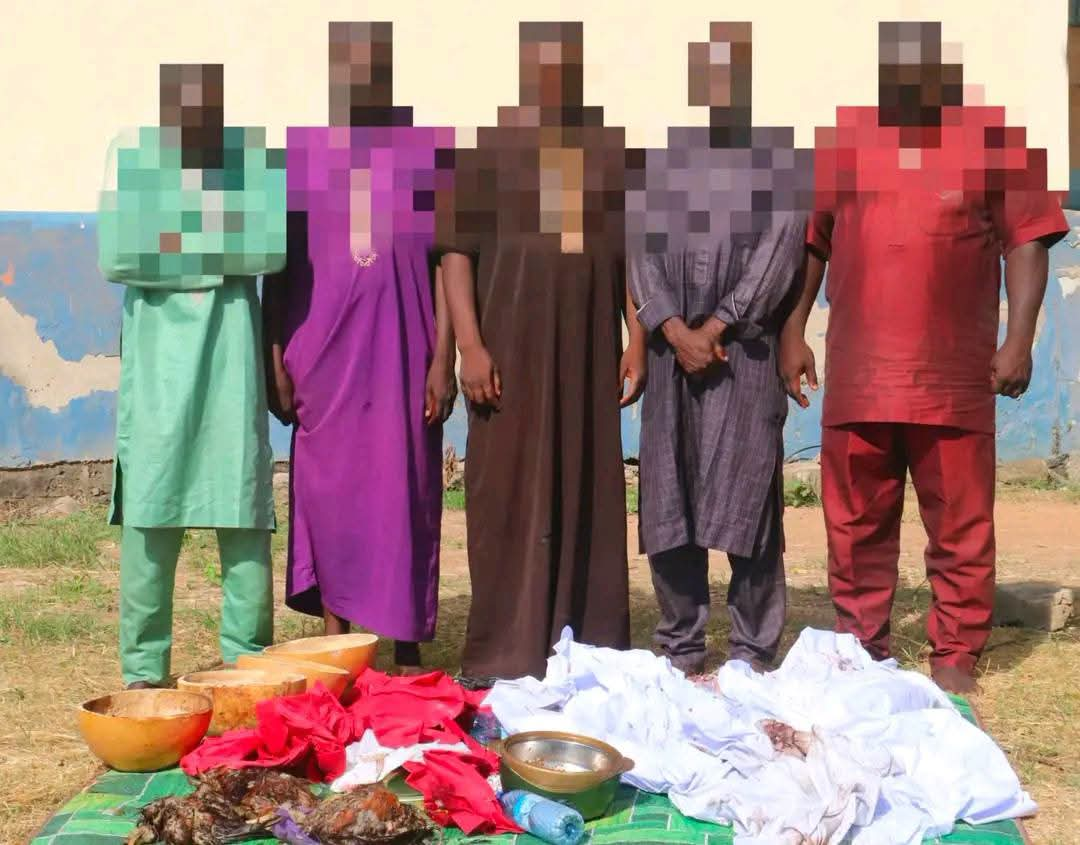
Niger Police Arrest Five Over Alleged Plot to Sacrifice Biological Children for Wealth
The Niger State Police Command has arrested five suspects, including four fathers accused of offering their biological children for money rituals in exchange for wealth.
The suspects were reportedly apprehended while allegedly preparing to perform a money ritual at an isolated compound in the Garima area of Bosso, Minna, following an intelligence report received by police operatives.
The Police Public Relations Officer, SP Wasiu Abiodun, disclosed this in a statement issued in Minna, saying the operation was carried out on October 27, 2026, at about 8:30pm.
According to him, operatives of the Anti-Kidnapping Unit, while on routine patrol around Bosso, received information about suspected ritual activities taking place at an isolated compound in Garima.
The officers reportedly stormed the location and arrested five men, identified as Mohammed Idris Dogara, 57, from Nasarawa State but residing in Bosso; Aliyu Sule, 25; Abubakar Abdullahi, 40, both of New Garima; Ibrahim Mohammed Hamisu, 43; and Shehu Abubakar, 40, a native doctor from Maikunkele.
Items recovered from the scene included blood-stained red and white clothing, four calabashes, two live chickens, three slaughtered chickens, a blood-stained knife and a large mat on which the suspected ritual materials were arranged.
The police said preliminary investigations revealed that four of the suspects — Ibrahim, Abubakar, Aliyu and Mohammed — had approached the native doctor to perform money rituals for them using a human skeleton allegedly discovered during mining activities.
However, the native doctor reportedly declined their request, insisting that he did not offer such services.
The four men allegedly persisted and offered their biological children as sacrifices in exchange for different sums of money.
Following their insistence, the native doctor reportedly instructed each of them to procure a chicken and meet at a designated location for the ritual.
The police said the suspects were arrested while allegedly carrying out the activities. Aliyu Sule was reportedly found holding a blood-stained knife and preparing to slaughter his chicken, while three other suspects had already slaughtered theirs.
The command added that the suspects had confessed to the allegations and were undergoing further investigation before being charged to court.
Meanwhile, the police statement did not disclose the identities or ages of the children allegedly offered for the ritual, or whether they had been located and placed under protective care.
It also remained unclear whether any of the children had been exposed to immediate danger or whether the alleged ritual had progressed beyond the slaughtering of the chickens.
The circumstances surrounding the alleged discovery of the human skeleton and its intended use in the ritual were also not fully explained by the police.
metro
NNPCL Slashes Petrol Price By Up To ₦80, Sells At ₦1,325 Per Litre In Abuja

NNPCL Slashes Petrol Price By Up To ₦80, Sells At ₦1,325 Per Litre In Abuja
ABUJA — Motorists in Abuja have received some relief following a downward adjustment in petrol pump prices by the Nigerian National Petroleum Company Limited (NNPCL), with its retail outlets now dispensing the product at ₦1,325 per litre in parts of the Federal Capital Territory.
The reduction, which followed a recent adjustment in the petrol pricing structure by the Dangote Petroleum Refinery, represents a decrease of between ₦45 and ₦80 per litre compared with the previous prices charged by NNPCL retail outlets.
According to a report by DAILY POST published on Wednesday, November 4, 2026, a market survey showed that NNPCL filling stations in Abuja and neighbouring areas had adjusted their pump prices from between ₦1,370 and ₦1,405 to ₦1,325 per litre.
The new price was reportedly implemented at the company’s retail outlets in Gwarimpa and along the Kubwa Expressway.
A fuel attendant at one of the affected NNPCL filling stations confirmed the development, explaining that the downward adjustment took effect on Wednesday afternoon.
The latest reduction comes amid renewed movements in Nigeria’s downstream petroleum market, where changes in the prices of petrol supplied by domestic refineries and depot operators continue to influence retail pump prices.
Barely two days before the adjustment, Dangote Petroleum Refinery reportedly reduced its petrol gantry price to ₦1,215 per litre, prompting expectations that filling stations would review their retail prices downward.
The development had raised hopes among motorists that the reduction in the refinery’s wholesale price would translate into cheaper petrol at filling stations across the country.
However, the impact has not been uniform across locations, as petrol prices continue to fluctuate among different marketers.
In Lagos, for instance, separate market checks reported by Vanguard showed that NNPCL and MRS filling stations were selling petrol at approximately ₦1,360 per litre, while some independent marketers charged between ₦1,365 and ₦1,370.
The differing prices highlight the competitive and changing nature of Nigeria’s deregulated downstream petroleum market.
Although the latest adjustment offers some relief to motorists patronising the affected NNPCL outlets in Abuja, it remains unclear whether the company will extend the new price to all its filling stations nationwide.
For now, motorists in Abuja can take advantage of the reduced price at the affected outlets, while consumers elsewhere will have to monitor developments in their respective locations as petroleum marketers continue to adjust their pump prices.
NNPCL Slashes Petrol Price By Up To ₦80, Sells At ₦1,325 Per Litre In Abuja
-
 metro2 days ago
FG’s N50,000 Relief: OPay Details Eligibility Check Process, Issues Strong Warning Against Scams
-

 metro2 days ago
Bandits Demand Over ₦100m Ransom for 15 Abducted Islamiya Students in Niger
-

 metro3 days ago
Tears In Ebonyi Community As Newlyweds, Groom’s Mother, Seven Others Perish In Crash
-

 International3 days ago
Australia Under Pressure To Scrap $368bn US-UK Nuclear Submarine Deal As Inquiry Warns Of China War
-

 Politics3 days ago
DSS Denies Plot to Disrupt ADC Rally, Orders Probe into Atiku’s Allegations
-

 metro3 days ago
‘I Went to My Pastor for Deliverance, Ended Up in Bed With Him’ – Lady Recounts Encounter
-

 International2 days ago
Musk Breaks Silence After $458M Gamble Backfires in Historic Democratic Sweep
-

 News2 days ago
Omoda and Jaecoo Race Past 1.4m Sales, Expand Push into AI, Electrification