

metro
Xenophobia: Nigeria Demands Justice Over Killing of Citizens in South Africa
Xenophobia: Nigeria Demands Justice Over Killing of Citizens in South Africa
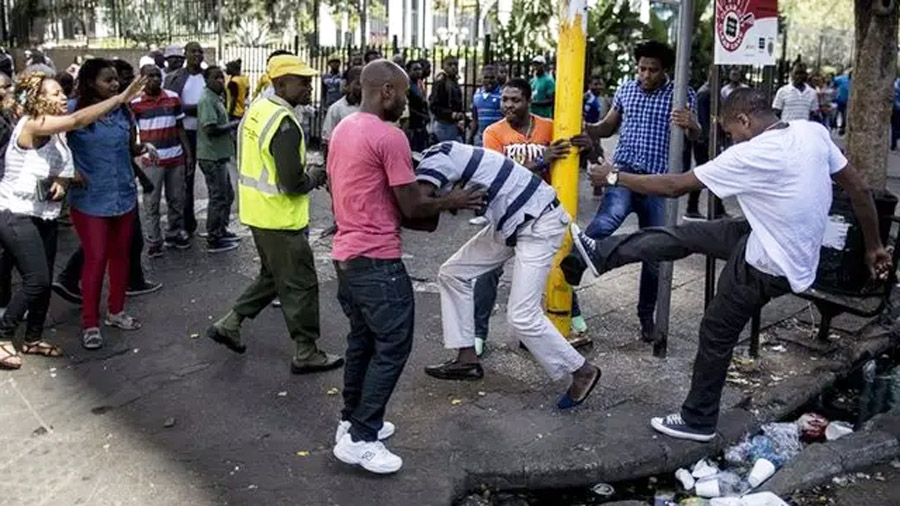
The Federal Government has stepped up diplomatic pressure on South Africa, demanding a thorough and impartial investigation into the deaths of two Nigerians, as concerns grow over renewed xenophobic tensions targeting foreign nationals.
The position was made known by the spokesperson of the Ministry of Foreign Affairs, Mr. Kimiebi Imomotimi Ebienfa, following a high-level meeting in Abuja between Nigerian officials and South Africa’s diplomatic representatives.
The meeting involved the Permanent Secretary of the Ministry, Ambassador Dunoma Umar Ahmed, and the Acting High Commissioner of South Africa to Nigeria, Lesoli Machele, among other diplomats, and was held on the directive of the Minister of Foreign Affairs, Ambassador Bianca Odumegwu Ojukwu.
Nigeria expressed deep concern over ongoing protests in parts of South Africa where groups have reportedly called for foreigners—particularly black Africans—to leave the country, warning that the situation has heightened fear among Nigerians living there.
The government confirmed the deaths of two Nigerians—Nnaemeka Matthew Andrew Ekpeyong and Kelvin Chidiebere Amaramiro—who allegedly died after sustaining injuries while in the custody of South African security agencies. According to officials, Ekpeyong died on April 21, 2026, while in the custody of the Tshwane Metro Police Department, after reportedly suffering injuries linked to personnel of the South African National Defence Force (SANDF). Amaramiro, on the other hand, died on April 25, 2026, at Livingstone Hospital in the Eastern Cape following an alleged assault by SANDF personnel.
READ ALSO:
- LG Autonomy: S’Court Judgment Still Ignored Nearly Two Years After Ruling — NULGE
- NCC Orders Airtel, MTN to Compensate Subscribers for Poor Network Service
- Coup Plot Trial: Video Shows Defendants Admit Plan Against Tinubu
The Federal Government described the incidents as disturbing and said they have triggered anxiety within the Nigerian community, calling for urgent and credible remedial action.
Nigeria has formally demanded a transparent investigation into the deaths, including access to autopsy reports, post-mortem documentation, and relevant case files. It also stressed the need for accountability, insisting that any personnel found culpable must face appropriate disciplinary and legal consequences.
Beyond the specific incidents, Nigeria raised alarm over broader threats against foreign nationals, urging South African authorities to take proactive steps to prevent incitement, intimidation, and violence.
As part of diplomatic measures, Nigeria is fast-tracking the implementation of a bilateral Early Warning Mechanism designed to improve rapid response to xenophobic threats. The government confirmed that it recently received a signed copy of the Memorandum of Understanding (MoU) from South Africa and is pushing for its immediate activation.
Officials say the mechanism will serve as a practical channel for intelligence sharing, early alerts, and de-escalation whenever threats to Nigerians arise.
The government also called on South Africa to ensure the safety and dignity of Nigerians residing lawfully in the country, emphasizing the need to rebuild confidence among the diaspora community.
Meanwhile, Nigeria acknowledged recent protests by its citizens at the South African High Commission in Abuja but urged restraint, while assuring that diplomatic engagement remains ongoing.
During discussions, concerns were raised over the lack of arrests and what many perceive as repeated assurances without concrete action. In response, the Nigerian government stressed that it expects more than verbal commitments.
“We are not satisfied with just statements. We need actions,” the ministry’s spokesperson said, underscoring Nigeria’s demand for tangible outcomes.
On the issue of Nigerians seeking to return home, the government noted that there are different categories of returnees, including those who feel unsafe and those facing documentation challenges. While voluntary return remains self-funded for now, officials indicated that government intervention could be considered if the situation deteriorates further.
Analysts say the latest development underscores recurring tensions in Nigeria–South Africa relations, particularly around xenophobic violence, and highlights the need for sustained diplomatic engagement and stronger enforcement mechanisms to protect foreign nationals.
Xenophobia: Nigeria Demands Justice Over Killing of Citizens in South Africa










metro
FG’s N50,000 Relief: OPay Details Eligibility Check Process, Issues Strong Warning Against Scams

FG’s N50,000 Relief: OPay Details Eligibility Check Process, Issues Strong Warning Against Scams
Lagos, Nigeria — Following the Federal Government’s introduction of the N50,000 relief package, leading financial technology platform, OPay, has released comprehensive guidelines on how customers can verify their eligibility for the funds. The company has simultaneously issued a stern warning to users regarding the rise of fraudulent schemes targeting beneficiaries.
In a statement released on Tuesday, November 3, 2026, and reported by Punch, OPay clarified the procedural steps for Nigerians to determine if they qualify for the government’s financial intervention. The move comes as millions of citizens seek clarity on accessing the relief aimed at cushioning economic hardship.
How to Check Eligibility
According to OPay, the verification process is designed to be seamless and accessible directly through the OPay mobile application. Customers are advised to log into their updated OPay app to access the dedicated section for the Federal Government’s relief program.
The fintech giant explained that users will be required to provide specific details to verify their status. Once logged in, customers can navigate to the designated “Government Relief” or notification tab where the eligibility checker is situated. The system cross-references the user’s verified identity (such as their Bank Verification Number, BVN, and National Identification Number, NIN) with government databases to confirm qualification.
Strict Warning Against Fraudsters
In a critical advisory, OPay warned customers to remain vigilant against scammers who are leveraging the news of the N50,000 relief to defraud unsuspecting citizens. The company emphasized that it will never ask customers to pay a fee or provide sensitive information over the phone to claim the relief.
“OPay urges all Nigerians to be cautious. The N50,000 relief is a government initiative, and no fee is required to check eligibility or receive funds,” a representative stated. “We will never ask for your OPay PIN, passwords, or OTPs via phone calls, text messages, or social media. Beware of fake links claiming to be from OPay or the government.”
Security Tips for Users
To ensure safety, OPay advised users to follow these guidelines:
· Use Only the App: Only check your eligibility through the official OPay mobile application.
· Protect Your Data: Never share your ATM card details, OPay PIN, or One-Time Passwords (OTPs) with anyone.
· Ignore Suspicious Links: Do not click on links received via SMS or WhatsApp claiming to offer the N50,000 relief.
· Verify Information: Always confirm information through OPay’s official customer service channels or verified social media pages.
The company reaffirmed its commitment to the financial security of its customers and stated that it is working closely with relevant government agencies to ensure a smooth and transparent disbursement process for eligible beneficiaries.
For those who may face difficulties checking their eligibility, OPay has encouraged customers to contact their customer care team through the in-app support feature.
FG’s N50,000 Relief: OPay Details Eligibility Check Process, Issues Strong Warning Against Scams
About Newstrends.ng:
Newstrends.ng is your premier source for breaking news, business, and technology updates in Nigeria and across the globe.
metro
‘I Went to My Pastor for Deliverance, Ended Up in Bed With Him’ – Lady Recounts Encounter

‘I Went to My Pastor for Deliverance, Ended Up in Bed With Him’ – Lady Recounts Encounter
A Nigerian woman has sparked controversy on social media after recounting an alleged sexual encounter with her former pastor during a deliverance session.
The unidentified woman reportedly made the revelation during a video interview shared by social media platform NewsVista, claiming that what began as a visit to seek spiritual intervention eventually ended in a sexual encounter.
In the viral clip, the woman expressed confusion over how the incident happened, insisting that she still struggles to understand how a session she had expected to be devoted to prayer and deliverance turned into an intimate encounter.
The interview has since attracted attention online, with the allegation raising concerns about the relationship between religious leaders and members who approach them for spiritual guidance and counselling.
Although details surrounding the alleged incident remain unclear, the woman’s account has triggered discussions about the responsibility of religious leaders to maintain professional and ethical boundaries while attending to vulnerable members of their congregations.
Some social media users have criticised the alleged conduct, arguing that pastors and other religious leaders occupy positions of trust and should not exploit their spiritual authority or the vulnerability of people seeking assistance.
Others have called for religious organisations to strengthen accountability measures and introduce safeguards for private counselling and deliverance sessions.
However, the identity of the pastor, the church involved and the location where the alleged incident occurred have not been disclosed.
It is also unclear when the alleged encounter took place or whether the woman has made any formal complaint to the relevant authorities.
NewsTrends.ng cannot independently verify the circumstances surrounding the woman’s account. The allegation should therefore be treated as unverified pending further details or an official response from the person concerned.
The development has once again drawn attention to the need for accountability, transparency and appropriate boundaries in religious counselling, particularly where individuals place their trust in spiritual leaders for help with personal challenges.
‘I Went to My Pastor for Deliverance, Ended Up in Bed With Him’ – Lady Recounts Encounter
metro
Port Harcourt Married Women Use Husbands’ Cars To Visit Lovers, Lady Alleges

Port Harcourt Married Women Use Husbands’ Cars To Visit Lovers, Lady Alleges
A Nigerian lady has stirred controversy on social media after making a sweeping allegation about the alleged infidelity of some married women in Port Harcourt, Rivers State.
The unidentified woman reportedly made the controversial claim in a viral video, alleging that some married women in the oil-rich city use vehicles provided by their husbands to visit their secret lovers.
According to a report by Gistlover dated November 3, 2026, the lady claimed that the alleged practice was particularly common in Port Harcourt, a remark that has since triggered widespread reactions across social media platforms.
In the video, she reportedly expressed surprise at what she portrayed as a disturbing pattern of marital betrayal, suggesting that some women allegedly use the comfort and resources provided by their husbands to maintain extramarital relationships.
Her remarks have generated mixed reactions among social media users, with some finding the allegation amusing, while others criticised the generalisation, arguing that infidelity is not peculiar to any city or gender.
Others questioned the basis of her claim, insisting that allegations involving marital relationships should not be used to stereotype women or residents of an entire city.
The controversy has once again sparked conversations about marital trust, fidelity, loyalty and the growing debate surrounding infidelity in modern relationships.
However, the woman’s allegation has not been independently verified, and there is no evidence establishing that the alleged conduct is widespread among married women in Port Harcourt.
Port Harcourt Married Women Use Husbands’ Cars To Visit Lovers, Lady Alleges
-

 metro3 days ago
Lami Dawa: CAN Takes 14-Year Jail Sentence to Appeal Court, Borno Govt Reacts
-

 metro2 days ago
Three Dead, Five Rescued as Two-Storey Building Collapses in Osun
-

 metro3 days ago
Adeboye Fires Back at Journalists Over Viral Jonathan Protest Photo, Says It Was Prayer Walk
-
 Politics1 day ago
APC Dumps Adeleke’s Campaign Structure, Unveils Separate 168-Member Council in Osun
-

 International2 days ago
Badenoch Rejects Slave Trade Apology, Says African Kingdoms Also Profited From Slavery
-

 metro3 days ago
Edo Youths Chase Policemen, Vigilantes From Checkpoint Over Alleged Extortion
-

 metro1 day ago
Three Homeless Men Shot Dead in Midnight Attack at Lagos Bus Stop
-

 Auto3 days ago
Nigeria’s Auto Dealers Face New Challenge as After-Sales Service Takes Centre Stage