

News
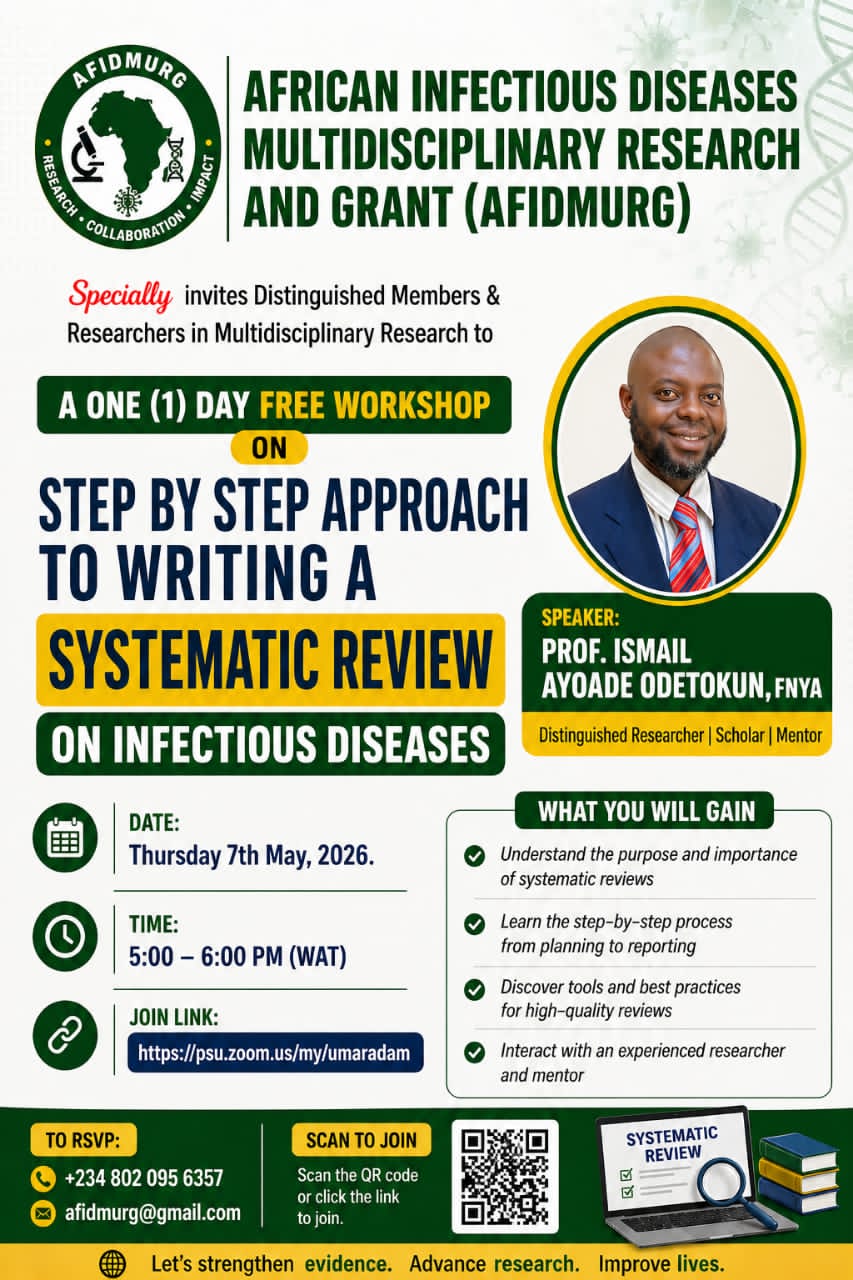
AFIDMURG Trains Over 150 African Researchers On Infectious Disease Systematic Review
AFIDMURG Trains Over 150 African Researchers On Infectious Disease Systematic Review
The African Infectious Disease Multidisciplinary Research and Grant (AFIDMURG) has successfully trained more than 150 infectious disease experts, researchers, academicians, laboratorians, policymakers and postgraduate students from Africa and other continents during a virtual workshop on systematic review reporting and infectious disease research.
The workshop, held on May 7, 2026, focused on strengthening Africa’s research capacity, improving evidence-based scientific reporting and enhancing preparedness against emerging and endemic infectious diseases across the continent.
Participants at the training came from Africa, Asia, Europe and the Americas, reflecting the growing international interest in collaborative infectious disease research involving Africa.
AFIDMURG, established in 2020, was founded with the vision of connecting African infectious disease experts and multidisciplinary researchers to solve communal health challenges linked to endemic and emerging diseases affecting the continent.
Speaking during the workshop themed “Step-by-Step Approach to a Systematic Review,” the Founder and Director of AFIDMURG, Dr. Abdul-Azeez Adeyemi Anjorin, stressed the urgent need to strengthen Africa’s contribution to global infectious disease data and scientific research.
Dr. Anjorin, the immediate past Head of the Department of Microbiology at Lagos State University, noted that infectious diseases remain among the leading causes of death globally, citing illnesses such as malaria, HIV/AIDS, tuberculosis, influenza, Lassa fever, Mpox and Ebola.
According to him, Africa must improve the quality and speed of infectious disease reporting and publication through globally recognised scientific tools such as systematic reviews.
READ ALSO:
- Over 90 Students Discharged After Ogun Methane Leak Incident In Ijebu-Ode
- ‘No Election While We Are Dying’ — Benue South Youths Block Roads
- Governors Tighten Grip As APC Reps Lose Return Bids (Full List)
“The battle against infectious diseases requires experts to be well equipped, hence the need for capacity building with correct instruments like systematic review to integrate African data into the world database,” he said.
Dr. Anjorin, who also serves on several international scientific and virology networks, explained that AFIDMURG intends to train researchers in areas such as disease surveillance, grant writing, pandemic prevention, artificial intelligence applications and practical research skills.
He added that the organisation aims to foster collaboration among African scientists globally while strengthening local and international partnerships in infectious disease research.
Delivering the keynote address, Dr. Muhabat Raji of Alfaisal University, Riyadh, highlighted the growing importance of systematic reviews in evidence-based research, public health policy and clinical decision-making.
She explained that systematic reviews offer a structured and transparent approach to synthesising scientific literature, thereby improving the reliability and credibility of research findings.
Dr. Raji urged researchers to adhere to ethical standards and globally accepted reporting guidelines while conducting systematic reviews to ensure impactful and internationally relevant studies.
She also encouraged young researchers and academics to embrace interdisciplinary collaboration and continuously develop their skills in research methodologies and digital research tools.
According to her, systematic reviews not only identify knowledge gaps but also contribute significantly to policy formulation, academic development and improved healthcare practices.
The guest speaker, Prof. Ismail Ayoade Odetokun of the University of Ilorin, delivered detailed practical sessions explaining the concept and processes involved in conducting systematic reviews.
He guided participants through major stages including topic selection, research question formulation, literature search strategies, data extraction and analysis of findings.
Prof. Odetokun also discussed common challenges associated with systematic reviews and advised researchers to maintain methodological rigor, objectivity and accuracy during scientific investigations.
The virtual workshop was moderated by Emmanuel Oyinloye of Hanover Medical School, Germany, who coordinated discussions and facilitated interaction between speakers and participants throughout the event.
In his closing remarks, Oyinloye summarised key lessons from the workshop and encouraged participants to apply the knowledge gained in future academic and scientific research projects.
AFIDMURG disclosed that its overarching mission is to foster infectious disease multidisciplinary collaborations among Africans globally, collect and analyse disease outbreak data, secure research grants and publish timely scientific findings on infectious diseases affecting Africa.
The organisation also highlighted some of its previous Pan-African studies on COVID-19, vaccine surveillance and Mpox outbreaks published in international journals including PLOS One, Tropical Medicine and International Health, Vaccines, PAMJ and COVID.
AFIDMURG further announced that it remains open to infectious disease experts and researchers interested in collaborative research, grant development and public health initiatives across Africa and beyond.
AFIDMURG Trains Over 150 African Researchers On Infectious Disease Systematic Review

News
Independence Day: No Going Back on Fuel Subsidy Removal – FG
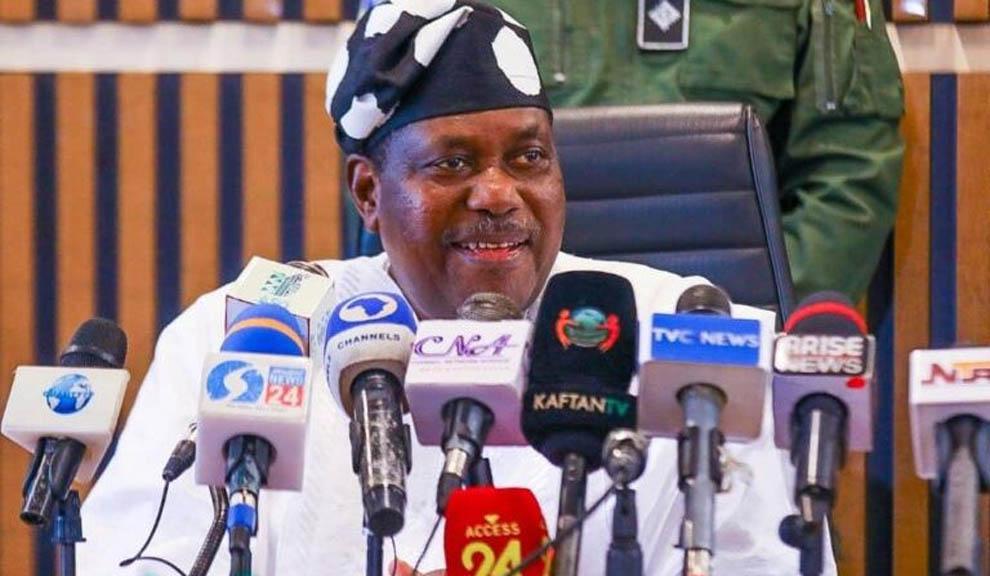
The Federal Government has ruled out any return to the fuel subsidy regime, saying the removal of the policy remains a key part of its economic reforms.
Secretary to the Government of the Federation, George Akume, stated this at the 66th Independence Day lecture in Abuja, where he defended the economic measures introduced by the administration of President Bola Ahmed Tinubu.
Akume said the government had taken difficult decisions, including the removal of petrol subsidy, foreign exchange reforms and changes to the fiscal system, to address longstanding weaknesses in the Nigerian economy.
He said the government would not return to what he described as the “ruinous petroleum subsidy regime of the past”.
The SGF argued that the reforms were beginning to produce measurable results, citing economic growth recorded in 2026.
He said Nigeria’s economy grew by 4.2 per cent in the first half of 2026, compared with 3.9 per cent during the corresponding period of the previous year, while other indicators were also showing improvement.
Akume, however, acknowledged that economic growth must translate into better living conditions, higher incomes and more employment opportunities for Nigerians.
The government has increasingly promoted Compressed Natural Gas (CNG) as an alternative to petrol following the removal of subsidy.
Akume said more than 120,000 vehicles had been converted to CNG, with more than 400 conversion centres and about 90 CNG fuelling stations established across the country.
He said the expansion of CNG was helping to reduce transportation costs and provide Nigerians with cheaper alternatives to petrol-powered transport.
READ ALSO:
- Israeli Actor, Flight Instructor Among Two Killed In California Plane Crash
- Flood Cuts Off Part of Agbarho-Ughelli Road, Strands Commuters in Delta
- Dangote Draws Battle Lines as Fuel Import Fight Heads Back to Court
The government also highlighted investments in infrastructure, agriculture, electricity, healthcare and education as part of its strategy to cushion the effects of economic reforms and strengthen long-term growth.
Akume cited projects including the Lagos-Calabar Coastal Highway, Abuja-Kano Highway and East-West Road, alongside railway and port development.
On agriculture, he disclosed that the World Bank had approved a $500 million credit facility for the Nigeria Sustainable Agricultural Value-Chains for Growth project.
The initiative is expected to support smallholder farmers, strengthen agricultural value chains and improve food and nutrition security.
Minister of Information and National Orientation, Mohammed Idris, also defended the government’s economic direction at the lecture, saying the economy recorded 4.43 per cent growth in the second quarter of 2026.
Idris acknowledged the difficulties caused by the reforms but said the government was working to address structural problems that had affected the economy for years.
The debate over petrol subsidy removal has remained a major political and economic issue ahead of the 2027 general election.
Opposition politicians have proposed different approaches to the subsidy policy. Former Vice President and African Democratic Congress (ADC) presidential candidate Atiku Abubakar has advocated a form of subsidy intervention, while Nigeria Democratic Congress (NDC) presidential candidate Peter Obi has also spoken about restoring subsidy under certain conditions.
The Tinubu administration, however, has maintained that the subsidy regime will not be restored.
President Tinubu, in his October 1 Independence Day address, defended the reforms and said the government’s priority was to reduce the cost of living by lowering production and transportation costs and expanding investment in agriculture, infrastructure and other productive sectors.
The Federal Government’s latest position therefore reinforces its commitment to keeping the petrol subsidy removal in place while pursuing alternatives such as CNG, domestic refining, increased energy production and broader economic reforms.
Independence Day: No Going Back on Fuel Subsidy Removal – FG
News
Court remands alleged ‘fake PFIPC DG’ Adeyemi in Kuje over forgery
Court remands alleged ‘fake PFIPC DG’ Adeyemi in Kuje over forgery
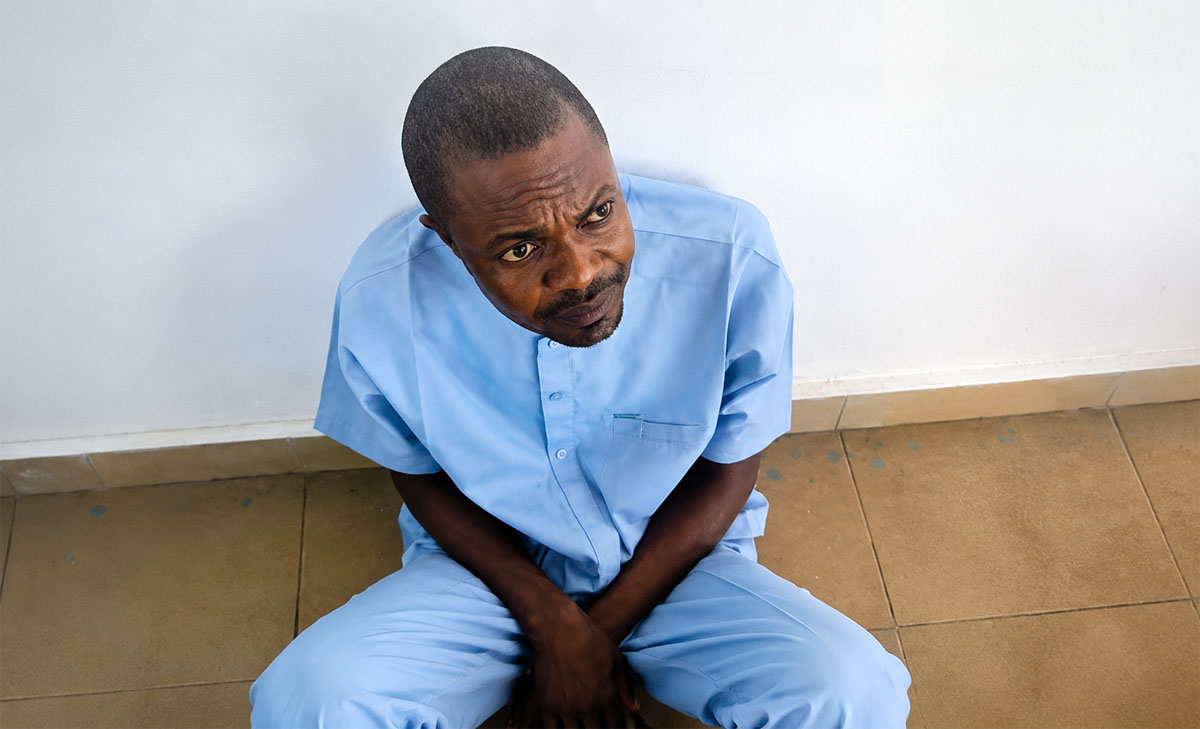
A Federal High Court sitting in Abuja has ordered the remand of Adeniyi Adeyemi Matthew, who allegedly presented himself as the Director-General of the Presidential Foreign Intervention Promotion Council, PFIPC, at the Kuje Correctional Centre over alleged forgery.
Justice Muhammed Umar reportedly made the order on Wednesday after Adeyemi was arraigned on an eight-count charge bordering on alleged forgery.
Adeyemi pleaded not guilty to the charges.
The court also fixed October 12, 2026, for the hearing of his bail application and directed that the case be given accelerated hearing.
One of the allegations against Adeyemi relates to the alleged forgery of presidential letterhead paper on March 8, 2024.
He was also accused of allegedly forging a request for collaboration with the Ministry of the Area Councils, as well as documents requesting land allocation and office accommodation across the 36 states of the federation.
The documents were allegedly presented as having emanated from the State House in Abuja.
The case is connected to the controversy surrounding the purported Presidential Foreign Intervention Promotion Council, an organisation the Federal Government has said was never established as a government agency.
The Presidency had earlier disowned the organisation and warned members of the public and foreign missions against dealing with Adeyemi on the basis of his alleged claim to have been appointed by the Presidency.
The government subsequently said investigations had established that the purported agency was fictitious and alleged that Adeyemi used forged appointment letters and other government documents to present himself as a presidential appointee.
The authorities further alleged that documents associated with the purported organisation were used to seek official recognition and diplomatic assistance.
The controversy also attracted the attention of the House of Representatives, which investigated the activities of the organisation and the circumstances surrounding Adeyemi’s alleged appointment.
During the investigation, lawmakers were told that the appointment letter allegedly presented by Adeyemi had been confirmed to be fake by relevant government authorities.
The case has also raised questions over how the purported organisation was able to operate and obtain correspondence with some government institutions before the Presidency publicly disowned it.
Adeyemi, however, has denied the allegations against him and previously made counter-allegations concerning the circumstances surrounding his purported appointment. He has also questioned references to the PFIPC in government documents.
Those claims remain part of the wider controversy and have yet to be determined by the court.
With the latest order, Adeyemi will remain at the Kuje Correctional Centre pending further proceedings.
His bail application is expected to come up on October 12, 2026.
The allegations against him remain unproven until determined by the court.
Court remands alleged ‘fake PFIPC DG’ Adeyemi in Kuje over forgery
News
FG Opens Nationwide Youth Registration, Targets Nigerians Aged 15–35

FG Opens Nationwide Youth Registration, Targets Nigerians Aged 15–35
The Federal Government has commenced nationwide registration of Nigerians aged 15 to 35 under the National Youth Data Bank (NYDB), a new initiative designed to build a reliable database of young people and support access to jobs, skills training, internships, entrepreneurship and other opportunities.
Minister of Youth Development, Ayodele Olawande, announced the commencement of the exercise as the government launched the National Youth Data Bank, saying accurate youth data would help improve the planning, targeting and delivery of government programmes.
The NYDB is designed to capture information on young Nigerians, including their education, skills, employment, entrepreneurship and other demographic characteristics. The official platform says the database is intended to provide a centralised and continuously updated picture of Nigeria’s youth population.
The government said the initiative is not an electoral registration exercise but a youth development programme aimed at improving how government identifies young people and connects them with relevant opportunities.
The registration covers young Nigerians in different sectors and settings, including those in schools, the informal sector, agriculture, sports, creative industries and technology.
READ ALSO:
- Dangote Draws Battle Lines as Fuel Import Fight Heads Back to Court
- Tinubu Returns After 30 Days in Europe, Says ‘I’m Healthy and Ready to Work’
- NMDPRA Moves Against Fuel Pump Fraud, Threatens Licence Revocation
A key part of the exercise is the establishment of approved NYDB registration centres or cluster points. According to the official NYDB platform, young Nigerians can register at approved locations within their state, Local Government Area (LGA), school or other specially designated locations.
This means that not every school, LGA office or public facility is automatically a registration centre. Applicants are expected to use approved NYDB cluster points, where trained registration personnel will guide them through the process.
The exercise is being extended across Nigeria’s 36 states and the Federal Capital Territory, with the programme designed to reach young people in rural and underserved communities as well as those in urban areas.
The registration process begins with a visit to an approved NYDB cluster point, followed by an eligibility check and the creation of a youth profile. Participants are then required to confirm the information provided before completing the registration.
The 15 to 35 age bracket is the target population for the data-bank exercise. The database is expected to be updated continuously to maintain current information on eligible young Nigerians.
The Federal Ministry of Youth Development says the information gathered will help government understand where young people are located, what qualifications and skills they have, whether they are employed or seeking opportunities, and what forms of support may be required.
The NYDB platform identifies education, skills, employment, entrepreneurship, civic participation and health among the key areas of information being developed to strengthen youth-focused planning and interventions.
The initiative is also expected to improve the ability of government and authorised partners to identify young people who may be missing from existing datasets, particularly those in rural communities and underserved groups.
The Federal Ministry of Youth Development has separately announced plans for a National Youth Confab 2026, scheduled to begin in October, with participation expected from young Nigerians across the country’s 360 federal constituencies.
For Nigerians within the 15–35 age bracket, the government is therefore encouraging participation through the approved NYDB registration centres as the nationwide exercise expands.
FG Opens Nationwide Youth Registration, Targets Nigerians Aged 15–35
-

 metro2 days ago
Osogbo Food Bonanza Turns Nightmare as Discount Vendor Vanishes With Customers’ Millions
-

 metro3 days ago
24 Hours in Darkness: Iju Ishaga Residents, Businesses Count Losses as Ikeja Electric Fails to Restore Power
-
 Education2 days ago
FG Releases 2026–2028 Approved Textbooks, Introduces QR Codes for Tracking
-

 News3 days ago
Agbede Mourns Baba Alado, Says Mushin Has Lost Pillar of Peace
-

 Sports2 days ago
Nigeria XI vs Guinea-Bissau: Awoniyi, Lookman, Adams Lead Super Eagles Attack
-

 News2 days ago
Breaking: Tinubu Ends Extended European Vacation, Departs Paris for Nigeria
-

 Politics3 days ago
Why I Can No Longer Defend Peter Obi’s Lifestyle – Okonkwo
-

 metro2 days ago
Hamzat Clarifies Lagos Traffic ‘Lifestyle’ Remark After Backlash