

Politics
2027: Atiku Vows to Reopen Borders, Develop Southern Ports if Elected
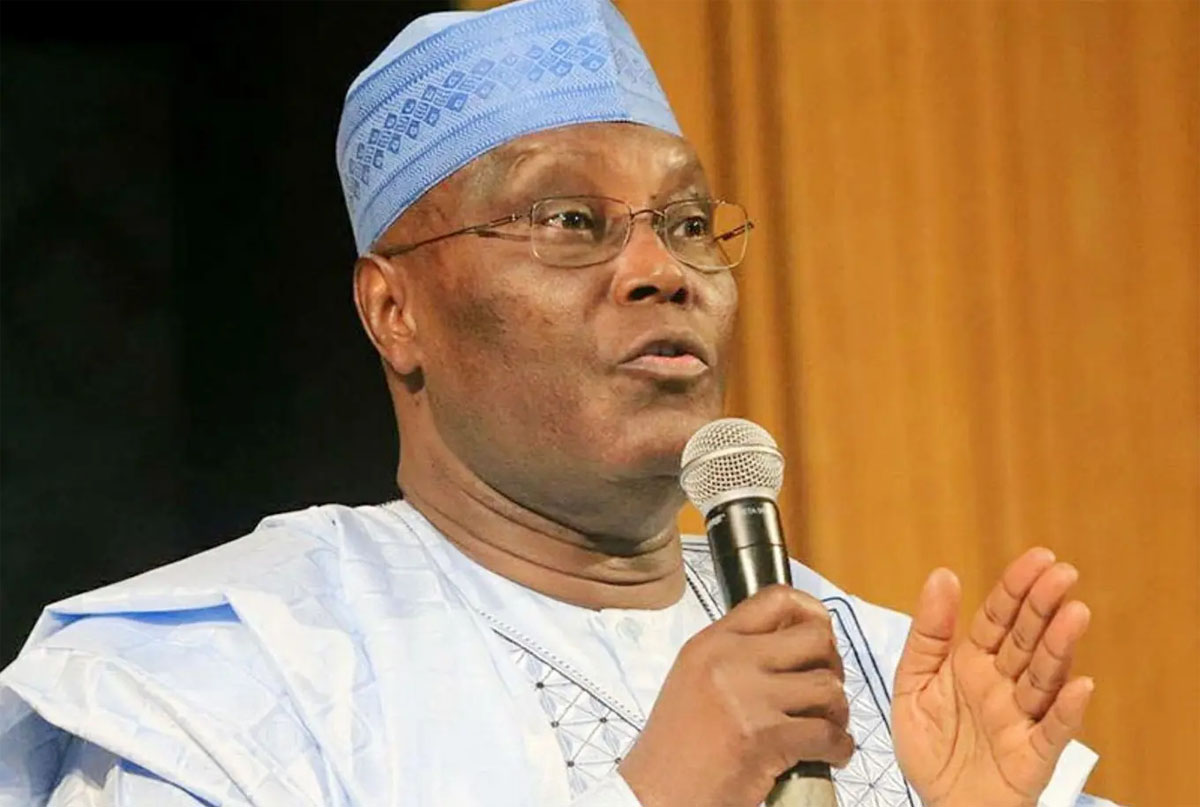
2027: Atiku Vows to Reopen Borders, Develop Southern Ports if Elected
The ADC presidential candidate says border closures have crippled transborder trade, pushed young Nigerians into bankruptcy, and worsened insecurity.
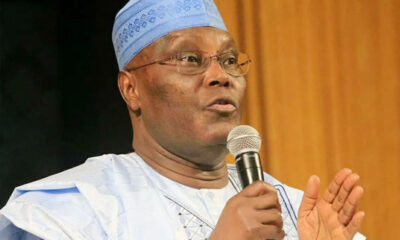
Former Vice President and presidential candidate of the African Democratic Congress (ADC), Atiku Abubakar, has pledged to reopen Nigeria’s land borders and develop port infrastructure in the southern part of the country if elected in the 2027 general election. He made the promise while addressing supporters in a video shared online on Friday by ADC chieftain Dele Momodu.
Atiku argued that the closure of Nigeria’s borders with neighbouring countries, initially implemented in August 2019 under former President Muhammadu Buhari, has dealt a devastating blow to transborder trade and contributed to widespread unemployment, particularly among young Nigerians. He noted that several northern states share borders with Cameroon, Chad, Niger Republic, and Benin Republic, making cross-border commerce a vital part of the region’s economic activities. “The Northern states is bordering Cameroon, Chad, Niger, Benin Republic. And you close all those borders. All our young men who are doing trading between these countries, they carry goods across, they do this and that, all what we call transborder trade is a legitimate business,” Atiku said.
He painted a stark picture of the economic consequences, claiming that many young entrepreneurs who had built businesses with capital running into millions of naira, and who employed others, had been forced into bankruptcy following the border restrictions. According to him, this loss of livelihoods has directly contributed to the country’s security challenges. “All the upcoming young men and women who used to have a capital of 10 million, 20 million, and they were employing two, three other people, and then all of them went bankrupt and unemployed. How can there be security?” he asked. He then declared, “So I said I am going to reopen the borders and I will.”
READ ALSO:
- Bauchi Police Arrest Stepfather for Alleged Defilement of 8-Month-Old Baby
- Niger Police Arrest Six in Kidnap Syndicate Using Fake Lifts to Abduct Victims
- Troops Neutralise Over 21 Boko Haram, ISWAP Terrorists in Adamawa Precision Strike
Beyond reopening land borders, Atiku also outlined plans to improve port facilities in the South and South-East to create a better balance in the handling and transportation of imported goods across the country. He said he had already begun exploring this by engaging shipping and port development companies in Europe during his last campaign. “During the last campaign, I went across to Europe to discuss with shippers and ship development companies how we can together develop South and South-Eastern ports so that there is balance as far as importation of goods and transportation of goods are concerned,” he stated.
The former vice president argued that developing ports in places like Calabar, Uyo, and Port Harcourt would significantly reduce the time and cost of transporting goods to the North-East. He used his own experience as an example, noting that he has a factory in Yola, Adamawa State, and currently faces significant logistical hurdles because his containers must come through Lagos. He illustrated, “So when, if I drop my container in Calabar or in Uyo or in Port Harcourt, it will just take me 24 hours to take the container to Yola. But right now, it takes me not less than two months to take my container from Lagos because you have to cross over from South-West, you go to North-East, and then there is even no road.”
Atiku’s proposal has sparked mixed reactions online, with some Nigerians supporting the plan as a practical economic strategy that could boost trade and create jobs. However, critics have raised concerns about security implications and the potential threat to local investors from increased imports, while others dismissed the promise as familiar campaign rhetoric. The border closure policy, initiated in 2019, was justified by the Federal Government as a measure to curb large-scale smuggling of rice, poultry, petroleum products, and other commodities, as well as the movement of illegal arms and drugs. It was also aimed at encouraging domestic agricultural production. Economists, however, have noted that the policy failed both efficiency tests, enriching a handful of manufacturers while leaving consumers poorer and the wider economy weaker. The Lagos Chamber of Commerce and Industry (LCCI) also attributed renewed inflationary pressure to the border closure, with food inflation hitting record highs during the period.
Although the administration of President Bola Tinubu has partially reopened some strategic corridors, such as the Kamba and Tsamiya border posts linking Kebbi to Benin and Niger Republics in February 2026, several land borders remain restricted or under tight controls. The reopening of the Kamba and Tsamiya routes was described as a stroke of economic diplomacy that restored economic life to border communities, with over 2,000 stranded trucks beginning to move freely. However, concerns remain over smuggling and the sustainability of the policy.
2027: Atiku Vows to Reopen Borders, Develop Southern Ports if Elected







Politics
Okonkwo Alleges Return of Subsidy, Accuses NNPC of Plotting Trillions in ‘Lost Profit’

Okonkwo Alleges Return of Subsidy, Accuses NNPC of Plotting Trillions in ‘Lost Profit’
Says FG’s 30-Day Fuel Discount Not Sourced from Dangote
The spokesman for the African Democratic Congress (ADC) presidential campaign, Kenneth Okonkwo, has raised an alarm over the Federal Government’s new 30-day fuel discount policy, describing it as a deceptive return to the previously abolished fuel subsidy regime.
In an interview with Channels TV on Sunday, October 11, 2026, Okonkwo criticized the policy for failing to source petroleum products from the Dangote Refinery. He argued that the Nigerian National Petroleum Company Limited (NNPC) is poised to claim trillions of naira in alleged lost profits as a result of the scheme.
Okonkwo, a political commentator, stated that because the NNPC is not producing domestic refined fuel, the discount is essentially an “import-related subsidy” that benefits foreign refineries and shipping operations rather than local ones.
“The NNPC is not taking from Dangote at all, but they’ll claim trillions in lost profit,” Okonkwo said. “Since NNPC isn’t producing domestic refined fuel, this discount is essentially an import-related subsidy benefiting foreign refineries and shipping operations instead of local ones.”
He warned that the return to a subsidy system opens the door to financial fraud, particularly through the inflation of consumption figures.
“You could report 70 million liters when only 15 million liters were used,” he cautioned, noting the risk of opaque accounting in the sector.
As an alternative, Okonkwo advocated for supplying crude oil directly to the Dangote Refinery for domestic processing to reduce import costs. He stated that domestic refining is a central pillar of the ADC’s economic proposal.
The ADC chieftain’s comments come amid ongoing debate over the Federal Government’s new fuel price mechanism. The government, through Finance Minister Taiwo Oyedele, has maintained that the 30-day discount is a “NNPC margin cut” and not a subsidy.
Under the arrangement, NNPC Retail is expected to forgo its profit margin on petrol rather than using public funds to stabilize prices. However, Okonkwo contends that this still constitutes a subsidy, as it artificially reduces consumer costs while masking the true financial burden on the state oil company.
Okonkwo Alleges Return of Subsidy, Accuses NNPC of Plotting Trillions in ‘Lost Profit’
Politics
2027 Elections: FG Warns Hotel Owners Against Illegal Activities, Suspicious Funds
The Federal Government has warned hotel owners and managers across Nigeria against allowing their facilities to be used for illegal activities, including the movement of illicit funds, as political activities intensify ahead of the 2027 general elections.
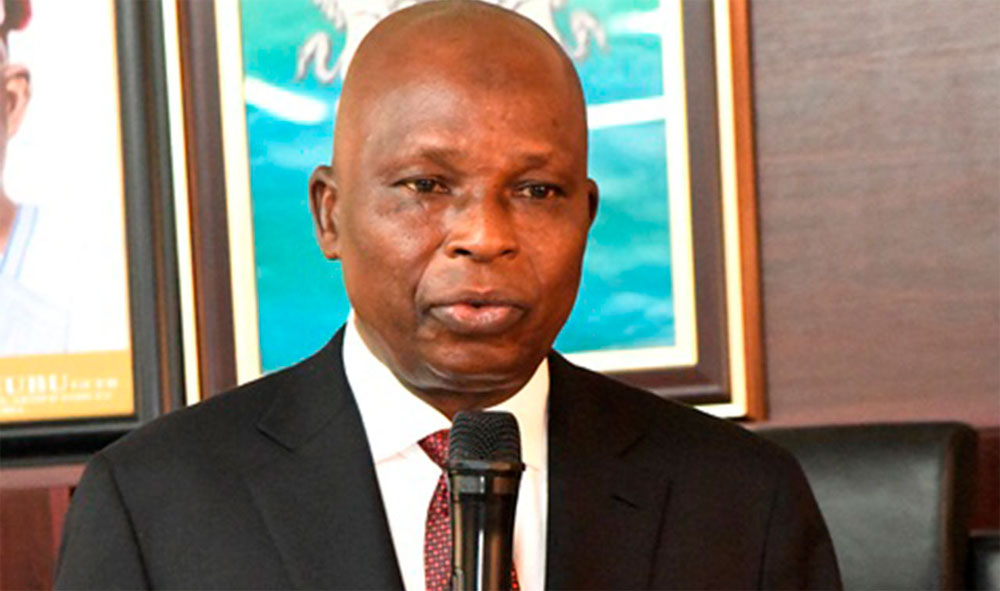
The Attorney-General of the Federation and Minister of Justice, Lateef Fagbemi, issued the warning while addressing the second edition of the JAGZ Hospitality Conference in Ibadan, Oyo State.
Fagbemi, who was represented by Fernandez Marcus-Obiene, Special Assistant to President Bola Ahmed Tinubu on Justice Sector Reform and ICT/Digital and Innovative Technology, said the hospitality industry had an important role to play in promoting security and peaceful elections.
The conference, themed “The Hotel at the Centre: Money, Elections, Security,” brought together government officials, security personnel, financial crime regulators and hospitality industry stakeholders to examine the responsibilities of hotel operators as the country approaches another election cycle.
Fagbemi urged hotel managers to strengthen their security arrangements, maintain accurate records of guests and cooperate with relevant authorities when legally required to provide information concerning individuals or groups using their facilities.
He stressed that hotels must not become channels for illicit financial transactions or provide cover for activities capable of undermining public security during the election period.
READ ALSO:
- NDC Blames Computer Glitch as INEC Omits Kano Governorship Candidate From Final List
- Oshiomhole Accuses Umahi of Bias in Road Projects, Demands Repairs Before New Construction
- 2027: Pantami Breaks Silence as INEC Excludes Him From Final Gombe Governorship List
The Attorney-General’s warning comes as political parties, campaign organisations and political interest groups increase their activities ahead of the 2027 polls. Hotels and event centres are expected to host political meetings, campaign teams, journalists, business representatives and security personnel.
The government therefore wants hospitality operators to ensure that their businesses comply with relevant laws and financial regulations while maintaining professional standards and political neutrality.
Fagbemi’s warning also reflects growing concerns about the possible use of commercial establishments to facilitate suspicious financial transactions during election campaigns.
At the conference, stakeholders emphasised the need for stronger cooperation between hotel operators, law enforcement agencies and financial regulators to identify and address suspicious activities without disrupting legitimate hospitality services.
The convener of the conference and Group Managing Director of Charis Ultimo Hotels Limited, Lugard Agbomoagan, said the hospitality sector had evolved beyond providing accommodation to become an important part of international tourism, foreign investment, cross-border business and financial transactions.
He argued that hotel operators needed a clearer understanding of their legal obligations when dealing with customers, political organisations and transactions involving substantial sums of money.
Agbomoagan stressed that the objective was not to portray hotels as centres of criminal activity but to encourage preparedness, professionalism and compliance.
He also urged hotel managers to review their security arrangements ahead of the election period rather than wait until incidents occurred.
As an example of security preparedness, Agbomoagan said The JAGZ Hotel operated a dedicated surveillance unit that monitored closed-circuit television footage around the clock to observe activities within the premises and respond to potential security concerns.
The conference also highlighted the importance of maintaining reliable guest records and ensuring that suspicious transactions are handled in accordance with applicable anti-money laundering requirements.
The warning follows an earlier directive by the Federal Capital Territory Administration (FCTA) cautioning hotel and event-centre owners in Abuja against allowing their premises to be used by political organisations or factions whose leadership was not recognised by the Independent National Electoral Commission (INEC).
The FCTA had directed operators to verify the status of political groups seeking to use their facilities and maintain proper records of transactions. It warned that non-compliance could attract severe consequences, including the revocation of property title documents.
Although the FCTA directive applies specifically to the Federal Capital Territory, the latest comments by the Attorney-General underline the Federal Government’s broader concerns about election security, financial transparency and the responsibilities of businesses during the political season.
However, the warning does not mean that hotels are prohibited from accommodating politicians or hosting lawful political meetings. Rather, operators are being urged to ensure that their facilities are not used to facilitate criminal activities and that they comply with applicable legal and regulatory requirements.
With the 2027 elections approaching, hotel owners and managers face increased pressure to strengthen internal controls, protect guests and employees, maintain accurate records and cooperate appropriately with law enforcement agencies.
The Federal Government’s message is that the hospitality industry must remain professional and politically neutral while ensuring that its facilities are not exploited for illegal financial activities or other offences during the electioneering period.
2027 Elections: FG Warns Hotel Owners Against Illegal Activities, Suspicious Funds
Politics
NDC Blames Computer Glitch as INEC Omits Kano Governorship Candidate From Final List
NDC Blames Computer Glitch as INEC Omits Kano Governorship Candidate From Final List
The Nigeria Democratic Congress (NDC) has attributed the absence of its Kano State governorship candidate, Aminu Abdussalam-Gwarzo, from the Independent National Electoral Commission’s (INEC) final list of candidates for the 2027 election to an alleged computer glitch.
The party has urged its members and supporters to remain calm, insisting that it completed the necessary nomination procedures within the stipulated period and that the omission was not caused by any failure on its part.
The NDC’s Kano State Public Relations Officer, Yusif Fasaha, disclosed this in a statement made available to journalists in Kano following the publication of INEC’s final list on Saturday, October 10, 2026.
Fasaha said the party had contacted the electoral commission over the omission and was assured that the problem would be addressed.
“I want to assure you that, as the PRO of the party, the problem is not from us. We have consulted INEC, and they told us that the problem was from the computer and that they would rectify it,” he said.
The spokesperson expressed confidence that a corrected list containing Gwarzo’s name would be published by Monday, October 12, and appealed to party members not to panic over the development.
“So, everybody should remain calm. Between now and Monday, another list containing his name will be released,” Fasaha added.
He maintained that Gwarzo had fulfilled all the requirements for the governorship election and that the party had completed the relevant processes on time.
However, INEC has not publicly confirmed that a computer glitch caused the omission or independently explained why the candidate was left off the final list.
The commission’s published document contains 17 governorship candidates and their running mates from various political parties contesting the February 6, 2027 Kano governorship election. Neither Gwarzo nor his running mate, Mustapha Rabiu Kwankwaso, appears on the list.
READ ALSO:
- Oshiomhole Accuses Umahi of Bias in Road Projects, Demands Repairs Before New Construction
- 2027: Pantami Breaks Silence as INEC Excludes Him From Final Gombe Governorship List
- ‘My Wife Fed Actresses I Was Dating Despite Knowing About Our Affairs’ – Yinka Quadri
Among the candidates included is incumbent Governor Abba Kabir Yusuf, who is listed as the candidate of the All Progressives Congress (APC), with Murtala Sule-Garo as his running mate.
Abacha Muhammad Sani is listed as the candidate of the Peoples Democratic Party (PDP), while other political parties also have candidates on the commission’s list.
The omission has raised questions about the NDC’s participation in the Kano governorship election, particularly because Gwarzo had emerged as the party’s candidate alongside Kwankwaso, a former Kano State commissioner for youth development and son of former governor Rabiu Musa Kwankwaso.
The development also comes amid wider scrutiny of INEC’s final lists for the 2027 governorship elections. In Gombe State, the commission omitted former Minister of Communications and Digital Economy Isa Ali Pantami, who had emerged as the PDP candidate following a fresh primary.
In Pantami’s case, the omission comes against the backdrop of legal disputes over the party’s nomination process and questions surrounding compliance with the Electoral Act 2026.
The Supreme Court’s September 24 judgment restored provisions of the Electoral Act governing political party membership registers and eligibility to participate in party primaries. The provisions require parties to comply with statutory deadlines for submitting their membership registers to INEC.
However, the electoral commission’s published Kano list does not establish whether the NDC’s omission is connected to the membership-register requirements, a documentation issue or another administrative matter.
The distinction is important because the NDC’s claim of a computer glitch remains unconfirmed by the commission.
If INEC issues a revised list, it would clarify whether Gwarzo and his running mate have been included among the candidates cleared to contest the election. Until then, uncertainty remains over the party’s representation in the Kano governorship race.
The NDC has maintained that it complied with the nomination requirements and is continuing consultations with the electoral commission to resolve the matter.
The immediate focus is now on whether INEC will publish a corrected list by the date indicated by the party and provide an official explanation for the omission.
For the NDC, the outcome will determine whether its preferred candidates appear on the final list for the Kano governorship election. For voters, the issue highlights the importance of transparent candidate-selection procedures and clear communication from electoral authorities ahead of the 2027 polls.
NDC Blames Computer Glitch as INEC Omits Kano Governorship Candidate From Final List
-

 metro1 day ago
Tension in Kano as Phone Traders Confront Chinese Sellers Over Cheaper Phones
-
 Health2 days ago
NAFDAC Raises Alarm Over Toxic Pesticides in Beans, Seizes ₦800m Banned Chemicals
-
 metro2 days ago
Police Launch Manhunt After Fresh Attacks, Kidnappings Rock Four Nigerian States
-

 Business3 days ago
NNPCL: We Introduced ₦66 Fuel Discount Before FG’s Announcement
-

 metro3 days ago
2027: Ekiti Driver Takes ₦3.5m Loan to Back Tinubu’s Re-election Bid
-

 metro2 days ago
EFCC Wins ₦132m Money Laundering Case as Court Orders Forfeiture of Lagos Properties
-

 Auto3 days ago
Electric Mobility: Spiro Unveils Expansion Plan, Names Nigeria New MD
-

 Business2 days ago
NNPC Petrol Discount: Motorists Must Download App to Save ₦66 Per Litre