

International
Iran Unveils ‘We Will Kill Trump’ Billboard in Tehran Amid Rising Tensions With US
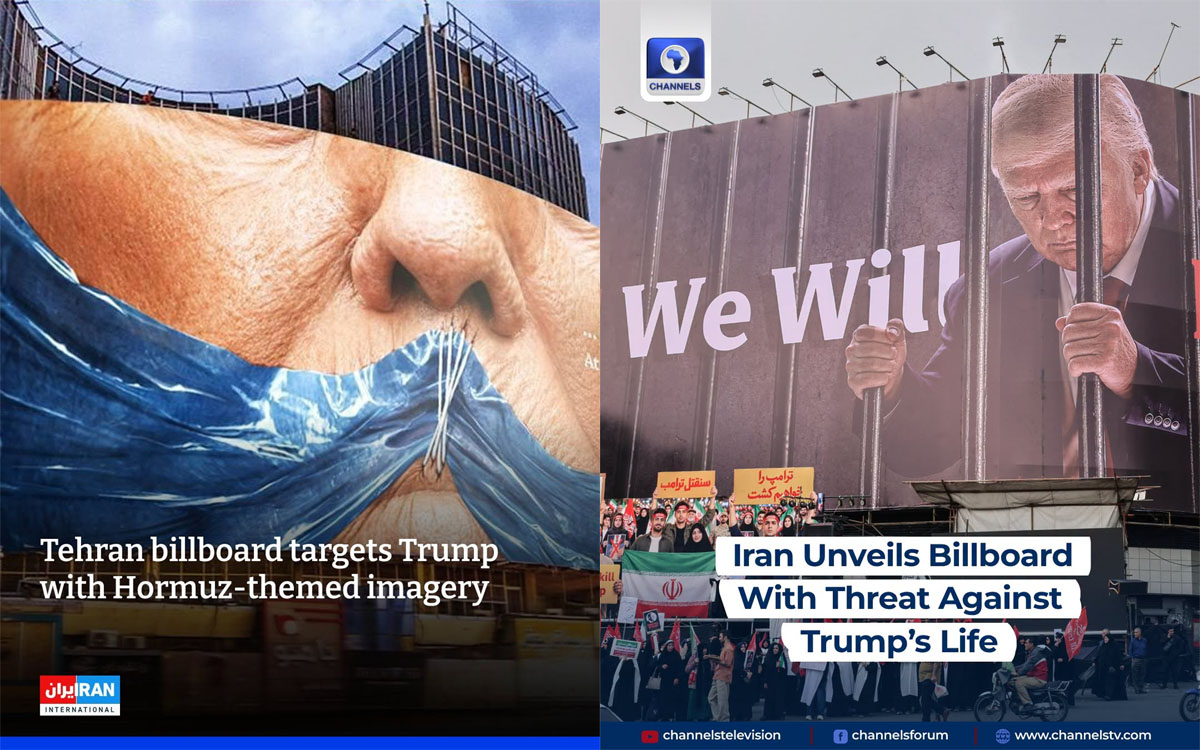
Iran has unveiled a massive billboard in its capital, Tehran, bearing the threatening message “We Will Kill Trump”, in an escalation of anti-American rhetoric amid heightened tensions between Tehran and Washington.
The billboard, displayed above the busy Enghelab Square on Tuesday, November 3, 2026, depicts US President Donald Trump behind prison bars with his head bowed beneath the threatening inscription.
The development comes as the conflict involving Iran, the United States and Israel continues to generate tensions across the Middle East, despite renewed diplomatic efforts to prevent a fresh escalation of hostilities.
According to reports by the Agence France-Presse (AFP), another billboard displayed nearby features Trump, US Vice-President JD Vance, American special envoy Steve Witkoff and Israeli Prime Minister Benjamin Netanyahu with bloodied faces and torn suits against the backdrop of damaged American and Israeli flags.
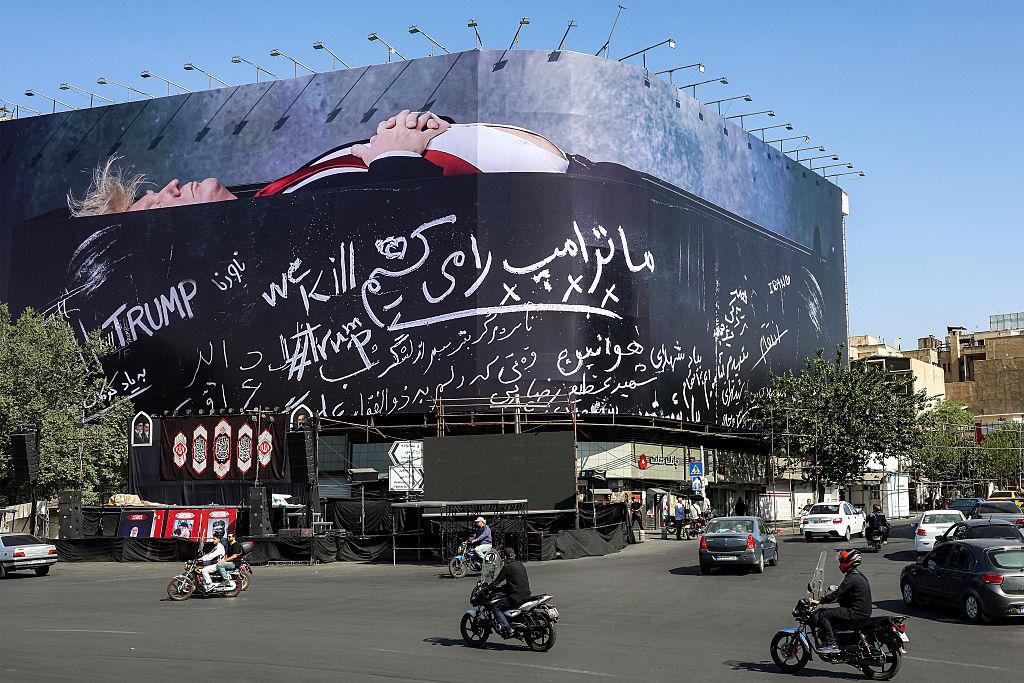
Iran Unveils ‘We Will Kill Trump’ Billboard in Tehran Amid Rising Tensions With US
Dozens of people gathered around Enghelab Square, waving red flags and carrying banners bearing messages such as “There Will Be Blood”.
The gathering also featured calls for revenge over the killing of Iran’s Supreme Leader, Ayatollah Ali Khamenei, in US-Israeli attacks on February 28, 2026, which triggered the current regional conflict.
The latest displays are part of a series of anti-American and anti-Israeli messages that have appeared across Tehran since the outbreak of the war.
READ ALSO:
- Tinubu’s Re-election: Osun APC Leaders Reject Oyebamiji-Led Campaign Council
- Tragedy: Spanish Footballer Jesús de Miguel Dies at 30 After On-Field Collision
- Tourist Killed, Three Injured as Two Helicopters Collide Near Mount Everest in Nepal
In recent days, an open-air exhibition at Tajrish Square in northern Tehran has also featured paintings portraying Trump in humiliating situations.
One of the artworks depicts the US President lying bloodied on the ground with a foot pressing against his head, while another shows a bomb obscuring his face.
A life-sized replica of a prison cell has also been installed at the exhibition, with an actor impersonating Trump sitting inside. A nearby screen reportedly displays images of destruction caused by US military strikes in Iran.
Iranian authorities have accused Trump of deliberately targeting civilian facilities during the conflict, including a school and a wedding ceremony, allegedly killing dozens of people.
The billboard campaign comes amid renewed diplomatic efforts to bring Washington and Tehran back to negotiations and prevent fighting from resuming across the region.
Trump, speaking ahead of the November 3 US midterm elections, has indicated that an agreement with Iran remains possible, saying a deal “could happen”.
The conflict has also contributed to rising global economic uncertainty, particularly in energy markets, amid concerns over disruptions to oil supplies and shipping routes.
Iran has a long history of using state-sponsored murals, billboards and public exhibitions to communicate political messages, celebrate military figures and express opposition to foreign governments, particularly the United States and Israel.
The latest billboard, however, stands out for its explicit threat against the American President at a time when diplomatic efforts are continuing to prevent another escalation of the conflict.
Iran Unveils ‘We Will Kill Trump’ Billboard in Tehran Amid Rising Tensions With US








International
Tourist Killed, Three Injured as Two Helicopters Collide Near Mount Everest in Nepal

A 47-year-old Indian tourist has been killed and three other people injured after two helicopters collided while attempting to land in Nepal’s Mount Everest region.
The accident occurred at approximately 8:11 a.m. local time on Tuesday at the helipad in Pheriche, Solukhumbu district, when helicopters operated by Fishtail Air and Air Dynasty collided during their landing approach.
The deceased was identified as Vasanth Kumar Balaramaramudu, an Indian national from Tamil Nadu, who was travelling aboard the Fishtail Air helicopter.
Three other people, including the pilots of both aircraft, sustained injuries in the collision.
They were identified as Shailesh Krishna Patel, a 49-year-old New Zealand citizen of Indian origin, and the two pilots, Rabindra Prajapati and Prajal KC.
READ ALSO:
- Kogi: Troops Destroy Kidnappers’ Hideout, Recover 1,000 Rounds of Ammunition, Six Motorcycles
- Nasarawa: Suspected Kidnapper Arrested While Collecting N200,000 Ransom
- Taraba Pageant Community Mourns as Former Queen Comfort Williams Dies
According to local authorities, the injured passenger and one of the pilots were airlifted to Mediciti Hospital in Kathmandu for treatment, while the other pilot received medical attention in Lukla.
The body of the deceased tourist was also transported to Lukla following the accident.
Reports indicated that the helicopters were attempting to land at the same helipad when their rotor blades struck each other, causing the collision.
The Fishtail Air helicopter was carrying tourists who had been rescued from the Everest region, while the Air Dynasty aircraft was reportedly transporting cargo and had no passengers aboard.
The incident has drawn attention to aviation safety in Nepal, where helicopters play a crucial role in transporting tourists, climbers and supplies across the mountainous Himalayan region.
Pheriche is a major stop for trekkers and mountaineers travelling towards Mount Everest Base Camp. The area is particularly dependent on helicopter services because of its difficult terrain and limited road access.
Helicopters are frequently used to evacuate climbers and trekkers who become ill, exhausted or stranded at high altitudes, as well as to transport essential supplies.
The accident occurred during Nepal’s peak trekking season, when thousands of visitors travel to the Everest region.
Authorities have commenced investigations to establish the circumstances surrounding the collision and determine what led to the two helicopters making contact during their landing manoeuvres.
Tourist Killed, Three Injured as Two Helicopters Collide Near Mount Everest in Nepal
International
US Strikes Iran’s Qeshm Island as Tensions Escalate Around Strait of Hormuz

US Strikes Iran’s Qeshm Island as Tensions Escalate Around Strait of Hormuz
The United States has carried out fresh military strikes on Iran’s strategically important Qeshm Island, raising fears of renewed escalation in the conflict between Washington and Tehran amid mounting tensions around the Strait of Hormuz.
The strikes, conducted on Monday, November 2, 2026, reportedly targeted Iranian military installations, including missile launchers and radar systems, according to US officials cited by international media.
The operation was described by American officials as a limited defensive action intended to prevent Iranian forces from threatening US military assets and commercial vessels navigating the strategic waterway.
According to reports by Reuters and The Wall Street Journal, the strikes followed an incident in which Iranian forces allegedly fired surface-to-air missiles at an American aircraft operating in the region.
A US official also said American forces intercepted another Iranian missile launched from Qeshm Island towards commercial shipping.
The Pentagon referred enquiries about the operation to the US Central Command, which had not publicly provided details of the strikes as of Tuesday.
Iranian state media subsequently reported several explosions on Qeshm Island and in the nearby coastal city of Bandar Lengeh.
READ ALSO:
- APC Dumps Adeleke’s Campaign Structure, Unveils Separate 168-Member Council in Osun
- Three Homeless Men Shot Dead in Midnight Attack at Lagos Bus Stop
- Super Falcons Receive $100,000 Each as Tinubu Finally Fulfils WAFCON Pledge
The Iranian state news agency, IRNA, reported that the explosions occurred late Monday, with witnesses claiming to have seen aircraft flying over the island.
However, Iranian authorities had not provided a confirmed account of the extent of the damage or possible casualties.
The latest military operation comes after Iran’s Islamic Revolutionary Guard Corps (IRGC) claimed to have intercepted three American drones operating near the Strait of Hormuz.
Iranian state media reported that two reconnaissance drones were brought down south of Qeshm Island using electronic warfare systems, while another MQ-9 drone was allegedly destroyed east of the strait.
The claims had not been independently verified, and the US military had not publicly confirmed the alleged losses.
Qeshm Island occupies a strategic position near the entrance to the Strait of Hormuz, one of the world’s most important maritime routes for crude oil and natural gas shipments.
The waterway connects the Persian Gulf with the Gulf of Oman and the Arabian Sea, making it a critical passage for international energy supplies.
Before the conflict, approximately one-fifth of global oil and liquefied natural gas supplies passed through the strait.
Military confrontations around the area have already disrupted commercial shipping, raising concerns about the security of oil tankers and the potential consequences for global energy markets.
The latest strikes also come against the backdrop of diplomatic efforts to end the conflict, which began in late February 2026.
Despite the military developments, US President Donald Trump has played down the possibility of renewed large-scale fighting, suggesting that a diplomatic agreement with Tehran could be within reach.
Trump said on Monday that Iran wanted a settlement and expressed optimism that negotiations could produce an agreement.
Vice-President JD Vance also indicated that Washington believed progress was being made towards a possible negotiated settlement.
Iran, however, has maintained that any agreement must address the American naval blockade of its ports and guarantee an end to hostilities.
Iranian Foreign Ministry spokesman Esmaeil Baghaei said Tehran had communicated its conditions to Washington, adding that the United States must respond to its proposals.
Iran also indicated that its proposal for reopening the Strait of Hormuz could be implemented within two days if Washington met its conditions.
The latest strikes have nevertheless exposed the fragile nature of the diplomatic efforts, with military confrontations continuing even as both sides signal interest in negotiations.
The development has also unsettled international oil markets, with crude prices rising in early Asian trading on Tuesday following reports of the American operation.
Brent crude futures rose by 0.5 per cent to $105.25 per barrel, while US West Texas Intermediate crude increased by 0.5 per cent to $96.93 per barrel, according to Reuters.
Analysts warned that further military escalation around the Strait of Hormuz could increase the risk premium on oil prices and prolong disruptions to global energy supplies.
With Washington describing its latest operation as defensive and Tehran maintaining its military posture, uncertainty remains over whether diplomatic negotiations will prevent another round of direct confrontation.
US Strikes Iran’s Qeshm Island as Tensions Escalate Around Strait of Hormuz
International
Iran Offers to Reopen Strait of Hormuz Within 48 Hours If…

Iran has offered to reopen the strategically important Strait of Hormuz within 48 hours, but says the move depends on the United States accepting a series of conditions aimed at easing tensions and paving the way for renewed negotiations.
Iranian Foreign Ministry spokesperson Esmaeil Baghaei announced the proposal on Monday, November 2, 2026, describing it as part of Tehran’s efforts to resolve the ongoing confrontation through diplomatic engagement.
Under the proposed arrangement, the United States would first have to meet Iran’s demands, after which the country could begin restoring access to the strategic waterway within two days. The proposal also provides for the resumption of negotiations between the two countries.
The offer marks a shift from an earlier seven-day framework reportedly communicated through mediators in September. Iran had previously proposed a sequence under which the Strait would reopen after certain conditions were met.
Baghaei described the shorter timeline as evidence of Tehran’s willingness to pursue a diplomatic solution. However, he made clear that the proposal would depend on Washington agreeing to the conditions.
Among Iran’s key demands is an end to the US naval blockade of Iranian ports, which Tehran regards as a major obstacle to negotiations. It is also seeking the removal of sanctions targeting its oil industry and the release of Iranian assets frozen abroad.
READ ALSO:
- I Believe God Has Answered My Prayer, Says Tinubu After Entering Holy Ka’abah
- Footballer Dies as Trailer Rams Car Into Bus on Lagos-Ibadan Expressway
- Gunmen Intercept Family Car, Abduct Woman, Two Children, Release Husband in Abuja
Iran has further called for an end to hostilities across the region, including the conflict involving Lebanon, arguing that any agreement should address the wider security situation rather than focus exclusively on the confrontation between Tehran and Washington.
Iranian Foreign Minister Abbas Araghchi has also outlined a proposed arrangement for maritime traffic through the Strait. Under the plan, ships would use a new route agreed upon by Iran and Oman, with passage taking place under Iranian supervision.
Tehran has additionally called for a reduction in the presence of US military forces in the region and the removal of sanctions imposed on Iran since August.
Qatar is among the countries involved in diplomatic efforts to ease the crisis. Iranian Deputy Foreign Minister Kazem Gharibabadi has also travelled to Doha as part of the consultations surrounding the proposed framework.
However, there has been no indication that the United States has accepted Iran’s conditions. Consequently, the proposed 48-hour timeline should not be interpreted as confirmation that the waterway will reopen within that period.
The proposal comes amid continued tensions between the two countries. US President Donald Trump has warned that military action could resume if diplomatic efforts fail, while leaving room for negotiations to continue.
The Strait of Hormuz is one of the world’s most important maritime energy corridors. Connecting the Persian Gulf with the Gulf of Oman and the Arabian Sea, it provides a major route for crude oil and liquefied natural gas shipments from Gulf producers to international markets.
Any prolonged disruption to shipping through the passage could affect global energy supplies, increase transportation costs and put further pressure on oil prices and fuel markets.
Iran’s latest offer has therefore attracted international attention, particularly among energy-importing countries and shipping operators concerned about the security of vessels using the route.
For now, the proposed reopening remains conditional on an agreement with Washington. Whether the two sides can bridge their differences over sanctions, the naval blockade and regional security will determine whether the 48-hour proposal translates into the restoration of normal maritime traffic.
Iran Offers to Reopen Strait of Hormuz Within 48 Hours If US Meets Demands
-

 metro2 days ago
Lami Dawa: CAN Takes 14-Year Jail Sentence to Appeal Court, Borno Govt Reacts
-
 metro1 day ago
Three Dead, Five Rescued as Two-Storey Building Collapses in Osun
-

 News3 days ago
2027 Presidency: Allah’s Will Must Prevail, Tinubu Declares in Makkah
-

 Auto2 days ago
Nigeria’s Auto Dealers Face New Challenge as After-Sales Service Takes Centre Stage
-

 News3 days ago
Breaking: Two Fresh Ebola Cases Emerge in North-East, says NCDC, begins test
-

 International1 day ago
Badenoch Rejects Slave Trade Apology, Says African Kingdoms Also Profited From Slavery
-

 metro2 days ago
Edo Youths Chase Policemen, Vigilantes From Checkpoint Over Alleged Extortion
-

 metro2 days ago
Adeboye Fires Back at Journalists Over Viral Jonathan Protest Photo, Says It Was Prayer Walk