

Auto
Chinese brands have taken over truck market — Taiwo Shittu, ED, Lanre Shittu Motors

Executive Director of Lanre Shittu Motors, Mr Taiwo Shittu, speaks on high cost of vehicles, used vehicle imports and quality of Chinese brands, among other issues relating to the auto industry in this interview with some journalists in Lagos including NewsTrends
How has it been running an auto assembly plant in Nigeria?
We started our auto assembly plant in October 2018. So far, it has been a good experience for us. It has been smooth running the plant. We have two plants now; one for the truck, the other is the car assembly section.
The truck plant just won the Best Auto Plant of the Year Award in Nigeria at the Nigeria Auto Journalists Awards. I can tell you that it was based on merit. No one in the auto industry can fault it. We all know who is doing what. Our turnaround in terms of operation is high. The assembly is always busy with activities with a lot of local content. We make sure we patronise local steel industry. Most of the hard body is being done here by young Nigerians; you won’t believe the capability of these young Nigerians. They are young Nigerian engineers who have passion for what they do.
The plant is doing well. Right now, we are looking towards its expansion. We just got a grant from the Central Bank of Nigeria, CBN, at a single digit interest rate to expand our plant. That is where we are now.
Is the car plant in the same location with the truck plant?
Yes. They are both at the Amuwo, Lagos.
How much of local content do you incorporate into assembling of vehicles now?
Right now, we source our steel from the local market. For instance, the back body/trailer body, the tipping bucket, the diesel tanks are local content; they are mainly fabricated there. We make sure we patronise indigenous companies for these materials. The same goes for our lubricants and grease. You will be surprised what some of these young Nigerians are capable of doing. Nigerians have the skills. They just need the support of the government; this is what will make the industry to develop.
The current generation of leaders must invest and make sacrifice for the development of the next generation just like the Chinese did. In those days, many people looked down on the Chinese and derided them for looking haggard and wretched. What they did not know was that they were making sacrifice for the current generation. Today, the China’s story has changed. Nigeria also needs to do the same.
Why are the locally-made/assembled vehicles still expensive and beyond the reach of the common man?
The price is still tied to imports in some way. The effect of the COVID has taken the freight rate of imported containers from about $2,000 to $16,000 and above. And that has had a significant effect on pricing of products in Nigeria. This is because most of the things we use (vehicle components) are imported from China.
And that is why I fault the media team of this government. It has failed to enlighten the public on why things are generally expensive in Nigeria.
Freight rate accounts largely for why things are expensive right now. Freight rate from China has gone up astronomically after COVID; it had never happened before. Our company is 40 years now; this is the first time freight rate will cost so much. Bringing in a container of 40 feet from China used to be around $2,000 to $3,000. It is now over $16,000.
This is what the media team of the government needs to let the people know. The current high cost of things is caused by external factor that the government has no control over. The world is facing it. It is not only in Nigeria.
The dollar or exchange rate has its own issue, but it is minimal compared to this external factor of high freight rate.
Is there anything the business community or government can do about this problem?
It is not a deliberate action. It was precipitated by COVID-19. What happened was that at the peak of the COVID infection, many people were falling sick and some dying; a lot of containers were abandoned midway on the high sea. Now, many of the containers are not back at their bases, making them to have shortage of containers. And when the demand is high, the supply is low, the result is high price.
The solution is to work on returning the containers to their home countries and ease the shortage.
Are the products being made here of the same quality with those produced abroad?
They are of the same quality. Everything is regulated by the parent company. But nobody gets to the top overnight. I will take you back to China; they did not get to where they are now overnight. Nigeria was better than China in the ‘70s. Today, China has become a reference point because their former leaders made sacrifice for the present generation. Our own leaders too must be ready to make such sacrifice. It will be tough, but the result will be sweet victory. Industrialisation is the key to economic success of any country.
Are Nigerians not making enough sacrifice already?
This has to be consistent and it should cut across all strata of the society, the followers and the leaders. There is so much greed in the system. It’s in Nigeria you see people at a buffet packing food without any thought about those waiting in a queue yet to eat.
What has been the response of people to the JAC trucks being assembled in your factory? How many have you sold?
The response has been very encouraging. We’ve sold thousands. When we signed the dealership of the truck in 2014, it was rated number 9.
But today, we are the third highest selling heavy trucks in Nigeria. But when it comes to quality, people know it is JAC truck.
Are you saying Chinese trucks are leading the truck market in Nigeria?
Yes, they have taken over the market; it’s not only in Nigeria; it is everywhere.
Is this a function of low price?
Not just low pricing but it is also in terms of quality. The truth is that the Chinese brands have come to stay. In the area of truck, you either align with them or you get out of the business. They are getting better every day and these trucks are working (well). We have a lot of key players using the trucks. How many of these European trucks can you see on the road?

What is your assessment of the National Automotive Design and Development Council (NADDC) as an agency of government expected to facilitate your business?
I must say the agency has been very amazing, especially under the leadership of Jelani Aliyu as its director general. He is very sound; he has played in the big boys’ league in the US. I’m not surprised that he is performing well. We are getting a lot of support from him because he believes in this industry. I must say that with someone like him, we’re going to get there.
Government must give him more listening ear. We are lucky to have him. He is an asset to Nigeria. He has tried it in America and it worked; it will work in Nigeria too.

What has been the contribution of Lanre Shittu Motors to Nigeria after 40 years of the company’s establishment?
The company has contributed a lot to the Nigerian economy, especially when it comes to manpower, training and empowerment of young Nigerians. We have an empowerment scheme for school leavers, who have passion for automotive development.
They are trained for a period of four years and get paid even while on training. After the training, we send them to our customers across the country to service them. We ask them to get them employed, accommodated and be paid well. In some cases, they are given a car and placed on a good salary that we dictate.
We are getting good testimonies from those we sent to Kano, Bauchi, Ondo and Cross River states, among others. These are people that would have been bus conductors, touts or motor boys, now heading a facility of 300 to 500 trucks.
Those who own these trucks know that these guys taking care of the valuable vehicles are as important as their expensive trucks. Lanre Shittu Motors has done miraculously well to young Nigerians in the engineering sector, making them to actualise their dreams in life.
We have the graduate empowerment scheme too, with a different package. They are also trained for a period before we send them out to people who need their service. We have some people sending interested young graduates and school leavers to us for training.
For instance, Desmond Elliot, a member of the Lagos State House of Assembly, sent 10 people from his Surulere constituency to us for the scheme.
We just got a grant from the government. They have seen that what we are doing is extensive. Government did due diligence before giving out the loans. We are one of the best indigenous companies in the automobile industry.
We believe strongly in this auto policy that will make Nigeria a hub for auto producing vehicles in Africa. Government’s representatives have visited our factories a number of times and they have seen that we mean business. The plant is always busy. And in the auto industry, we are the only company that got the loan in the first set they just released.
What is your view about the crash in import duty of used vehicles by the government?
If we believe in Nigeria, we must do away with used vehicles. It’s part of the sacrifice that we need to make. We can start by making it look unattractive to reduce the volume being imported. We have to look for a good finance scheme to support the new vehicle purchase. It is not that Nigerians don’t like new vehicles; it is because finance is not there. And where there is a finance arrangement, the issue is the cost and how to pay back. If I’m buying a car on loan for my comfort, I may be sceptical about how to pay back without a reliable income. Government should therefore focus more on how to finance the commercial segment of new vehicles’ purchase. Since the vehicles are going to be used for business, it will be easy to pay back the loans. This will also generate more employment opportunities for the people. Giving a loan to anyone to buy a vehicle that will be used for business is like an asset that will bring back money. There is no way you will buy a new truck on loan for a business venture and you will not make back the money in one and a half years. And in the case of trucks, they will still be on the road for 15 years or more. Look at the farmers in the North producing tomatoes and others, most of these perishable food items get destroyed in the farm because they cannot afford the high cost of transporting these goods to the big markets in the cities like Lagos and Abuja. The cost of moving the items from Kano to Lagos can be as high as N1 million. How many of these peasant farmers can afford that? But if the government can have a finance scheme for new commercial vehicles, they would be able to buy the vehicles and promptly move the goods to Lagos, Ibadan, Port Harcourt, Aba, Onitsha, Abuja and those places with high population. More people would be encouraged to return to the farm and do more.











Auto
Abuja Roars to Life as Jetour X50 Headlines Three-Day Motoring Experience
Abuja Roars to Life as Jetour X50 Headlines Three-Day Motoring Experience
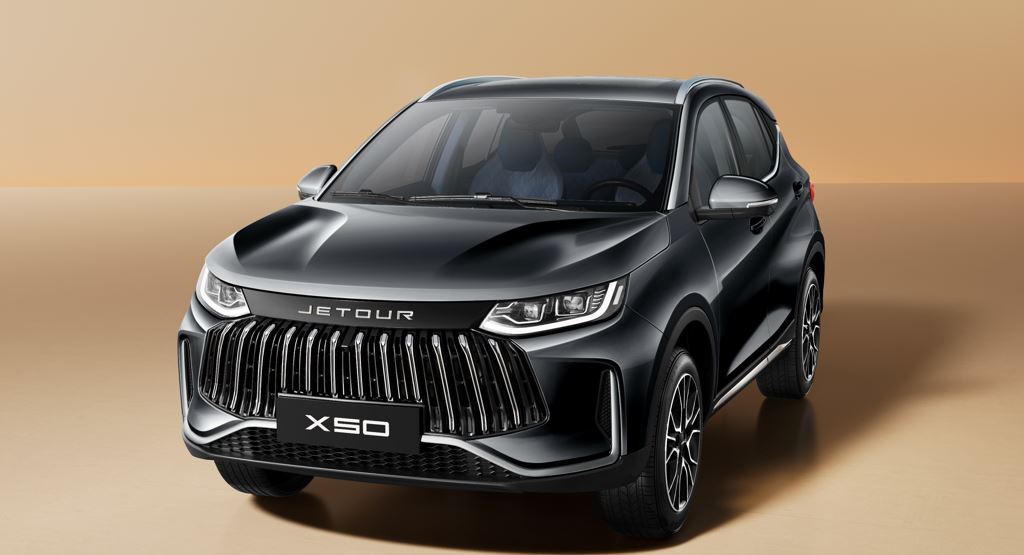
Abuja is gearing up for a major motoring spectacle as Jetour Nigeria brings its fast-growing brand experience to the Federal Capital Territory, with the stylish Jetour X50 set to take centre stage in a three-day showcase of performance, technology and automotive innovation.
Scheduled for September 22 to 24, 2026, the Jetour Experience Abuja will move beyond the conventional vehicle exhibition, giving motorists and prospective buyers the opportunity to test-drive the X50, interact with automotive specialists and experience a range of entertainment and interactive activities.
The Abuja activation follows the strong reception recorded during Jetour Nigeria’s recent Lagos experience and forms part of the automaker’s strategy to deepen customer engagement while expanding its footprint across Nigeria.
Backed by an expanding authorised dealer network comprising Elizade Nigeria Limited, Mandilas Autos, Germaine Auto Centre, Kojo Motors, R.T. Briscoe, Tab Autos and New Era AutoVehicle Services, Jetour is also strengthening access to vehicle sales, after-sales support, genuine spare parts and certified technical services nationwide.
At the heart of the Abuja experience will be the Jetour X50, a compact SUV designed to combine contemporary styling, performance and a technology-rich driving environment.
Powered by a 1.5-litre turbocharged engine paired with a dual-clutch transmission, the X50 has positioned itself as a strong contender in Nigeria’s competitive compact SUV segment.
Jetour has equipped the model with a range of premium features, including a 360-degree camera, Blind Spot Detection, 10.5-inch infotainment system with Apple CarPlay and Android Auto, wireless charging and leather upholstery.
The combination of technology, comfort and performance is part of Jetour’s strategy of offering premium motoring features at competitive price points.
The Abuja event also highlights Jetour’s aggressive expansion strategy in Nigeria, following the brand’s recognition with industry accolades including Fastest Growing Auto Brand and Auto Brand of the Year.
With its expanding dealer network providing nationwide sales and after-sales support, Jetour is seeking to deepen customer engagement while making its vehicles and ownership services more accessible to motorists across the country.
As Abuja prepares to welcome the Jetour Experience, the three-day activation is expected to provide motorists with an opportunity to see, feel and drive the X50 while experiencing first-hand what is driving the brand’s growing appeal in Nigeria.
Auto
Kaduna to Lead Govt Patronage of Local Vehicles as Sani Unveils Peugeot 5008
Kaduna to Lead Govt Patronage of Local Vehicles as Sani Unveils Peugeot 5008
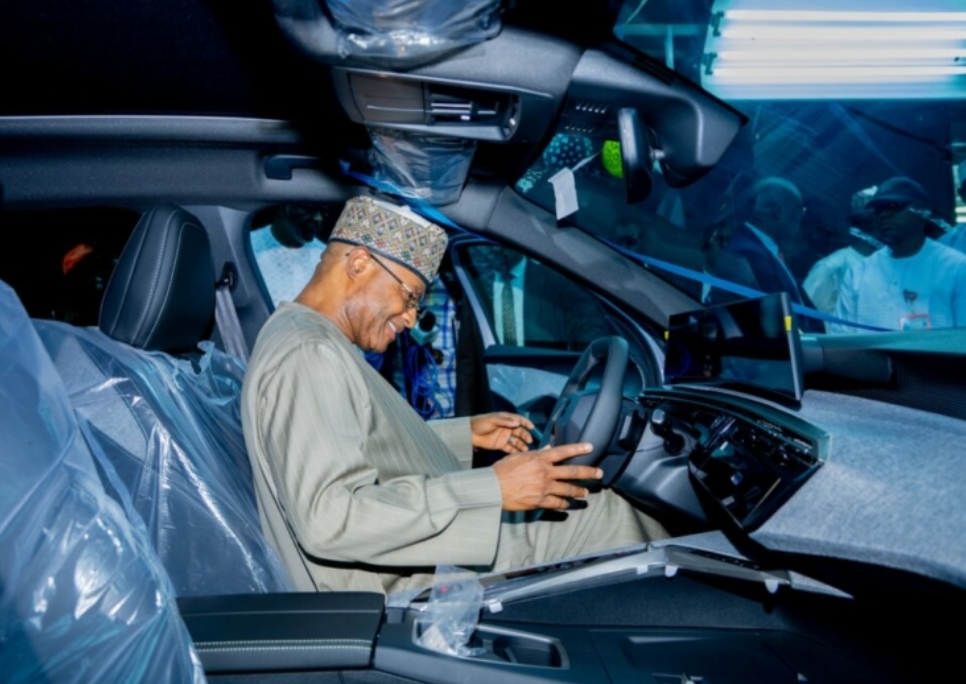
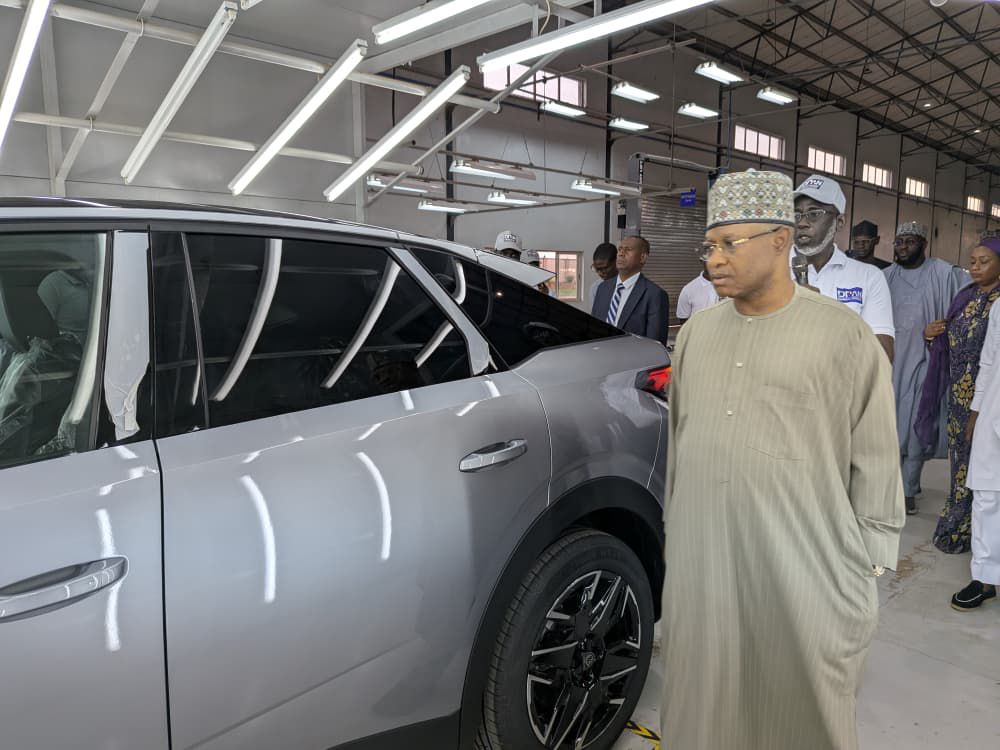
Kaduna State Governor, Uba Sani, has pledged to lead a fresh push for government patronage of vehicles assembled by Dangote Peugeot Automobile Nigeria (D-PAN), promising to make a strong case for the company at the National Economic Council (NEC).
Sani, who made the commitment while unveiling the new Peugeot 5008 2026 model at the D-PAN plant in Kaduna on Friday, said increased patronage by Federal and state government Ministries, Departments and Agencies (MDAs) was critical to sustaining local vehicle assembly, protecting jobs and strengthening Nigeria’s automotive value chain.
The governor’s intervention comes amid renewed efforts to revive Nigeria’s automotive manufacturing industry by increasing local vehicle production and reducing dependence on imported completely built units.
Industry stakeholders have consistently identified government fleet procurement as a major instrument for creating sustained demand for locally assembled vehicles and encouraging investment in assembly plants.
With government agencies operating large vehicle fleets nationwide, stronger preference for locally assembled automobiles could provide the market certainty required by assemblers to expand production, develop local suppliers and deepen technology and skills transfer. It could also support the broader objective of increasing local content in Nigeria’s automotive industry.
READ ALSO:
- Peter Obi, Others Challenging Tinubu Cannot Transform Nigeria — Datti Baba-Ahmed
- FG Opens N2.5bn Grant Window For 50 Student Innovators Under “Next Moonshot Initiative”
- Kneeling to Propose Is Why Western Marriages Fail — Pete Edochie Sparks Fresh Debate
Against this background, Sani said government patronage remained crucial to ensuring the sustainability of local assembly operations and encouraging further investment in the sector.
“I will make a strong presentation at the National Economic Council, urging both the Federal and state governments to patronise the products of this company because that is the only way they can survive,” Sani said.
He also announced that the Kaduna State Government would procure some vehicles from D-PAN, saying the state would lead by example and encourage other governments to patronise locally assembled automobiles.
“As a government, Kaduna State will order some of the vehicles, so that we can show the example for others to follow by patronising this very important company,” the governor added.
Sani pledged continued support and collaboration between the Kaduna State Government and D-PAN, stressing the importance of strengthening local manufacturing as part of efforts to grow Nigeria’s industrial base.
He said D-PAN had made significant contributions to Kaduna’s economy through job creation, skills development and business opportunities for communities within and around its operating environment.
The governor also urged the company to consider employing graduates of the Kaduna State Institute of Vocational and Skills Development, who, according to him, recently completed intensive training in partnership with the National Board for Technical Education (NBTE).
Sani commended D-PAN for its Corporate Social Responsibility (CSR) initiatives in communities around its plant, while urging the company to further expand its support for the host communities.
He said the peaceful relationship between D-PAN and its host community was important to the sustainability of the company’s operations, stressing that continued investment in the welfare and development of surrounding communities would help preserve the harmony.
Kaduna to Lead Govt Patronage of Local Vehicles as Sani Unveils Peugeot 5008
Auto
NAJA 19th Auto Awards: Industry’s best to battle for honours December 3
NAJA 19th Auto Awards: Industry’s best to battle for honours December 3
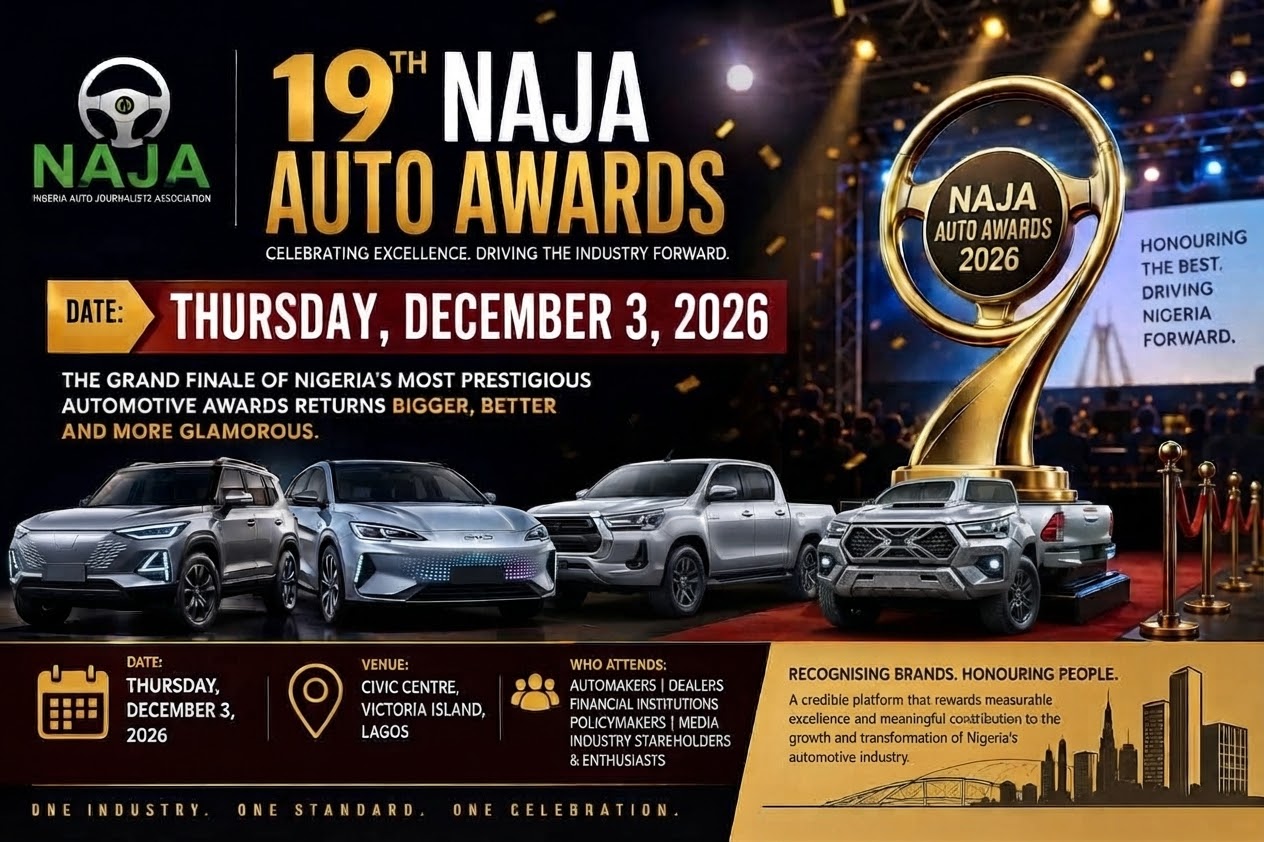
The battle for recognition among Nigeria’s automobile brands, executives and industry players will reach its climax on December 3, 2026, as the Nigeria Auto Journalists Association (NAJA) stages the grand finale of its 19th annual automotive awards.
The prestigious ceremony, scheduled for the Civic Centre, Victoria Island, Lagos, is expected to bring together leading automobile manufacturers, distributors, dealers, financial institutions, policymakers, motoring enthusiasts and other major stakeholders in the automotive industry.
The organisers said the 19th edition is being designed to surpass previous editions in scale, organisation and glamour, without compromising the credibility and professional standards for which the awards have become known.
Chairman of the 2026 NAJA Awards Planning Committee, Frank Kintum, said the committee was determined to deliver a ceremony that would reflect the growing importance of the automotive industry to Nigeria’s economy.
According to him, the awards have evolved beyond a mere celebration of popular brands to become a platform for identifying and rewarding individuals, companies and products that have made measurable contributions to the development of the sector.
READ ALSO:
- 15 northern states may collapse if fuel subsidy returns, OAU professor warns Atiku
- Kano Hisbah arrests 22 suspected crossdressers over alleged hook-up, drug abuse
- Two Weeks of Silence: Families of 600 Abducted Muslim Worshippers in Niger Demand Govt Action
Kintum said the 19th edition would be “bigger and more glamorous” than previous editions, adding that the committee was working to ensure that every aspect of the ceremony reflects the quality, innovation and achievements of the industry.
He said products, brands and personalities would be assessed across relevant segments of the automotive sector, with winners emerging through the approved NAJA awards modalities.
Also speaking on the awards, NAJA Chairman, Theodore Opara, said the association was focused on rewarding genuine excellence rather than simply celebrating the biggest players in the market.
Opara said the objective was to recognise individuals and organisations that had demonstrated measurable excellence and made meaningful contributions to the growth and transformation of Nigeria’s automotive industry.
He noted that the awards had continued to gain relevance among industry stakeholders because of the credibility attached to the judging and evaluation process.
The 2026 edition comes at a critical period for Nigeria’s automotive industry, which is undergoing significant transformation driven by emerging technologies, electric mobility, local vehicle production, changing consumer preferences and evolving government policies.
Against this backdrop, NAJA said the awards would provide an opportunity to celebrate companies and individuals at the forefront of these changes and those contributing to the future direction of the industry.
The association urged automobile manufacturers, distributors, dealers and other stakeholders to participate actively in the awards process as preparations gather momentum for the December 3 grand finale.
NAJA 19th Auto Awards: Industry’s best to battle for honours December 3
-
 metro3 days ago
APC rally: Suspected thugs attack journalists, smash Radio Nigeria vehicle in Kano
-

 Education3 days ago
FG Opens N2.5bn Grant Window For 50 Student Innovators Under “Next Moonshot Initiative”
-

 Politics2 days ago
Peter Obi, Others Challenging Tinubu Cannot Transform Nigeria — Datti Baba-Ahmed
-
 Politics3 days ago
Kano Political Earthquake: Kwankwaso Loyalists Dump NDC, Defect to APC in Major 2027 Blow
-

 Entertainment3 days ago
Wizkid Mocks Davido’s Family Wealth: “Rich and Empty” — Afrobeats Feud Escalates
-

 metro2 days ago
Socialite Igho ‘Tiny’ Ubiribo Dies After Penis Enlargement Surgery
-
 Auto2 days ago
Kaduna to Lead Govt Patronage of Local Vehicles as Sani Unveils Peugeot 5008
-

 Entertainment3 days ago
Kneeling to Propose Is Why Western Marriages Fail — Pete Edochie Sparks Fresh Debate