

News
Ghana, other African countries lobbying companies to leave Nigeria —Adebayo, Industry Minister
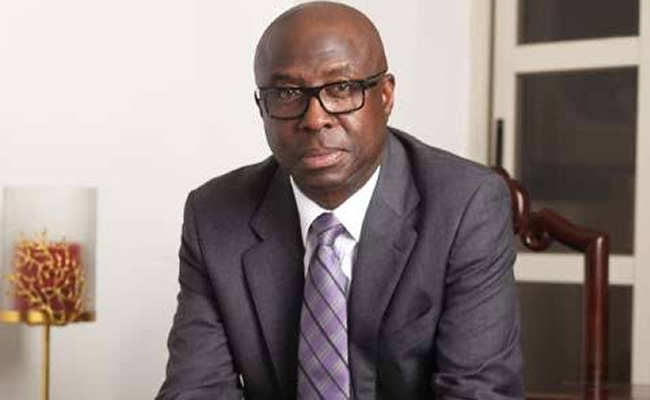
The Minister of Industry, Trade and Investment, Niyi Adebayo, revealed yesterday that many African countries were lobbying companies operating in Nigeria to leave and come to them.
Appearing before the House of Representatives Committee on Public Accounts, the minister, who led other agencies under the Ministry to the committee to respond to queries from the Auditor General for the Federation, said one of such countries was Ghana.
He said those countries had raised the capital allowances of the companies, stressing that those still left behind were attracted by Nigeria’s huge population.
He, however, said the federal government was making efforts to support investments.
“Our duty is to support investment growth in Nigeria. It is public knowledge that getting these investments is increasingly becoming difficult today,” he said.
In his remarks, Chairman of the House Committee on Public Account, Wole Oke, said the country is bleeding economically, decrying that several companies are evading taxes.
READ ALSO:
- Russia becomes 2nd country ever kicked off UN Human Rights Council
- No more media coverage of Nnamdi Kanu, B’Haram sponsors trials – Court
- Eight years after, court acquits Abba Moro over recruitment tragedy
“Nigeria is bleeding. We are borrowing daily to finance our budget and the Minister of Finance has said the reason we are borrowing is the fact that we are not collecting the revenue we are supposed to collect.
“The Ministry of Industry, Trade and Investment has issued some instruments which earned companies tax breaks and tax holiday. But this scheme has been abused by the companies.
“When some of these companies appeared before this committee, we noticed from their presentation elements of tax invasion. For example, China Habour got a waiver of N5 billion to import nails and wire nets.
”In my village, we have a company that manufactures nails, but cost of manufacturing nails locally is higher than those imported. So, how do we encourage local production?
“The same company evaded some of the schemes of government and they are seeking to have pioneer status. We also have a company that has been existing in Nigeria since 1979 and has never paid one Kobo to the government. ALSCON has been in operation and has not paid a single Kobo to government’s coffers.
“There is a company that put up a show and usurped the function of NEPZA who are supposed to remit it’s operating surplus. But it’s licensees have undermined the agency.
“Millions of dollars that are supposed to go into NEPZA’a coffees are going into private pockets. That is why we are trying to find out if there is need to review existing laws because the Parliament will not allow the country to continue to bleed.
“MTN gave us certificate of acceptance worth N2.6 trillion and claimed to be the highest tax payers in the country. We are asking them to provide us evidence of how they got those certificates. That is where we are right now.
“Airtel, 9 Mobile are running away. But the law will catch up with them. We are aware that they have spent so much on their investment and so don’t want to be party to dragging their names in the mud. But they must come before parliament to defend the capital allowances they have collected,” he said.
Speaking on the operations of the Oil and Gas Free Zone Authority, Oke said the payments many companies claimed to have made could not be seen.
“Some licensees claimed to have made payment which we cannot see. For example, AGIP claimed it has paid millions of dollars to you. I checked the records of your submission and cannot find even one million dollars tracable to a single company.
“They also filed for capital allowance with FIRS and FIRS has given effect to that without the certificate of acceptance issued by the Ministry of Industry. We have asked for evidence of exception and there is none. We have also asked for a list of the assets they imported that qualified and inspected which the FIRS acted on,” he said.
VANGUARD








News
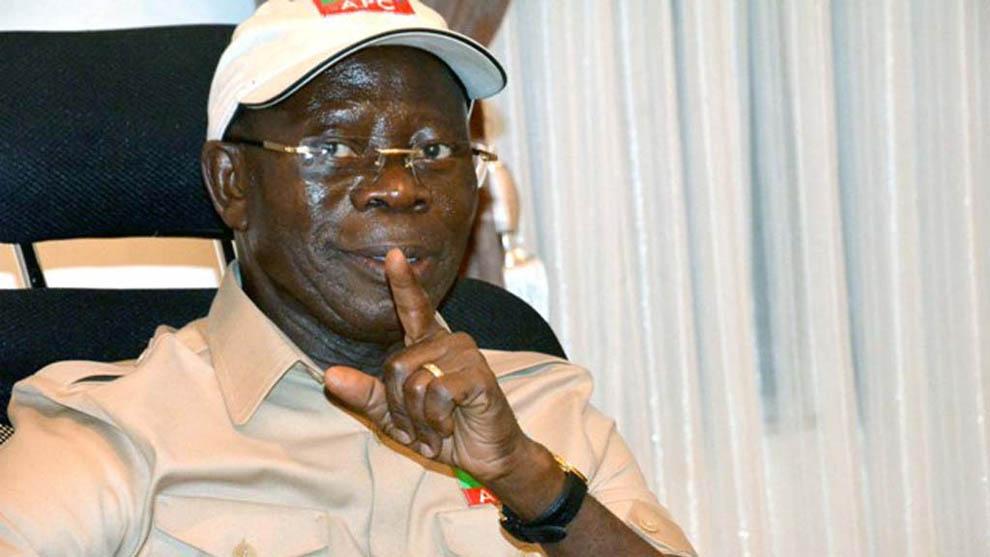
Oshiomhole Accuses Umahi of Bias in Road Projects, Demands Repairs Before New Construction
Oshiomhole Accuses Umahi of Bias in Road Projects, Demands Repairs Before New Construction
Senator Adams Oshiomhole has accused the Minister of Works, David Umahi, of alleged bias in the allocation of funds for federal road projects, insisting that the government should prioritise the rehabilitation of deteriorating highways before embarking on new construction.
Oshiomhole, who represents Edo North Senatorial District, made the allegations during a podcast interview shared on social media, revisiting his disagreement with Umahi over the management of federal road infrastructure and budgetary priorities.
The former Edo State governor said his criticism of the minister during a Senate budget-defence session was part of his responsibility to scrutinise government spending and ensure that public funds address the most pressing infrastructure needs.
According to Oshiomhole, several existing federal roads across the country have deteriorated to the point where motorists and commuters struggle to use them, yet the Ministry of Works continues to pursue new projects.
He argued that the government should concentrate available resources on rehabilitating roads that have become severely damaged instead of expanding the project portfolio while critical routes remain in poor condition.
“As a manager, you do not keep on building new houses when you cannot maintain the houses you already have. It is common sense,” Oshiomhole said.
The senator maintained that his intervention was not politically motivated, despite both men belonging to the ruling All Progressives Congress (APC).
He also criticised what he described as Umahi’s tendency to invoke President Bola Ahmed Tinubu’s name when responding to questions about the ministry’s decisions.
READ ALSO:
- 2027: Pantami Breaks Silence as INEC Excludes Him From Final Gombe Governorship List
- ‘My Wife Fed Actresses I Was Dating Despite Knowing About Our Affairs’ – Yinka Quadri
- Tension in Kano as Phone Traders Confront Chinese Sellers Over Cheaper Phones
Oshiomhole argued that the responsibility for identifying road maintenance priorities, assessing infrastructure conditions and proposing appropriate budgetary allocations rests with the minister rather than the President having to intervene in individual projects.
“Ministers should not drop his name to cover up their own mess,” he said.
The lawmaker further questioned the proposal to submit additional road projects to the Federal Executive Council when existing highways still require urgent attention. He called for greater coordination between the Ministry of Works and the Federal Roads Maintenance Agency (FERMA), which is responsible for maintaining federal roads.
Oshiomhole urged the minister to use reports from federal directors of works across the country’s geopolitical zones to identify the most urgent rehabilitation needs and guide spending decisions.
The senator’s latest comments follow his July 2026 criticism of the minister over the condition of major highways linking Edo and Delta states.
During a Senate plenary session, Oshiomhole complained about the condition of routes connecting Benin City with Warri, Asaba, Auchi and Okene, arguing that motorists continued to face serious difficulties despite the approval of new road projects elsewhere.
He alleged that critical sections of roads in the two states had been left out of federal budgetary allocations over several years and urged the Senate leadership to press the minister for a more balanced approach to infrastructure development.
Oshiomhole also said presidential intervention through tax credits had helped address parts of the affected road network.
The disagreement between the two APC figures had previously surfaced during a Senate budget-defence session in February 2026, when lawmakers questioned Umahi about the funding and implementation of major federal highway projects, including the Lagos-Calabar Coastal Highway.
During that exchange, Oshiomhole raised concerns about transparency in road funding and delays in releasing money for projects. Umahi, in turn, complained about the manner in which the senator questioned him, leading to a heated exchange before the session continued.
Umahi has also faced criticism over claims that federal road projects are concentrated in the South-East. In September, however, the minister rejected allegations of regional favouritism, insisting that projects were being implemented across the country in line with approvals granted by President Tinubu.
At an October 7 press conference, the Ministry of Works outlined progress on major federal highway projects and other road interventions, including work on the Lagos-Calabar Coastal Highway and the Trans-Saharan Highway corridor.
The ministry has also acknowledged challenges involving funding, contractors and project delivery. In June, Umahi warned contractors handling federal road projects against delays and said funding constraints had forced adjustments to the scope of some highway works.
Oshiomhole’s criticism has renewed debate over how the Federal Government should balance the construction of new highways with the maintenance and rehabilitation of existing roads.
While the senator is calling for greater attention to deteriorating routes, the minister’s position is that the government’s infrastructure programme covers strategic projects across multiple regions.
The key questions remain how road projects are prioritised, how available funds are distributed and how the government can ensure that existing highways receive timely repairs while major new infrastructure investments continue.
Oshiomhole has called on the Senate to strengthen its oversight of the Ministry of Works and ensure that road spending reflects the needs of communities and motorists across the country.
Oshiomhole Accuses Umahi of Bias in Road Projects, Demands Repairs Before New Construction
News
OASIS Muslim Care Foundation Holds Webinar on Healthy Lifestyles, NCD Prevention
OASIS Muslim Care Foundation Holds Webinar on Healthy Lifestyles, NCD Prevention
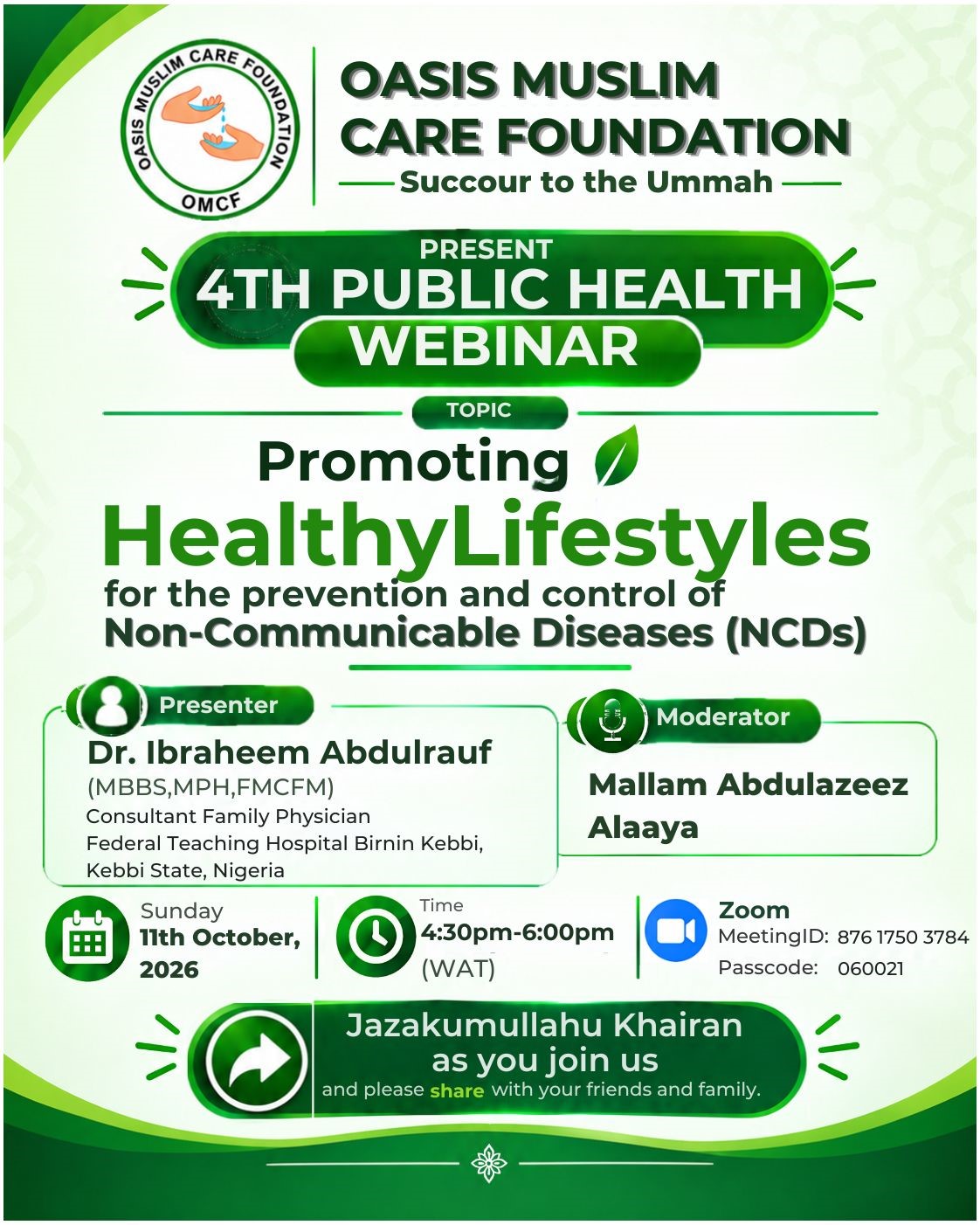
The OASIS Muslim Care Foundation is set to host its fourth public health webinar on Sunday, October 11, 2026, focusing on the promotion of healthy lifestyles as a strategy for preventing and controlling non-communicable diseases (NCDs).
The webinar, titled “Promoting Healthy Lifestyles for the Prevention and Control of Non-Communicable Diseases (NCDs),” is expected to educate participants on the importance of adopting healthier habits to reduce the risk of diseases that pose significant public health challenges.
The session will be delivered by Dr. Ibraheem AbdulRauf, a Consultant Family Physician at the Federal Teaching Hospital, Birnin Kebbi, Kebbi State.
Dr. AbdulRauf holds a Bachelor of Medicine and Bachelor of Surgery (MBBS), a Master of Public Health (MPH) and fellowship qualifications in family medicine (FMCFM).
READ ALSO:
- NNPC Petrol Discount: Motorists Must Download App to Save ₦66 Per Litre
- Panama Earthquake: 27 Injured as Powerful 7.7-Magnitude Tremor Damages Hundreds of Buildings
- EFCC Wins ₦132m Money Laundering Case as Court Orders Forfeiture of Lagos Properties
According to the event announcement, the webinar is part of the foundation’s public health engagement efforts aimed at promoting awareness and encouraging individuals to take practical steps towards improving their health and well-being.
Non-communicable diseases, including cardiovascular diseases, diabetes, cancers and chronic respiratory diseases, are major health concerns worldwide. Many of these conditions are associated with risk factors such as unhealthy diets, physical inactivity, tobacco use and harmful alcohol consumption.
Health education and the adoption of healthy lifestyle practices are important measures for reducing the risk of such diseases and improving the quality of life.
The online event is scheduled to commence at 4:30 p.m. West Africa Time (WAT) and will be held via Zoom.
Interested participants can join the webinar using the following details:
Meeting ID: 876 1750 3784
Passcode: 060021
Zoom link: https://us06web.zoom.us/j/87617503784?pwd=Xf2f6XuCfunLuNYjnbqjVfz92EFAt9.1
The foundation has invited members of the public to participate in the session and share the announcement with others to widen awareness of healthy living and the prevention and control of non-communicable diseases.
The webinar is open to everyone interested in learning more about practical approaches to maintaining good health and preventing lifestyle-related illnesses.
OASIS Muslim Care Foundation Holds Webinar on Healthy Lifestyles, NCD Prevention
News
₦60 Fuel Discount: Ondo ADC Slams Tinubu, Says Atiku Deserves Credit for Subsidy Restoration
₦60 Fuel Discount: Ondo ADC Slams Tinubu, Says Atiku Deserves Credit for Subsidy Restoration
The party describes the discount as inadequate relief for Nigerians battling rising petrol prices, transportation costs and the high cost of living ahead of the 2027 general election.
The Ondo State chapter of the African Democratic Congress (ADC) has criticised President Bola Ahmed Tinubu’s administration over its reported ₦60-per-litre petrol discount, describing the measure as inadequate to address the economic hardship confronting millions of Nigerians.
The party also commended former Vice-President Atiku Abubakar for advocating the restoration of fuel subsidy, arguing that government policies should prioritise citizens’ welfare and provide meaningful relief from the rising cost of living.
The ADC’s position was contained in a press statement signed by its Ondo State Publicity Secretary, Hon. Remi Ofakunrin, in which the party accused the All Progressives Congress (APC)-led Federal Government of offering Nigerians insufficient relief amid soaring fuel prices and declining purchasing power.
According to the statement, the reported ₦60 discount falls far short of what households, businesses, transport operators, students and workers need to cope with the prevailing economic challenges.
The party argued that Nigerians require sustainable measures to reduce the cost of living rather than temporary interventions that have limited reach and impact.
“At a time when Nigerians are struggling to survive the crushing cost of living, with petrol prices reportedly hovering around ₦1,400 per litre, the government’s decision to offer a mere ₦60 discount is not the relief citizens deserve,” the statement said.
The opposition party maintained that the discount was insignificant compared with the financial pressure experienced by ordinary Nigerians, particularly those whose livelihoods depend on transportation and fuel-powered businesses.
It accused the Tinubu administration of expecting public approval for what it described as a token concession after implementing policies that have significantly affected household budgets and business operating costs.
ADC questions petrol prices despite Nigeria’s crude oil resources
The ADC also questioned why petrol prices remained so high in Nigeria, an oil-producing country, despite the availability of abundant crude oil resources.
READ ALSO:
- ‘Mad People’: Presidency Fires Back at Amaechi Over Tinubu Re-Election Remarks
- ‘What Happens on Day 31?’ Atiku Slams Tinubu’s 30-Day Fuel Discount as Election-Laced Package
- Ronaldo Breaks Silence on Portugal Row as Pelé, Maradona Comparison Sparks Meme Frenzy
It asked why citizens should continue to struggle with the cost of fuel and other essential commodities while bearing the consequences of government economic policies.
The party further argued that the discount underscored the need for government intervention to cushion the effects of high fuel prices on the wider economy.
According to the ADC, the measure demonstrated that the consequences of petrol pricing remained a major concern requiring a broader policy response.
However, the party said a temporary discount at selected Nigerian National Petroleum Company Limited (NNPCL) filling stations could not provide lasting relief from the rising costs of food, transportation, production and other necessities.
It called on the Federal Government to adopt a more comprehensive and transparent approach to addressing fuel costs and their impact on Nigerians.
The ADC also urged the government to explain how the country’s oil resources could be better managed to improve citizens’ living conditions and promote national prosperity.
Atiku deserves credit for subsidy restoration advocacy — ADC
The Ondo ADC chapter used the statement to commend Atiku Abubakar for advocating the restoration of fuel subsidy as part of a broader strategy to ease economic hardship and improve the welfare of Nigerians.
The party said Atiku’s position deserved consideration, insisting that the debate should focus on how economic policies could protect citizens’ purchasing power and ensure that the benefits of the country’s natural resources reached ordinary people.
According to the ADC, the reported fuel discount reinforces the argument that government intervention may be necessary to cushion the effects of high petrol prices, although it maintained that the current measure was inadequate.
The party called for a more sustainable framework capable of delivering meaningful relief rather than temporary concessions.
It said Atiku and the ADC were committed to an economic direction that would enable workers to earn a living wage, businesses to operate sustainably and families to afford food, transportation, education and healthcare.
Beyond fuel subsidy, the party said its proposed policy direction included economic recovery, improved purchasing power, affordable education, local government autonomy, the fight against insecurity and corruption, and responsible management of national resources.
The statement presented these priorities as part of the party’s broader vision for addressing the country’s economic and governance challenges.
ADC urges Nigerians to vote for change in 2027
With the 2027 general election approaching, the Ondo ADC urged Nigerians to assess the performance of the current administration and consider alternative leadership.
The party cautioned citizens against being swayed by temporary concessions that, in its view, failed to address the underlying causes of economic hardship.
It called on voters to support Atiku Abubakar and other ADC candidates, arguing that a change in leadership and policy direction could provide an opportunity to improve living standards and restore public confidence in government.
The party said Nigeria needed leadership capable of addressing economic difficulties, insecurity and declining purchasing power while promoting national unity and development.
It also expressed confidence that the country could harness its human and natural resources to create prosperity and improve the welfare of present and future generations.
“A ₦60 discount cannot erase years of blanket display of mercilessness and economic hardship, but a change in leadership and policy direction can begin the process of national recovery,” the statement said.
The ADC consequently called on Nigerians to demand economic reforms that would produce measurable improvements in their daily lives and support the party in the 2027 elections.
Fuel pricing remains a major political issue
The statement highlights the continuing political debate over petrol pricing, the removal of fuel subsidy and the government’s responsibility to cushion the effects of economic reforms.
While the Tinubu administration has defended its economic policy direction as part of efforts to reform the economy, opposition parties have continued to raise concerns about the effects of higher fuel costs on transportation, food prices, businesses and household incomes.
The Ondo ADC’s latest position places fuel subsidy and the affordability of petrol at the centre of its campaign message ahead of the next general election.
However, the party’s claims about the adequacy of the discount and the benefits of subsidy restoration reflect its political position. The actual impact of any fuel discount depends on its implementation, duration, eligibility conditions and the extent to which the savings are passed on to consumers.
The statement was signed by Hon. Remi Ofakunrin, Publicity Secretary of the African Democratic Congress in Ondo State.
The party concluded by insisting that Nigerians deserved meaningful economic relief and urging voters to support what it described as an alternative path to national recovery.
₦60 Fuel Discount: Ondo ADC Slams Tinubu, Says Atiku Deserves Credit for Subsidy Restoration
-
 Africa3 days ago
FBI Raids Ghana Scam Centre, Detains Over 130 in $10m Fraud Probe
-
 metro3 days ago
EFCC Re-Arraigns Two Over Alleged £110,000 Money Laundering, ₦500m Fraud
-
 metro2 days ago
How Parents Raised Millions to Free 20 Abducted NYSC Members
-
 News3 days ago
World Bank Raises Nigeria Growth Forecast, Demands More Jobs, Poverty Reduction
-
 metro2 days ago
[UPDATED] Lagos Train Crash: 55-Year-Old Motorist Survives as Honda Car Is Wrecked at PWD Crossing
-

 metro3 days ago
Flood Submerges Enugu Road, Strands School Children, Passengers
-
 metro2 hours ago
Tension in Kano as Phone Traders Confront Chinese Sellers Over Cheaper Phones
-
 metro3 days ago
BREAKING: FG Unveils 10 Measures to Cushion Fuel Price, Inflation Pressures