
Business
No agenda to Islamise Nigeria, says Islamic Devt Bank

The Islamic Development Bank, IsDB, has no agenda to Islamise Nigeria, Dr. Thamer Baazeem, Director of Marketing and Communication, has said.
Leading a four-man delegation to Vanguard Regional Office, Abuja, yesterday, Baazeem explained that the IsDB was like any other development finance institution mainly focusing on the socio-economic development of the people in member countries.
He said: “Sometimes, because our name is Islamic Development Bank, some people think that we do projects to Islamise the places we operate, especially here in Nigeria, we have heard that a lot. I can assure you, this is not in our agenda at all.
“We are a socio-economic development agency or institution. Our projects can be in a Christian dominated community, depending on the needs of the country.
“If the national development plan says we have a need here and the project went well, the project will be done there, no matter the religion or ethnicity in that part of the country.
“Even our projects in non-member countries we help Muslim communities in non-member countries but we help them in projects like schools and hospitals.
READ ALSO:
- PDP moves to sideline Wike
- Auction: Lagos Assembly reviewing traffic law, says Justice commissioner
- INEC excludes Lawan, lists Akpabio, Umahi as APC senatorial candidates
‘’These facilities are open to everyone and we help them to be better citizens of their countries because when people have better economic status, they begin to contribute to the development of their nations, no matter whether they are Muslims or not.
‘’We need the media to help us in tackling this perception because that will help a lot in the success of our projects in Nigeria and other countries.”
He commended Nigeria for its leadership role among African region members countries and the bank, as a whole, which prompted it to establish the African regional hub in Abuja.
“Our decision to open the Region Hub Office in Nigeria is a demonstration of how important Nigeria is for us and to also show the people the impact of our projects.
“We have a portfolio of $1.8 billion in Nigeria with quite a number of projects. These projects are in several sectors to improve the socio-economic status of the people of Nigeria,’’ he said.
He also commended Nigeria’s quick response in contributing to the Special Fund for Afghanistan, following the Taliban take-over of government of that country last year, which precipitated the crisis there, saying Nigeria was the first country to contribute to that fund, along with Saudi Arabia.
In his remarks, Senior Regional Communications Specialist, Mr. Assane Ba, Mustapha, said the IsDB usually runs four-year programmes with member countries, adding that such programmes were determined by the priority and the needs of each country.
The Regional Editor, Vanguard Newspapers, Mr. Soni Daniel, who received the delegation on behalf of the Editor-in-Chief/General Manager, Mr. Gbenga Adefaye, assured of the organisation’s readiness to collaborate with the bank to improve the socio-economic status of Nigerians.
According to him, Vanguard is driven by a philosophy based on how to make the society a better place for all Nigerians.
Vanguard





Business
Fixing Nigeria’s Logistics Crisis: Oyetola, Stakeholders Demand Seamless Multimodal Infrastructure
Fixing Nigeria’s Logistics Crisis: Oyetola, Stakeholders Demand Seamless Multimodal Infrastructure
As Nigeria’s logistics and transportation landscape face a critical turning point, top government officials and industry experts have united to demand a shift away from the country’s heavy reliance on road travel.
Minister of Marine and Blue Economy, Dr. Adegboyega Oyetola, alongside transport experts and industry stakeholders, specificall called for the urgent integration of road, rail, maritime, inland waterways and aviation networks to accelerate economic growth and reduce logistics costs.
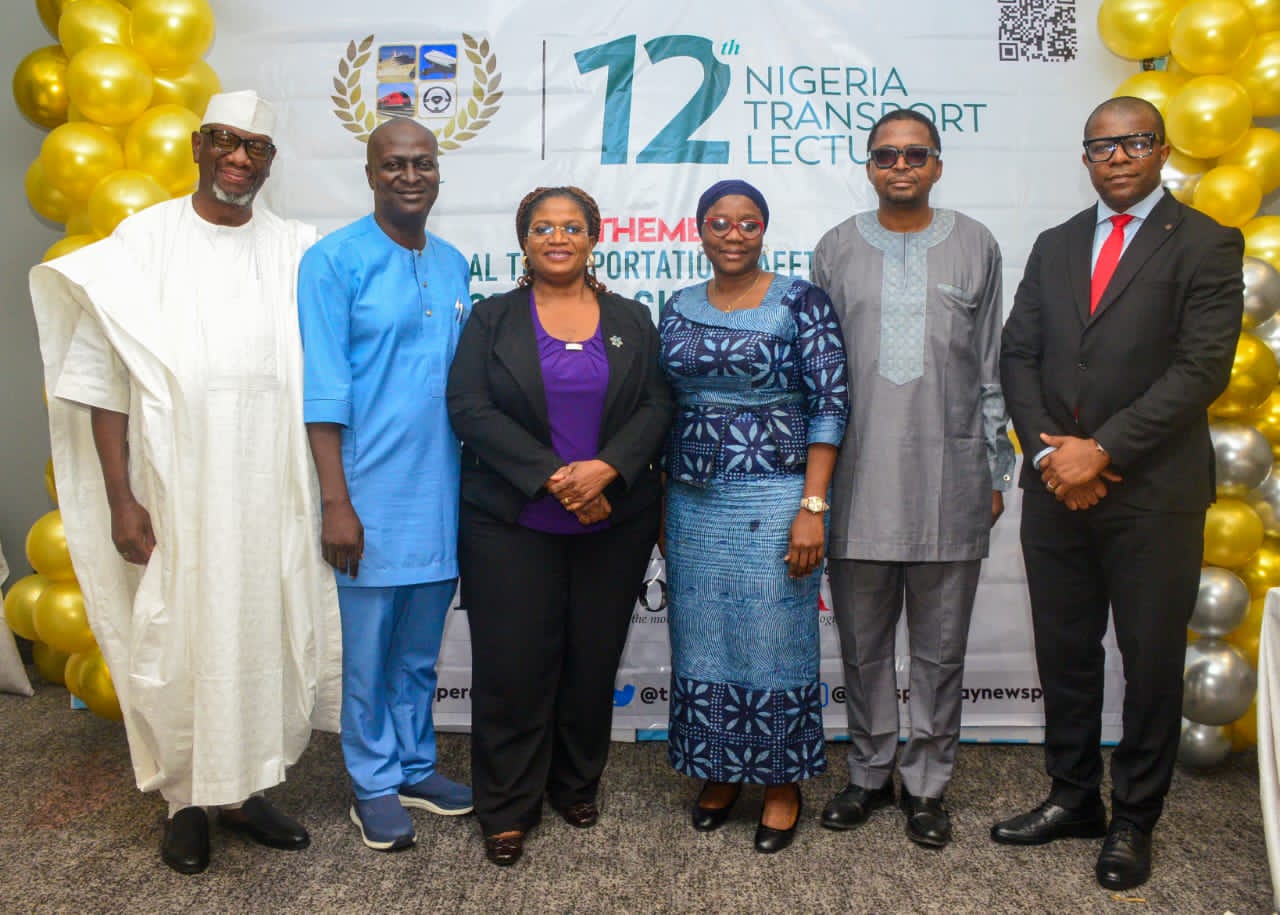
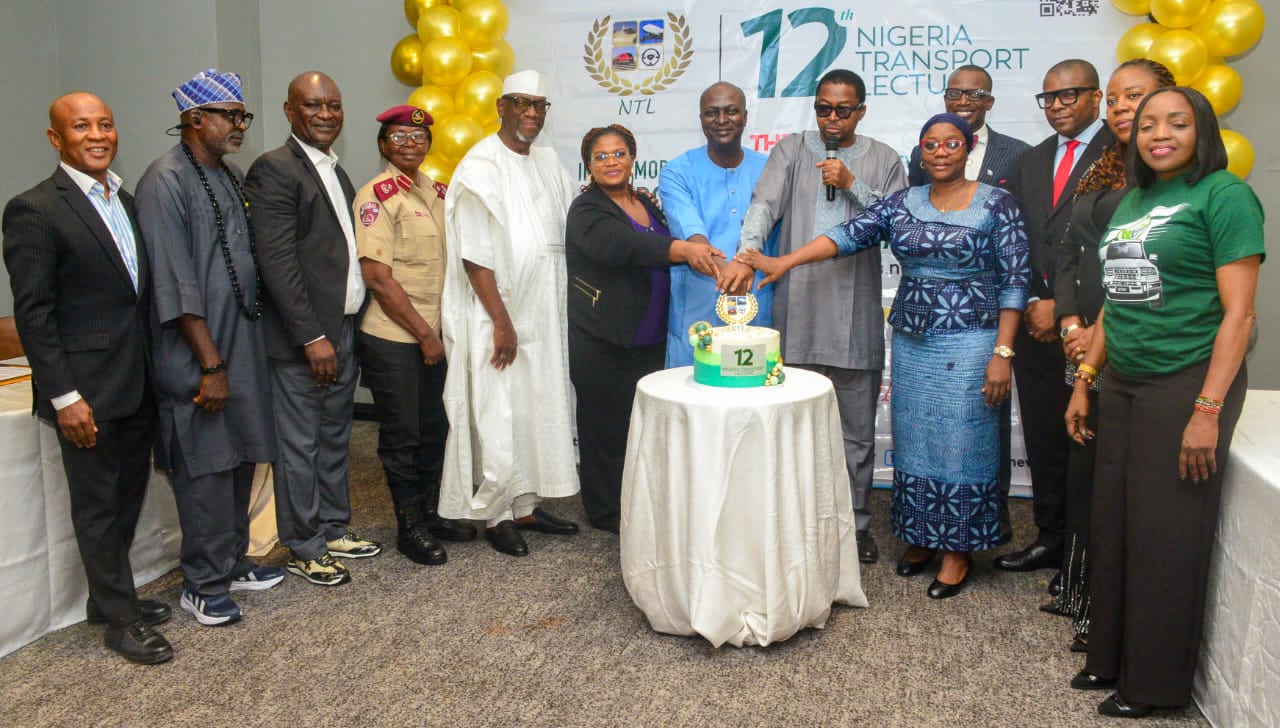
The consensus emerged at the 12th Nigeria Transport Lecture organised by Transport Day Newspapers at the Radisson Blu Hotel, Ikeja, Lagos, where participants stressed that Nigeria cannot achieve its full economic potential without a coordinated multimodal transportation framework.
Represented by a director in the ministry, Mrs Rashidat Yusuf, Oyetola described transportation as the backbone of economic development, trade facilitation and industrial growth, noting that the maritime sector remains central to Nigeria’s international trade and must be effectively linked with other modes of transport.
According to the minister, ongoing government investments in maritime security, port modernisation, digital transformation and inland waterway development are already yielding positive results by improving cargo movement, reducing logistics bottlenecks and enhancing investor confidence.
He said recent successes in combating piracy and other maritime crimes in the Gulf of Guinea have strengthened Nigeria’s position as a regional trade hub, while efforts to improve connectivity between seaports, rail lines and highways are expected to further boost economic productivity.
Oyetola, however, identified infrastructure deficits, weak inter-agency coordination, inadequate maintenance, regulatory bottlenecks and human capacity gaps as major obstacles to the sector’s growth, urging stakeholders to collaborate in addressing the challenges.
Delivering the keynote lecture titled, “Multimodal Transport Safety in Nigeria: Prospects, Challenges and Contribution to National Growth Pursuant to the Renewed Hope Agenda,” former Corps Marshal of the Federal Road Safety Corps and Chairman of the Council of the Chartered Institute of Logistics and Transport, Dr Boboye Oyeyemi, warned that Nigeria’s heavy dependence on road transport is undermining safety, increasing costs and limiting economic growth.
Oyeyemi disclosed that nearly 90 per cent of freight and passenger movement in the country is carried out by road, placing enormous pressure on infrastructure, accelerating road deterioration and heightening accident risks. He added that only about 40 per cent of Nigeria’s road network is paved, further compounding the challenge.
The transport expert noted that although Nigeria possesses one of Africa’s largest transportation systems, it has yet to maximise the benefits of a fully integrated multimodal network.
He pointed to ongoing rail projects, including the Lagos-Ibadan Standard Gauge Railway and the Abuja-Kaduna corridor, as evidence of progress towards reducing pressure on the roads.
He further noted that plans to achieve 24-hour port operations, improve rail connectivity to seaports and expand the commercial use of inland waterways could significantly enhance logistics efficiency and strengthen Nigeria’s competitiveness under the African Continental Free Trade Area (AfCFTA).
In a lead paper titled, “From Port to Hinterland: Rethinking Safety Governance Along Nigeria’s Intermodal Freight Corridors,” Associate Professor of Transport and Logistics at Lagos State University, Dr Ogochukwu Ugboma, called for a fundamental shift in the management of freight transportation in Nigeria.
She argued that safety should be treated as a governance issue rather than merely an operational concern, stressing that fragmented oversight across different transport modes continues to undermine logistics efficiency and freight safety.
According to Ugboma, more than 85 per cent of cargoes destined for Nigeria’s hinterland leave the ports by road, contributing to congestion, infrastructure damage, truck crashes, cargo theft and supply chain disruptions.
She advocated corridor-based governance, unified safety standards, shared databases, coordinated inspections and real-time monitoring systems to improve freight movement.
Also speaking, the Registrar of the Council for the Regulation of Freight Forwarding in Nigeria, Mr Kingsley Igwe, said the country possesses immense potential to develop a world-class intermodal transportation system.
He, however, identified inadequate infrastructure connectivity, regulatory fragmentation, poor maintenance culture, security challenges, human capacity deficits and limited deployment of data and technology as major impediments to progress.
Igwe urged the government to accelerate the adoption of water-based transportation, arguing that greater use of inland waterways would ease highway congestion, reduce freight delays and lower logistics costs that contribute to inflation and rising business expenses.
Earlier, the Publisher and Managing Editor of Transport Day Newspapers, Frank Kintum, said the annual lecture was established to provide a platform for regulators, operators and policymakers to identify challenges and develop practical solutions for the transport sector.
Participants at the event unanimously agreed that sustained infrastructure investment, stronger safety governance and seamless integration of all transport modes are critical to building a modern transportation system capable of driving Nigeria’s economic transformation under the Renewed Hope Agenda.
Insurance
Regency Alliance Insurance Launches Rights Issue to Strengthen Capital Base, Drive Expansion
Regency Alliance Insurance Launches Rights Issue to Strengthen Capital Base, Drive Expansion
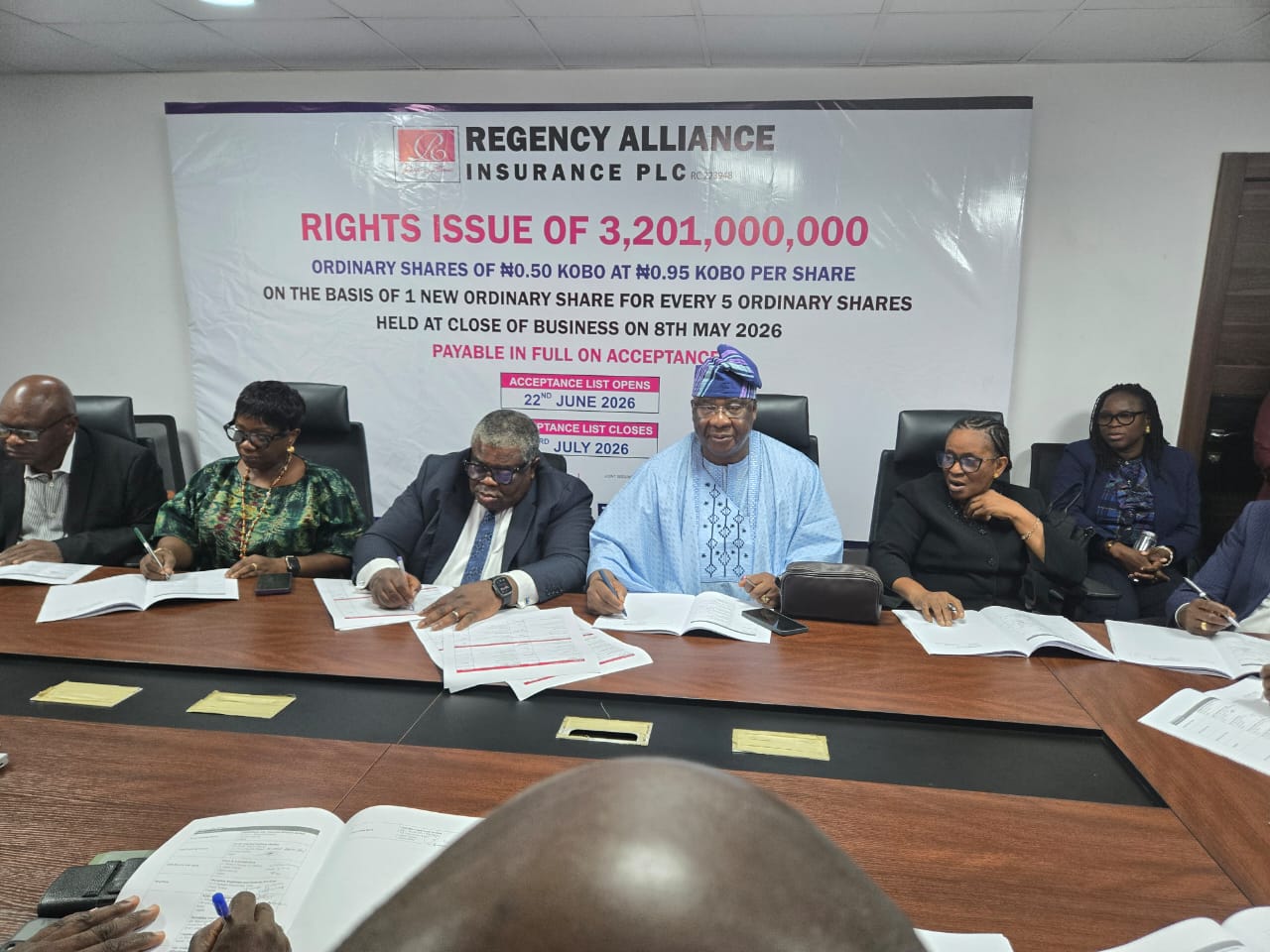
LAGOS – Regency Alliance Insurance Plc has taken a significant step toward strengthening its financial position and accelerating business growth with the formal signing of its Rights Issue Agreement, paving the way for a fresh capital injection aimed at enhancing the company’s competitiveness and long-term sustainability.
The signing ceremony, held at the insurer’s headquarters in Lagos on Wednesday, brought together members of the Board of Directors, management team, issuing house, legal advisers, stockbrokers and other stakeholders, reflecting widespread confidence in the company’s strategic direction and growth prospects.
Under the Rights Issue, Regency Alliance Insurance Plc is offering 3.201 billion ordinary shares of 50 kobo each at 95 kobo per share, on the basis of one new ordinary share for every five ordinary shares currently held by shareholders.
The capital raise is expected to bolster the company’s capital base, improve underwriting capacity and provide funding for strategic investments in technology, product innovation and customer service enhancement.
Speaking during the signing ceremony, the Acting Chairman of Regency Alliance Insurance Plc, Chief Wale Taiwo, SAN, described the development as a major statement of confidence in the company’s future.
According to him, the exercise represents more than a regulatory requirement, noting that it reflects faith in the organisation’s workforce, business strategy and the trust reposed in it by customers and shareholders over the years.
READ ALSO:
- Court Declares PENGASSAN Strike Against Dangote Refinery Illegal, Labels Crude Supply Disruption ‘Economic Sabotage’
- Libya Arrests Two Nigerians Over “Inciting” Social Media Posts
- LP Chieftain Calls for Protest Against Peter Obi Over Okonkwo Feud
“Today’s signing is more than a formality. It is a statement of belief – belief in our people, our strategy, and the trust our customers and shareholders have placed in us over the years,” Taiwo said.
He explained that the additional capital would enable the company to respond more effectively to evolving risk landscapes, expand its market reach and strengthen its commitment to policyholders.
“This capital raise will give us the firepower to meet evolving risks, expand our reach, and deepen the promise we make to every policyholder: that Regency Alliance will be there when it matters most,” he added.
Taiwo also expressed appreciation for the continued support of shareholders and urged all eligible investors to fully participate in the offer.
He noted that taking up their rights would not only protect existing investments from dilution but also allow shareholders to benefit directly from the company’s future growth and profitability.
Also speaking, the Managing Director of the company, Mr. Bode Oseni, said the proceeds from the Rights Issue would accelerate Regency Alliance’s ongoing digital transformation agenda and support the development of innovative insurance products targeted at underserved market segments.
According to Oseni, the company remains committed to maintaining its reputation as an agile, customer-focused and financially sound insurer.
“The proceeds from this Rights Issue will accelerate our digital transformation, enhance claims efficiency, and enable us to introduce innovative products tailored to SMEs, Gen Z, and other underserved segments across Nigeria and beyond,” he said.
“We are not merely raising capital; we are raising our ambition.”
He expressed optimism that shareholders would embrace the opportunity and demonstrate confidence in the company’s future by fully subscribing to the offer.
Regency Alliance stated that the Rights Issue is intended to strengthen its solvency position, support business expansion and fund investments in digital infrastructure and new product development.
The company noted that existing shareholders would have the opportunity to subscribe for additional shares in proportion to their current holdings, thereby preserving their ownership interests while participating in future value creation.
Management further said the successful execution of the signing process demonstrates strong confidence among advisers and stakeholders in the company’s corporate governance framework, risk management systems and long-term business strategy.
According to the timetable released by the company, the Acceptance List will open on June 22, 2026, and close on July 3, 2026, during which eligible shareholders are expected to submit their applications.
Regency Alliance Insurance Plc has established itself as one of Nigeria’s leading general insurance providers, offering a broad range of insurance products to individuals and businesses across the country. The company is known for prompt claims settlement, innovative insurance solutions and adherence to strong corporate governance standards.
With the signing of the agreement and the completion of required regulatory approvals, the company said it would proceed with shareholder communications and implementation of the offer in compliance with the requirements of the Securities and Exchange Commission (SEC) and the Nigerian Exchange Limited (NGX).
The Board and Management expressed confidence that the Rights Issue would receive strong shareholder support and position the insurer for sustainable growth, enhanced profitability and increased market relevance in Nigeria’s evolving insurance industry.
Regency Alliance Insurance Launches Rights Issue to Strengthen Capital Base, Drive Expansion
Business
UK Social Media Ban Could Increase Online Risks for Teens — Telegram CEO

UK Social Media Ban Could Increase Online Risks for Teens — Telegram CEO
Telegram CEO, Pavel Durov, has intensified his criticism of the United Kingdom’s proposed policy to restrict social media access for users under the age of 16, describing the move as “dangerous” and arguing that it could create unintended risks for teenagers rather than protect them.
The UK government is currently advancing plans to ban under-16s from accessing major social media platforms, including Instagram, TikTok, Snapchat, Facebook, YouTube and X (formerly Twitter), as part of a wider online safety framework aimed at reducing children’s exposure to harmful content, cyberbullying and online exploitation.
Under the proposal, platforms would be required to enforce strict age-verification systems, which could include government-issued identification checks, facial recognition technology, or bank card verification before users are allowed access.
According to official proposals, the measures form part of the government’s broader push to strengthen the Online Safety Act, with enforcement expected to be overseen by regulator Ofcom and phased in over the coming period.
READ ALSO:
- Kingibe Denies Endorsing Akpoti-Uduaghan Suspension
- Witness Reveals How Sirika Approved Nigeria Air Consultancy Deal for Associate
- Police Arrest Boko Haram, Lakurawa Terror Suspects, Rescue Kidnap Victim
Reacting in a series of posts on X, Durov questioned the effectiveness of age-based restrictions, arguing that teenagers are likely to bypass such controls using VPNs and other tools, which he says may expose them to even less regulated and more harmful online environments.
He warned that banning social media outright for teenagers “only puts them in greater danger,” adding that historical attempts to restrict platforms in other countries did not stop usage, but instead pushed users to alternative access methods.
Durov also stressed that parental responsibility remains more effective than government bans, insisting that parents already have tools such as screen-time controls and parental monitoring systems to manage children’s online activity.
He further argued that excessive regulation cannot replace parenting choices, noting that many children are already introduced to digital devices at a very young age without adequate supervision.
The Telegram chief also raised concerns about the privacy implications of mandatory age verification, suggesting that requiring users to prove their identity online could lead to increased data collection and surveillance risks.
He questioned whether the policy was solely about child protection or whether it could also expand government oversight of online users, a point that has added to ongoing debates about digital privacy and regulation in the UK.
The UK government, however, maintains that stronger restrictions are necessary to protect children from online harm, while public debate continues over how best to balance child safety, privacy, and digital freedom in an increasingly connected world.
The proposal is still under consideration, with further details expected as lawmakers refine the framework before implementation.
UK Social Media Ban Could Increase Online Risks for Teens — Telegram CEO
-

 metro2 days ago
BREAKING: UK Court Clears Diezani Alison-Madueke of All Bribery Charges
-

 metro2 days ago
‘They Assigned One Girl to 3 or 4 Men Daily’: Survivor Recounts 20 Days of Rape, Torture in Bandits’ Den
-

 metro3 days ago
Abducted Kwara Monarch Dies in Captivity Despite N18m Ransom Payment
-

 News23 hours ago
FG Launches FreeTV, Offers Nigerians Over 100 Free Digital TV Channels
-

 Business3 days ago
Dangote Refinery Announces New Petrol Price as Crude Oil Eases
-
 metro2 days ago
Iyabo Obasanjo Secures PDP Senate Ticket After Party Switch
-

 metro2 days ago
Oshiomhole Clarifies Remarks on Natasha Suspension, Denies Forgery Allegation
-
 International1 day ago
US-Iran MoU Details Emerge: $300bn Reconstruction Aid, Sanctions Relief in 14-Point Deal