

metro
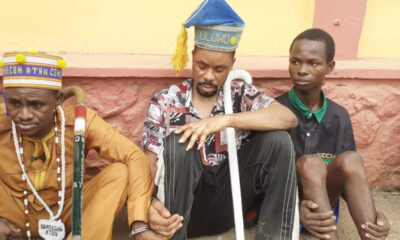
Beninese father, others arrested over attempt to use son for ritual

Beninese father, others arrested over attempt to use son for ritual
The Zone 2 Police Command has arrested a 50-year-old Beninese father, Mr Pome Banda, and three others who allegedly lured a nine-year-old boy from Benin Republic for money ritual.
The Assistant Inspector-General of Police (AIG), Mr Ari Mohammed, disclosed this to newsmen in Lagos.
Mohammed said in the process of their plans, Zone 2 Criminal Investigation Department got information about them and the police acted as the herbalist who wanted to help them to use the boy for money ritual.
He said the operatives started discussing with the boy’s father, his brother living in Nigeria, one Benjamin Balobi, and two Nigerians – Segun Shile and Ige Koshelu.
The AIG said that Banda left Ajah Jakatome, his hometown in Benin Republic and came to Nigeria on May 30, 2023 with his son after telling him that they were coming to secure a housemaid job for him.
He said the boy was given to a man simply identified as Baba Shina, now at large, as his house help.
Mohammed said after the boy lived with Baba Shina for a month, he was then taken back to Cotonou and N35,000 was given to his father in his presence as salary so as to confuse the boy.
He said that between June 17 and 23, Banda, after making final arrangement with other suspects, brought the boy from Benin Republic again to Nigeria for money making ritual purpose.
READ ALSO:
- Discos to upgrade customers’ metering before Nov. 2024 – official
- Review hike in school fees, ASUU president, others advise FG
- #Endsars: Lagos explains N62m approval for 103 victims mass burial
The AIG said the four suspects involved were arrested at Sango Ota in Ogun, the presumed native doctor place, stressing that all suspects have confessed to the crime.
He said they would be charged to court soon at the completion of investigation.
The News Agency of Nigeria (NAN) reports that during interrogation, the boy’s father who spoke through an interpreter at the Zone 2 Police Command Headquarters, Onikan Lagos, said he wanted to use his fifth child for ritual because he was poor.
He said he called his brother living in Nigeria, Mr Benjamin Balobi, to make contact for a house help job and also assist in the money ritual.
Banda said his brother was able to secure one Baba Shina as his house help master.
He said he was connected to a Nigerian, one Ige Koshelu and discussed with him of what he wanted to use his son to do.
He said he met Koshelu at Ilaro area of Ogun, who then contacted another Nigerian, Segun Shile, who allegedly made arrangement for a herbalist at the Owode Yewa area in Ogun.
Banda said Shile became the middleman and coordinator between Ige, himself and the suspected herbalist, they never knew was a policeman.
On the part of Benjamin Balobi, the boy’s father called him to know what he was doing in Nigeria and wanted him to help get a place where his son would work as a house boy.
Balobi said he told Banda that the job he saw paid N5,000 salary monthly.
“It was later he opened up to me that he wanted to use his son for money ritual, that is when I connected him with one Baba Shina who is on the run now. The boy was taken to Baba Shina house.
“He said he wanted to be rich, that was why he wanted to use his son for the ritual, but I don’t know anything about it. I only assisted him to secure a house help job for his son,” he said.
Ige Koshelu said that when Banda brought his son from Benin Republic, it was Baba Shina ( the boy’s master) that called to inform him that he wanted to use his son for money ritual.
READ ALSO:
- 20 BBN housemates ushered in for All Stars edition
- Gunmen attack ex-Information minister Maku’s house in Nasarawa
- [BREAKING] Recruitment: NDLEA releases names of successful candidate, see full list
Koshelu said that he told Banda that he did not know anything about ritual, but promised to help them to ask another friend who may help them to get a herbalist.
“It was a friend of mine whom I contacted that promised to get someone for them at the Oja Odan area of Ogun, who finally helped them.
“It was that my friend who later took us to the herbalist house at Owode Yewa, and from Owode Yewa, we moved again to Sango to meet the herbalist. Unfortunately, we were arrested at the scene where the policemen were already waiting,” he said.
Segun Shile said he was at Oja-Odan working as a welder when Koshelu met him that someone wanted to do money ritual with his son.
Shile said that the herbalist called on phone at Owode Yewa about the matter said that there was nothing like money ritual.
He said five days after, the herbalist called him again requesting to see him and the man who wanted to use his son for money ritual and they visited him.
“The herbalist called me two days after again that he had contacted another herbalist, who promised to help them but will collect N100,000.
“Balobi then told me he would donate N50,000, while I and Koshelu should contribute the remaining N50,000, as the father of the boy will not bring a dine, because he presented his son for the ritual.
“After the contribution, we took the money to the herbalist, after collecting it, he kept it under his mat and picked his phone to call someone.
“Few hours later, we were arrested on the spot by the police while we were waiting for the second herbalist,” he said. (NAN)









metro
Nigerian military’s X account hacked as attackers push crypto scam

Nigerian military’s X account hacked as attackers push crypto scam
The official X account of Nigeria’s Defence Headquarters (DHQ), @DHQNigeria, has been compromised, with hackers using the platform to promote a cryptocurrency scam to its nearly one million followers.
The account, which had about 982,900 followers, was taken over on Saturday, with unauthorised posts promoting Firelight FXRP rewards and directing users to a cryptocurrency claims portal.
The breach was confirmed by the Defence Headquarters in a statement signed by the Director of Defence Information, Major General Samaila Uba.
Uba said the military was treating the incident as a cybersecurity matter and had activated measures to secure the account and prevent further unauthorised activity.
He urged Nigerians to disregard any “suspicious, unauthorised or misleading content” published through the account while efforts continued to restore full control.
The DHQ also advised members of the public, journalists and other stakeholders to rely on its verified accounts on other social media platforms for official information during the recovery process.
READ ALSO:
- Peterside Demands INEC Explain Hours-Long Delay in Uploading Final Osun Election Results
- From Pulpit to Ifá Shrine: Ex-Pastor Exposes ‘Deceit’ in Christianity, Embraces Yoruba Tradition
- Osun election: Adeleke widens lead as Oyinlola, Omisore lose polling units
The compromised account has been an important communication channel for the Nigerian Armed Forces, providing updates on military operations, security developments, official activities and other information from the Defence Headquarters.
Screenshots reviewed after the breach indicated that the last clearly identifiable military-related post on the account was published on August 7, before the cryptocurrency-related content began appearing.
The account, created in May 2013, had built a substantial following over the years and retained its established identity even after the compromise, making the unauthorised posts potentially more convincing to unsuspecting users.
The attackers reportedly used the account to promote Firelight FXRP rewards and encourage users to visit a cryptocurrency claims portal. The Defence Headquarters has not endorsed the scheme and warned the public against relying on the unauthorised posts.
The exact method used to compromise the DHQ X account remains unknown. The military has not disclosed whether the attackers gained access through stolen login credentials, social engineering, a compromised device or another method.
The Defence Headquarters has also not identified the individuals or group responsible for the breach and has not disclosed whether anyone suffered financial losses after interacting with the cryptocurrency content.
The incident highlights the growing security risks faced by verified social media accounts, particularly those belonging to government institutions and other organisations with large audiences.
Cybercriminals have increasingly targeted high-profile accounts because control of an established platform can give fraudulent messages an appearance of legitimacy and expose large numbers of followers to potentially harmful links.
In the case of the Nigerian military’s X account, the security implications extend beyond the cryptocurrency scam because the platform is also used to communicate official information concerning national security and the activities of the Armed Forces.
The DHQ has therefore cautioned the public against treating posts from the compromised account as official until the military confirms that it has regained full control.
Nigerians have also been advised not to click on suspicious links, connect cryptocurrency wallets, transfer funds or submit personal information in response to the unauthorised posts.
The Defence Headquarters said efforts to recover and secure the hacked X account were ongoing and that further information would be provided as the situation develops.
For now, the military’s warning remains clear: any cryptocurrency-related content appearing on @DHQNigeria should be treated as unauthorised until the Defence Headquarters announces that control of the account has been fully restored.
Nigerian military’s X account hacked as attackers push crypto scam
metro
From Pulpit to Ifá Shrine: Ex-Pastor Exposes ‘Deceit’ in Christianity, Embraces Yoruba Tradition
From Pulpit to Ifá Shrine: Ex-Pastor Exposes ‘Deceit’ in Christianity, Embraces Yoruba Tradition
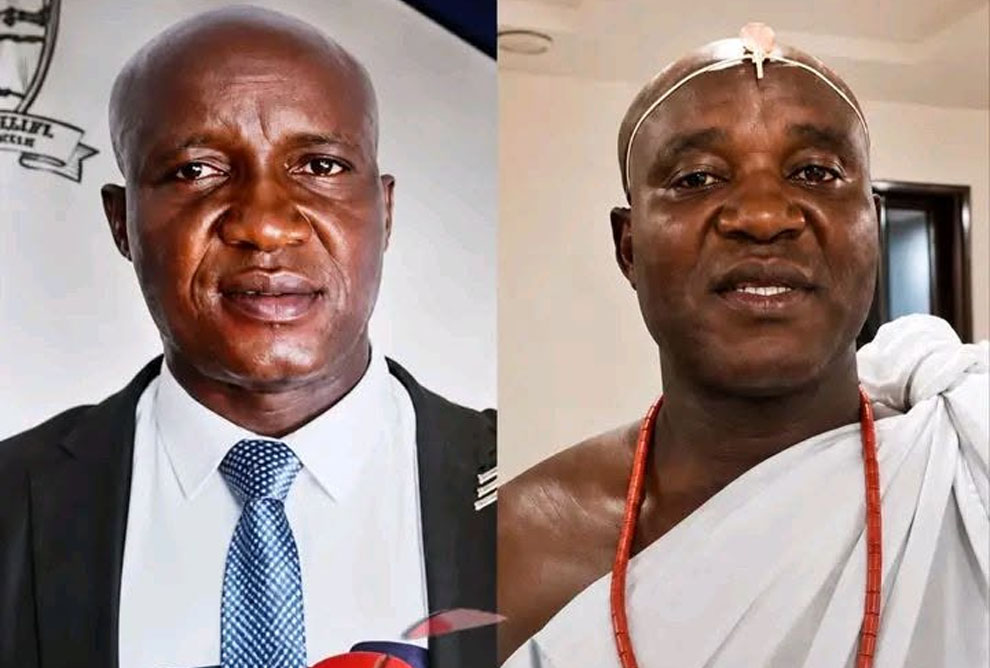
After a two-year soul-searching journey, an Ondo State-based cleric has publicly abandoned his pastoral ministry to embrace Ìṣẹ̀ṣe, the traditional Yoruba spiritual practice, citing widespread deception among Christian leaders and contradictions in the Bible.
Olabanjo Felix, who once led the Image of God Evangelical and Prophetic Ministries in Ibaka, Oka Akoko, Ondo State, has officially transitioned from Christianity to become a Babalawo (Ifá priest). In a viral video that surfaced on Thursday, Felix announced his new spiritual identity as Ifawamiri Aworan Olodumare, declaring his allegiance to the indigenous Yoruba faith. The former pastor told Sunday PUNCH that his decision was not impulsive but the culmination of a two-year period of intense spiritual introspection. During this time, he became deeply troubled by what he perceived as contradictions within the Bible and what he described as the commercialisation and manipulation of Christianity by Nigerian pastors. He emphasised that he publicly announced his transition to stop people from continuing to address him as a pastor, stating that he could not accept a title that no longer reflected his beliefs.
Felix did not mince words in his criticism of the Christian faith as practised in Nigeria. He alleged that there is “no true pastor of the Bible in Nigeria,” with the exception of Pastor Gbile Akanni, and accused many church leaders of turning Christianity into a family business designed to enrich themselves and brainwash their congregations. He claimed that his deep understanding of the Bible, acquired through years of study, made him increasingly uncomfortable with the inconsistencies he found in the scriptures. Felix further alleged that many pastors who publicly condemn traditional religions secretly consult Ifá practitioners for divination, a hypocrisy he said he could no longer tolerate. His frustration, he explained, was not with God but with the institutionalised deception he witnessed, which ultimately drove him to seek spiritual authenticity elsewhere.
READ ALSO:
- Osun election: Adeleke widens lead as Oyinlola, Omisore lose polling units
- 2027: Atiku’s suit seeking Tinubu’s disqualification meets deadline, faces procedural hurdle
- APC Humiliates Aregbesola, Wins His Polling Unit in Osun Governorship Election
Before settling on Ifá, Felix revealed that he had seriously considered converting to Islam. He consulted a Muslim cleric who advised him to study the Quran, and he subsequently downloaded the Yoruba translation of the holy book. However, after reading it, he concluded that he found the same level of deception that had driven him away from Christianity. This realisation, he said, solidified his resolve to look inward toward his ancestral heritage, leading him to explore the traditional Yoruba spiritual system of Ifá. He began searching for genuine Ifá priests who could mentor him, determined to find a path that felt authentic and free from the manipulation he had experienced in the Abrahamic religions.
Felix’s search for guidance eventually led him to the Araba of Isararemọ, Oluṣẹgun Latunji Aifuwapẹ, whom he discovered on Facebook. He reached out to the revered traditional priest and expressed his intention to learn Ifá. Since joining the Araba’s spiritual community, Felix said he has been engaged in prayers, supplications, and the study of herbs and roots, which he described as potent and effective. He insisted that his practice is not fetish, as many outsiders assume, but rather a disciplined spiritual system focused on healing, destiny, and connection to the divine through the Orishas and ancestors. He noted that foreigners from around the world visit the Araba’s centre to learn about Ifá, a testament to the growing global interest in the tradition.
A significant factor in Felix’s decision to embrace Ifá was his personal experience with traditional herbs and roots. He said that his conviction was strengthened by witnessing their potency, which he contrasted with what he perceived as the empty rituals and ineffective prayers of modern Christianity. For Felix, the tangible results of traditional medicine and spiritual practices validated the Ifá system in a way that Christianity could not. He now views Ìṣẹ̀ṣe not as a primitive or backward belief system but as a sophisticated spiritual science that has sustained the Yoruba people for centuries, long before the arrival of colonial religions.
READ ALSO:
- Oyo Police Smash Human Parts Syndicate: 10 Arrested, Heart, Skull Recovered
- Heavy Security, Long Queues, Massive Turnout Mark Osun Governorship Election in Ede
- Protest in Osogbo Over Ballot Paper Shortage, Missing Voter Names
Felix’s public renunciation of Christianity has generated significant buzz on social media, with reactions sharply divided. Some online users have applauded his courage to follow his convictions and reconnect with his ancestral roots, while others have questioned the sincerity of his years in ministry. A number of commentators speculated that Felix may have always been a traditional practitioner in disguise, while others expressed sympathy for his former congregation, who had trusted his pastoral leadership. The viral video has also reignited broader conversations about the role of Christianity in Nigeria, the legacy of colonialism, and the growing movement of Nigerians returning to indigenous spiritual practices.
Felix’s story is part of a larger trend across the African diaspora, where individuals are increasingly rejecting foreign religions in favour of indigenous spiritual systems like Ifá, Vodun, and Candomblé. This movement is often framed as an act of decolonisation—a reclamation of identity, culture, and spirituality that was suppressed during the transatlantic slave trade and colonial era. For many, embracing Ifá is not merely a religious choice but a political and cultural statement about the importance of ancestral heritage and self-determination. Felix’s journey underscores this shift, as he described his transition as a homecoming to a faith that feels more authentic and aligned with his identity as a Yoruba man.
Now known as Ifawamiri Aworan Olodumare, Felix has fully embraced his new role as a Babalawo. He expressed gratitude to his mentor, the Araba of Isararemọ, for guiding him through the transition. While he acknowledged that his decision has attracted criticism, he remains firm in his conviction, stating that he cannot continue to live a lie. He said he will now dedicate his life to the practice and propagation of Ifá, focusing on healing, spiritual counselling, and the preservation of Yoruba cultural heritage. He also reiterated that his practice is transparent and open, in contrast to the hidden hypocrisy he claims to have witnessed in Christian circles.
Olabanjo Felix’s journey from Christian pastor to Ifá priest is a deeply personal and controversial one, reflecting broader tensions between tradition and modernity, faith and authenticity, and colonialism and cultural reclamation. While his allegations against Christianity have drawn sharp criticism from religious leaders, his story has resonated with many who feel disconnected from the faiths imposed on their ancestors. Whether viewed as a betrayal or a homecoming, Felix’s transition highlights the complex spiritual landscape of contemporary Nigeria and the enduring power of indigenous belief systems.
From Pulpit to Ifá Shrine: Ex-Pastor Exposes ‘Deceit’ in Christianity, Embraces Yoruba Tradition
PUNCH
metro
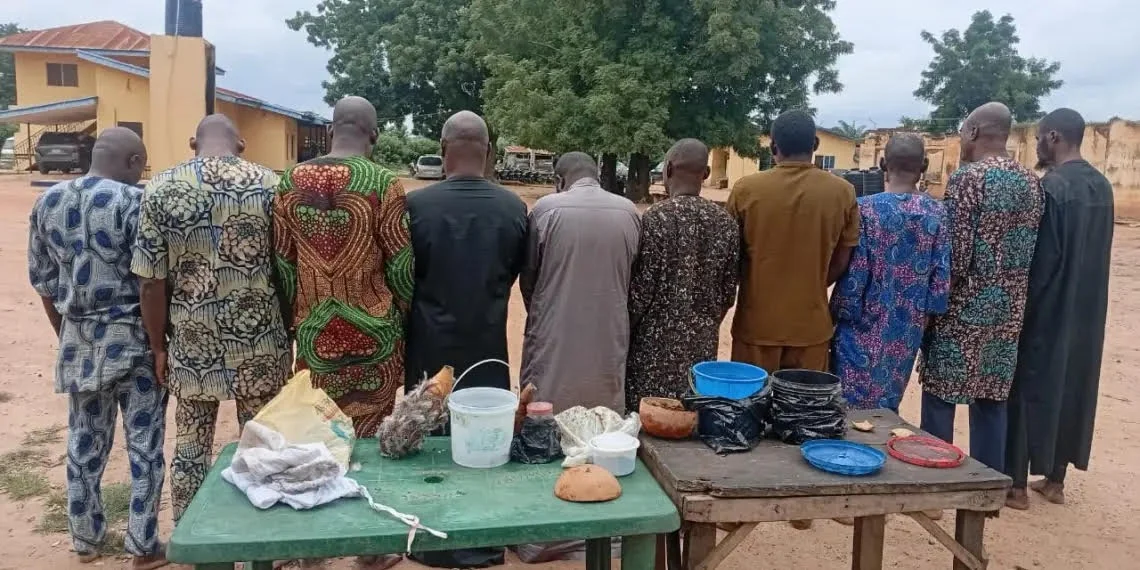
Oyo Police Smash Human Parts Syndicate: 10 Arrested, Heart, Skull Recovered
Oyo Police Smash Human Parts Syndicate: 10 Arrested, Heart, Skull Recovered
-

 News2 days ago
UK Opens 2026/27 Commonwealth Fellowship Applications for Nigerians – How to Apply
-

 Education3 days ago
JAMB Aggregate Score 2026/2027: How Nigerian Universities Calculate Your Admission Chances
-
![[UPDATED] Osun Election: Police Arrest Lawmaker with 200 PVCs, 146 Suspected Electoral Mercenaries](https://newstrends.ng/wp-content/uploads/2026/08/1786781299004-400x240.jpg)
![[UPDATED] Osun Election: Police Arrest Lawmaker with 200 PVCs, 146 Suspected Electoral Mercenaries](https://newstrends.ng/wp-content/uploads/2026/08/1786781299004-80x80.jpg) Politics2 days ago
Politics2 days agoOsun Decides: Over 100 ‘Imported’ Voters Arrested With New PVCs
-
 News3 days ago
Oyinlola Denies Adeleke’s Car Gift Claim: “Osun Govt Gave Me the Car, Not You”
-

 Entertainment1 day ago
Osun Election: Davido Alleges Soldiers Tried to Stop Him from Entering State
-
metro1 day ago
[UPDATED] Osun Election: Police Arrest Lawmaker with 200 PVCs, 146 Suspected Electoral Mercenaries
-

 International2 days ago
Netanyahu Calls UK ‘Islamic Republic of Britain,’ Sparks Outrage Over Islamophobic Remark
-

 Politics2 days ago
Osun Decides 2026: Over 40,000 Security Operatives Deploy as Voters Brave Tensions to Elect New Governor