

International
Ferrari begins accepting crypto as payment for its cars

Ferrari begins accepting crypto as payment for its cars
Ferrari (RACE.MI) has started to accept payment in cryptocurrency for its luxury sports cars in the U.S. and will extend the scheme to Europe following requests from its wealthy customers, its marketing and commercial chief told Reuters.
The vast majority of blue-chip companies have steered clear of crypto as the volatility of bitcoin and other tokens renders them impractical for commerce. Patchy regulation and high energy usage have also prevented the spread of crypto as a means of payment.
These include electric carmaker Tesla (TSLA.O), which in 2021 began to accept payment in bitcoin, the biggest crypto coin, before CEO Elon Musk halted it because of environmental concerns.
Ferrari’s Chief Marketing and Commercial Officer Enrico Galliera told that Reuters cryptocurrencies had made efforts to reduce their carbon footprint through the introduction of new software and a larger use of renewable sources.
“Our target to reach for carbon neutrality by 2030 along our whole value chain is absolutely confirmed,” he said in an interview.
Ferrari said the decision came in response to requests from the market and dealers as many of its clients have invested in crypto.
“Some are young investors who have built their fortunes around cryptocurrencies,” he said. “Some others are more traditional investors, who want to diversify their portfolios.”
READ ALSO:
-
Tinubu, Sultan, Bayero, Oloyede, 11 other Nigerians listed among 500 world influential Muslims
-
Euro 2024: Kylian Mbappe scores twice as France beat Netherlands to seal qualification
-
Insecurity: NSCDC deploys undercover agents to schools
While some cryptocurrencies, such as the second-largest, ether , have improved their energy efficiency, bitcoin still attracts criticism for its energy-intensive mining.
Ferrari shipped more than 1,800 cars to its Americas region, which includes the U.S., in the first half of this year.
Galliera did not say how many cars Ferrari expected to sell through crypto. He said the company’s order portfolio was strong and fully booked well into 2025, but the company wanted to test this expanding universe.
“This will help us connect to people who are not necessarily our clients but might afford a Ferrari,” he said.
The Italian company, which sold 13,200 cars in 2022, with prices starting at over 200,000 euros ($211,000) and going up to 2 million euros, plans to extend the crypto scheme to Europe by the first quarter of next year and then to other regions where crypto is legally accepted.
Europe, the Middle East and Africa (EMEA) is Ferrari’s largest region, accounting for 46% of its total car shipments in the first half of this year.
“Interest is the same in the U.S. and Europe, we don’t see huge differences,” Galliera said.
Countries where cryptocurrencies are restricted include China.
READ ALSO:
- Ondo Assembly halts impeachment process against Aiyedatiwa
-
Fake lawyer who won 26 cases against trained lawyers arrested
-
Suspected herdsmen hijack fully loaded Benue Links bus, butcher passengers
Ferrari has turned to one of the biggest cryptocurrency payment processors, BitPay, for the initial phase in the U.S., and will allow transactions in bitcoin, ether and USDC, one of the largest so-called stablecoins. Ferrari might use other payment processors in different regions.
“Prices will not change, no fees, no surcharges if you pay through cryptocurrencies,” Galliera said.
Bitpay will immediately turn cryptocurrency payments into traditional currency on behalf of Ferrari’s dealers, so they are protected from price swings.
“This was one of our main goals: avoiding, both our dealers and us, to directly handle cryptocurrencies and being shielded from their wide fluctuations,” Galliera said.
As the payment processor, BitPay will ensure that the virtual currencies come from legitimate sources and not derived from criminal activity or to be used to launder the proceeds of crime or evade tax.
Ferrari’s marketing and commercial chief said that the majority of its U.S. dealers have already signed up, or are about to agree, to the scheme
“I am confident others will join soon,” Galliera said.
(REUTERS)






International
UK Navy Sailor Charged Over Alleged Plot to Leak Intelligence to Russia

UK Navy Sailor Charged Over Alleged Plot to Leak Intelligence to Russia
A 24-year-old British Royal Navy sailor has been charged with national security offences over an alleged plot to obtain sensitive military intelligence and pass protected information to Russia, raising fresh concerns about the security of classified defence information.
The suspect, Teddy Young, appeared before Westminster Magistrates’ Court in London on Thursday, October 8, where the allegations against him were outlined.
According to British authorities, Young faces two charges under the National Security Act 2023 relating to the alleged retention of protected information and preparations to disclose sensitive material for the benefit of a foreign power.
The Crown Prosecution Service (CPS) alleged that Young accessed and retained sensitive United Kingdom defence and intelligence information while serving as a Royal Navy warfare intelligence rating with high-level security clearance and access to intelligence systems.
Prosecutors said the alleged offences occurred between November 2024 and May 2025, during his first deployment, which began on November 4, 2024.
The allegations include obtaining, copying, recording or retaining protected information with the intention of benefiting a foreign power, as well as engaging in conduct in preparation for disclosing the material.
READ ALSO:
- How Parents Raised Millions to Free 20 Abducted NYSC Members
- Lasaco Assurance Retains A(NG) Rating as Revenue Rises 35.2% to N30.8bn
- Man Allegedly Caught Using Old Tyres to Scam POS Operator
Although the charges identify an unnamed foreign power, British media reports have identified Russia as the country Young allegedly sought to assist.
Investigators reportedly suspect that Young used the dark web to explore ways of contacting Russian authorities. He is also alleged to have drafted a message in Russian intended to establish contact with a potential recipient of the sensitive information.
Reports further alleged that he copied information to a private email account, in breach of Navy rules.
Young joined the Royal Navy in April 2024 and was serving in a warfare intelligence role when the alleged offences took place.
He was first arrested on May 21, 2025, and subsequently released on bail while investigations continued. His security clearance was suspended, and he was removed from his duties.
Counterterrorism police arrested him again at his home in Bedfordshire on Tuesday, October 6, 2026, before charging him with the offences.
During Thursday’s brief court hearing, Young was not asked to enter a plea because the seriousness of the charges meant the case could not be dealt with at the magistrates’ court.
District Judge Annabel Pilling ordered that he remain in custody pending his next appearance at the Central Criminal Court, commonly known as the Old Bailey, on October 16.
The Royal Navy confirmed that a serving member had been charged following an investigation by Counter Terrorism Policing London.
The Navy declined to comment further, citing the ongoing legal proceedings.
British authorities also stressed that the investigation was separate from a recent security incident involving suspicious vehicles near RAF Fairford, a military airbase in Gloucestershire.
The case comes amid continuing concerns among Western governments about espionage, the protection of sensitive military information and attempts by foreign powers to obtain intelligence relating to national security.
However, the allegations against Young remain unproven, and any determination of his criminal responsibility will be made through the judicial process.
UK Navy Sailor Charged Over Alleged Plot to Leak Intelligence to Russia
International
Russian Bomb Kills 33 in Ukraine, Hits Two Passenger Buses
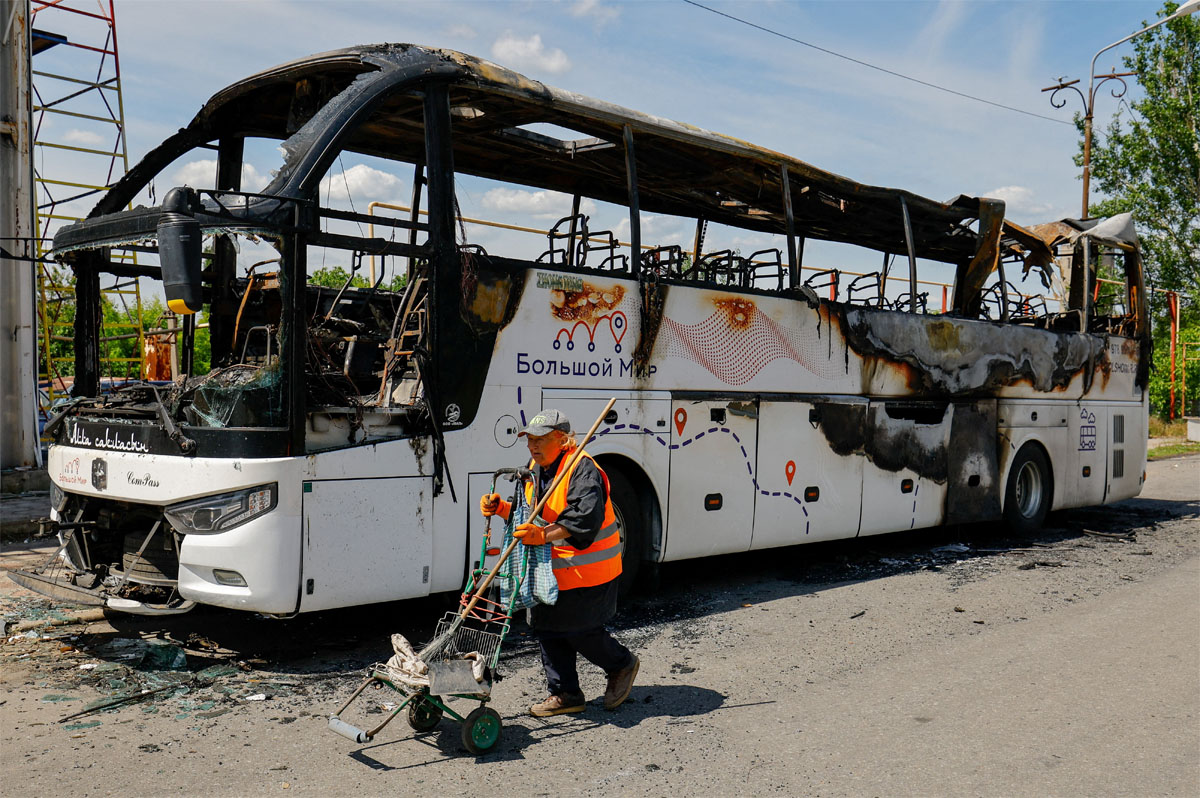
Russian Bomb Kills 33 in Ukraine, Hits Two Passenger Buses
At least 33 people have been killed and 18 others injured after a Russian guided bomb struck a road in Kramatorsk, eastern Ukraine, hitting two passenger buses in one of the deadliest attacks on civilians reported in the country this year.
The attack occurred at about 10am in the Donetsk region, where two scheduled buses were operating when the Russian munition struck the road.
The blast triggered fires in the buses and surrounding area, leaving passengers and other civilians dead or injured. Emergency workers were deployed to the scene to extinguish the fires, recover victims and evacuate the wounded.
The death toll rose from an initial figure of 12 as rescuers continued their search of the area.
Preliminary investigations indicated that the weapon may have been a UMPB D-30SN guided aerial bomb, although authorities said investigations were continuing to establish the exact type of munition used.
Images from the scene showed a badly burned bus, debris scattered across the road and bodies lying near the site of the explosion.
Donetsk Governor Vadym Filashkin accused Russian forces of deliberately targeting civilians, while Ukrainian President Volodymyr Zelenskyy condemned the attack and described the location as a bus stop.
READ ALSO:
- How Six Members of a Family Were Murdered in Oyo
- World Bank Raises Nigeria Growth Forecast, Demands More Jobs, Poverty Reduction
- Flood Submerges Enugu Road, Strands School Children, Passengers
Russia has not immediately commented on the attack or the reported casualty figures. Moscow has consistently denied deliberately targeting civilians during its war against Ukraine.
Authorities suspended public transportation in Kramatorsk and neighbouring Sloviansk following the attack as a precaution against further strikes.
Kramatorsk, an important Ukrainian-controlled city in the Donetsk region, has faced repeated Russian drone and guided-bomb attacks as fighting intensifies along the eastern front.
The latest attack came a day after another deadly Russian strike on Pryluky, in Ukraine’s Chernihiv region, where a missile hit a five-storey residential building.
The death toll in Pryluky rose to 22 people, including five children, while 54 others were injured. Several people were rescued from the damaged building as emergency crews continued search-and-rescue operations.
The attacks came amid an intensified Russian aerial campaign involving missiles, drones and guided bombs against Ukrainian cities and infrastructure.
Ukrainian authorities have appealed for stronger air-defence support from international partners as the country faces renewed attacks ahead of winter.
The latest strikes have also renewed concerns over the safety of civilians and critical infrastructure nearly five years after Russia launched its full-scale invasion of Ukraine.
Russian Bomb Kills 33 in Ukraine, Hits Two Passenger Buses
International
US Proposes $70,000 OPT Fee for Nigerians, Other Foreign Students

US Proposes $70,000 OPT Fee for Nigerians, Other Foreign Students
The administration of US President Donald Trump has proposed a $70,000 fee for international students seeking to participate in a programme that allows them to work in the United States after completing their studies.
The proposed rule by the US Department of Homeland Security (DHS) targets the Optional Practical Training (OPT) programme available to eligible foreign students on F-1 visas, including Nigerians studying in the US.
Under the proposal, US educational institutions would be required to pay $70,000 for each student’s initial OPT participation, while an additional $30,000 fee would apply for each renewal or further training.
The proposal does not initially require students themselves to pay the $70,000 directly. Instead, the financial obligation would fall on the schools recommending students for OPT, although education groups warn that the cost could ultimately affect students and universities.
The OPT programme allows eligible international students to obtain temporary work experience in jobs related to their fields of study. Most students can participate for up to one year after graduation, while graduates in qualifying science, technology, engineering and mathematics (STEM) fields can receive an additional two years.
READ ALSO:
- EFCC Re-Arraigns Two Over Alleged £110,000 Money Laundering, ₦500m Fraud
- Three Killed, 36 Injured as Houthi Attacks Hit Saudi Airports
- Bandits Kill Three in Fresh Attack on Kebbi Community
DHS said the proposed fees are intended to combat fraud, strengthen the integrity of the immigration system and protect US workers.
The department has also argued that OPT has been misused as a source of cheap foreign labour and that the proposed fees would encourage universities to exercise greater scrutiny when recommending students for the programme.
The proposed charge represents a sharp increase from the current cost associated with OPT applications, which is around $500.
The plan could have significant implications for international students from countries such as Nigeria, India and China, whose graduates make substantial use of OPT, particularly in technology and other specialised fields.
American universities and business groups have raised concerns that the proposed fee could discourage international students from studying in the US and make it harder for companies to recruit skilled graduates.
Education groups have also warned that the measure could affect American universities that rely on international enrolment for tuition revenue and employers that depend on foreign graduates to fill specialised positions.
The proposal is part of the Trump administration’s broader effort to tighten US immigration policies and impose greater restrictions on foreign students and workers.
The DHS proposal is subject to a public comment period before it can be finalised. If approved, the rule would take effect after an additional implementation period, while legal challenges are also expected.
The proposed OPT fee is separate from other changes to the H-1B visa programme, which has also faced increased costs and restrictions under the Trump administration.
US Proposes $70,000 OPT Fee for Nigerians, Other Foreign Students
-

 metro1 day ago
[UPDATED] 20 NYSC Prospective Corps Members Freed After Seven Days in Captivity
-

 metro3 days ago
Supreme Council For Sharia Secretary-General Nafiu Baba-Ahmed Dies
-

 metro3 days ago
UCH CMD: After Decades Without Muslim, Agunbiade Demands Fair Chance
-

 News3 days ago
Iwo Son Becomes Yorubaland’s First Muslim Professor of Arabic Without Secondary School
-

 Politics2 days ago
‘No Decent Wages, No Credible Elections’ — Sowore Threatens 2027 Boycott
-

 metro2 days ago
Seven Years With Parkinson’s: Man Seeks N65m for Brain Surgery in Türkiye
-

 Politics3 days ago
Tompolo’s PBAT Movement Suspends Campaign Over Ondo Military Crash
-

 Politics2 days ago
2027: Obi Makes U-Turn, Vows to Restore Fuel Subsidy If Elected