

Business
Egg price hike caused by feed cost – Poultry farmers

Egg price hike caused by feed cost – Poultry farmers
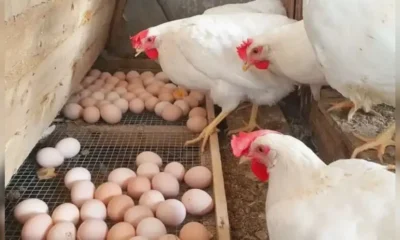
The Poultry Association of Nigeria (PAN) has blamed the consistent hike in egg prices on low production and high cost of feed.
The PAN Lagos state Chairman, Mr Mojeed Iyiola, and other stakeholders in the sector disclosed this in separate interviews with the News Agency of Nigeria (NAN) on Wednesday in Lagos.
NAN reports that the price of egg has increased tremendously, making the common source of protein in the past out of the reach of many Nigerians.
NAN also reports that a crate of egg sells between N3,800 and N4,000 from the farm gate and above N4,500 in retail shops and markets against N3,200 to N3,500 it was sold in May.
A tonne of maize currently sells for N800,000 as against N400,000 in January.
Iyiola attributed the persistent hike in the price of eggs to scarcity.
“The reason for the current hike in the price of eggs is that eggs are very scarce now.
“Most farmers have sold off their old layers, and to get new stock is very expensive as the price of a day-old chick is becoming unbearable.
“Farmers able to buy day-old chicks are considered to be well-to-do. Also, a majority of our local farmers have shut down their farms due to the high cost of feed.
READ ALSO:
- 25 persons killed in multiple crashes at Enugu Army checkpoint
- Democracy Day: Protest begins in Lagos amid tight security (Photos)
- UK varsity offers flight assistance to expelled Nigerian students
“Presently, a kilogramme of maize costs as high as N850 as against N400 to N500 that was being sold for at the beginning of the year.
“The same thing applies to soya and the groundnut cake, the prices have increased astronomically,” the PAN chairman said.
He, however, said that the increase in the cost of eggs is not commensurate to the rate at which the cost of feed materials are increasing.
“In fact most farmers are running at a loss. That is why the only existing farmers are trying to keep the sector running.
“Even if a crate of egg sells at N5,000, the farmers will only be managing to get by.
“We want to liaise with the food hub at Idi-oro, our farmers are complaining that they can no longer afford to sell at a loss.
“We supply eggs at the farm gate at N3,800 per crate and with the same logistics we still sell at N3,800 at the hub. This means we are running at a loss.
“With all these incurred logistics expenses a crate of eggs should be sold for N4,500 at the food hub,” he said.
According to him, the way things are going if things are not controlled, the sector may collapse entirely.
“It seems consuming eggs have become luxury in our diets.
“We have scheduled a meeting with the government to tackle the situation because there is nothing an individual can do on this issue. We need government intervention,” Iyiola added.
Also speaking, Mr Godwin Egbebe, the National Publicity Secretary PAN, attributed the hike in the cost of raw materials to the reason for the rise in egg prices.
“Early this month, a tonne of maize sold for N720,000 but as of today 12 June, 2024, it sells at N800,000. During the former President Buhari’s administration a tonne of maize was sold at N80,000.
“The increment is over 1,000 per cent, so you can see the reasons for the hike in poultry producers.
“The way forward is that government as a matter of urgency should bring in grains in the short term.
“And in the long term, they should ensure that farmers go back to their farms secured.
“Farmers are not producing enough grains because of insecurity. Palliatives cannot solve the problem, it is like a drop in an ocean. It makes little or no impact,” Egbebe said.
He said that in some supermarkets, eggs are being sold for N5,000 and above.
“Everyday we go to buy feeds, the price changes. As we speak, farmers are actually selling at a loss.
“Most farmers are not breaking even, so they are folding up, it is not funny anymore,” he said.
On her part, Mrs Theresa Muyi, a poultry farmer in Alimosho, decried the situation and the helplessness of local farmers to the persistent hike in feed prices.
“Poultry feed has gone up and we now sell a crate of egg from the farm gate between N3,800 and N4,000. The retailers sell from N4,500 and above.
“The price is still unstable because almost every week there is an increase in feed prices.
“Eggs seem to have become luxury to the common man as a piece of egg now sells at N200 and above,” Muyi said.
Egg price hike caused by feed cost – Poultry farmers
NAN





Business
Nigerians Pay N44 Extra Per Litre as Retailers Defy Falling Depot Prices – Full Report

Auto
Abuja Roars to Life as Jetour X50 Headlines Three-Day Motoring Experience

Abuja Roars to Life as Jetour X50 Headlines Three-Day Motoring Experience
Abuja is gearing up for a major motoring spectacle as Jetour Nigeria brings its fast-growing brand experience to the Federal Capital Territory, with the stylish Jetour X50 set to take centre stage in a three-day showcase of performance, technology and automotive innovation.
Scheduled for September 22 to 24, 2026, the Jetour Experience Abuja will move beyond the conventional vehicle exhibition, giving motorists and prospective buyers the opportunity to test-drive the X50, interact with automotive specialists and experience a range of entertainment and interactive activities.
The Abuja activation follows the strong reception recorded during Jetour Nigeria’s recent Lagos experience and forms part of the automaker’s strategy to deepen customer engagement while expanding its footprint across Nigeria.
Backed by an expanding authorised dealer network comprising Elizade Nigeria Limited, Mandilas Autos, Germaine Auto Centre, Kojo Motors, R.T. Briscoe, Tab Autos and New Era AutoVehicle Services, Jetour is also strengthening access to vehicle sales, after-sales support, genuine spare parts and certified technical services nationwide.
At the heart of the Abuja experience will be the Jetour X50, a compact SUV designed to combine contemporary styling, performance and a technology-rich driving environment.
Powered by a 1.5-litre turbocharged engine paired with a dual-clutch transmission, the X50 has positioned itself as a strong contender in Nigeria’s competitive compact SUV segment.
Jetour has equipped the model with a range of premium features, including a 360-degree camera, Blind Spot Detection, 10.5-inch infotainment system with Apple CarPlay and Android Auto, wireless charging and leather upholstery.
The combination of technology, comfort and performance is part of Jetour’s strategy of offering premium motoring features at competitive price points.
The Abuja event also highlights Jetour’s aggressive expansion strategy in Nigeria, following the brand’s recognition with industry accolades including Fastest Growing Auto Brand and Auto Brand of the Year.
With its expanding dealer network providing nationwide sales and after-sales support, Jetour is seeking to deepen customer engagement while making its vehicles and ownership services more accessible to motorists across the country.
As Abuja prepares to welcome the Jetour Experience, the three-day activation is expected to provide motorists with an opportunity to see, feel and drive the X50 while experiencing first-hand what is driving the brand’s growing appeal in Nigeria.
Business
Dangote Refinery Sets ₦525 Per Share for Landmark IPO

For ₦5,250, Nigerians could soon own a piece of the refinery that has reshaped the country’s fuel market.
-

 Auto2 days ago
Kaduna to Lead Govt Patronage of Local Vehicles as Sani Unveils Peugeot 5008
-

 metro1 day ago
El-Rufai Demands ₦10bn from Defence Minister Over Southern Kaduna Killings Allegation
-

 metro1 day ago
Catholic priest leaves priesthood, weds Kenyan woman after 12 years in Kenya
-

 metro2 days ago
Socialite Igho ‘Tiny’ Ubiribo Dies After Penis Enlargement Surgery
-

 Politics3 days ago
Demystifying the Political Monolith: Wike’s ‘See Finish’ Doctrine and Nigeria’s New Political Calculus
-

 Politics1 day ago
Why Did Peter Obi Attend Seyi Makinde’s Campaign Launch? Here’s What He Said
-

 metro1 day ago
No US Case Against Tinubu, Family Enjoy Unimpeded Transit for UNGA — Ambassador Ibrahim
-

 News1 day ago
Lagos Moves to Slash Agency Fees, Curb Rent Hikes With New Tenancy Bill