

News
ACF hails 19 Northern governors for launching Northern Nigeria Security Trust Fund

ACF hails 19 Northern governors for launching Northern Nigeria Security Trust Fund
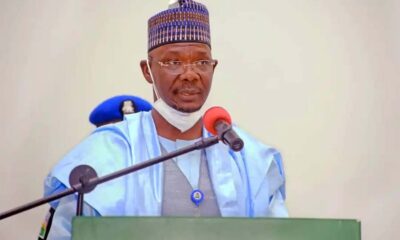
The Arewa Consultative Forum (ACF) has commended the 19 Northern governors for establishing the Northern Nigeria Security Trust Fund (NNSTF), describing the initiative as a landmark regional response to the growing security challenges confronting Northern Nigeria.
The forum said the creation of the trust fund demonstrates the governors’ commitment to complementing the efforts of federal security agencies in tackling terrorism, banditry, kidnapping, cattle rustling, communal violence and other criminal activities that have continued to threaten lives, livelihoods and economic development across the region.
In a statement issued in Kaduna on Friday, Chairman of the ACF Board of Trustees, Bashir Dalhatu, said the initiative reflects a shared understanding among Northern leaders that insecurity can only be addressed through sustained collaboration, adequate funding, innovation and stronger partnerships between governments, security agencies, traditional institutions and local communities.
Dalhatu described the trust fund as a strategic intervention that would mobilise additional financial resources to strengthen regional security architecture and improve the operational capacity of security agencies working across the North.
According to him, years of insecurity have inflicted enormous human and economic costs on the region, forcing thousands of residents to flee their communities, disrupting farming activities, discouraging investments, affecting interstate commerce and slowing overall economic growth.
He stressed that restoring peace remains critical to achieving food security, improving agricultural productivity, creating employment opportunities and attracting both local and foreign investments to Northern Nigeria.
The ACF chairman expressed confidence that the Northern Nigeria Security Trust Fund would enhance intelligence gathering, surveillance operations, operational logistics, communication systems and the deployment of modern security technologies needed to combat emerging security threats.
READ ALSO:
- Spain edge Belgium to book 2026 FIFA World Cup semi-final against France
- 2027 election: Tinubu’s retention of Shettima strengthens APC in the North – Kwankwaso
- MURIC demands swift prosecution of Oriire terrorists after rescue of abducted Oyo pupils, teachers
He added that the initiative would also strengthen community-based security mechanisms, improve coordination among security agencies and provide assistance to victims of attacks, while supporting ongoing efforts to restore peace in troubled communities.
Dalhatu congratulated members of the newly inaugurated Board of Trustees of the trust fund, expressing optimism that they would provide transparent, accountable and effective leadership in managing the initiative.
He specifically congratulated the Co-Chairmen of the board, Yayale Ahmed and retired General Martin Luther Agwai, describing them as accomplished public servants whose extensive experience in governance, public administration and national security would strengthen public confidence in the management of the fund.
He urged the governors to sustain the political will that gave birth to the initiative by ensuring prudent utilisation of resources, strict accountability and transparency in all financial transactions.
According to him, the trust fund must remain focused on its core objectives of protecting lives and property, supporting security operations, rebuilding communities devastated by violence and creating an enabling environment for sustainable economic and social development.
“The people of Northern Nigeria deserve to live peacefully, cultivate their farms without fear, carry out legitimate businesses safely and travel freely across the region without constant security concerns,” Dalhatu said while reaffirming the forum’s commitment to supporting credible efforts aimed at ending insecurity.
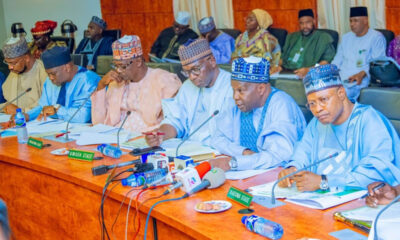
The ACF’s endorsement follows the formal inauguration of the Northern Nigeria Security Trust Fund by the Northern States Governors’ Forum (NSGF) in collaboration with the Northern Traditional Rulers’ Council during a high-level meeting held at the Sir Kashim Ibrahim House in Kaduna.
At the meeting, the 19 Northern governors unanimously approved a monthly contribution of ₦1 billion from member states to finance the trust fund and strengthen regional efforts to combat insecurity. The governors explained that the initiative would complement federal security operations through improved intelligence sharing, enhanced logistics, technological surveillance and stronger collaboration among states in addressing cross-border criminal activities.
The governors also reiterated the need for broader security reforms, including improved policing, enhanced intelligence coordination and greater investment in modern security infrastructure to address evolving threats across the region.
Security experts and stakeholders have welcomed the initiative, describing sustainable funding, regional collaboration and community participation as essential components in addressing the complex security challenges facing Northern Nigeria. They, however, stressed that effective implementation, transparency and accountability would determine the long-term success of the trust fund.
As insecurity continues to affect farming, education, transportation and commercial activities across several Northern states, many residents and development partners are expected to closely monitor the implementation of the initiative and its impact on improving safety, restoring confidence and accelerating economic recovery.
ACF hails 19 Northern governors for launching Northern Nigeria Security Trust Fund











News
OASIS Muslim Care Foundation Holds Webinar on Healthy Lifestyles, NCD Prevention
OASIS Muslim Care Foundation Holds Webinar on Healthy Lifestyles, NCD Prevention
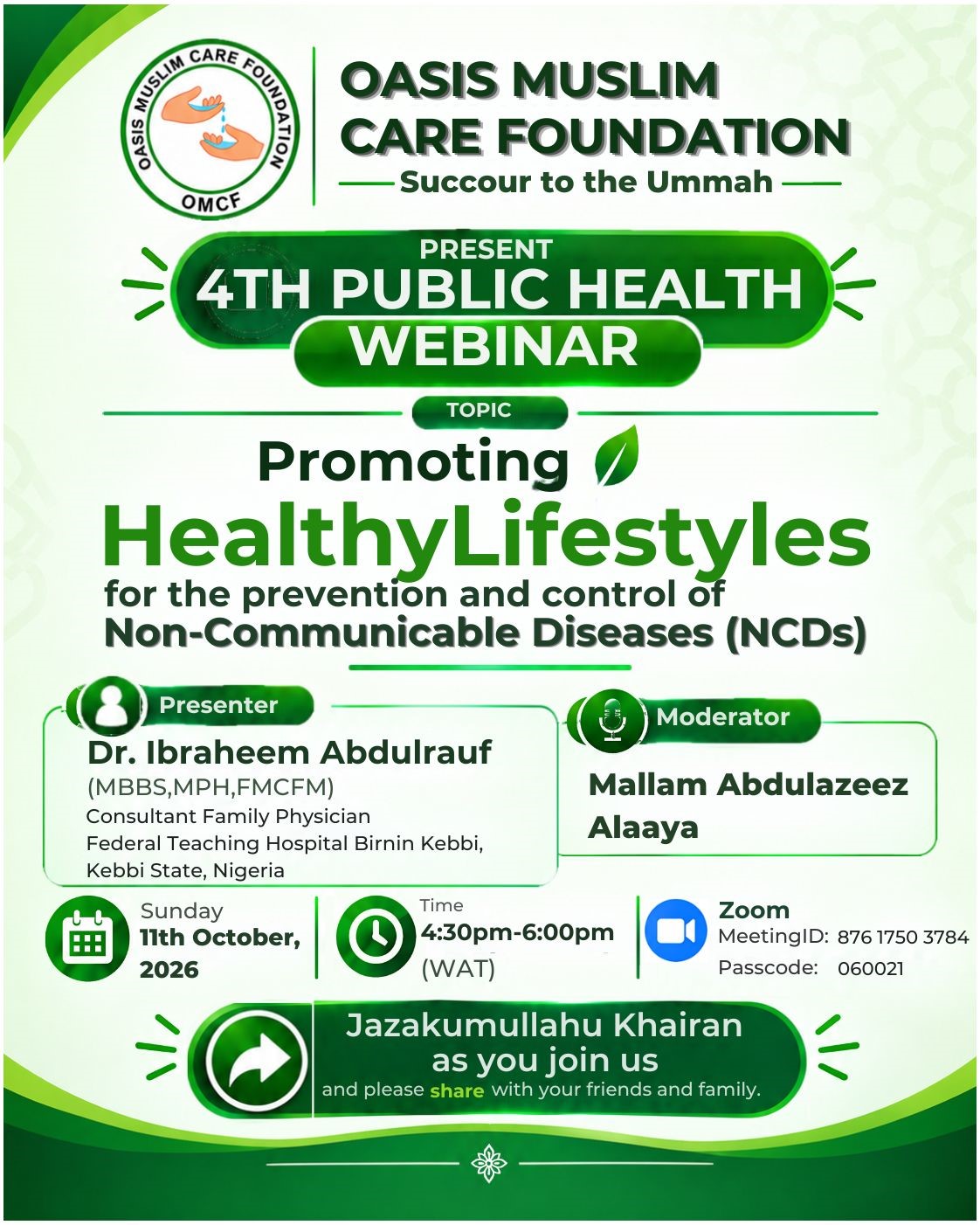
The OASIS Muslim Care Foundation is set to host its fourth public health webinar on Sunday, October 11, 2026, focusing on the promotion of healthy lifestyles as a strategy for preventing and controlling non-communicable diseases (NCDs).
The webinar, titled “Promoting Healthy Lifestyles for the Prevention and Control of Non-Communicable Diseases (NCDs),” is expected to educate participants on the importance of adopting healthier habits to reduce the risk of diseases that pose significant public health challenges.
The session will be delivered by Dr. Ibraheem AbdulRauf, a Consultant Family Physician at the Federal Teaching Hospital, Birnin Kebbi, Kebbi State.
Dr. AbdulRauf holds a Bachelor of Medicine and Bachelor of Surgery (MBBS), a Master of Public Health (MPH) and fellowship qualifications in family medicine (FMCFM).
READ ALSO:
- NNPC Petrol Discount: Motorists Must Download App to Save ₦66 Per Litre
- Panama Earthquake: 27 Injured as Powerful 7.7-Magnitude Tremor Damages Hundreds of Buildings
- EFCC Wins ₦132m Money Laundering Case as Court Orders Forfeiture of Lagos Properties
According to the event announcement, the webinar is part of the foundation’s public health engagement efforts aimed at promoting awareness and encouraging individuals to take practical steps towards improving their health and well-being.
Non-communicable diseases, including cardiovascular diseases, diabetes, cancers and chronic respiratory diseases, are major health concerns worldwide. Many of these conditions are associated with risk factors such as unhealthy diets, physical inactivity, tobacco use and harmful alcohol consumption.
Health education and the adoption of healthy lifestyle practices are important measures for reducing the risk of such diseases and improving the quality of life.
The online event is scheduled to commence at 4:30 p.m. West Africa Time (WAT) and will be held via Zoom.
Interested participants can join the webinar using the following details:
Meeting ID: 876 1750 3784
Passcode: 060021
Zoom link: https://us06web.zoom.us/j/87617503784?pwd=Xf2f6XuCfunLuNYjnbqjVfz92EFAt9.1
The foundation has invited members of the public to participate in the session and share the announcement with others to widen awareness of healthy living and the prevention and control of non-communicable diseases.
The webinar is open to everyone interested in learning more about practical approaches to maintaining good health and preventing lifestyle-related illnesses.
OASIS Muslim Care Foundation Holds Webinar on Healthy Lifestyles, NCD Prevention
News
₦60 Fuel Discount: Ondo ADC Slams Tinubu, Says Atiku Deserves Credit for Subsidy Restoration
₦60 Fuel Discount: Ondo ADC Slams Tinubu, Says Atiku Deserves Credit for Subsidy Restoration
The party describes the discount as inadequate relief for Nigerians battling rising petrol prices, transportation costs and the high cost of living ahead of the 2027 general election.
The Ondo State chapter of the African Democratic Congress (ADC) has criticised President Bola Ahmed Tinubu’s administration over its reported ₦60-per-litre petrol discount, describing the measure as inadequate to address the economic hardship confronting millions of Nigerians.
The party also commended former Vice-President Atiku Abubakar for advocating the restoration of fuel subsidy, arguing that government policies should prioritise citizens’ welfare and provide meaningful relief from the rising cost of living.
The ADC’s position was contained in a press statement signed by its Ondo State Publicity Secretary, Hon. Remi Ofakunrin, in which the party accused the All Progressives Congress (APC)-led Federal Government of offering Nigerians insufficient relief amid soaring fuel prices and declining purchasing power.
According to the statement, the reported ₦60 discount falls far short of what households, businesses, transport operators, students and workers need to cope with the prevailing economic challenges.
The party argued that Nigerians require sustainable measures to reduce the cost of living rather than temporary interventions that have limited reach and impact.
“At a time when Nigerians are struggling to survive the crushing cost of living, with petrol prices reportedly hovering around ₦1,400 per litre, the government’s decision to offer a mere ₦60 discount is not the relief citizens deserve,” the statement said.
The opposition party maintained that the discount was insignificant compared with the financial pressure experienced by ordinary Nigerians, particularly those whose livelihoods depend on transportation and fuel-powered businesses.
It accused the Tinubu administration of expecting public approval for what it described as a token concession after implementing policies that have significantly affected household budgets and business operating costs.
ADC questions petrol prices despite Nigeria’s crude oil resources
The ADC also questioned why petrol prices remained so high in Nigeria, an oil-producing country, despite the availability of abundant crude oil resources.
READ ALSO:
- ‘Mad People’: Presidency Fires Back at Amaechi Over Tinubu Re-Election Remarks
- ‘What Happens on Day 31?’ Atiku Slams Tinubu’s 30-Day Fuel Discount as Election-Laced Package
- Ronaldo Breaks Silence on Portugal Row as Pelé, Maradona Comparison Sparks Meme Frenzy
It asked why citizens should continue to struggle with the cost of fuel and other essential commodities while bearing the consequences of government economic policies.
The party further argued that the discount underscored the need for government intervention to cushion the effects of high fuel prices on the wider economy.
According to the ADC, the measure demonstrated that the consequences of petrol pricing remained a major concern requiring a broader policy response.
However, the party said a temporary discount at selected Nigerian National Petroleum Company Limited (NNPCL) filling stations could not provide lasting relief from the rising costs of food, transportation, production and other necessities.
It called on the Federal Government to adopt a more comprehensive and transparent approach to addressing fuel costs and their impact on Nigerians.
The ADC also urged the government to explain how the country’s oil resources could be better managed to improve citizens’ living conditions and promote national prosperity.
Atiku deserves credit for subsidy restoration advocacy — ADC
The Ondo ADC chapter used the statement to commend Atiku Abubakar for advocating the restoration of fuel subsidy as part of a broader strategy to ease economic hardship and improve the welfare of Nigerians.
The party said Atiku’s position deserved consideration, insisting that the debate should focus on how economic policies could protect citizens’ purchasing power and ensure that the benefits of the country’s natural resources reached ordinary people.
According to the ADC, the reported fuel discount reinforces the argument that government intervention may be necessary to cushion the effects of high petrol prices, although it maintained that the current measure was inadequate.
The party called for a more sustainable framework capable of delivering meaningful relief rather than temporary concessions.
It said Atiku and the ADC were committed to an economic direction that would enable workers to earn a living wage, businesses to operate sustainably and families to afford food, transportation, education and healthcare.
Beyond fuel subsidy, the party said its proposed policy direction included economic recovery, improved purchasing power, affordable education, local government autonomy, the fight against insecurity and corruption, and responsible management of national resources.
The statement presented these priorities as part of the party’s broader vision for addressing the country’s economic and governance challenges.
ADC urges Nigerians to vote for change in 2027
With the 2027 general election approaching, the Ondo ADC urged Nigerians to assess the performance of the current administration and consider alternative leadership.
The party cautioned citizens against being swayed by temporary concessions that, in its view, failed to address the underlying causes of economic hardship.
It called on voters to support Atiku Abubakar and other ADC candidates, arguing that a change in leadership and policy direction could provide an opportunity to improve living standards and restore public confidence in government.
The party said Nigeria needed leadership capable of addressing economic difficulties, insecurity and declining purchasing power while promoting national unity and development.
It also expressed confidence that the country could harness its human and natural resources to create prosperity and improve the welfare of present and future generations.
“A ₦60 discount cannot erase years of blanket display of mercilessness and economic hardship, but a change in leadership and policy direction can begin the process of national recovery,” the statement said.
The ADC consequently called on Nigerians to demand economic reforms that would produce measurable improvements in their daily lives and support the party in the 2027 elections.
Fuel pricing remains a major political issue
The statement highlights the continuing political debate over petrol pricing, the removal of fuel subsidy and the government’s responsibility to cushion the effects of economic reforms.
While the Tinubu administration has defended its economic policy direction as part of efforts to reform the economy, opposition parties have continued to raise concerns about the effects of higher fuel costs on transportation, food prices, businesses and household incomes.
The Ondo ADC’s latest position places fuel subsidy and the affordability of petrol at the centre of its campaign message ahead of the next general election.
However, the party’s claims about the adequacy of the discount and the benefits of subsidy restoration reflect its political position. The actual impact of any fuel discount depends on its implementation, duration, eligibility conditions and the extent to which the savings are passed on to consumers.
The statement was signed by Hon. Remi Ofakunrin, Publicity Secretary of the African Democratic Congress in Ondo State.
The party concluded by insisting that Nigerians deserved meaningful economic relief and urging voters to support what it described as an alternative path to national recovery.
₦60 Fuel Discount: Ondo ADC Slams Tinubu, Says Atiku Deserves Credit for Subsidy Restoration
News
‘What Happens on Day 31?’ Atiku Slams Tinubu’s 30-Day Fuel Discount as Election-Laced Package

‘What Happens on Day 31?’ Atiku Slams Tinubu’s 30-Day Fuel Discount as Election-Laced Package
Former Vice-President Atiku Abubakar has criticised President Bola Tinubu’s proposed 30-day petrol discount, describing it as an “election-laced subsidy package” and questioning whether Nigerians will receive lasting relief from rising fuel prices and living costs.
Atiku argued that the Federal Government’s intervention was too limited to address the economic pressures facing households and businesses, warning that motorists could return to paying higher prices once the 30-day arrangement expires.
The criticism came after the government announced a temporary fuel-price intervention at Nigerian National Petroleum Company Limited (NNPC) filling stations as part of efforts to cushion the impact of rising petrol prices, transportation costs and international crude oil market pressures.
In a statement issued on Thursday, October 8, through Phrank Shaibu, Director of Strategic Communication of the African Democratic Congress (ADC) Presidential Campaign Council, Atiku questioned the timing, scope and sustainability of the initiative.
The former vice-president described the measure as a “panic-driven publicity stunt”, arguing that a temporary discount could not compensate Nigerians for the prolonged increase in the cost of fuel, transportation, food and other essential goods.
“What happens on Day 31?” Atiku asked, warning that consumers could face the same economic difficulties when the intervention ends.
He maintained that Nigerians needed a sustainable strategy to reduce the cost of living rather than a short-term measure that offered relief for only one month.
The Federal Government’s plan provides for NNPC Limited to temporarily forgo its retail profit margin and sell petrol at cost at its filling stations during the 30-day period. Finance Minister and Coordinating Minister of the Economy Taiwo Oyedele said public transport operators would receive priority under the arrangement.
The government has maintained that the initiative is not a return to the former petrol subsidy regime, which the Tinubu administration removed on May 29, 2023.
READ ALSO:
- Ronaldo Breaks Silence on Portugal Row as Pelé, Maradona Comparison Sparks Meme Frenzy
- [UPDATED] Lagos Train Crash: 55-Year-Old Motorist Survives as Honda Car Is Wrecked at PWD Crossing
- How Parents Raised Millions to Free 20 Abducted NYSC Members
However, Atiku questioned whether the proposed discount would deliver meaningful savings to ordinary Nigerians, particularly those who depend on commercial buses, taxis and other forms of public transportation.
He also raised concerns about the initiative’s limited coverage, noting that the arrangement was tied to NNPC filling stations. He called for greater clarity on the expected reduction in petrol prices and how any savings would translate into lower transport fares and reduced costs for consumers.
According to Atiku, without clear implementation details and measures to ensure that the benefits reach the public, the intervention could offer only limited relief while leaving the wider economic challenges unresolved.
The ADC presidential candidate also advocated a more sustainable approach linked to locally refined petroleum products, proposing capped and budgeted support for domestic refining with safeguards to ensure that consumers benefit.
He argued that a structured framework could help ease pressure on households while supporting Nigeria’s domestic refining capacity.
The government, however, has defended the removal of petrol subsidies on the grounds that the previous arrangement placed a heavy burden on public finances. The administration has argued that the savings can be redirected towards infrastructure, healthcare, education and other public services.
Despite that position, petrol prices and their knock-on effects on transportation, food distribution and business operating costs remain major concerns for many Nigerians.
Atiku’s criticism has also brought the economic intervention into the political debate ahead of the 2027 general elections. He questioned the timing of the announcement and suggested that the short duration of the discount raised concerns about its political implications.
The government’s stated objective is to cushion consumers against rising fuel costs, while Atiku insists that the initiative falls short of the lasting relief Nigerians need.
Ultimately, the impact of the 30-day NNPC petrol discount will depend on how the arrangement is implemented, the actual savings delivered to motorists and whether public transport operators pass on any reductions to passengers.
For Nigerians facing higher fuel and transportation expenses, the central question remains whether the temporary intervention will provide meaningful relief or merely postpone the return of higher costs.
‘What Happens on Day 31?’ Atiku Slams Tinubu’s 30-Day Fuel Discount as Election-Laced Package
-

 metro3 days ago
[UPDATED] 20 NYSC Prospective Corps Members Freed After Seven Days in Captivity
-

 metro3 days ago
EFCC Re-Arraigns Two Over Alleged £110,000 Money Laundering, ₦500m Fraud
-

 Africa2 days ago
FBI Raids Ghana Scam Centre, Detains Over 130 in $10m Fraud Probe
-
metro2 days ago
How Parents Raised Millions to Free 20 Abducted NYSC Members
-

 News3 days ago
World Bank Raises Nigeria Growth Forecast, Demands More Jobs, Poverty Reduction
-

 Sports3 days ago
Ronaldo Pays Emotional Tribute to Messi After Argentina Farewell
-

 metro2 days ago
[UPDATED] Lagos Train Crash: 55-Year-Old Motorist Survives as Honda Car Is Wrecked at PWD Crossing
-

 metro3 days ago
NAF Crash: NYSC-Bound Graduate, Only Son, Among 25 Victims