
News
Female senators above sexual harassment, Akpoti-Uduaghan’s allegation shows weakness – Ita Giwa
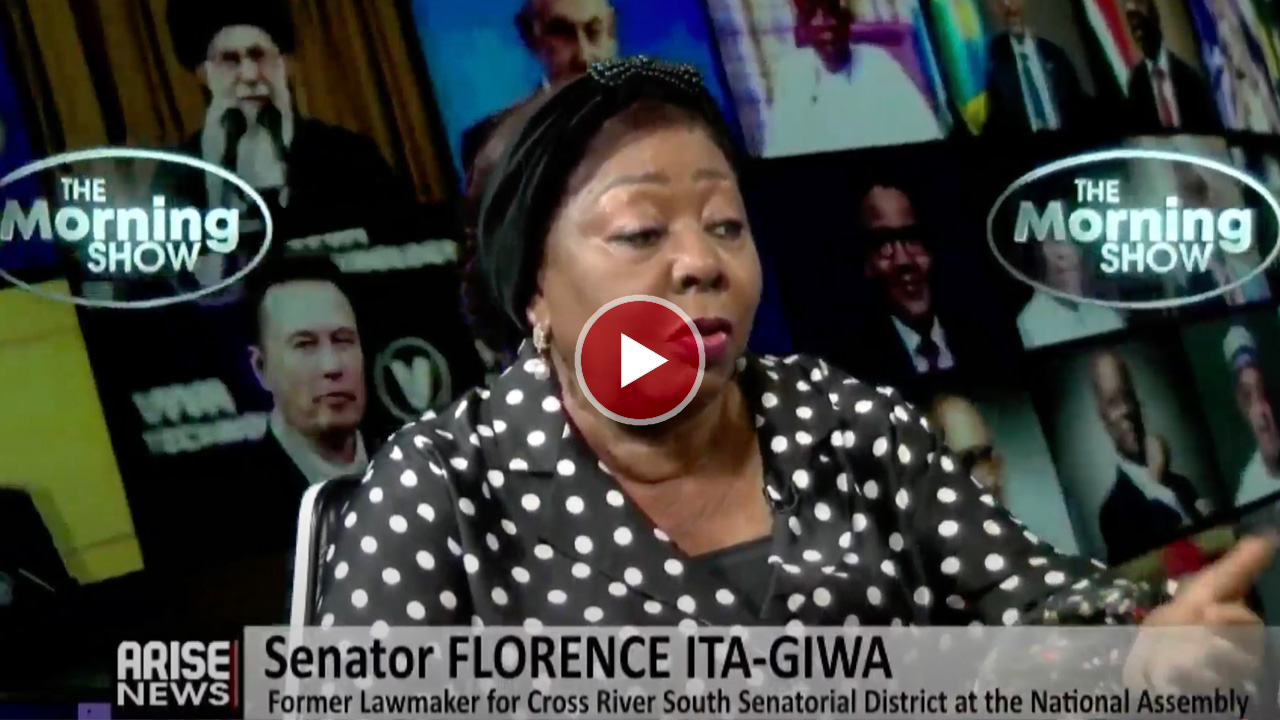
Female senators above sexual harassment, Akpoti-Uduaghan’s allegation shows weakness – Ita Giwa
Florence Ita-Giwa, a former senator who represented Cross River South Senatorial District in the Senate, has said that female senators have passed the stage of being sexually harassed.
The former senator gave this assertion while reacting to the sexual harassment allegations involving Senator Natasha Akpoti-Uduaghan and Senate President Godswill Akpabio in an interview with Arise News on Tuesday.
Indeed, he noted that Akpoti-Uduaghan alleging that he was sexually harassed by the Senate president showed a sign of weakness on her part.
“By the time you contest elections and get to the Senate, you have passed that stage of your life of being sexually harassed,” said Ita-Giwa.
“At that stage in the Senate, if you come and say that somebody is sexually harassing you, it’s a weakness. You make yourself unapproachable.
“You don’t let anybody take you around and show you things. You don’t allow it. It cannot happen in the Senate,” she added.
She however clarified that she was not saying that Akpoti-Uduagahan wrongly accused the Senate President.
According to her, becoming a senator should embolden female senators to stand strong against any form of harassment.
She said, “I am not saying the lady is lying, but when you get to the Senate, you’re there as a person. You’re not there as a woman.”
Re all that in February, the Senator representing the Federal Capital Territory (FCT), Ireti Kingibe, berated Akpoti-Uduaghan for her outburst over the seating reassignment in the Senate.
The FCT senator added that Akpoti-Uduaghan was the most privileged of all serving female senators.







News
Nigerian Man Appeals for Repatriation After Alleged Forced Enlistment in Russian Military
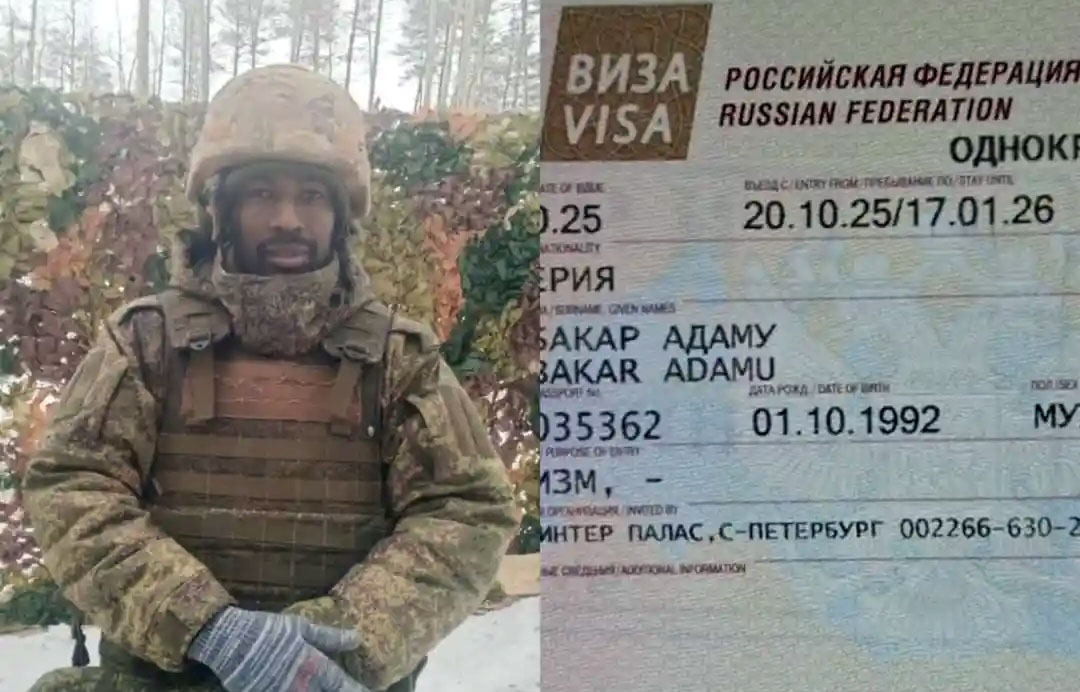
Nigerian Man Appeals for Repatriation After Alleged Forced Enlistment in Russian Military
A Nigerian citizen, Abubakar Adamu, has appealed to the Federal Government of Nigeria for urgent repatriation after alleging that he was deceived into joining the Russian military following a trip to Moscow for what he believed was a civilian job opportunity.
According to his legal representatives, Adamu travelled to Russia on a tourist visa issued by the Russian Embassy in Abuja, after being promised employment as a civilian security guard. However, upon arrival in Moscow, his international passport and travel documents were allegedly confiscated, and he was reportedly compelled to sign enlistment documents written entirely in Russian without the assistance of an interpreter.
His lawyers stated that he later discovered the documents had effectively enrolled him into the Russian Armed Forces, despite having no intention of joining the military. In a formal petition submitted to Nigerian authorities, the legal team invoked the legal doctrine of Non Est Factum, arguing that Adamu did not understand the nature or implications of the contract he signed.
They further alleged fundamental misrepresentation, claiming he was misled into military service under false pretences. The petition also raised concerns about possible violations of international law, including forced conscription, coercion, and deprivation of personal liberty.
READ ALSO:
- El-Rufai to Appear Before EFCC After Alleged Airport Arrest Attempt
- Four Sentenced to Death for Murder of Ahoada DPO in Rivers
- Nigerian Army Rescues Eight Kidnapped Wedding Guests in Kano
Adamu is reportedly being held at a Russian military camp and has refused deployment to combat zones in Ukraine, where Russia has been engaged in ongoing military operations since 2022. His lawyers have demanded that Russian authorities immediately halt any deployment process, return his seized documents, and facilitate his safe return to Nigeria.
The case comes amid growing international reports that African nationals are being recruited into the Russian military under questionable circumstances. A previous investigative report by CNN revealed that citizens from Nigeria, Ghana, Kenya, Uganda, South Africa, and other African countries were allegedly lured with promises of high salaries, signing bonuses, and pathways to Russian citizenship.
According to the investigation, many recruits were reportedly given minimal training and deployed to combat zones in Ukraine, with allegations of coercion, racial abuse, and inhumane treatment emerging from multiple testimonies.
Last year, Ukraine’s Foreign Minister, Andrii Sybiha, disclosed that more than 1,400 citizens from 36 African countries were fighting for Russia in Ukraine, with some reportedly captured as prisoners of war. Similarly, Kenya’s Ministry of Foreign and Diaspora Affairs confirmed that over 200 Kenyan nationals might have been drawn into the conflict through deceptive online recruitment schemes.
The precise number of Nigerians involved or killed in the conflict remains unclear, and Russian authorities have not officially confirmed casualties among foreign recruits.
Responding to earlier allegations, Russian Ambassador to Nigeria, Andrey Podyelyshev, denied that the recruitment of Nigerians into the war effort was state-sponsored. He stated at a press conference in Abuja that there is no official government programme to recruit Nigerians to fight in Ukraine, adding that any illegal actors involved would be operating independently of the Russian state.
As of the time of filing this report, Nigeria’s Ministry of Foreign Affairs has yet to issue a formal statement on Adamu’s case. However, civil society organisations and family members are urging swift diplomatic engagement to secure the release and repatriation of Nigerians allegedly trapped in the Russia–Ukraine conflict.
Adamu’s case has reignited concerns about the vulnerability of African job seekers to international recruitment scams, particularly in regions affected by armed conflict.
Nigerian Man Appeals for Repatriation After Alleged Forced Enlistment in Russian Military
News
US Congress Seeks Cooperation With Nigeria to Stop Chinese Mining Funding Militias
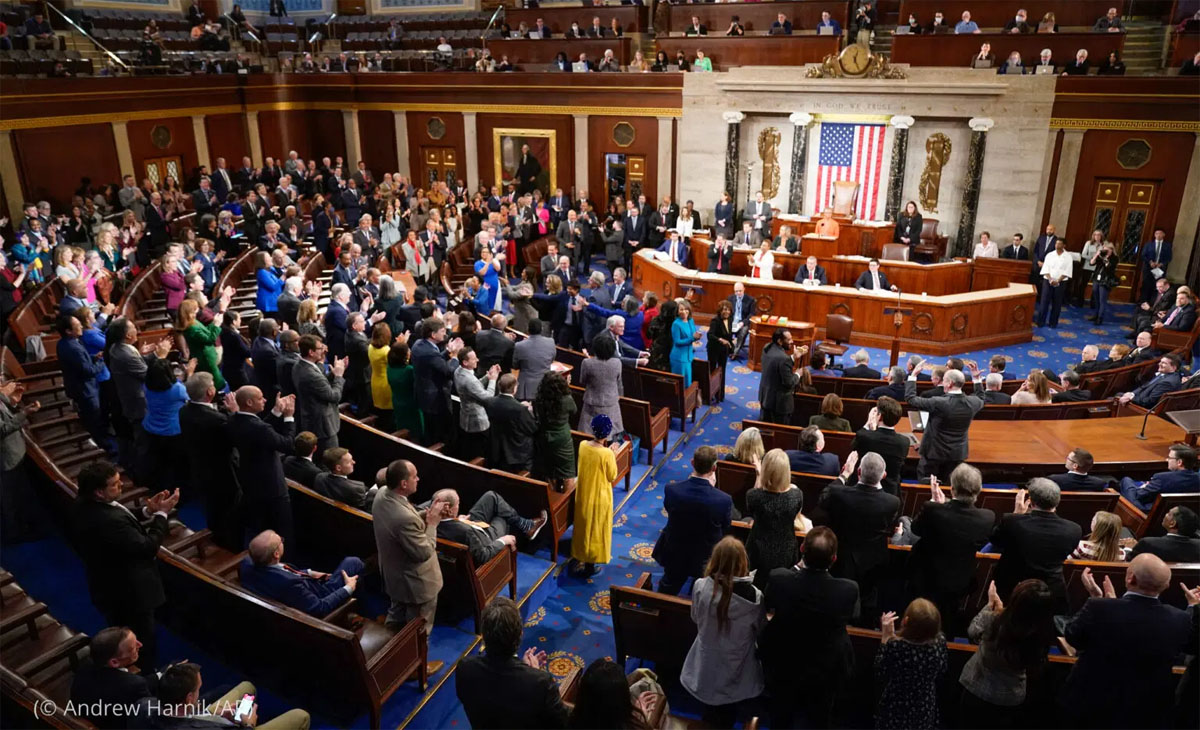
US Congress Seeks Cooperation With Nigeria to Stop Chinese Mining Funding Militias
A new United States congressional bill has proposed measures to counter the alleged illegal Chinese mining operations in Nigeria and their role in financing Fulani militias, raising concerns over security, religious freedom, and regional stability. The legislation, titled the Nigeria Religious Freedom and Accountability Act of 2026, was introduced on Tuesday, February 10, 2026, by five Republican lawmakers: Riley Moore, Chris Smith, Brian Mast, Mario Diaz-Balart, and Bill Huizenga.
The bill directs the U.S. Secretary of State to work with the Nigerian government to address what lawmakers describe as the “hostile foreign exploitation of Chinese illegal mining operations” and their alleged payments of “protection money” to Fulani militias. It further recommends providing technical support, including disarmament programs and counter-terrorism cooperation, to reduce violence from armed groups in northern and northwest Nigeria.
READ ALSO:
- IKEDC Sets Feb 20 Deadline for Customers to Submit Valid IDs or Face Disconnection
- Trump Halts Minnesota Immigration Crackdown After Fatal Shootings, Protests
- Army University Professor Dies in Boko Haram Captivity After Nearly One Year
Clauses 10 and 11 of the proposed legislation specifically call for:
- Technical assistance to the Nigerian government to reduce and eliminate militia violence, targeting groups that could be designated as Foreign Terrorist Organizations (FTOs).
- Cooperation with Nigerian authorities to counter illegal mining activities that allegedly destabilize communities by funding armed Fulani militias.
The legislation also urges collaboration with international partners such as France, Hungary, and the United Kingdom to promote religious freedom, peace, and accountability in Nigeria. The Secretary of State is tasked with evaluating whether certain Fulani-ethnic militias meet the criteria to be listed as FTOs, a designation that could trigger sanctions, visa restrictions, and asset freezes.
Lawmakers cited a 2023 report by The Times, which alleged that some Chinese nationals operating in Nigeria’s mining sector provided financial support to militant networks in states such as Zamfara, often using bribery or informal transactions to access mineral reserves. The report warned that such activities could indirectly fuel militia violence and insecurity in Nigeria’s northwest region.
The bill is part of a broader U.S. focus on religious freedom, communal violence, and national security in Nigeria. It also includes provisions for annual reporting to Congress on U.S. efforts to curb foreign involvement in funding militias and promote accountability for extremist activities.
While supporters argue that the bill strengthens U.S.–Nigeria cooperation to promote peace, security, and accountability, critics caution that allegations of militia funding by Chinese mining operators must be carefully investigated and verified to avoid misrepresentation or diplomatic tension.
US Congress Seeks Cooperation With Nigeria to Stop Chinese Mining Funding Militias
News
Umahi Vows to Quit if Road Project Fails Independent Quality Test
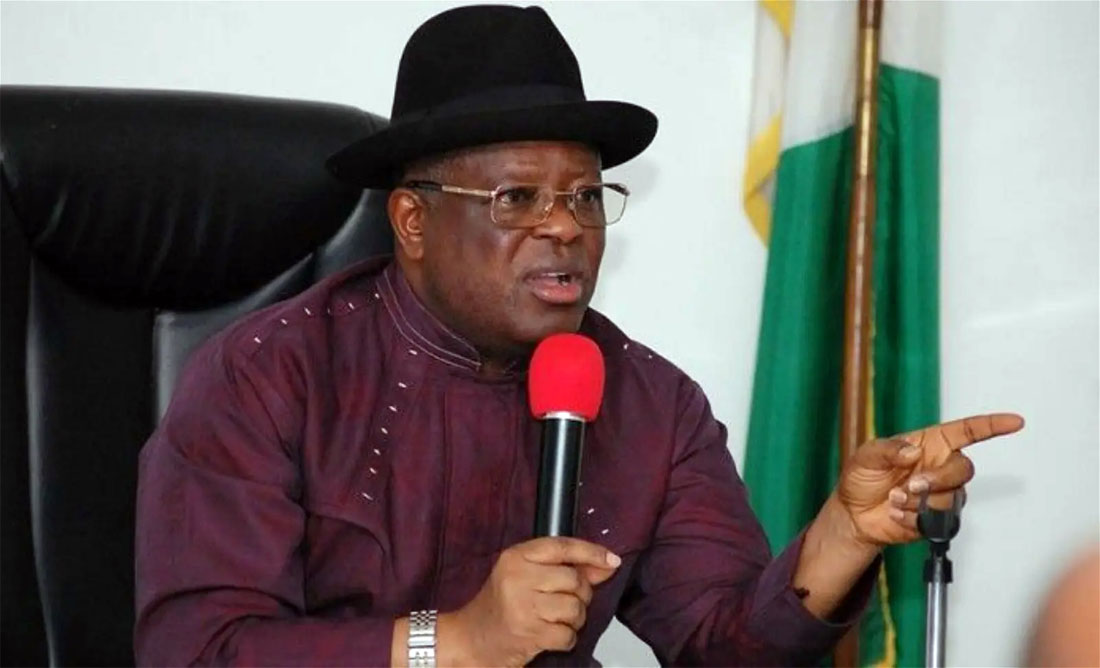
Umahi Vows to Quit if Road Project Fails Independent Quality Test
The Minister of Works, David Umahi, has pledged to resign if the ongoing Abuja–Kaduna–Kano road project does not meet required quality standards after independent testing. Umahi made the bold declaration while defending the Federal Ministry of Works’ ₦3.4 trillion budget proposal before a joint session of the National Assembly on Wednesday, stressing accountability and the importance of high-quality infrastructure delivery.
During the session, lawmakers raised concerns over the award of a section of the highway to a company reportedly unfamiliar in road construction, with some questioning the firm’s reputation and previous experience. Senator Adams Oshiomhole (APC, Edo North) asked why the contract was withdrawn from a previously established contractor and awarded to another company allegedly linked to unrelated businesses like generator sales.
Responding to the concerns, Umahi dismissed criticisms about the contractor’s background and emphasized the quality of workmanship above public perception. “I’m just hearing about Maikano for the first time. Whether they are selling goats or cows, they are doing well. I am satisfied with the quality of work on the Abuja–Kaduna stretch, and I challenge you to an inspection. Bring the best of your concrete testers. If it fails, I will throw in the towel,” the minister said.
READ ALSO:
- NUFBTE Workers Occupy NAFDAC Lagos Office Over Sachet Alcohol Ban
- Naira Could Trade Below ₦1,000/$ With Dangote Refinery at Full Capacity — Otedola
- Adeyanju Urges EFCC, DSS to Probe El-Rufai Over Alleged Corruption, Insecurity in Kaduna
The minister further highlighted that proper supervision and engineering oversight are key to durable infrastructure, stressing that failures in asphalt or concrete roads often stem from poor monitoring rather than the choice of material.
Budget Defence and Funding Concerns
Umahi also used the National Assembly session to raise concerns about the capital funding structure for federal projects, describing the cash plan adopted by the Federal Ministry of Finance as limiting the effectiveness of the Ministry of Works. He noted that over 95% of projects under his supervision are ongoing, making consistent and adequate capital releases critical for timely completion and quality assurance.
The budget defence session was marked by tension, with lawmakers and the minister engaging in heated exchanges over procedural conduct and lines of questioning. At one point, Senator Onyekachi Nwaebonyi (APC, Ebonyi North Central) objected to attempts to curtail his remarks, while senior lawmakers, including Senator Ali Ndume (APC, Borno South), intervened to restore order.
Strategic Importance of the Highway
The Abuja–Kaduna–Kano road is a key federal transport corridor connecting central and northern Nigeria. The project aims to enhance trade, freight movement, and regional connectivity, reduce travel time, and improve road safety for commuters and commercial operators. Sections of the highway were reassigned to new contractors to expedite completion and ensure long-lasting infrastructure standards.
Umahi’s public pledge to resign if the project fails independent testing reflects a rare commitment to accountability and transparency in Nigeria’s federal infrastructure projects. Experts say such a stance could set a precedent for rigorous quality assurance and oversight across similar national initiatives.
Umahi Vows to Quit if Road Project Fails Independent Quality Test

-

 metro2 days ago
Leadership Crisis at NAHCON as Chairman Abdullahi Saleh Usman Resigns
-

 News2 days ago
Oyo Muslims Reaffirm Loyalty to Sultan on Islamic Matters — Grand Chief Imam
-
 News2 days ago
US Judge Orders FBI, DEA to Release Tinubu’s Criminal Records, Faults Delays
-

 International2 days ago
US to Deport 18 More Nigerians on ‘Worst-of-the-Worst’ Criminal List (Full Names)
-
metro2 days ago
Former NAHCON Chief Explains Why He Stepped Down, Denies Conflicts
-

 Business2 days ago
Naira Posts Strong Comeback, Breaking Two‑Year High Against Dollar
-
 metro1 day ago
Kwara, Katsina Bloodshed: TMC Condemns Attacks, Dismisses ‘Jihadist Preacher’ Claims
-
 metro2 days ago
Governor Peter Mbah Orders Closure of Bet9ja Operations in Enugu