New York Times and Onitsha screwdriver sellers’ data, By Farooq Kperogi - Newstrends
Connect with us

Opinion

New York Times and Onitsha screwdriver sellers’ data, By Farooq Kperogi

Published

on

Case for replicating the Oyo kidnap-rescue template nationwide, By Farooq Kperogi
Farooq Kperogi

New York Times and Onitsha screwdriver sellers’ data, By Farooq Kperogi
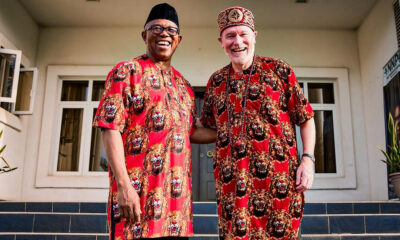
The New York Times of January 18, 2026 published an explosive story showing how unverified and methodologically questionable data produced by a little-known Onitsha screwdriver seller who moonlights as an NGO activist, Emeka Umeagbalasi of Intersociety, traveled upward into US Republican politics and helped shape a narrative of “Christian genocide” in Nigeria, culminating in Trump-ordered airstrikes in Sokoto State.

Umeagbalasi, who runs Intersociety from his home and relies largely on secondary sources, assumptions, presumptions and Google searches, admitted that he rarely verifies deaths, often imputes victims’ religious identities based on his understanding of what I like to call Nigeria’s emotional geography, and inflates figures that conflict researchers and even church leaders dispute.

Despite these flaws, his claims were cited by Fox News, Senator Ted Cruz, Rep. Riley Moore and other Republicans, and echoed by the White House. It illustrates how fraudulent data, ideological advocacy and US culture-war politics converged to misframe Nigeria’s complex violence as a one-sided religious slaughter rather than a crisis of state failure affecting Christians, Muslims, traditional religious worshipers and nonreligious people.

But a certain class of Nigerians have chosen to either not read the New York Times story (instantiating my recent Facebook post about Nigerians’ fixation with forming opinions based only on headlines) or to read it but allow their preconceived biases to befog their comprehension.

Some low-information, high-ignorance Nigerians even claim that the New York Times report was bought with the reported $9 million the Bola Tinubu government paid to a conservative lobbying firm in Washington, DC. I will return to this point shortly.

Interestingly, a December 26, 2025 investigation by the BBC’s Global Disinformation Unit reached strikingly similar conclusions to those of the New York Times. The BBC investigation, which surprisingly did not gain traction in Nigeria when it was first published, also showed that the figures underpinning the “Christian genocide” narrative are unverifiable, internally inconsistent and sharply at odds with independent conflict-monitoring data.

It noted that groups such as ACLED document widespread killings across Nigeria but find no credible evidence of a coordinated campaign targeting Christians alone. Violence in Nigeria, the BBC observed, is better explained by state weakness, banditry, insurgency and impunity, dynamics that endanger Muslims and Christians alike.

READ ALSO:

Crucially, the BBC report situates the persistence of the genocide framing within southeastern Nigeria’s political history. It highlights how some of the loudest voices amplifying the narrative are rooted in Igbo political grievances and are entangled with pro-Biafra networks that have long sought international sympathy by portraying the Nigerian state as genocidal.

Recasting Nigeria’s complex security crisis as a religious extermination campaign provides a morally powerful export narrative, particularly when targeted at US evangelical and conservative audiences.

The report quoted a Biafran separatist group as admitting to playing a major role in promoting the “Christian genocide” narrative in the US Congress. “The Biafra Republic Government in Exile, BRGIE, described it as a ‘highly orchestrated effort,’ saying it had hired lobbying firms and met US officials, including Cruz.”

That framing found fertile ground in Washington. Lobbying firms and advocacy networks tailored the message for American culture-war politics, where persecution of Christians abroad resonates strongly. Republican lawmakers, often unfamiliar with Nigeria’s internal dynamics, repeated the claims with little scrutiny.

In that sense, the genocide story was less the product of rigorous evidence than of ideological alignment, diaspora activism and a lobbying ecosystem eager for simple moral binaries.

This does not, by any stretch of the imagination, suggest that Christians are not being killed in large numbers in northern Nigeria or that victims are unjustified in framing their suffering in religious terms simply because many of the perpetrators identify as Muslims. My first column on this issue acknowledged this fact.

But the pushback is warranted because the narrative is built on false data and amplified to US lobby groups by people whose agenda is not primarily about Christian genocide. It is also warranted because Muslims are being murdered in large numbers by the same actors who are killing Christians.

On the surface, it may seem defensible to argue that since the people killing Muslims are also Muslims, only the killings of Christians matter. But that position is both morally and sociologically problematic.

First, every unjustified death should concern us. Second, human beings inhabit a multiplicity of identities. Being Muslim is not the sum total of the lives of people murdered by bandits and terrorists.

To suggest that the murder of Hausa and sedentary Fulani by bandits and terrorists does not matter as much as the murder of Christians simply because the villains and victims share the same faith betrays a lack of humanity.

READ ALSO:

In my part of Nigeria, broadly speaking Borgu, which stretches across parts of Kebbi, Niger and Kwara States, scores of our people are murdered regularly. To imply that those deaths do not matter because most people there are Muslims cuts deeply. And that is where the “Christian genocide” narrative has led.

The internationalization of this narrative in the service of separatist advocacy makes it particularly jarring. That is why independent international media have been drawn to interrogate it, and why the story is now crumbling under sustained scrutiny.

Now, back to the conspiracy theory that the New York Times story was spurred by the Nigerian government.

There is no relationship between the Nigerian government’s reported payment to a conservative lobbying firm in Washington and the New York Times investigation that dismantled the Christian genocide narrative. None. The two events merely occurred in the same news cycle, and coincidence is being mistaken for causation.

To begin with the basics, there is no credible historical record of the New York Times ever accepting monetary inducement to write or slant a story. Not from governments, not from corporations, not from foreign lobbies.

In more than a century of operation, the paper has been sued, criticized, corrected, embarrassed and sometimes wrong, but it has never been shown to have sold its news judgment for cash.

The Times is not a fragile outfit scrambling for influence money. It is a multibillion-dollar publicly traded company whose value runs into the low tens of billions of dollars, whose brand is widely regarded as America’s newspaper of record and whose reporters earn, on average, six-figure salaries.

Its institutional power flows from credibility, not access fees. Destroying that credibility for a $9 million foreign lobbying contract, money that would not even pass through its books, would be commercial and reputational suicide.

Just as importantly, the lobbying payment itself is being misunderstood. Lobbyists in Washington influence government policy, not news coverage. They target lawmakers, executive agencies and regulatory processes.

They do not buy front-page investigations at elite newspapers, especially not papers that routinely antagonize conservative politicians and administrations. The idea that a conservative lobby would bribe a liberal newspaper to undermine a conservative narrative is internally incoherent.

The contrast with Nigerian media practices is uncomfortable but unavoidable. In the United States, mainstream news organizations do not accept bribes to write stories. Paying journalists to publish or suppress coverage is a career-ending offense. Newsrooms are legally exposed, aggressively scrutinized and professionally policed in ways that make such conduct extraordinarily risky.

That does not mean American journalism is perfect or bias-free. It means its failures are not transactional in the crude cash-for-coverage sense that some Nigerians assume or know.

So why does the bribery explanation feel plausible to some Nigerians? The answer lies not in evidence but in cognition and experience.

People rely on the availability heuristic, drawing on what they know best. If influence at home is often bought with money, money becomes the default explanation everywhere else. This is reinforced by analogical overreach, that is, the assumption that foreign institutions must function like local ones despite radically different incentive structures and accountability systems.

There is also institutional opacity. When people lack procedural knowledge of how elite Western media operate, they substitute a simpler question for a harder one. Instead of asking how a newspaper verifies sources or decides newsworthiness, they ask who paid whom. Add correlation-as-causation bias, the temptation to connect two adjacent events, and a narrative writes itself.

Layered onto this is monocausal populism, the belief that complex outcomes must have a single villain, usually money, and epistemic provincialism, the assumption that local moral failures are universal features of power.

In low-trust environments like Nigeria, conspiracy rationality becomes an ordinary mode of explanation rather than a fringe pathology. It supplies coherence where institutional trust is absent.

Finally, there is what in media studies we call narrative closure bias. The bribery story feels complete. Institutional independence feels abstract and unsatisfying. Closure beats accuracy.

Put plainly, the claim that a conservative lobby bribed a liberal American newspaper to publish an investigation that undercut conservative politicians tells us far more about how Nigerians make sense of distant power than about how American journalism actually works.

The New York Times story stands or falls on its evidence and methods. So far, critics have attacked neither. They have simply imagined a transaction that never happened.

Kperogi is a renowned Nigerian columnist and United States-based professor of Journalism.

Views expressed on this opinion are personal and do not reflect the thoughts and beliefs of newstrends.ng or its owners.

New York Times and Onitsha screwdriver sellers’ data, By Farooq Kperogi

Loading

Opinion

WHO WILL SPEAK FOR WASILAT? WHEN TRADITION BECOMES HUMILIATION, JUSTICE MUST SPEAK

Published

on

TikToker undergoes cleansing after filming Oloolu procession in Ibadan

WHO WILL SPEAK FOR WASILAT? WHEN TRADITION BECOMES HUMILIATION, JUSTICE MUST SPEAK

A young Nigerian lady, Wasilat, has become the centre of a disturbing controversy that should concern every defender of human rights, justice, and the rule of law.
According to her own account during a live interview on Lagelu FM, she did not film the Olóòlù masquerade itself. She said she only recorded the gathering of people and later uploaded the video to TikTok. She further stated that she was advised to remove the video, and she complied.

If her account is true, the events that followed should alarm every conscientious citizen.
She alleged that she was arrested the following day by followers of the olóòlù and later detained by the police. Images that circulated widely on social media appeared to show her publicly humiliated—made to wear a red wrapper, adorned with ritual objects, compelled to carry a live She-goat, and having her head shaved in public while being filmed. She also stated that these rituals were arranged between her mother and those involved while she was in detention not with her own consent.

Whether one believes in the spiritual significance of the Olóòlù tradition is beside the point.

The questions are:

1- Can any Nigerian be deprived of liberty, publicly humiliated, or compelled to participate in rituals against their will simply because of a traditional belief?

2- If the belief is that any woman who sees Olóòlù will automatically suffer supernatural consequences, why would human beings need to arrest, detain, and punish the alleged offender the next day?

3- If the supernatural claim is true, why was human intervention necessary?

4- If it is not true, then what justification exists for the alleged humiliation?

These are legitimate questions. They are not attacks on culture. They are questions about justice.
Nigeria is governed by law, not fear.
The Constitution guarantees the dignity of every human person. It protects personal liberty. It protects freedom of conscience. It prohibits degrading treatment.
No tradition, however ancient, should become a licence for intimidation, coercion, or public disgrace.
Culture deserves respect.
Human dignity deserves greater respect.
If Wasilat’s account is accurate, then what happened to her represents far more than a disagreement over tradition. It raises concerns about arbitrary arrest, coercion, degrading treatment, invasion of privacy, and possible violations of her constitutional rights.

Even more troubling is the public circulation of images depicting her alleged humiliation. In the digital age, such images can haunt a victim for years, affecting education, employment, mental well-being, and social acceptance.
Justice cannot remain silent.
Today it is Wasilat.
Tomorrow it could be another young woman.
The silence of good people is often the greatest ally of injustice.
This is therefore a call—not for violence, not for hatred against any cultural group—but for lawful action.
We call upon human rights organisations, the legal community, civil society organisations, women’s rights advocates, youth groups, and all lovers of justice to demand an impartial investigation into these allegations.
Let the truth be established.

If Wasilat’s rights were violated, those responsible should be held accountable in accordance with the law.
If public officials participated in or enabled unlawful conduct, they too should answer before the law.
No Nigerian should be subjected to degrading treatment in the name of culture.
No woman should be publicly humiliated because of superstition.
No citizen should lose her dignity because others choose fear over justice.
A society is judged not by how it treats the powerful, but by how it protects the vulnerable.
Justice delayed encourages injustice.

Justice denied encourages oppression.
Justice done restores confidence in both culture and the law.
Today, let us ask one simple question:
If this happened to your daughter, your sister, your wife, or your mother, would you remain silent?
If your answer is “No,” then now is the time to speak—not with anger, but with courage; not with violence, but with justice; not with vengeance, but with the unwavering conviction that every Nigerian deserves dignity, liberty, and equal protection under the law.
Justice for Wasilat is justice for every Nigerian woman.

Almudeer Ajiginni
Director, The City of knowledge /SSA to National chairman PCRC
4/8/2026.


WHO WILL SPEAK FOR WASILAT? WHEN TRADITION BECOMES HUMILIATION, JUSTICE MUST SPEAK

Loading

Continue Reading

Opinion

Five days in Salvador, Brazil’s Yoruba city, By Farooq Kperogi

Published

on

Five days in Salvador, Brazil’s Yoruba city, By Farooq Kperogi

Five days in Salvador, Brazil’s Yoruba city, By Farooq Kperogi

For the past couple of years, my wife and I have instituted a yearly self-care ritual of taking at least one vacation in a part of the world we have not visited before. This year, I suggested Brazil for two reasons.

One, my interest in recreational genetics has led me to join Facebook groups where people from all over the world share their DNA results and invite conversation. I was struck by the number of phenotypically white Brazilians who show significant Central and West African ancestry. Although the Brazilians who share their DNA results on social media groups are not representative of the entire population, their results nonetheless signaled to me that African filiation in the country is higher and deeper than most people assume.

Second, I have had a faint familiarity with the surviving vestiges of African, particularly Yoruba, cultural and linguistic influences in Brazilian culture and wanted to deepen my knowledge experientially.

So, we planned a 10-day, three-city vacation. We would visit Salvador, Brazil’s Blackest and fifth-largest city, which has the distinction of being the country’s first capital and is now the capital of the northeastern state of Bahia; São Paulo, Brazil’s commercial nerve center and the most populous city in the Americas; and Rio de Janeiro, Brazil’s second-largest city and its federal capital until 1960, which is also home to the Christ the Redeemer statue, one of the New Seven Wonders of the World.

Because of Salvador’s historical and cultural significance to us, we chose to spend half of our stay there. In this remarkable city, we repeatedly encountered West Africa speaking Portuguese. The resemblance was not always visible in faces. Sometimes it announced itself in food, gesture, rhythm and words whose African ancestry had survived even when their speakers no longer remembered it.

In more ways than I can express, driving and walking through Salvador was redolent of the sights, sounds, occasional smells and rhythms of Lagos.

Except for its exquisitely hilly landscape and its mixed-race and white populations, almost everything else about it reminded me of Lagos. The sight of helmeted “Okada” riders competing with motorists for the road, vulcanizer shops, street vendors, occasional unsolicited car windshield cleaners during traffic jams, bus conductors shouting destinations to attract passengers, open-air markets and the architecture of the buildings could have made me momentarily lose awareness of where I was. Only the phenotypic diversity of the people around us kept reminding us that we were not in West Africa.

READ ALSO:

Although Salvador is Brazil’s Blackest city, and the northeastern region is the country’s Black Belt, Black people who look like me are no longer the numerical majority there. They now constitute about 34 percent of the city’s population. Mixed-race people, classified as pardos in Brazil, are the majority, with more than 49 percent of the population. White Brazilians constitute a little more than 16 percent of the city’s population.

Salvador’s demographic changes reflect a broader national trend in Brazil. Brazil’s population went from predominantly Black in 1872 to predominantly white in subsequent censuses and then, for the first time in its census history, to predominantly mixed-race in the 2022 census. According to that census, mixed-race Brazilians now constitute about 45 percent of the country’s population. Whites constitute a little over 43 percent and Blacks a little over 10 percent.

However, although Salvador is now only a little over 30 percent Black, the Yoruba influence in the city is unmistakable. The people depicted in murals are predominantly Black. Representations of traditional attire reflect unmistakably West African aesthetics.

The most recognizable monument to the city’s Yoruba heritage can be found near its center. There stands a historic urban lagoon called Dique do Tororó, distinguished by eight monumental sculptures of Yoruba and Fon-Gbe deities standing in the water.

Designed by the Bahian artist Tatti Moreno, the sculptures represent Oxalá, or Òrìṣà-ńlá; Iemanjá, or Yemọja; Oxum, or Ọ̀ṣun; Ogum, or Ògún; Oxóssi, or Ọ̀ṣọ́ọ̀sì; Xangô, or Ṣàngó; Nanã, or Nàná Bùrùkúù; and Iansã, or Ọya.

Four smaller sculptures on the surrounding land represent Oxumaré, or Òṣùmàrè; Ossain, or Ọ̀sanyìn; Logun-Edé, or Lógun Ẹ̀dẹ; and Ewá, or Yewa. The works were created during the 1990s and have become internationally recognizable symbols of Salvador’s African religious and cultural identity.

We visited the city’s historic Pelourinho neighborhood, where Michael Jackson performed with Olodum, the Afro-Brazilian percussion group whose name recalls Olódùmarè, the Yoruba name for the Supreme Being, and shot his iconic music video for “They Don’t Really Care About Us.”

Pelourinho was once a place where enslaved Africans and others were publicly punished during the colonial period. Today, it is known for its cobblestone streets, brightly painted colonial buildings, churches and strong Afro-Brazilian cultural presence.

There, we also visited the Afro-Brazilian Museum, where we found street vendors selling everything from food and clothing to artwork amid the familiar sounds and movements of African open-air markets.

We explored Salvador’s cuisine, which reminded us of West Africa in several ways. In Salvador, you cannot miss acarajé, which anyone with even a faint familiarity with Yoruba would recognize as deriving from “àkàrà jẹ,” that is, “eat akara.”

Like Nigerian akara, acarajé is made from beans, although the Bahian version is fried in palm oil. Salvador’s acarajé is then sliced open and filled with sautéed shrimp, diced onions and peppers, with chopped okra sometimes added. The acarajé we ate in São Paulo, however, looked and tasted almost exactly like Nigerian akara.

READ ALSO:

The women who traditionally fry and sell acarajé are called baianas. They dress in white or other brightly colored dresses with matching headwraps, resembling exaggerated forms of modern West African dress. They could easily pass for our mothers and sisters in almost any part of West Africa.

We also found that Brazilian cuisine is full of something that looked and tasted to us like garri. They call it farofa, a toasted cassava flour prepared in many varieties and often mixed with palm oil. It is served alongside stews, incorporated into other dishes or sprinkled dry as a garnish.

My wife initially thought it was something else. When she tasted it and discovered that it was essentially garri by another name, she remarked that she would not pay good money to fly from the United States to Brazil to eat garri in expensive restaurants.

It turned out that cassava, from which garri is made, came to us in Nigeria by way of Brazil. The Portuguese who introduced cassava to Africa first encountered it in Brazil.

But the similarities in our cuisines did not stop there. On Salvador’s beaches, which have an elaborate nightlife, we sampled several kinds of street food. One that stood out was queijo coalho, often translated simply as coalho cheese, which tasted exactly like wàrà to us. It is a firm, mildly salty Brazilian cheese made from cow’s milk. You buy it ungrilled and beach vendors roast it for you on skewers.

Perhaps the most surprising gastronomic discovery for us on the beaches was the sight of vendors selling what looked, and even tasted, like tsire, the Hausa-style skewered meat, usually beef, coated with a spicy groundnut-based seasoning and grilled over an open fire.

Brazilians call their version espetinho. Although it is not coated in the distinctive groundnut-and-spice mixture used for tsire, it looks every bit like tsire nonetheless. It is served with farofa, vinaigrette-style salad or hot sauce.

Seeing tsire-like meat being sold alongside people hawking sugarcane made me do a double take. Was I suddenly in Kano?

By far the most mind-blowing experience for us was attending two Candomblé ritual ceremonies. Candomblé is an Afro-Brazilian religion rooted in Yoruba and other African traditions. Much of its ritual liturgy is preserved in Yoruba.

I have a working knowledge of Yoruba, and my wife, who attended high school in Ogbomoso for three years, speaks Yoruba even better than I do.

It was a surreal experience seeing Portuguese-speaking Brazilians beating drums and dancing like Yoruba people while reciting incantations, prayers and songs in Yoruba, a language they did not speak conversationally and whose literal meanings many of them did not appear to understand.

Because the ceremonies were not open to everyone, we had to gain access through a tour guide who was an adherent of the faith.

He had given his business a Yoruba name, and because he was as dark-skinned as any regular Nigerian, I assumed he spoke some Yoruba. He did not. But, like the worshippers we encountered at Ilê Asé Opô Aganju, as the shrine is called, he had memorized inherited prayers, chants and songs in Yoruba, much as non-Arabic-speaking Muslims use Arabic in worship.

The ritual language, of course, often preserves older Yoruba forms and pronunciations shaped by centuries of transmission in Brazil.

We encountered an Egúngún, a Yoruba ancestral masquerade preserved in Bahia. Completely concealed beneath an elaborate cascade of brightly colored cloth, the masquerader is regarded as the temporary embodiment of a departed ancestor returning to counsel, bless or discipline the living.

As it danced and lunged through the gathering, a cane or ritual staff enforced a respectful distance, threatening men who obstructed its path and sending spectators scrambling aside.

After the Egúngún ceremony was over and the crowd was dispersing, we heard someone say in accentless Yoruba, “Kí ló dé?” That stopped us in our tracks.

We did not know the context in which he said it, but it fascinated us. Could this be a native Yoruba speaker visiting from Nigeria or the Benin Republic? Could it be a Brazilian who had learned and understood the language?

So, I asked, in my limited Yoruba, who there spoke Yoruba. The person looked in our direction with great surprise and enthusiasm, but we had to leave because it was late and our guide had other commitments.

I will conclude this travelogue next week.

Five days in Salvador, Brazil’s Yoruba city, By Farooq Kperogi


Kperogi is a renowned columnist and United States-based Professor of Journalism 

Loading

Continue Reading

Opinion

Stop, CBN! The baby is in the bathwater

Published

on

Stop, CBN! The baby is in the bathwater
Tunde Odesola

Stop, CBN! The baby is in the bathwater

Tunde Odesola

(Published in The PUNCH, on Friday, July 31, 2026)

I invite you to join me on this journey to the Central Bank of Nigeria headquarters in Abuja, where I shall be meeting with the CBN Governor, Mr Olayemi Michael Cardoso. The meeting is neither official nor scheduled, but its importance highlights the potential harm a recent CBN directive portends for the nation’s banking sector.

The trip will be long and windy; I will be driving in my rugged BMW, which can only take a few passengers. So, the privilege to be on the trip will be on a ‘first come, first served’ basis. The journey is a rescue mission! The CBN is about to disrupt the equilibrium in the banking sector over advertisement fines, giving no room for feedback or consultation with stakeholders. Even the itinerant thrift collector, Bàbá AlájọṢómólú, talks with stakeholders.
Having traversed the nation’s banking corridors for forty-four years, with nearly three of those years as the helmsman at CBN, it is not too much to expect Cardoso, at 69, to possess the wisdom of an elephant.

I looked up Cardoso’s name half‑expecting to find “Solomon” tucked in the middle; instead, I found “Michael.” And the more I weighed both names, the clearer it became that Michael suits him better. Archangel Michael stands for protection and justice, flaming sword in hand, while Solomon’s famed judgment has long been questioned by ethicists who argue that no ruler should threaten or appear willing to endanger an innocent child, insisting that the outcome of Solomon’s judgment depended on emotional reaction, which could have been mistaken.

Instructively, the case I’m discussing with Cardoso rests more on protection and justice than wisdom, though justice rarely walks without wisdom in its shadow.

It was in the groundbreaking book, “Frames of Mind: The Theory of Multiple Intelligences,” written by Harvard professor Howard Gardner and published in 1983, that I discovered why I always muddle up music notes whenever I sing. It was Gardner’s book that told me music intelligence was among the eight types of intelligences there are. Gardner’s work opened my eyes to a moment of epiphany when I realised that no matter what I do, I can never sing according to notes because I do not possess music intelligence. Just look in my direction if you’re looking for the king of ‘off-beat’ singing. You won’t have to mock me for too long though, as I shall enrol in a music school soon.

But Bob Marley wasn’t beset with my “off-key” fate. Still the greatest reggae music band after 45 years of dissolution, Bob Marley and the Wailers bequeathed to humanity timeless songs such as ‘One Love’, ‘No Woman, No Cry’, ‘War’, ‘Buffalo Soldier’, ‘Exodus’, ‘Could You Be Loved’, ‘Three Little Birds’, and many more. The acronym of Marley’s evergreen band is BMW.

READ ALSO:

If you ask me which I prefer between going down on bended knees before a cheering crowd in the street, engagement ring in hand, asking my beloved, “Will you marry me?” and holding my partner in high esteem at all times? I would choose the latter. What is the essence of public display of affection when the man is a King Kong at home?

Anyway, the whole essence of dating and courting becomes promising when the man proposes and tells the lady to “Be My Wife”: BMW.

Germany produced Adolf Hitler, the mass murderer. It also gave the world great men like Karl Marx, Beethoven, Goethe, Kant, Nietzsche, Engels, and Bismarck, even as the auto world owes gratitude to Germany’s genius, which produced Mercedes-Benz, Porsche, Maybach, Volkswagen, Audi, Opel, etc.

Germany is also the home of Bayerische Motoren Werke, the makers of my very first car, a three-series BMW. Is there someone who didn’t like their first car? I was besotted by my darling BMW. Young and dashing, with a dream job in hand, my silver BMW represented the five stars on the epaulette of a bachelor ready to explore possibilities, promise and passion.

One day, I took my BMW to my panel beater, whose shack flanked the Central Bank of Nigeria, Akure branch. I had just bought a stereo and the gadget wasn’t sitting properly in the radio cavity. The stereo jutted out a jot from the cavity, and I felt the panel beater would have a device to slightly expand the cavity for the radio to sit smugly.

“I’ll be back soon,” I told the guy as I trekked to my bank across the road. When I got back from the bank, the panel beater sprouted from under a car; a big smile spread on his face. “I have finished your work,” he beamed. I joked with him as I paid him his charge, and we both walked to my BMW. I got into my car and froze as I looked at the radio.

The stereo was right there sitting in the cavity. But the panel beater had gouged a big hollow under the cavity to allow the stereo to fit in, leaving an unsightly gash, like missing incisors. I looked at him for an explanation. Heartily, he sprinted from my side to the passenger’s side, got into the car and regaled me about the genius he employed to perform the magic.

I felt like punching him right in the face. But the close range he was to me in the car wouldn’t allow me to deliver the type of punches I wanted. I was too angry to talk as I watched him fiddling with the stereo and telling me the wisdom that produced his act of vandalism. So, I got out of the car, paced about as I wrestled with the thoughts of how best to avenge the wanton destruction.

When other craftsmen saw my state, they abandoned what they were doing and came over to me, asking, “Ọ̀gá, kíló ṣẹlẹ̀. Wetin happen?” It was the panel beater who answered the questions. “Ọ̀gá ń bínú nítorí iṣẹ́kékeré tí mo ṣe ni,” he announced, smiling, “Ọ̀gá is angry because of the little job I did.” So, his colleagues went to the car to see the little job he did. Everyone was aghast, vehemently condemning his stupidity and calling him names.

I got into my car and drove off with my stereo. I didn’t even remember to collect the money I paid him. That was about 30 years ago.

The panel beater’s reckless solution – a crude fix that destroys what it intends to improve – is exactly what the CBN is about to inflict on Nigeria’s banking sector. A badly worded directive that threatens to deduct from the Cash Reserve Ratio kept with the CBN, following a five-day ultimatum, is not regulation. It is panel beaters at work at the CBN

READ ALSO:

Now, let’s unbare the issues. In a July 24, 2026, circular to all commercial banks aka Deposit Money Banks (DMBs), the CBN recalled a November 27, 2025, circular, alleging that many banks had failed to comply “with regulatory provisions on advertisement,” thereby ordering “immediate withdrawal of non-compliant advertisements”.

The latest circular entitled “Imposition of Regulatory Sanctions For Breaches of Advertising Requirement,” goes on to say that the CBN had conducted a review of non-compliant advertisements, promotions and related communications by affected commercial banks, adding that “continued circulation of non-compliant advertisements and promotional materials after the November 27, 2025, circular” has attracted fines that run into billions of naira across the banks. My investigation revealed that over 95% of commercial banks are affected in a wave of fines that range between N250m and N500m.

Accusing the affected commercial banks of unprofessionalism in their advertisements, the CBN alleged that, “Misleading claims, omitted conditions and prohibited inducements distort consumer decisions, cause avoidable harm and give non-compliant institutions an unfair advantage over those that observe the rules.” The apex bank added that “penalties are imposed pursuant to Section 95(f) and (g) of BOFIA 2020,” stressing that “the sanctions reflect the nature, severity and persistence of the breach, as well as the consumer protection risks arising therefrom”. BOFIA is the Banks and Other Financial Institutions Act. It encourages sound banking practices and the prevention of misleading representations in promotions and gambling-like advertisements.

To put the scenario in perspective, a layman’s explanation would suffice. The CBN is frowning on advertisements and promotional materials that say bank customers can win a certain amount of money if they participate in a promotion. In the wisdom of the CBN, such a promotion is unethical because not all bank customers can win the promised package.

As good as CBN’s oversight appears in this context, it will amount to cutting off the nose to spite the face if Cardoso does not take a critical look at the whole process holistically. For example, the banks coming under the hammer of the CBN obtained approvals from relevant statutory regulators such as the Advertising Regulatory Council of Nigeria (ARCON) and the Federal Competition and Consumer Protection Commission (FCCPC). Does this mean that the alleged breaches the CBN is complaining about are different from the laws of the nation’s apex regulatory bodies for advertising and consumer protection? Are there two sets of advertising and consumer protection laws in the country? Should there not be a consultative meeting among the CBN, the affected banks and the nation’s advertising and consumer protection bodies so that a proper perspective of all the issues could be unfurled before commercial banks’ balances with the CBN are deducted?

READ ALSO:

Given the interconnected nature of the banking system in Nigeria, as is the case in most jurisdictions around the world, the practice of deducting regulatory penalties directly from commercial banks’ accounts maintained with the Central Bank of Nigeria (CBN) carries the risk of creating unintended disruptions. Such deductions can adversely affect the liquidity reserves of Deposit Money Banks (DMBs), funds that ultimately underpin customer deposits and financial obligations. Consequently, while regulatory sanctions are an important tool for enforcing compliance, care must be taken to ensure that their implementation does not inadvertently undermine the very financial stability and depositor interests that the CBN is mandated to protect. This concern becomes particularly relevant for several reasons.

Except the CBN takes the role of another panel beater, it should be crystal clear that if substantial penalties are debited directly from a bank’s balances maintained with it, the following industry implications may arise:

Firstly, deductions may temporarily reduce the affected bank’s liquidity position, particularly where the sanction is significant and applied without prior provisioning.

Also, the penalties may negatively impact profitability by reducing earnings available to shareholders and limiting resources that could otherwise be deployed for lending, technology investments, branch expansion or customer service improvements.

It should be noted that widespread industry sanctions can create operational pressure on banks, prompting emergency compliance reviews, forensic audits and the diversion of management attention from business growth initiatives to regulatory remediation efforts.

If the sanctions are imposed simultaneously on a large number of banks, the cumulative effect could tighten liquidity within the banking sector, albeit temporarily, depending on the magnitude of the deductions and prevailing market conditions.

Such actions may increase regulatory risk perceptions among investors, potentially affecting market sentiment, valuation metrics and confidence in the stability of the operating environment.

And there may be reputational consequences for affected institutions, particularly where sanctions receive extensive media coverage. Customers and counterparties may seek explanations regarding the nature of the breaches, even where the infractions relate to historical marketing materials rather than prudential or solvency concerns.

However, arguing from a regulatory perspective, the CBN may contend that enforcement actions are necessary to preserve market discipline, promote consumer protection, ensure compliance with BOFIA, and maintain confidence in the banking system. Sound argument!

But what is the motive behind a punitive circular that does not state the particular infractions committed by respective banks – in the face of the fact that most of the alleged infractions had been corrected by some of the banks? Why issue sanctions without allowing affected banks to respond and present their cases? By holding affected commercial banks by the jugular, without giving room for fair hearing, the CBN has chosen to be draconian. This is a disturbing trend.

I strongly think that the CBN should look inwards and evolve an organic solution to the sectoral challenge because where the alleged infractions relate to historical advertisements already withdrawn by banks, and where there is no evidence of customer loss, financial instability, fraud or prudential misconduct, a collaborative remediation framework may achieve regulatory objectives more effectively than punitive sanctions of a magnitude capable of affecting industry liquidity and operational efficiency

Cardoso, I have laid out the cards. Please, deal wisely. Use your flaming sword of protection and justice fairly.

Email: tundeodes2003@yahoo.com

Facebook: @Tunde Odesola

X: @Tunde_Odesola

Stop, CBN! The baby is in the bathwater

Loading

Continue Reading

Trending