

metro
Foreign Fulani herdsmen have invaded South-West – Amotekun boss
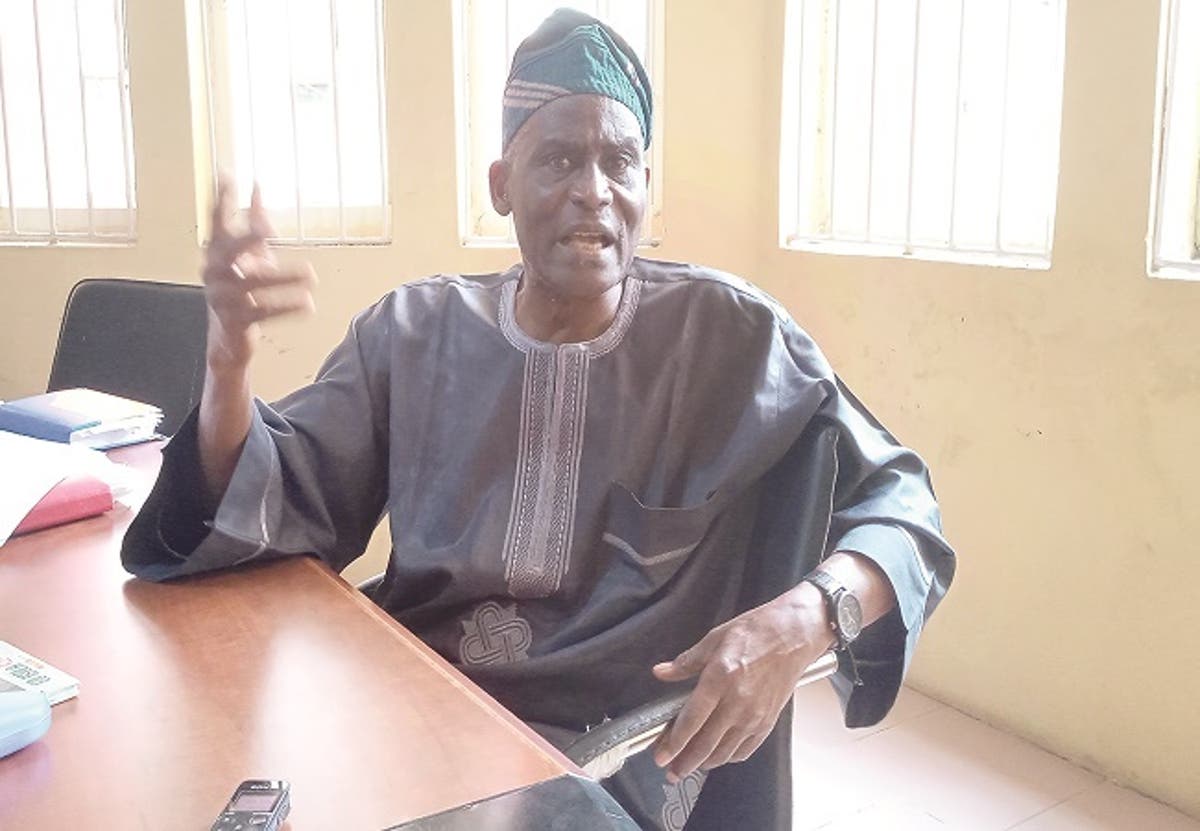
Chairman Oyo State Security Network codenamed Amotekun Corps, General Kunle Togun (Retd), says foreign Fulani have invaded the South-West region and expresses fear that they may strike if nothing is done urgently.
Togun, a former Director of Military Intelligence (DMI) and former Deputy Director-General of State Security Service (SSS), however advised people to be security conscious and prepare to defend themselves.
The Oyo Amotekun boss said the foreigners had been penetrating localities in the region to monitor the environment over the years in preparation for a possible big strike.
Quoting an intelligence report, he said could be aided by local collaborators based on the belief God had given them Nigeria, especially, the South-West as inheritance.
Togun spoke to journalists after a presentation as a guest lecturer at the Institute of Peace and Strategic Studies Student Association (IPSSSA) at the University of Ibadan.
His lecture was entitled, ‘Security Challenges: The significance of regional security dimensions’.
He said, “The foreign Fulani herdsmen have invaded the South-West. There is nowhere in the South-West that they are not. They are there.
“They are the Okada riders. They are the ones using wheelbarrows to sell carrots and other things. I said they are foot soldiers.
“They said they had come in to take the inheritance given to them by Allah and that is Nigerian land, particularly South-West.
“So, they will still strike. I am not just screaming aloud. So, everybody has to be ready.
“It is only a foolish soldier that would say he wants to die for his country. His death cannot help his country. You are to stay alive to help your country.
“When a soldier is sent to capture a particular place, they did not send him to go and die. If he gets there and scares them and the people run away, he has done what he supposed to do.
“But if he was shot at and he fired back, he did not shoot to kill anybody, but to defend himself and keep himself alive, so that he can help his country.
“For over 10 years, I have been saying it that the 10 local government areas of Oke-Ogun and the three local government areas of Ibarapa, both in Oyo State, have been saturated by these foreign Fulanis.
“After that, they brought in their children, selling pepper, tomatoes, carrots and so on with wheelbarrows.”








metro
Missing Robbery Suspect: Anambra CP Queries DPO, Orders Probe
Missing Robbery Suspect: Anambra CP Queries DPO, Orders Probe
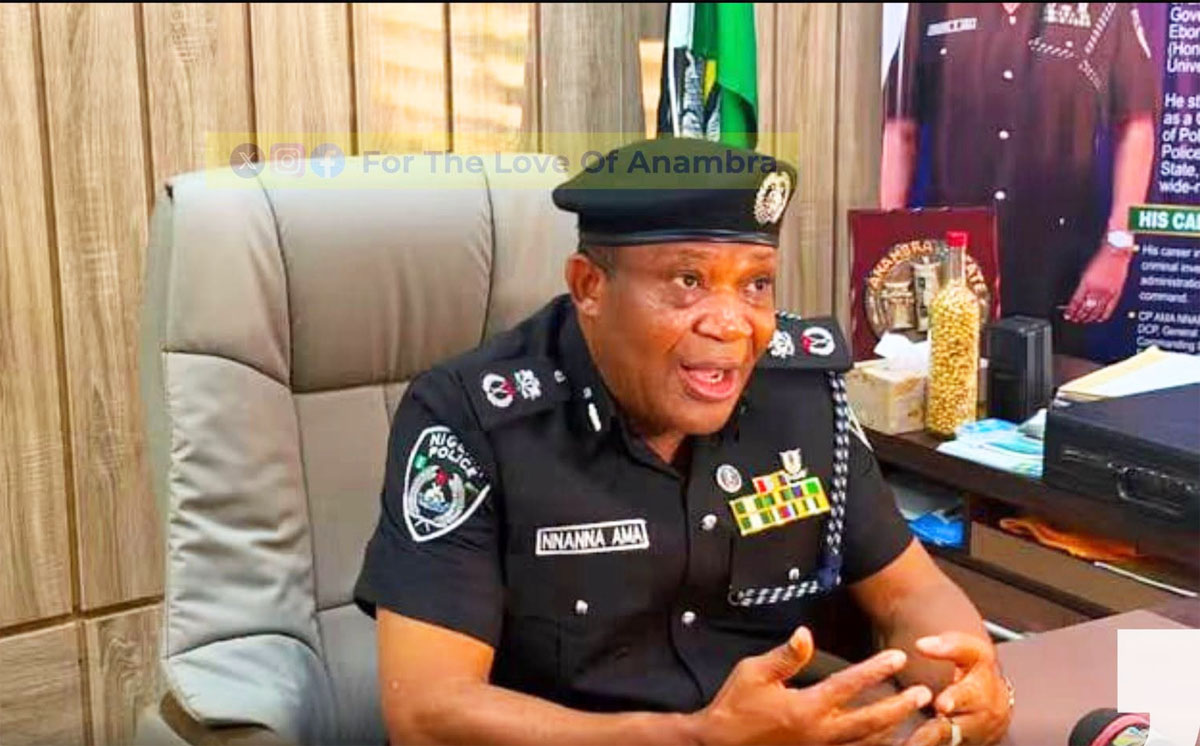
The Anambra State Commissioner of Police, CP Nnanna Oji Ama, has ordered queries for the Divisional Police Officer (DPO) of 3-3 Police Station, Onitsha, and a Deputy Superintendent of Police (DSP) following allegations that an armed robbery suspect arrested and taken to the station could no longer be accounted for.
The commissioner also directed the immediate commencement of disciplinary proceedings against an Inspector of Police linked to the matter.
The action followed the circulation of a viral video alleging that the suspect, who had reportedly been arrested and brought to the police station, subsequently disappeared from custody.
Ama personally interviewed the complainant and officers connected to the incident before issuing the directives.
The commissioner described the allegation as serious, stressing that conduct capable of undermining public confidence in the Nigeria Police Force would not be tolerated.
He said the command would take firm action against unprofessional conduct, dereliction of duty, abuse of office and violations of established police procedures.
READ ALSO:
- FULL LIST: NAF Releases Names Of 25 Victims Killed In Ondo Crash
- Supreme Council For Sharia Secretary-General Nafiu Baba-Ahmed Dies
- Former NADECO Leader Ralph Obioha Dies At 80
Following the interviews, Ama ordered the command’s X-Squad to conduct a comprehensive investigation into the circumstances surrounding the suspect’s arrest, detention and documentation, as well as what happened after the suspect was taken into custody.
The investigation will also establish the roles played by the officers involved and determine whether any police personnel breached established procedures.
The commissioner further said operational measures had been put in place to facilitate the rearrest of the suspect, although the police have not publicly disclosed his current whereabouts.
Ama assured the public that the findings of the investigation would be communicated once the facts had been established.
He also warned against the circulation of unverified information that could prejudice the investigation, stressing the need for the matter to be handled based on established facts.
The commissioner reiterated his commitment to police accountability and professional conduct, saying officers entrusted with protecting members of the public must also be subject to scrutiny when allegations of misconduct arise.
The development has drawn attention to the procedures governing the arrest, detention and documentation of suspects in police custody, particularly the responsibility of officers to maintain accurate records and ensure that detainees remain properly accounted for.
For now, the exact circumstances surrounding the suspect’s alleged disappearance remain unclear. The ongoing X-Squad investigation is expected to determine how the suspect allegedly went missing and whether any police officer bears responsibility.
Missing Robbery Suspect: Anambra CP Queries DPO, Orders Probe
metro
Four NAF Engineers Died Days Before Foreign Course Deployment — Sources
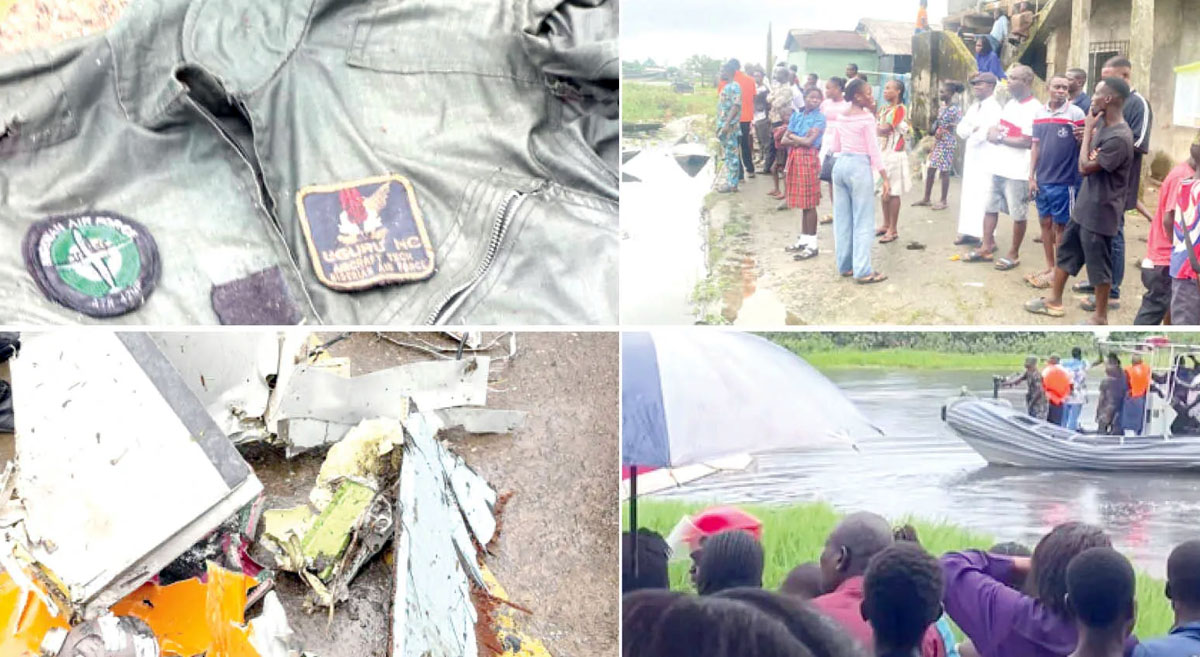
Four NAF Engineers Died Days Before Foreign Course Deployment — Sources
Four Nigerian Air Force (NAF) engineers killed in the Ondo aircraft crash had reportedly travelled to Abuja for documentation ahead of specialised foreign training courses.
The personnel were identified as Master Warrant Officer Matini BA, Flight Sergeant Mohammed AI, Sergeant Izibenikien SI and Sergeant Alafuka C.
According to information surrounding the tragedy, the four engineers had travelled to Abuja as part of preparations for their deployment abroad for professional courses. Their deaths came just days before they were expected to begin the specialised training.
The four were among the 25 people on board the NAF 931 ATR-42 aircraft that crashed in the Igbokoda area of Ilaje Local Government Area of Ondo State. The victims comprised five crew members and 20 passengers.
The aircraft was reportedly on a routine mission when it crashed in the riverine area of Ondo State. Search-and-rescue operations were immediately launched, but the Nigerian Air Force later confirmed that there were no survivors.
The tragedy claimed the lives of several military personnel, including Squadron Leader AP Man-Ugwueje, who was among the aircraft’s crew.
READ ALSO:
- FULL LIST: NAF Releases Names Of 25 Victims Killed In Ondo Crash
- Supreme Council For Sharia Secretary-General Nafiu Baba-Ahmed Dies
- Former NADECO Leader Ralph Obioha Dies At 80
Reports following the crash said Man-Ugwueje had recently been promoted and had married about two weeks before the tragedy.
Another victim, Flying Officer IM Adeshina, was also reportedly a relatively recent addition to the NAF and was said to have distinguished himself during his training.
The deaths have sent shockwaves through the Nigerian military, particularly because some of the personnel were reportedly preparing for further professional development when the tragedy occurred.
The Chief of the Air Staff, Air Marshal Sunday Kelvin Aneke, has ordered a comprehensive investigation into the circumstances surrounding the crash.
The Nigerian Air Force has also appealed to the public to avoid speculation and the circulation of unverified information while the investigation continues.
For the four engineers, what was expected to be the beginning of an important phase in their military careers ended in tragedy, with their planned foreign training cut short by the fatal aircraft crash.
Four NAF Engineers Died Days Before Foreign Course Deployment — Sources
metro
UCH CMD: After Decades Without Muslim, Agunbiade Demands Fair Chance

UCH CMD: After Decades Without Muslim, Agunbiade Demands Fair Chance
‘Let Merit, Not Religion, Decide Next Appointment’
IBADAN — A Muslim stakeholder, Mallam Ibrahim Agunbiade, has called for a transparent and merit-driven process in the appointment of the next Chief Medical Director (CMD) of the University College Hospital (UCH), Ibadan, saying a qualified Muslim candidate should be given a fair chance to lead the institution.
Agunbiade, in a statement on Monday, argued that the leadership history of the premier teaching hospital showed that Muslims had not occupied the position of Chief Medical Director for decades.
He said the situation deserved serious consideration as the process for selecting a successor to the incumbent CMD, Prof. Jesse Abiodun Otegbayo, gets underway.
According to him, Otegbayo, who became CMD in 2019, was reappointed for a second term in 2023.
Agunbiade said the succession of UCH chief executives had included Prof. E. O. Akande (1978–1984), Prof. A. O. K. Johnson (1984–1985), Prof. B. O. Osuntokun (1986–1990), Prof. O. O. Ajayi (1990–1998), Prof. M. O. Olatawura (1998–2003), Prof. A. O. Ilesanmi (2003–2011), Prof. T. O. Alonge (2011–2019) and Otegbayo.
He stressed that his intervention was not intended to question the professional records or achievements of the past CMDs.
Rather, he said, the issue was whether a qualified Muslim professional should continue to be excluded from the highest executive position at the institution.
“How long should a qualified section of the institution’s community wait before it sees one of its own given a genuine opportunity to lead?”
Agunbiade said the question was particularly important because UCH was a federal teaching hospital with a national mandate, serving Nigerians irrespective of religion, ethnicity or background.
‘Not Asking For Religious Favour’
The stakeholder rejected the suggestion that his position amounted to a demand for religious preference.
READ ALSO:
- Troops Take Down Zamfara Bandit Kingpins Baban Love, Mai Zamani, Three Others
- FG Gives N250m To Families Of 37 Miners Who Died In NSCDC Custody
- Tompolo’s PBAT Movement Suspends Campaign Over Ondo Military Crash
He said his argument was that merit and representation should work together, rather than treating them as opposing principles.
“The demand, therefore, is not that UCH should appoint a Muslim because he is Muslim,” he said.
“The demand is that if a Muslim candidate is professionally qualified, experienced, competent and suitable, his religion must not become an invisible barrier to his appointment.”
He noted that the advertised position carried stringent requirements, including medical registration, post-qualification experience, specialist fellowship, consultancy experience, integrity and administrative competence.
According to him, once a candidate meets the professional requirements and emerges as the best person through a credible selection process, religion should not disqualify the candidate.
‘Muslim CMD Will Serve All Nigerians’
Agunbiade also dismissed the notion that appointing a Muslim as CMD would change the character of UCH.
He said the successful candidate would remain the head of a federal institution responsible for providing healthcare to Nigerians of all faiths.
“A Muslim CMD will not turn UCH into a Muslim hospital. He will remain the Chief Medical Director of a federal institution serving every Nigerian who walks through its doors,” he said.
He argued that religious identity should not be an obstacle to professional service.
“Just as a Christian CMD can serve Muslim patients without difficulty, a Muslim CMD can serve Christian patients with the same professionalism,” he added.
‘Let Credentials Decide’
Agunbiade urged the authorities to ensure that all qualified candidates are subjected to the same standards during the selection process.
He called for candidates’ academic and professional credentials, experience, integrity, administrative competence and vision to be carefully assessed.
“Let every qualified candidate compete. Let credentials be examined. Let professional experience be assessed. Let integrity and vision determine the outcome,” he said.
He also referred to wider concerns about religious representation in the leadership of institutions linked to UCH and the University of Ibadan, saying the issue had generated concerns among Muslim stakeholders.
He, however, warned against turning the matter into a religious confrontation.
“This is not a call for religious confrontation. It is not an attack on Christians. It is not a rejection of merit. It is a call for inclusion within merit,” he said.
Agunbiade maintained that if a Muslim candidate emerged as the strongest candidate through a transparent and credible process, his faith should not count against him.
He said giving a qualified Muslim a genuine opportunity after decades without a Muslim CMD would send a powerful message about inclusion and equal opportunity in Nigeria’s public institutions.
According to him, UCH belongs to all Nigerians, and its leadership selection should reflect that principle.
UCH CMD: After Decades Without Muslim, Agunbiade Demands Fair Chance
-

 metro2 days ago
‘I Thought I Was Dead’ — Hairstylist’s Daring Escape From Kidnappers After Benin-Ore Ambush
-

 metro1 day ago
Tragedy Strikes FMC: Medical Director Loses Two Daughters—A Doctor and a Pharmacist—Within 48 Hours
-
 metro3 days ago
Tension as Kidnappers Threaten to Kill Abducted Oyo Corps Members
-

 metro1 day ago
Transporters Urge IGP Disu to Arrest Illegal Highway Tax Collectors
-

 metro2 days ago
Court Restricts Osun Accounts Over $13.9m Arbitration Award
-
 Politics1 day ago
2027: Soludo Govt Accuses Peter Obi Of Plot To Destroy APGA
-
 metro1 day ago
Army, DSS, Amotekun Kill ISWAP Commander Planning Attacks in Southern Nigeria
-

 Entertainment2 days ago
“Sometimes, I Wonder Why I Married My Husband” — Omotola