

International
Israel strikes Gaza as Palestinians pin hopes on Trump peace plan
Israel strikes Gaza as Palestinians pin hopes on Trump peace plan
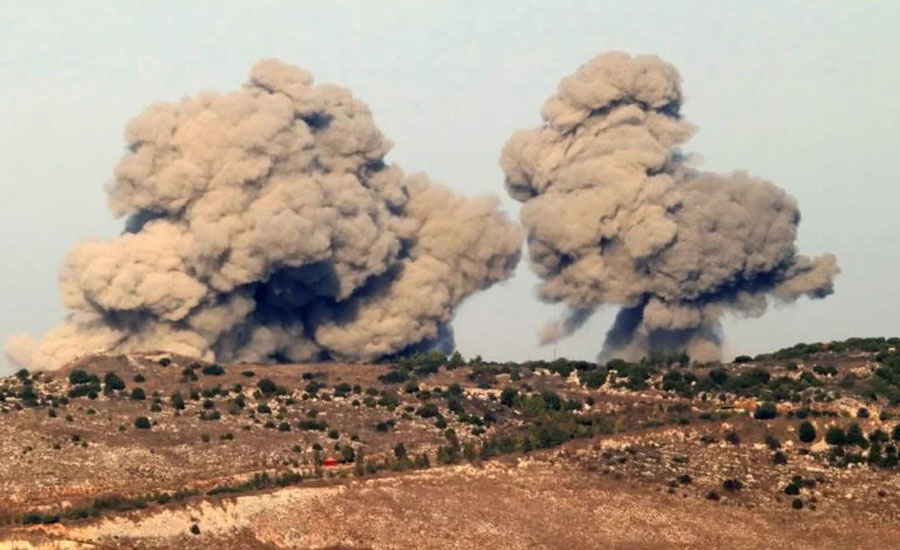
CAIRO/JERUSALEM: Israeli planes and tanks pounded areas across the Gaza Strip overnight and on Sunday, destroying several residential buildings, witnesses said, as traumatized Palestinians hoped a US plan to end the war would soon ease their suffering.
US President Donald Trump, who had called for an end to the bombing, said on Saturday on his Truth Social platform that Israel had agreed to an “initial withdrawal line” inside Gaza and that “when Hamas confirms, the Ceasefire will be IMMEDIATELY effective.”
Israel escalated its offensive as Egypt prepares to host delegates from Hamas, Israel and the United States, and Qatar, to kick off talks over the implementation of the most advanced effort yet to halt the conflict.
Cairo talks will tackle unresolved issues
Hamas had drawn a welcoming response from Trump on Friday by saying it accepted certain key parts of his 20-point peace proposal, including ending the war, Israel’s withdrawal, and the release of Israeli hostages and Palestinian captives.
But the group left some issues up for further negotiation, as well as questions unanswered, such as whether it would be willing to disarm, a key demand from Israel to end the war.
“Progress would depend on whether Hamas would agree to the map, which shows the Israeli army would remain in control of most of the Gaza Strip,” said a Palestinian official, close to the talks.
“Hamas may also ask for a strict timetable for the Israeli withdrawal from Gaza. The first phase of talks will determine how things are going to proceed,” he told Reuters, asking not to be named.
In a sign of Israeli optimism over the Trump plan, the shekel currency hit a three-year high against the dollar and Tel Aviv stocks reached an all-time high.
READ ALSO:
- BBNaija: Imisi emerges winner, bags N80m cash prize
- Man arrested for reportedly killing wife after child’s birthday in Auchi
- 2027 : It’s my turn to govern Oyo – Power Minister
Domestically, Israeli Prime Minister Benjamin Netanyahu is caught between growing pressure to end the war — from hostage families and a war-weary public — and demands from hard-line members of his coalition who insist there must be no let-up in Israel’s campaign in Gaza.
Far-right Finance Minister Bezalel Smotrich said on X that halting attacks on Gaza was a “grave mistake.”
Smotrich and Security Minister Itamar Ben-Gvir, also a hard-liner, have significant influence in Netanyahu’s government and have threatened to bring it down if the Gaza war ends.
Arab states welcome Hamas response to Trump plan
But opposition leader Yair Lapid of the centrist Yesh Atid party has said political cover will be provided so the Trump initiative can succeed and “we won’t let them torpedo the deal.”
Trump has won backing from Arab and other Muslim states.
Saudi Arabia, the United Arab Emirates, Egypt, Qatar, Jordan, Turkiye, Indonesia, and Pakistan issued a joint statement welcoming the steps taken by Hamas regarding Trump’s Gaza plan.
“The Foreign Ministers reiterated their joint commitment to support efforts toward the implementation of the proposal, to work for the immediate end of the war on Gaza, and achieve a comprehensive agreement,” they said in the joint statement.
In Gaza City, which Israel describes as one of Hamas’ last bastions, Israeli forces continued attacks and warned residents who left against returning, saying it was a “dangerous combat zone.”
On Sunday, witnesses said Israeli planes escalated attacks against targets across the city, Gaza’s biggest urban center.
This followed a tense night in which drones dropped grenades on the rooftops of residential buildings and troops blew up explosive-laden vehicles, demolishing dozens of houses in two Gaza City neighborhoods, Sabra and Sheikh Radwan.
Hamas keen to reach deal
A senior Hamas official on Sunday said the Palestinian militant group is eager to reach an agreement to end the war and implement a prisoner swap with Israel, as negotiators converge in Egypt for talks.
Israeli and Hamas negotiators are set to iron out details during talks in Egypt in a bid to end nearly two years of war in Gaza, after Hamas approved a peace plan proposed by US President Donald Trump.
“Hamas is very keen to reach an agreement to end the war and immediately begin the prisoner exchange process in accordance with the field conditions,” he said.
“The occupation must not obstruct the implementation of President Trump’s plan. If the occupation has genuine intentions to reach an agreement, Hamas is ready.”
READ ALSO:
- Only Jonathan’s enemy wants him to contest 2027 election — Oshiomhole
- Alleged blasphemy: Kano Shura Council warns against further comments
- Most herbal remedies in Nigerian market safe, but ineffective – NIMR
A Palestinian source close to Hamas told AFP that the two delegations would be in the same building but away from media coverage.
“The negotiations aim to discuss the timeline for preparing field conditions for the transfer of captives held in Gaza, as a prelude to launching the prisoner exchange process,” he added.
“During communications with mediators, Hamas insisted that it is essential for Israel to halt military operations across all areas of the Gaza Strip, cease all air, reconnaissance, and drone activity, and withdraw from inside Gaza City,” the source said.
“In parallel with the cessation of Israeli military activity, Hamas and the resistance factions will also halt their military operations and actions,” he added.
Gazans desperate for start of Trump’s truce plan
“Where is Trump in all of this?” said Rami Mohammad-Ali, 37, from Gaza City, now displaced on the city’s western side.
“The explosions don’t stop, the drones drop bombs everywhere, as if nothing has happened. Where is the truce Trump told us about?” he asked.
Local health authorities said at least one Palestinian was killed, and several others were wounded in those attacks. Three other people were killed in separate Israeli strikes across the enclave, medics said.
Amjad Al-Shawa, head of the Palestinian NGOs Network, which liaises with the United Nations and international humanitarian organizations, said Gaza City has begun experiencing acute shortages of food and fuel, days after Israel blocked the route from the south to the north.
Under Trump’s plan, all Israeli hostages, alive and deceased, were due to be released within 72 hours of Israel publicly accepting the agreement. Israel says 48 hostages remain, 20 of whom are alive.
There may be logistical challenges too. Sources close to Hamas told Reuters handing over living hostages could prove relatively straightforward, but retrieving bodies of dead ones amid the huge devastation and rubble of Gaza may take longer than a few days to achieve.
Trump said on Friday he believed Hamas had shown it was “ready for a lasting PEACE” and he called on Netanyahu’s government to halt airstrikes in Gaza.
With Agencies











International
Five Arrested Near US-Used RAF Fairford in UK Terror Probe

Five Arrested Near US-Used RAF Fairford in UK Terror Probe
British police have arrested five men near RAF Fairford in Gloucestershire over suspected explosives offences, with the suspects subsequently detained on suspicion of preparing a terrorist act.
The arrests followed a report at about 12:45 a.m. on Sunday, September 27, 2026, concerning three suspicious vehicles that appeared to be travelling towards the air base. Armed officers responded and arrested the five men in the nearby Whelford area.
According to Counter Terrorism Policing, the men were initially arrested on suspicion of offences under the Explosives Act before being further arrested on suspicion of preparing a terrorist act contrary to Section 5 of the Terrorism Act. All five remained in custody as investigators continued gathering evidence.
The incident prompted authorities to declare a major incident, with about 85 households evacuated from Whelford as a precaution.
The evacuated residents were taken to a nearby leisure centre while police established a cordon around the vehicles. The Army’s specialist explosive ordnance disposal team was deployed to examine the vehicles and assess any potential threat.
Counter Terrorism Policing said the investigation was still in its early stages and that officers were working with Gloucestershire Police and other agencies to establish the circumstances surrounding the incident.
Police have not publicly confirmed that an attack on RAF Fairford was planned or that the suspects had entered the military installation. Investigators are examining why the vehicles were in the area and what materials, if any, were associated with them.
READ ALSO:
- Kano Upgrades Five PHCs to General Hospitals, Begins Assessment
- Iran Claims Capture of Second US Underwater Drone in Strait of Hormuz
- Kubwa Explosion: Vehicle Crashes Into Gas Outlet, Damages Nine Shops
The investigation is particularly significant because RAF Fairford is a British military air base used by the United States Air Force. The installation hosts US military personnel and has been used by American aircraft during operations connected with the conflict involving Iran.
The US Air Force said its personnel at Fairford remained vigilant but declined to disclose specific force-protection measures for operational security reasons.
The security operation involved armed police, roadblocks and specialist bomb-disposal personnel. A 400-metre cordon was established around the vehicles while the evacuation was carried out.
Investigators are expected to examine the vehicles, materials and other evidence recovered during the operation as they seek to establish whether there was a planned attack and, if so, its intended target and motive.
The arrests have drawn additional attention because of heightened security around US military installations in Britain. RAF Fairford has become strategically important because of its use by US forces during the conflict involving Iran.
However, British authorities have not publicly linked the five suspects to Iran, any other state or a particular extremist organisation. Any claims about their motive or intended target remain subject to investigation.
The US military has said it remains in close coordination with British authorities and continues to take appropriate measures to protect its personnel and facilities.
British officials have said the incident is believed to be contained, although a substantial security presence is expected to remain in the area while investigators complete their work.
Deputy Assistant Commissioner Vicki Evans, the UK Counter Terrorism Policing senior national coordinator, said investigators were still working to establish what happened.
The five men remain in custody and have not been convicted of any offence. The allegations against them will have to be tested through the British legal process as the UK counter-terrorism investigation continues.
Five Arrested Near US-Used RAF Fairford in UK Terror Probe
International
Iran Claims Capture of Second US Underwater Drone in Strait of Hormuz
Iran Claims Capture of Second US Underwater Drone in Strait of Hormuz
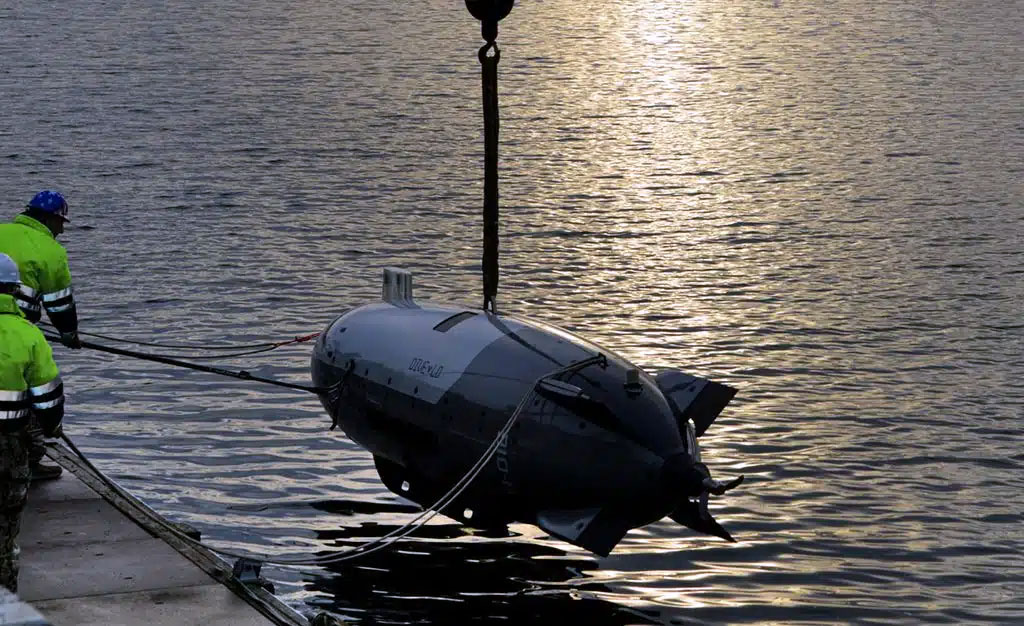
Iran’s Islamic Revolutionary Guard Corps (IRGC) has claimed that its naval forces captured a second U.S. unmanned underwater vehicle in the strategically important Strait of Hormuz, accusing the vehicle of conducting surveillance activities in the waterway.
The IRGC Navy said on Sunday, September 27, that the Remus 600 autonomous underwater vehicle was intercepted during what it described as a complex operation involving intelligence capabilities and electronic warfare.
According to the Iranian military, the vehicle was operating in the Strait of Hormuz for what it described as espionage purposes when it was captured.
The IRGC said the underwater drone has been handed over to specialists who are working to retrieve and examine information stored on the system. (Arab News)
The claim represents the second reported Iranian capture of a U.S. underwater drone in September, following an earlier incident involving a much larger Dive-LD autonomous underwater vehicle.
On September 8, Iran said its forces had captured the Dive-LD at the entrance to the Strait of Hormuz. The IRGC subsequently released images of the vehicle and described it as an advanced U.S. military unmanned submarine.
The U.S. military acknowledged around that time that one of its underwater drones had malfunctioned while operating in regional waters but did not publicly confirm that Iran had captured it. Reuters footage from the incident showed the vehicle identified by Iran as a Dive-LD. (Reuters Connect)
The latest vehicle, the Remus 600, is substantially smaller than the Dive-LD. It is an autonomous underwater system designed to operate without a crew and can be configured for a range of underwater missions.
Available technical information indicates that the Remus 600 can operate at depths of up to about 600 metres and can remain underwater for extended periods, depending on its configuration and operating conditions.
READ ALSO:
- Kubwa Explosion: Vehicle Crashes Into Gas Outlet, Damages Nine Shops
- Newlywed Arrested After Allegedly Excreting 72 Cocaine Wraps at Enugu Airport
- Bauchi Police Arrest Four Over Alleged Gun-Making, Rape
The system can be equipped for missions including seabed mapping, mine detection and intelligence, surveillance and reconnaissance (ISR). Its modular design also allows different sensors and equipment to be fitted according to mission requirements.
Reports indicate that the vehicle is about 3.25 metres long and can operate autonomously for up to about 70 hours on a single charge, although actual endurance depends on mission configuration and conditions. (Seoul Economic Daily)
Iran’s latest announcement comes amid heightened military tensions surrounding the Strait of Hormuz, a narrow waterway connecting the Persian Gulf with the Gulf of Oman.
The strait is strategically important to global energy markets because of the large volume of oil and gas shipments that traditionally pass through it.
The ongoing conflict in the region has severely disrupted commercial shipping through the waterway. Iran has said it considers the strait closed and has warned against what it describes as dangerous or unauthorised activity.
In its latest statement, the IRGC again declared the Strait of Hormuz closed and said it would respond to what it considers dangerous movements or unauthorised passage. (ایرنا)
The United States has not publicly provided a detailed account of the latest alleged seizure, leaving important questions about the circumstances of the incident unresolved.
In particular, it remains unclear when and where the Remus 600 was deployed, what mission it was conducting, whether it was operating under direct U.S. military control at the time and how Iranian forces allegedly took possession of it.
Iran’s assertion that the vehicle was conducting espionage also remains an Iranian military claim and has not been independently established.
The seizure claim nevertheless highlights the growing importance of autonomous underwater vehicles in modern military and maritime operations.
Such systems can conduct surveillance, map underwater terrain, detect mines and gather information without placing personnel aboard a conventional submarine.
The reported Iranian effort to retrieve data from the Remus 600 could also provide Tehran with an opportunity to examine the vehicle’s sensors, navigation systems and other technologies if the equipment is intact.
The significance of any information Iran could obtain from the system would depend on the condition of the vehicle and the amount of recoverable data and technology.
The latest development comes as Iran-US tensions remain high over the Strait of Hormuz, with Tehran and Washington pursuing opposing positions on access to the waterway.
For now, the capture of the Remus 600 remains a claim by Iran, while the absence of a detailed U.S. account means that several aspects of the incident cannot yet be independently confirmed.
Iran Claims Capture of Second US Underwater Drone in Strait of Hormuz
International
Milei Slams UN as ‘Useless’ Over Falklands Dispute

Milei Slams UN as ‘Useless’ Over Falklands Dispute
Argentine President Javier Milei has criticised the United Nations, describing the organisation as “useless” and accusing it of failing to make progress on the longstanding Falkland Islands sovereignty dispute between Argentina and the United Kingdom.
Milei made the remarks on Wednesday, September 23, while addressing the 81st United Nations General Assembly in New York. He used the speech to renew Argentina’s claim to the islands, which Argentina calls the Malvinas, and demand a peaceful resolution to the dispute.
The Argentine president accused the UN of failing to act on resolutions concerning the Falklands and said the organisation had effectively “looked the other way” while the dispute remained unresolved.
Milei pointed particularly to UN General Assembly Resolution 31/49, adopted in 1976, which called on Argentina and the UK to refrain from unilateral actions that could complicate the sovereignty dispute while negotiations continued. The UN has repeatedly called on both countries to pursue negotiations for a peaceful and lasting settlement.
READ ALSO:
- Lagos Arrests Man Over Viral Video of Toddler Being Flogged
- Kwara Police Deny Shooting Motorcyclist at Oyun Bridge, Explain Viral Video
- Police Probe Alleged Self-Kidnapping of Adeleke’s Aide in Osun
The dispute has gained fresh attention amid tensions over offshore oil exploration around the Falkland Islands. Argentina has objected to British-backed oil activities in the area and recently introduced measures aimed at increasing sanctions against companies involved in activities it considers unauthorised.
The UK, however, maintains that the Falkland Islands are British and says the islanders have the right to determine their own future and develop their natural resources. The British government has also rejected Argentine pressure on companies involved in economic activities around the islands.
Milei reaffirmed Argentina’s position that the Falklands are Argentine territory and called for the UK to return to negotiations. He stressed that Argentina’s claim would be pursued peacefully.
The disagreement over the islands dates back decades and led to the Falklands War in 1982, when Argentina invaded the territory and Britain sent military forces to retake it. The conflict ended with Argentina’s surrender after about 10 weeks.
The islands have remained under British administration since then, while Argentina has continued to press its sovereignty claim through diplomatic and international channels.
Beyond the Falklands dispute, Milei used his UN address to criticise the organisation’s broader role in international affairs. He accused the UN of failing to adequately address collective security, human rights, conflict and terrorism, arguing that it had become ineffective in dealing with major global crises.
His latest remarks come as Argentina and the UK remain divided over sovereignty, negotiations and the development of natural resources around the islands. While Buenos Aires continues to demand negotiations over sovereignty, London maintains its position that the Falkland Islanders’ right to self-determination must be respected.
Milei’s intervention has therefore brought the Falklands dispute back into focus at the UN, with the disagreement now also linked to the increasingly contentious issue of offshore oil exploration.
Milei Slams UN as ‘Useless’ Over Falklands Dispute
-

 News3 days ago
Anambra Releases ₦473m Salary Arrears Document as Obi’s Debt Claim Sparks Fresh Dispute
-

 News3 days ago
Keyamo: ₦70,000 Minimum Wage No Longer Enough as Cost of Living Soars
-

 metro3 days ago
EFCC Chairman Raises Alarm Over Alleged Theft of Nigeria’s Public Funds
-

 Sports2 days ago
AFCON 2027 Qualifier: Nigeria Fight Back to Beat Madagascar 2-1 in Uyo
-

 Politics3 days ago
2027: Otti Explains Why He Supports Tinubu Despite Remaining in Labour Party
-

 metro3 days ago
Umahi Announces First Niger Bridge Reopening Next Week, Orders Tinubu Pictures
-

 metro3 days ago
Anambra Police Arrest 25-Year-Old Suspect Linked to 2023 Kidnap, Murder
-

 Entertainment3 days ago
Jetour Takes Adventure Beyond the Road, Brings Solar-powered Borehole to Ibeju-Lekki community