

International
Israeli planes bomb southern Lebanon after radio blasts
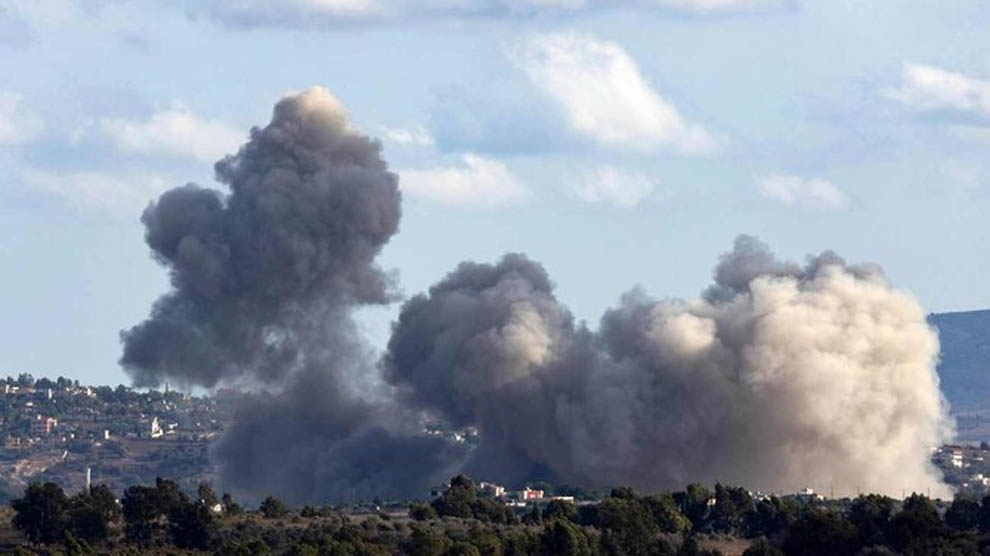
Israeli planes bomb southern Lebanon after radio blasts
BEIRUT/JERUSALEM: Israel bombed southern Lebanon on Thursday and said it had thwarted an Iranian-led assassination plot after explosions in booby-trapped radios and pagers in the past two days caused bloody havoc in the ranks of its arch-foe Hezbollah.
Air strikes hit “hundreds of rocket launcher barrels” ready to be fired toward Israel as well as “approximately 100 launchers and additional terrorist infrastructure sites,” the Israeli army said in a statement.
The attacks on Hezbollah’s communications equipment killed 37 people and wounded around 3,000, raising fears that a full-blown war was imminent. The action also sowed disarray across Lebanon as panicked residents abandoned their mobile phones.
“This isn’t a small matter, it’s war. Who can even secure their phone now? When I heard about what happened yesterday, I left my phone on my motorcycle and walked away,” said Mustafa Sibal on a street in Beirut.
Israel has neither confirmed nor denied being behind the attacks but multiple security sources have said they were carried out by its spy agency Mossad.
The Lebanese army said on Thursday it was blowing up pagers and suspicious telecom devices in controlled blasts in different areas. It called on citizens to report any suspicious devices.
Lebanese authorities banned walkie-talkies and pagers from being taken on flights from Beirut airport until further notice, the National News Agency reported. Such devices were also banned from being shipped by air.
In Beirut on Thursday, a distant roar in the skies could be heard from what state media said was Israeli warplanes breaking the sound barrier — a noise that has become common in recent months.
READ ALSO:
- Edo polls and the famous product vendor, by Azu Ishiekwene
- NCC moves to boost internet speed with 6GHz spectrum
- Pension bill: Police retirees to embark on protest
Hezbollah fired missiles at Israel on the day after the Oct. 7 cross-border attack by the Palestinian militant group Hamas which triggered the Gaza war, and since then constant exchanges of fire have occurred, although neither side has allowed this to escalate into a full-scale war.
Israel said its warplanes struck villages in southern Lebanon overnight, and a security source and Hezbollah’s Al-Manar TV reported airstrikes near the border began again on Thursday just after midday.
Hand-held radios used by Hezbollah detonated on Wednesday across Lebanon’s south.
The previous day, hundreds of pagers — used by Hezbollah to evade mobile phone surveillance — exploded at once, killing 12 people including two children, and injuring more than 2,300.
Lebanese Prime Minister Najib Mikati called on the United Nations Security Council to take a firm stand to stop what he called Israel’s “aggression” and “technological war” against his country.
Israel says its conflict with Hezbollah, like its war in Gaza against Hamas, is part of a wider regional confrontation with Iran, which sponsors both groups as well as armed movements in Syria, Yemen and Iraq.
Assassination plot
Also on Thursday, Israeli security forces said that an Israeli businessman had been arrested last month after attending at least two meetings in Iran where he discussed assassinating Prime Minister Benjamin Netanyahu, the defense minister or the head of the Shin Bet spy agency.
Last week, Shin Bet uncovered what it said was a plot by Hezbollah to assassinate former Defense Minister Moshe Ya’alon.
Israel has been accused of assassinations including a blast in Tehran that killed the leader of Hamas and another in a Beirut suburb that killed a senior Hezbollah commander within hours of each other in July.
Despite the events of the past few days, a spokesperson for the UN peacekeeping mission in southern Lebanon said the situation along the frontier had “not changed much in terms of exchanges of fire between the parties.”
“There was an intensification last week. This week it is more or less the same. There are still exchanges of fire. It is still worrying, still concerning, and the rhetoric is high,” the spokesperson, Andrea Tenenti, said.
Tens of thousands of people have had to flee the Israel-Lebanon border area on both sides since the hostilities began in October.
Shifting focus
The Israeli military said its overnight air strikes hit Hezbollah targets in Chihine, Tayibe, Blida, Meiss El Jabal, Aitaroun and Kfarkela in southern Lebanon, as well as a Hezbollah weapons storage facility in the area of Khiam.
On Wednesday, Israeli Defense Minister Yoav Gallant said the war was moving into a new phase, with more resources and military units being shifted to the northern border.
According to Israeli officials, the forces being deployed there include the 98th Division, an elite formation including commando and paratrooper elements that has been fighting in Gaza.
Israeli planes bomb southern Lebanon after radio blasts
ARAB NEWS







Health
Fiji Declares National HIV Emergency as Diagnoses Surge Sixteenfold
Fiji Declares National HIV Emergency as Diagnoses Surge Sixteenfold
Authorities launch a multi-agency public health campaign to expand free testing, treatment, and harm-reduction services
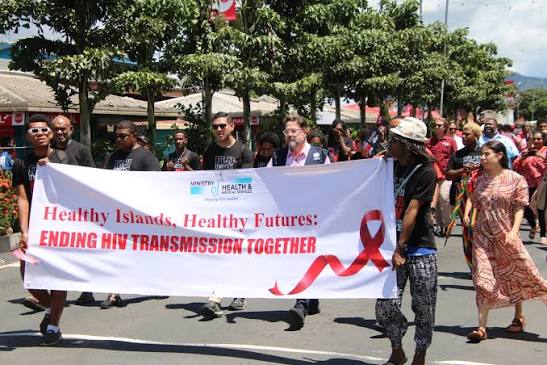
Fiji has announced a nationwide health response to address a significant rise in HIV cases and ensure that all residents can access essential medical care.
On Wednesday, Health Minister Dr. Atonio Lalabalavu shared the emergency declaration, explaining that national agencies are joining forces to provide rapid medical support, expand testing, and protect community well-being across the islands.
Official reports indicate that about one in every 60 adults in Fiji currently lives with HIV, following an increase in new infections over recent years. Health specialists explain that the virus spreads primarily through intimate sexual contact and shared needles among individuals using illicit substances.
Additionally, routine screenings revealed that two out of every 100 expecting mothers carry the virus, highlighting an urgent need for early maternal healthcare to protect newborns from infection.
To safeguard public health, authorities are delivering free daily treatments, distributing protective preventive medications, and setting up clean needle programs to stop infections before they start.
Furthermore, global partners, including Australia, New Zealand, India, and United Nations health bodies are providing financial resources and medical supplies to back the local effort.
By encouraging open community conversations and delivering accessible healthcare without judgment, health workers aim to ensure that everyone receives the care and dignity they deserve.
Fiji Declares National HIV Emergency as Diagnoses Surge Sixteenfold
International
Kim Yo-jong: Only ‘Idiots’ Think North Korea Will Give Up Nuclear Weapons

International
Gaza Building Collapse Kills 21, Including Eight Children
Gaza Building Collapse Kills 21, Including Eight Children
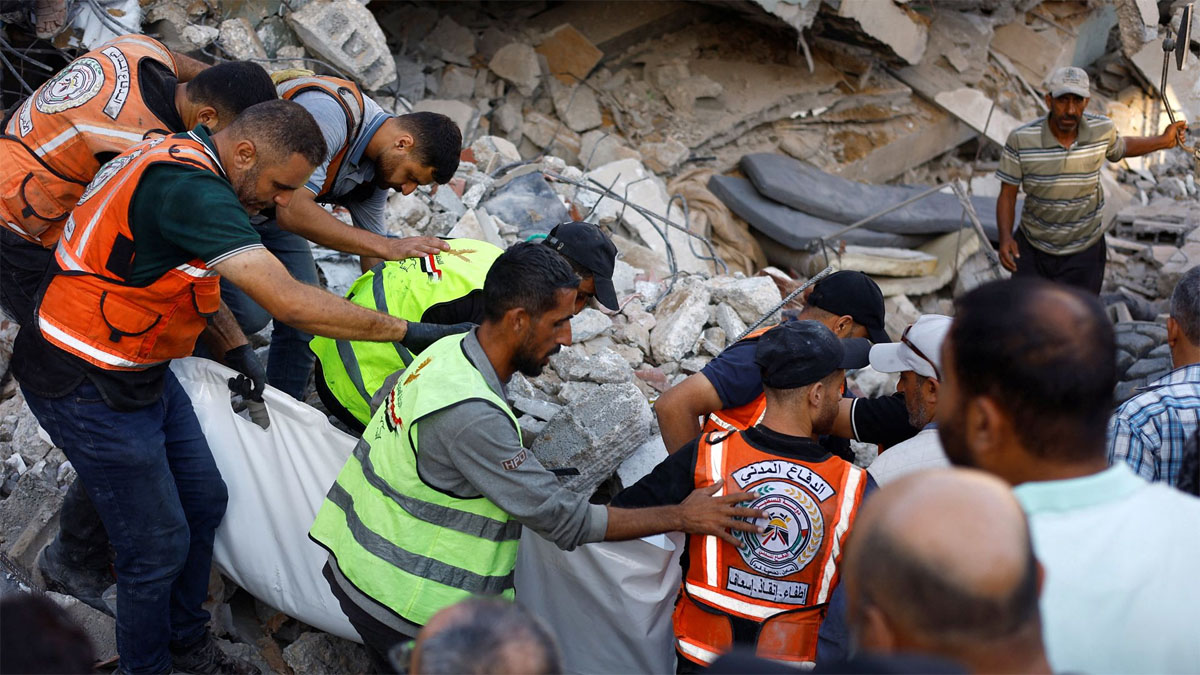
At least 21 people have been killed, including eight children, after a war-damaged building collapsed in Gaza City overnight, rescuers and medics say. The tragedy has renewed concerns about the collapse risk facing hundreds of bomb-damaged structures across the Gaza Strip as winter approaches.
The six-storey residential building in Gaza City’s Tal al-Hawa area collapsed in the early hours of Wednesday. According to the United Nations humanitarian coordinator for the occupied Palestinian territories, Ramiz Alakbarov, an estimated 100 people, including 50 children, were living in the building when it came down. The Gaza Civil Defence agency confirmed that rescuers extracted 21 bodies and rescued 20 unharmed individuals from the rubble on al-Sinaa Street in Tal al-Hawa. Dozens remain missing or injured underneath the debris.
Witnesses told the BBC that the building had been left tilting dangerously to one side after an Israeli strike more than a year ago. Displaced families had moved inside because they were desperate, with nowhere else to go. The building had been hit multiple times in 2024 and March 2025, leading to warnings for Gazans not to return, according to Civil Defence spokesman Mahmoud Basal. More than 10 families, totalling around 80 people, lived in the building, according to residents, with dozens of them being children. Sherif, whose sister was killed, said: “They couldn’t find a tent or somewhere to live. This was the last place they could turn to, despite the danger. They were aware that it would likely end in tragedy. A lack of resources drove them towards certain death.“
A woman living in a tent nearby, Umm Mohammed Bakrun, said she had been talking to her son when the building collapsed suddenly. “It felt like an earthquake. There was a loud sound and I couldn’t stand up. Stones rained down on us and when I looked outside I saw a lot of dust,” she told the BBC. “Within minutes, there were screams everywhere.” Another witness, Mansour Abu Mohammed, said the building collapsed “in a few seconds”. “Every day, a stone or a few stones would fall from it, but the people inside couldn’t find anywhere else to live. I used to live next door to it and you could see that it was tilting to one side.”
READ ALSO:
- Niger Mosque Abductions: Terrorists Execute 30 of 500 Captive Muslim Worshippers
- OAU Investigates Death of Final-Year Student as Police Begin Probe
- 57-Year-Old Man Arrested Over Sexual Abuse of Stepdaughter in Edo
UN and Egyptian teams joined the search for survivors, which was slow due to a lack of heavy machinery. Initially, rescuers from the Hamas-run Civil Defence agency had to use their bare hands. Egypt provided heavy machinery for the rescue operation, while the United Arab Emirates and Qatar were set to deliver relief items. The Palestinian Civil Defence said rescue teams had been working continuously since the collapse, but lacked even the most basic tools. “In the first moments after the collapse, we had to ask neighbours and displaced people nearby to bring hammers, shovels and other tools because of the severe shortage of equipment,” said Abdullah al-Majdalawi, director of public relations at Gaza’s Civil Defence. The head of the United Nations Development Programme (UNDP) Gaza office, Alessandro Mrakic, told reporters at the scene that “the situation… is tragic because we don’t have the equipment and machinery that is needed”.
Mrakic warned that approximately 400 other war-damaged buildings across Gaza were at imminent risk of collapse, particularly as winter approaches. The Civil Defence agency has identified around 2,000 buildings across the territory at risk of collapse. “We need support, most importantly with machinery, equipment, among others. Our colleagues here don’t have [engine] oil and spare parts to continue to work with all the equipment that is still in Gaza.” The UN’s humanitarian relief coordinator, Ramiz Alakbarov, said he was “devastated” by the reports. “No-one should have to risk their life simply to find a safe place to shelter,” he said. He also urged Israeli authorities to approve deliveries to Gaza of heavy machinery for rescue operations, as well as tents, tarpaulins and other non-food items for displaced people ahead of the winter rains. Israel says its restrictions are meant to keep equipment out of the hands of Palestinian armed groups that could also have military uses.
An estimated 80% of all structures in Gaza have been destroyed or damaged during the war between Israel and Hamas, according to the UN. More than 1.9 million people — about 90% of the territory’s population — have been displaced, many of them multiple times, and 1.2 million of them are currently living in tents or makeshift shelters. The UN has warned that the humanitarian situation in Gaza remains dire despite the ceasefire agreed last October, as Israeli air strikes and other attacks continue to hit populated areas, causing casualties and property damage and driving further displacement. According to Gaza’s health ministry, 1,369 Palestinians have been killed and 4,627 wounded since the fragile ceasefire took effect on 11 October 2025. The total death toll since the war began has reached 73,783, with 174,738 injured.
On Tuesday, Israeli air strikes killed at least five Palestinians, including two children and a Hamas commander, according to health officials and Hamas sources. The Israeli military said it killed a Hamas commander in southern Gaza and another fighter in the north. In both cases, a child was also reportedly killed. Separately, the British charity Medical Aid for Palestinians said that a patient was killed by an Israeli drone at a health centre it supports in Jabalia in northern Gaza. A spokesperson for the Israeli military told the BBC it was not aware of such an incident.
The Gaza war was triggered by the Hamas-led attack on southern Israel on 7 October 2023, when about 1,200 people were killed and 251 others were taken hostage. Since then, more than 73,790 people have been killed in Gaza, according to the territory’s Hamas-run health ministry, whose figures are considered reliable by the UN. In a statement, the Gaza government media office under Hamas said it held “the Israeli occupation and the international community fully and directly responsible for this catastrophe befalling our Palestinian people“.
Gaza Building Collapse Kills 21, Including Eight Children
-

 Politics3 days ago
2027: Northern Lecturers Back Tinubu, ASUU Disowns Endorsement
-
 metro3 days ago
Police Arrest Mother Over Alleged Brutal Abuse of 7-Year-Old Girl in Anambra
-

 Sports2 days ago
‘I Was Never the Chosen One’ — Dembele Responds to Mbappe
-

 International1 day ago
Islamic Council Condemns Attempted Attack on Holy City of Mecca
-

 metro2 days ago
Lagos Power Outage: Ikeja Electric Blames TCN as Businesses, Homes Groan
-

 News1 day ago
Keep Politics Out of My Office — Ogbomoso Grand Chief Imam Warns Politicians, Bloggers
-

 Education2 days ago
JAMB Moves 2027 UTME Time — Here’s What Candidates Need To Know
-

 Politics2 days ago
2027: APC Governors Reject Wike’s Rainbow Coalition, Insist on Party Loyalty