Ban movement of cattle from North to South, Ganduje urges FG - Newstrends
Connect with us

News

Ban movement of cattle from North to South, Ganduje urges FG
Published

on

Kano Governor Abdullahi Ganduje has urged the Federal Government to make a law banning movement of cattle by herders across the country.

He stated this at the weekend in an interview with journalists in Daura, Katsina State.

According to him, farmers/herders conflicts will not end until a law banning movement of cows from the North to the Middle Belt and the southern parts of the country.

He said the challenge of cattle rustling, just like that of the farmers/herders constant conflicts, would be also addressed with such a law.

The governor said Kano had been able to largely curtail banditry and related criminal activities because his administration had built a cattle rearing colony.

Ganduje said, “We are building a Ruga settlement in Samsosua Forest, our border with Katsina, and we have succeeded in curtailing the effect of banditry in that area.

“So, we are building many houses; we are constructing a dam; we are establishing a cattle artificial insemination centre. We are establishing veterinary clinic and already, we have started building houses for herdsmen.

“My advocacy is that we should abolish the transportation or trekking of herdsmen from the northern part of Nigeria to the Middle Belt and to the southern part of Nigeria.

“There should be a law that will ban (it); otherwise we cannot control the conflicts between herdsmen and farmers and cannot control the cattle rustling, which is affecting us greatly.”


Loading

News

PFIPC Probe: ICPC Indicts Civil Servants Over ₦1.3bn Fake Agency Scandal

Published

on

PFIPC Probe: ICPC Indicts Civil Servants Over ₦1.3bn Fake Agency Scandal

PFIPC Probe: ICPC Indicts Civil Servants Over ₦1.3bn Fake Agency Scandal

The Independent Corrupt Practices and Other Related Offences Commission (ICPC) has uncovered how several civil servants allegedly helped Adeniyi Adeyemi Mathew, the director-general of the now-disowned Presidential Foreign Investment Promotion Council (PFIPC), obtain government approvals and gain access to official financial and administrative systems. The findings are contained in the ICPC interim investigation report on the PFIPC saga, submitted to President Bola Tinubu on August 6, 2026, exactly 30 days after the President directed the commission to investigate the matter. The investigation established that Adeyemi was never appointed by the Federal Government and that the PFIPC had no legal basis for its existence.

The ICPC report reveals that Adeyemi’s ability to penetrate government structures went beyond the forged documents he allegedly presented. It also depended on the actions of officials in several government institutions who processed his requests and facilitated approvals despite gaps in the required procedures. According to the ICPC, Adeyemi began seeking formal recognition within government structures in November 2024 when he approached the Office of the Accountant-General of the Federation (OAGF) for an administrative code, self-accounting status and approval to open accounts with the Central Bank of Nigeria (CBN). He supported the applications with purported official documents, including an appointment letter, an establishment instrument, and a letter on State House letterhead allegedly signed by one Akanbi Adewale. Investigators found that Akanbi Adewale did not exist. Forensic examination also showed that the letter attributed to him was signed by Adeyemi himself. Despite these irregularities, the documents were used to process the applications. On 27 May 2025, the OAGF granted the organisation self-accounting status and assigned it the administrative code 0111062001, alongside authorised establishment and recruitment waiver arrangements. The approvals enabled the purported PFIPC to secure a place in the 2026 federal budget and gain access to government financial systems. The OAGF subsequently created a Government Integrated Financial Management Information System (GIFMIS) platform and a Sub-Treasury Account for the organisation. Acting on a request from the PFIPC, the OAGF also issued a mandate to the CBN for the creation of two domiciliary accounts. The CBN later told the House of Representatives that the accounts were never activated because the purported agency failed to provide authorised signatories.

READ ALSO:

The ICPC investigation examined the roles of several civil servants who allegedly facilitated the PFIPC’s operations. Three civil servants played key roles in securing an authorised establishment and recruitment waiver for the PFIPC. They are Rose Achem, senior administrative officer to the director-general of the Budget Office of the Federation; Patricia Akhigbe, an assistant director in the Ministry of Budget and Economic Planning; and Mimi Abu, director of organisation design and development at the Office of the Head of the Civil Service of the Federation (OHCSF). According to the ICPC, Achem introduced Akhigbe to Abu as the head of human resources of the PFIPC, even though Akhigbe was an assistant director in the Ministry of Budget and Economic Planning. The introduction was made to facilitate the purported council’s application for authorised establishment and recruitment waiver. The ICPC found that Achem, Akhigbe and Abu subsequently facilitated the approvals through the OHCSF. The investigation also found that Adeyemi paid Akhigbe ₦500,000 during Easter in 2025, with the payment described in evidence as a “thank you for your support”. The authorised establishment was granted on the same day the three officials met. Investigators found no evidence that the PFIPC had formally applied for an authorised establishment and recruitment waiver. Instead, Abu, Achem and Akhigbe proceeded with the approvals outside the required process. When investigators requested the relevant file from the OHCSF, the office reportedly said it was missing.

The ICPC scrutinised Abu’s role because her department is responsible for authorised establishment, manpower requirements and recruitment waivers for federal government organisations. Under the standard procedure, newly established government organisations seeking authorisation are expected to submit documents showing their mandate and establishment instruments, as well as the appointment letter of the head of the organisation. The investigation found that Achem and Akhigbe met Abu on behalf of the PFIPC and presented what investigators described as forged establishment instruments and a forged appointment letter for Adeyemi. Abu reportedly described the controversial appointment letter, said to have been issued by the Chief of Staff to the President, as an “aberration.” She told investigators she could not recall another government organisation presenting an appointment letter signed by the Chief of Staff. The ICPC also confirmed that the purported appointment letter did not originate from the Presidency and that forensic examination found the signature did not match the Chief of Staff’s official specimen signature.

READ ALSO:

The ICPC also examined the role of Aminu Abdullahi, the official responsible for office allocation within the Office of the Secretary to the Government of the Federation (OSGF). Abdullahi was responsible for coordinating the allocation of offices to political appointees within the OSGF. According to the investigation, Abdullahi was introduced to Adeyemi in March 2025 by Ibrahim Abdulkadir, a deputy director in General Services. The introduction was intended to guide Adeyemi through the process of obtaining office accommodation at the Federal Secretariat. The ICPC found that Abdullahi allocated offices previously occupied by the former Chief Economic Adviser to the President, Doyin Salami, at the Federal Secretariat Phase III for temporary use by the PFIPC without written approval. Only two keys were available for the allocated offices. The investigation found that Abdullahi broke the locks on the remaining doors to give Adeyemi access to the other office spaces. The financial trail also raised questions. An analysis of Abdullahi’s bank statement showed that he received ₦3.25 million from Adeyemi in three tranches between March and November 2025, according to the ICPC.

The ICPC has cleared Chief of Staff to the President, Femi Gbajabiamila, of any involvement in the scandal. According to the investigation, Adeyemi allegedly produced a fake appointment letter dated March 2024 using a State House letterhead, with a signature presented as that of Gbajabiamila. Investigators said they found no record showing that Gbajabiamila appointed Adeyemi or had any direct dealings with him over the purported agency. The ICPC also found no link between the Office of the Chief of Staff, the State House, and Adeyemi or the PFIPC. The commission explained that the Office of the Chief of Staff does not issue appointment letters for heads of government ministries, departments, and agencies. Its responsibility is to transmit presidential approvals to the Office of the Secretary to the Government of the Federation, which handles the formal appointment process. The ICPC also checked official correspondence records from the Office of the Chief of Staff, including its dispatch system and electronic correspondence platform, and found no communication involving Adeyemi or the PFIPC from 2024 to September 2025.

The investigation further uncovered two other purported fictitious agencies allegedly created by Adeyemi to facilitate and expand the activities of the scheme. These are the FCT Investment Promotion Agency and the Foreign Investment Promotion Agency and Public Private Partnership (FIFA-PPP). According to ICPC Chairman Musa Aliyu, forged legislative instruments were allegedly used to create the purported agencies and facilitate the opening and operation of bank accounts in their names.

The ICPC investigation identified weaknesses in existing civil service procedures that enabled the purported organisation to obtain official approvals. The commission said the OHCSF’s standard operating procedure did not adequately require newly established federal institutions to submit relevant establishment documents. It also found insufficient mechanisms for vetting and verifying documents presented by such organisations. Aliyu stated that weaknesses in verification procedures and inter-agency oversight created opportunities which were allegedly exploited by the suspect and his collaborators to operate the fictitious organisation. The self-accounting status granted by the OAGF was particularly significant because it enabled the purported council to operate within government financial reporting structures and became an important document in its dealings with other government institutions.

Following the ICPC findings, President Tinubu has directed the commissioning of a comprehensive forensic investigation into government processes and internal controls. The Minister of Finance and Coordinating Minister of the Economy, Taiwo Oyedele, disclosed this after the Federal Executive Council meeting on August 19, 2026. Oyedele said the investigation would establish how such bodies were able to operate within the government structure and identify weaknesses in existing administrative, accounting and governance systems. The review will also examine the Integrated Personnel and Payroll Information System (IPPIS), particularly because the existence of fictitious agencies could potentially create room for the registration of non-existent employees.

The ICPC has recommended the prosecution of Adeniyi Adeyemi for offences including forgery, impersonation and other related offences. The commission also recommended administrative sanctions against public officers whose acts of commission, omission or negligence facilitated the illegal operation of PFIPC. The ICPC further proposed institutional reforms aimed at strengthening verification mechanisms, internal controls and inter-agency oversight across Ministries, Departments and Agencies of the Federal Government. Aliyu stressed that the investigation is still ongoing, particularly to identify other persons who may have participated in or facilitated the alleged scheme and to obtain further evidence necessary to support criminal prosecution.

The African Democratic Congress (ADC) has dismissed the ICPC interim report as predictable and inadequate, accusing the federal government of prioritising damage control over a thorough investigation. The ADC said the report failed to explain how a fictitious agency secured federal office space, had civil servants deployed to it and found its way into the 2026 budget with a N1.3 billion provision. The party stated: “A forgery may explain the first door that was opened. It cannot explain why every subsequent door appears to have opened as well”.

PFIPC Probe: ICPC Indicts Civil Servants Over ₦1.3bn Fake Agency Scandal

Loading

Continue Reading

News

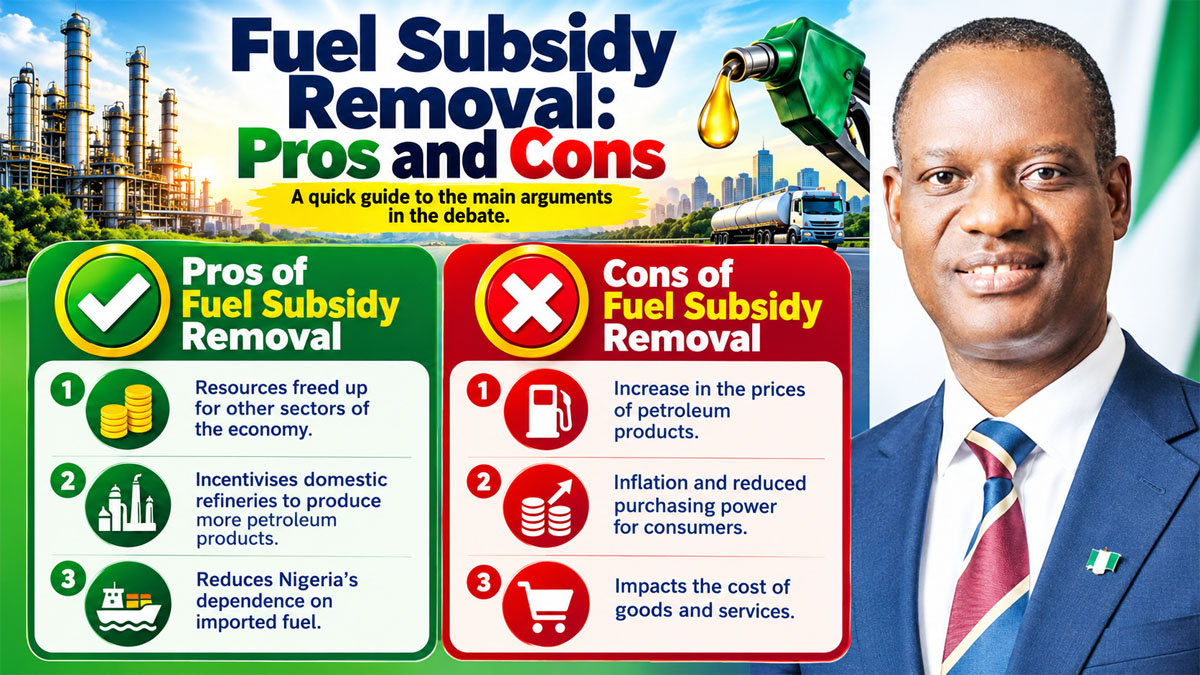
Subsidy removal stabilising Nigeria’s economy despite hardship — Doro

Published

on

Subsidy removal stabilising Nigeria’s economy despite hardship — Doro
Minister of Humanitarian Affairs and Poverty Reduction, Bernard Doro

Subsidy removal stabilising Nigeria’s economy despite hardship — Doro

The Federal Government has defended the removal of the fuel subsidy, saying the policy has contributed to greater stability in the Nigerian economy despite the hardship and higher living costs experienced by households.

Minister of Humanitarian Affairs and Poverty Reduction, Bernard Doro, made the claim during an interview on Channels Television’s Politics Today, where he defended the economic reforms introduced by President Bola Tinubu’s administration.

Doro said the reforms should not be assessed solely by their immediate impact on household finances but within the broader objective of correcting longstanding economic imbalances and creating a stronger foundation for sustainable growth.

According to the minister, the government is working to reduce inflation, improve purchasing power and address the economic difficulties facing Nigerians through a combination of macroeconomic reforms and targeted social interventions.

He also rejected claims that seven million Nigerians had fallen into poverty under the Tinubu administration, arguing that Nigeria’s poverty challenge predates the current government and requires sustained interventions to reverse.

Doro acknowledged the scale of poverty in the country but said meaningful poverty reduction could not be achieved overnight.

He cited China’s decades-long poverty-reduction experience as an example of the sustained effort required to achieve significant results.

“It took China 40 years to achieve the scale they achieved, Nigeria can scale up poverty reduction,” Doro said.

The minister said the government’s responsibility was to ensure that improvements in macroeconomic indicators eventually translate into better conditions for ordinary Nigerians.

READ ALSO:

He said the administration was therefore combining economic reforms with social protection programmes, including cash transfers, skills development and other initiatives designed to help vulnerable households move towards economic independence.

Doro disclosed that the Federal Government had distributed more than N600 billion in cash transfers to vulnerable Nigerians over the past three years, with the intervention reaching slightly more than 10 million households.

The minister said the government was also strengthening its approach to poverty reduction by tracking beneficiaries and assessing whether interventions were producing lasting improvements in household welfare.

The latest effort includes the Federal Government’s $1 billion Renewed Hope Social Protection Programme, which is designed to provide support to vulnerable Nigerians while helping beneficiaries build more sustainable livelihoods.

One component of the programme, the Household Prosperity and Empowerment Social Protection Project (HOPE-SP), targets about 7.6 million vulnerable households nationwide.

Under the programme, eligible households are expected to receive a one-off N40,000 digital shock-response payment, with beneficiaries selected from the National Social Register and validated through their National Identification Numbers.

The government says the programme is designed to move beyond emergency assistance by linking vulnerable households to interventions that can improve their economic prospects.

Doro said poverty reduction would require more than cash transfers, stressing the importance of skills acquisition, employment, entrepreneurship and economic empowerment.

The minister’s comments come amid continued debate over the consequences of the petrol subsidy removal announced in May 2023.

The policy immediately changed the fuel-pricing system and contributed to significant increases in transportation and living costs. The government has consistently argued that the previous subsidy regime was financially unsustainable and that its removal was necessary to improve public finances and redirect resources towards development.

The administration has also implemented foreign exchange reforms, which initially placed additional pressure on prices and the value of the naira.

Government officials now argue that the combination of subsidy removal and foreign-exchange reforms has helped address structural weaknesses in the economy and created the basis for stronger fiscal management.

Nigeria Revenue Service Chairman Zacch Adedeji recently similarly defended the reforms, saying the government inherited an economy facing significant fiscal and structural challenges, including an unsustainable fuel subsidy regime and distortions in the foreign exchange market.

However, the government’s assessment of economic stability continues to face scrutiny as households contend with food prices, transport costs and reduced purchasing power.

While some economic indicators have improved, many Nigerians continue to feel the effects of the cost-of-living crisis created by the rapid adjustment in fuel prices and other reforms.

This has increased pressure on the government to ensure that reported macroeconomic improvements translate into tangible benefits for households.

Doro said the administration recognised those concerns and would continue combining economic reforms with targeted social protection to cushion vulnerable Nigerians.

He maintained that the objective was not simply to provide temporary relief but to create a system capable of helping people escape poverty permanently.

The minister’s position reflects the Federal Government’s broader argument that the short-term pain associated with subsidy removal was necessary to address deeper economic problems and establish a more sustainable economic framework.

The challenge for the administration now is to demonstrate that the claimed gains in economic stability, government revenue and fiscal management can translate into lower inflation, stronger purchasing power, employment opportunities and measurable reductions in poverty.

For Nigerians, the ultimate measure of the reforms will be whether improvements in economic indicators eventually translate into a noticeable improvement in everyday living standards.

Subsidy removal stabilising Nigeria’s economy despite hardship — Doro

Loading

Continue Reading

News

FG Unveils $1bn HOPE-SP Programme Targeting 7.6m Vulnerable Households

Published

on

FG Unveils $1bn HOPE-SP Programme Targeting 7.6m Vulnerable Households
Minister of Humanitarian Affairs and Poverty Reduction, Mr Bernard Doro

FG Unveils $1bn HOPE-SP Programme Targeting 7.6m Vulnerable Households

The Federal Government has launched a $1 billion social protection programme targeting about 7.6 million vulnerable households across Nigeria, marking a fundamental shift from temporary palliatives to sustainable pathways out of poverty. The initiative, known as the Renewed Hope Social Protection Programme, was unveiled on Wednesday, August 26, 2026, by First Lady Oluremi Tinubu at the State House Banquet Hall, Abuja. The event, themed “From Palliatives to Pathways,” underscored the administration’s commitment to ensuring that vulnerable Nigerians do not remain permanently dependent on government assistance but are instead empowered to achieve self-reliance and prosperity. The First Lady described the programme as an important step towards improving the lives of vulnerable individuals, families, and communities across the country, emphasising that the days of ad-hoc, uncoordinated interventions were giving way to a structured, data-driven approach to poverty reduction.

At the heart of the new architecture is the Household Prosperity and Empowerment Social Protection Project (HOPE-SP) . This $1 billion initiative is designed to move vulnerable households beyond temporary financial assistance towards sustainable economic empowerment. Under the new system, the household — rather than individual government programmes — becomes the centre of social protection policy. Vulnerable households will be identified, their needs assessed, and their progress monitored through what the government describes as a “poverty graduation pathway” . According to the Minister of Humanitarian Affairs and Poverty Reduction, Bernard Doro, the objective is to “move from programmes to households, and from counting beneficiaries to measuring impact” . He explained that the government was moving away from a fragmented system where ministries, departments, and agencies operated separate social intervention programmes and databases without sufficient coordination. “We have a system where we want to deliberately track poverty,” Doro said, emphasizing that the new approach would focus on monitoring households and measuring their progress rather than simply distributing assistance without assessing its impact.

READ ALSO:

A key component of the new social protection framework is the Emergency Cash Transfer Programme, which aims to provide rapid financial support to households affected by economic shocks. Eligible households under the programme are expected to receive a one-off digital shock-response transfer of ₦40,000 . However, beneficiaries must be registered on the National Social Register and validated with their National Identification Numbers (NIN) . The government is working with the National Identity Management Commission (NIMC) to facilitate NIN registration and improve the verification process. This collaboration is expected to ensure that only eligible households receive assistance, reducing the risk of fraud and duplication. The minister disclosed that the Federal Government has already disbursed more than ₦600 billion in cash transfers to vulnerable Nigerians over the past three years, reaching slightly over 10 million households . The new initiative builds on this foundation while introducing a more structured and accountable system.

Alongside the HOPE-SP programme, the government unveiled the One-Humanitarian-One Poverty Response System (OHOPRS) . This platform provides a coordinated national mechanism for responding to humanitarian emergencies, delivering social protection, and tackling poverty. The system is expected to eliminate duplication among government interventions while maintaining unified national registries through which poor and vulnerable households can be identified, supported, and tracked as they progress towards prosperity. Explaining the rationale behind OHOPRS, Minister Doro said that Nigeria cannot continue with a system where one vulnerable household receives interventions from several institutions while another equally vulnerable household remains unseen. Under the new framework, beneficiaries would not simply receive assistance and disappear from government records. Instead, their progress would be tracked from identification and intervention through economic inclusion and eventual exit from poverty into what the government describes as a growth register . This unified approach is expected to end the practice of different agencies maintaining separate registers and data centres, ensuring that resources are deployed more efficiently and reach those who need them most.

READ ALSO:

To strengthen evidence-based decision-making, the minister announced plans to establish a National Poverty Intelligence Lab to provide data and analysis for government interventions . The lab will support the government’s ability to determine not only who is receiving assistance, but whether interventions are producing measurable improvements in the economic circumstances of beneficiaries. Doro explained that existing databases would be integrated into a unified platform anchored on the National Social Register, which currently contains about 20 million households . The success of social protection programmes would no longer be judged by the quantity of food, cash, or other materials distributed, but by the number of households protected against economic shocks, economically included, and ultimately lifted out of poverty. The minister stressed that the ultimate objective is not merely to increase the number of interventions but to ensure that assistance produces measurable improvement in people’s lives: “The question must go beyond how many people received assistance. We must know whether the household recovered, whether it became more resilient and whether it is progressing towards self-reliance and prosperity.”

Minister of Budget and Economic Planning, Atiku Bagudu, emphasised that the success of the programme would require a whole-of-government approach involving federal, state, and local governments, development partners, and other stakeholders . He noted that the Tinubu administration’s ambition to build a $1 trillion economy by 2030 must be accompanied by deliberate efforts to ensure inclusive growth. The government has stressed that the new social protection architecture is particularly significant against the backdrop of the far-reaching economic reforms being implemented by President Bola Tinubu’s administration, including the removal of fuel subsidy and unification of the foreign exchange market . While these reforms have improved investor confidence and strengthened government revenues, attention must also be directed at protecting Nigerians from economic shocks and providing sustainable routes out of poverty. Bagudu noted that economic growth alone would not automatically translate into poverty reduction unless deliberate measures were put in place to ensure that vulnerable populations were not left behind. The new social protection framework, he said, was designed to complement the administration’s broader economic reforms by providing a safety net for those most affected by the transition.

Borno State Governor Babagana Zulum, speaking at the launch, said the programme could contribute to addressing some of the underlying causes of insecurity in the country . Zulum noted that poverty, illiteracy, and social inequality were among the factors contributing to insurgency and crises, stressing that military action alone could not permanently resolve such challenges. “The kinetic measures alone will never end the insurgency. Addressing the social, economic, and political dimension of the crisis is synchronous to addressing insecurity challenges in Nigeria.” Governor Zulum’s remarks underscored the broader significance of the programme beyond poverty reduction. By addressing the root causes of social unrest and instability, the initiative could contribute to long-term peace and security in conflict-affected regions.

For the 7.6 million households targeted by the programme, the launch represents a potential lifeline. The key features for beneficiaries include a one-off ₦40,000 digital cash transfer for eligible households registered on the National Social Register and validated with NIN; needs-based assessment to determine appropriate interventions tailored to each household’s specific circumstances; tracking and monitoring through the poverty graduation pathway to measure progress over time; and integration into broader economic inclusion programmes where necessary, including skills training, livelihood support, and access to finance. The government has made it clear that the new approach is not about creating permanent dependence on government assistance. Instead, it aims to provide immediate stabilisation assistance while placing households on a pathway to recovery, empowerment, and self-reliance.

While the government has not yet disclosed the full timeline for disbursement under the new emergency cash transfer programme, the launch of the framework marks a significant step towards a more coordinated, responsive, and results-oriented social protection system . The Federal Government has emphasised that the new architecture will be supported by unified data systems integrating existing databases into a single platform; digital delivery infrastructure for efficient and transparent cash transfers; new financing arrangements to sustain the programme; and real-time poverty intelligence through the National Poverty Intelligence Lab. The minister expressed confidence that the new framework would enable the government to respond more effectively to economic shocks, natural disasters, and other emergencies while building the resilience of vulnerable households.

FG Unveils $1bn HOPE-SP Programme Targeting 7.6m Vulnerable Households

Loading

Continue Reading

Trending