
Business
Naira at par selling N1,485/$ in parallel, official markets
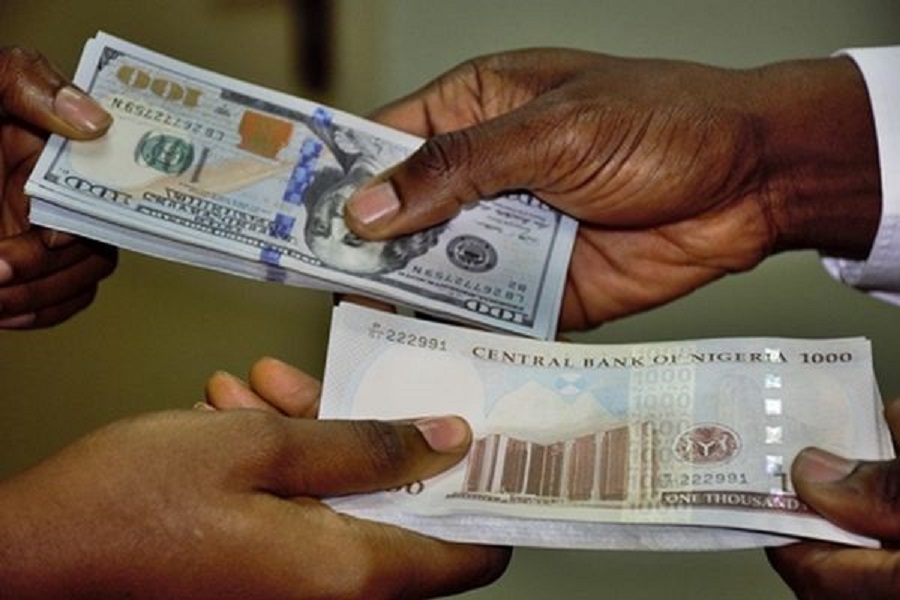
Naira at par selling N1,485/$ in parallel, official markets
The Naira yesterday appreciated in the parallel market to N1,485 per dollar from N1,490 per dollar on Wednesday.
Data from FMDQ showed that the indicative exchange rate for NAFEM rose to N1,485.06 per dollar from N1,483.02 per dollar on Wednesday, indicating N2.04 depreciation for the naira.
READ ALSO:
- Kano govt orders Ado Bayero palace demolition after court order
- Sanusi remains Emir, says Kano govt despite court order
- It’s a big mistake for South Korea to arm Ukraine – Putin
Consequently, the margin between the parallel market and NAFEM rates narrowed to 36 kobo per dollar from N6.98 per dollar on Wednesday.
Naira at par selling N1,485/$ in parallel, official markets





Business
US-Iran Conflict: MAN Outlines Urgent Steps to Shield Nigerian Manufacturers

US-Iran Conflict: MAN Outlines Urgent Steps to Shield Nigerian Manufacturers
The Manufacturers Association of Nigeria (MAN) has raised alarm over the escalating US-Iran conflict impact on Nigerian manufacturers, warning that the geopolitical tensions in the Middle East pose immediate, severe, and multi-layered risks to Nigeria’s industrial sector.
Director-General of MAN, Segun Ajayi-Kadir, said the sector is already feeling the effects of a global energy shock, noting that the industry’s projected 3.1% growth target for 2026 is now under serious threat.
He explained that manufacturers’ dependence on diesel and gas for production has left them highly vulnerable to rising global crude oil prices, which have pushed up domestic energy costs and significantly eroded profit margins.
“Energy cost escalation is biting hard. Many manufacturers are seeing their margins wiped out almost overnight,” Ajayi-Kadir said, highlighting the growing strain on operators.
The energy crisis in Nigeria’s manufacturing sector has been compounded by imported inflation, rising freight charges, and prolonged shipping delays. According to MAN, higher logistics and transportation costs are making the importation of critical raw materials increasingly expensive, thereby disrupting production cycles.
Ajayi-Kadir warned that the situation has created a double burden of rising production costs and weakening consumer demand, leaving many manufacturers with unsold inventories and shrinking revenues.
READ ALSO:
- Bandits Kill Two Abducted Women in Kaduna After Ransom Payment
- 2027: Atiku Signs $1.2m US Lobbying Deal to Engage Trump
- Tinubu Unveils ₦3.3tn Electricity Bailout to Revive Nigeria’s Power Sector
“The implication is clear – production costs are rising sharply, while consumer purchasing power is weakening. Manufacturers are now battling both high costs and unsold inventories,” he said.
Beyond energy and logistics challenges, MAN noted that exchange rate volatility and limited access to foreign exchange have further complicated operations, making it difficult for manufacturers to source essential inputs.
To mitigate the crisis, MAN outlined several key measures to stabilise Nigeria’s manufacturing sector, urging the Federal Government to act swiftly.
The association called for the fast-tracking of the Presidential Compressed Natural Gas (CNG) initiative, which it believes will help industrial clusters reduce reliance on diesel and lower energy costs.
It also recommended the creation of a dedicated foreign exchange window by the Central Bank of Nigeria to ensure manufacturers have timely access to forex for importing raw materials and machinery.
In addition, MAN advocated for the domestication of petroleum supply chains, urging local refineries to prioritise supply to domestic manufacturers at competitive rates to cushion the impact of global oil price volatility.
To ease logistics pressures, the group proposed a six-month suspension of multiple taxation, haulage levies, and highway tolls, noting that transport-related costs have surged significantly.
“The current crisis is a stark reminder of Nigeria’s vulnerability to external shocks due to our dependence on imported inputs,” Ajayi-Kadir said, stressing the need for structural reforms.
He added that the situation presents an opportunity for Nigeria to pursue manufacturing self-sufficiency, reduce import dependence, and build a more resilient industrial base.
Industry analysts also warn that sectors such as chemicals, pharmaceuticals, food processing, and steel are particularly exposed due to their reliance on imported inputs and sensitivity to global price fluctuations.
MAN cautioned that failure to implement urgent interventions could lead to factory shutdowns, job losses, reduced industrial output, and a major setback to Nigeria’s industrialisation drive.
“We cannot control global geopolitics, but we can control our domestic response,” Ajayi-Kadir reiterated, urging policymakers to treat the situation as both a crisis and an opportunity to reposition Nigeria’s manufacturing sector for long-term sustainability.
US-Iran Conflict: MAN Outlines Urgent Steps to Shield Nigerian Manufacturers
Business
Cash vs Digital: Nigeria’s Cashless Dream Meets Street Reality

Cash vs Digital: Nigeria’s Cashless Dream Meets Street Reality
By Dr Ramanathan Murugesan, FCA, CPA
On a humid afternoon in Lagos, 24-year-old Adaeze sways inside a crowded danfo bus—one hand clinging to a metal rail, the other navigating her phone. Within seconds, she transfers her fare to the conductor. No notes. No coins. No delay.
A few kilometres away, at a roadside fruit stall, the future stalls.
A customer reaches for his phone. “Transfer?” he asks.
The vendor doesn’t hesitate. “No network. Bring cash.”
In that moment lies the paradox of modern Nigeria.
Digital payments are booming, yet cash refuses to fade. After more than a decade of policy reforms and fintech disruption, Africa’s largest economy is not cashless. It is something far more complex—a nation suspended between innovation and infrastructure, trust and uncertainty.
Policy spark, behaviour shift
Nigeria’s cashless journey began in 2012, when the Central Bank of Nigeria rolled out policies to curb cash usage and modernise payments.
On paper, the transformation is undeniable.
Data from the Nigeria Inter-Bank Settlement System shows electronic transactions rising steadily year after year. The NIBSS Instant Payment platform has become the backbone of real-time transfers, powering everything from salary payments to street-level commerce.
Traditional banks—Access Bank, Guaranty Trust Bank (GTBank), Zenith Bank, and United Bank for Africa (UBA)—have reinvented themselves as digital-first institutions. Alongside them, fintech disruptors like Flutterwave, Paystack, Opay, and PalmPay have democratised payments, turning smartphones into wallets.
READ ALSO:
- NAF Releases DSSC 34/2025 Successful Candidates List, Announces Training Date
- Netanyahu Condemns ‘Christian Persecution’ in Nigeria in Easter Message
- Gunmen Attack Kaduna Churches During Easter, Kill 7, Abduct Worshippers
In Nigeria’s cities, cash is no longer king—it is contested territory.
Fintech’s quiet revolution
If policy lit the spark, fintech fanned the flames.
For decades, millions of Nigerians existed outside the formal banking system. Fintech changed that—swiftly and at scale. With minimal paperwork and mobile-first platforms, financial services reached markets banks had long ignored.
Nowhere is this more visible than in the explosion of PoS agents. Across urban streets and rural corners alike, small kiosks double as micro-banks, handling deposits, withdrawals, and transfers.
For small businesses, this shift has been transformative. Digital payments reduce the risks of holding cash, expand customer options, and streamline operations.
Yet the revolution is uneven.
While Lagos and Abuja surge ahead, large parts of rural Nigeria remain on the margins—held back not by resistance, but by access.
Pandemic acceleration, structural exposure
Then came COVID-19—a crisis that doubled as a catalyst.
Lockdowns and health concerns pushed millions toward contactless payments. What began as necessity quickly hardened into habit, particularly among younger Nigerians.
E-commerce surged. Digital wallets swelled. Platforms like Flutterwave and Paystack recorded spikes in transaction volumes as businesses rushed online.
But beneath the growth lay fragility.
The system expanded faster than the infrastructure supporting it.
The naira redesign stress test
That fragility was laid bare during the 2022–2023 naira redesign.
As old notes were withdrawn and new ones rationed, Nigeria plunged into a cash crisis. ATMs ran empty. Banking halls overflowed. Frustration boiled over.
In desperation, millions turned to digital channels.
Transaction volumes surged—but so did failures.
Across banking apps and fintech platforms, transfers hung in limbo. Alerts delayed. Systems crashed under pressure. From GTBank to Opay, the message was the same: Nigeria’s digital rails were not yet built for shock.
The episode was more than a policy misstep—it was a stress test the system failed.
Infrastructure: The Achilles’ heel
At the heart of Nigeria’s cashless struggle lies a stubborn truth: infrastructure still lags ambition.
Unreliable electricity disrupts devices, servers, and networks. Patchy internet connectivity turns simple transfers into uncertain gambles. For millions, “transaction failed” is not an exception—it is routine.
For a roadside trader, a failed payment is not a technical glitch. It is lost income.
Cash, by contrast, is brutally simple. It works—every time.
Trust: The currency behind the currency
Beyond infrastructure lies an even more delicate issue: trust.
Digital systems promise speed, but not always certainty. Fraud, phishing, and account breaches continue to erode confidence. When transactions fail, reversals are often slow and opaque.
For many Nigerians—especially those outside the tech-savvy demographic—this uncertainty is costly.
Cash offers something digital still struggles to replicate: finality.
No pending alerts. No reversals. No doubt.
The informal economy’s quiet resistance
Any conversation about Nigeria’s payment future must confront its informal economy—vast, dynamic, and deeply cash-driven.
From open markets to roadside workshops, a significant share of economic activity operates beyond formal systems. Here, cash is not just convenient—it is strategic.
Digital payments leave trails. Cash offers discretion.
For many, the choice is not about technology, but about control.
Bringing this sector into the digital fold will require more than apps and policies. It will demand trust, incentives, and a system that works reliably at the last mile.
A nation split by access
Nigeria’s digital transition is also generational—and geographical.
Urban youth have embraced fintech with speed and ease. Smartphones, apps, and instant transfers are second nature.
But in rural communities and among older populations, adoption lags. Limited access to devices, connectivity, and digital literacy continues to widen the gap.
The result is not a unified shift, but a fragmented transition.
Cashless or cash-light?
So, has Nigeria gone cashless?
Not quite.
What has emerged instead is a “cash-light” economy—one where digital payments thrive, but cash remains indispensable.
Consumers toggle between both worlds. When networks are stable, digital wins. When systems falter, cash takes over.
This duality is not a failure. It is a reflection of reality.
The road ahead
Nigeria’s path to a truly cashless economy will not be decided by policy alone.
It will depend on power supply that does not fail, networks that do not drop, and systems that do not crash under pressure. It will require stronger consumer protection, faster dispute resolution, and deeper financial literacy.
Most importantly, it will demand trust—earned not through promises, but through performance.
An economy in motion
Nigeria is no longer where it was a decade ago. Digital payments have moved from the margins to the mainstream.
But cash remains embedded—resilient, reliable, and, for many, indispensable.
For now, the country exists between two financial realities—neither fully digital nor entirely cash-based.
It is an economy in motion, where the future of money is being shaped not just in boardrooms and policy circles, but in buses, markets, and roadside stalls.
And in Lagos, that future is decided every day—in a simple, familiar choice: Pay with a phone, or pay with cash.
Cash vs Digital: Nigeria’s Cashless Dream Meets Street Reality
Insurance
Lasaco Assurance Launches N18.47bn Rights Issue to Strengthen Capital Base
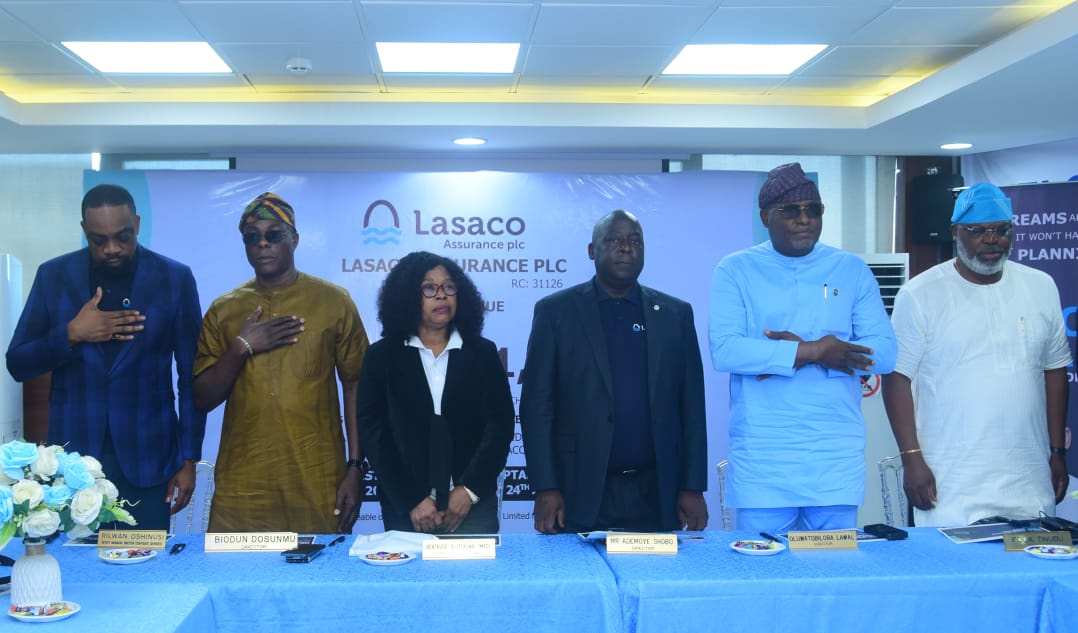
Lasaco Assurance Launches N18.47bn Rights Issue to Strengthen Capital Base
Lasaco Assurance Plc has unveiled a ₦18.47 billion rights issue, announcing plans to offer 9,236,321,546 ordinary shares as part of efforts to reinforce its capital base and drive future growth.
The announcement was made during a signing ceremony held at the company’s head office in Lagos, following approvals from the Nigerian Exchange Group (NGX) and the Securities and Exchange Commission (SEC).

Lasaco Assurance Plc
Prior to this development, the company had secured shareholder backing at an extra general meeting, where investors approved the move to raise fresh capital through a rights issue.
Under the terms of the offer, shares are priced at ₦2.00 per share, with each share having a nominal value of 50 kobo. The rights issue is structured on the basis of five new shares for every six existing shares held by shareholders.
According to details released by the insurer, eligibility is limited to shareholders whose names appeared on the company’s register as of the close of business on February 20, 2026. The acceptance list opened on April 2, 2026, and will close on April 24, 2026.
READ ALSO:
- ADC Crisis Deepens as Bala Denies Resignation, Insists on Chairmanship
- Ghana Sweeps Top Three Positions in 2025 WASSCE, Outshining Nigeria, Others
- Tinubu Approves 1,000 Forest Guards, Orders 5,000 CCTV Cameras to Boost Security in Plateau
The capital raise is expected to generate approximately ₦18.47 billion, which will be used to strengthen the company’s underwriting capacity and position it for expansion within Nigeria’s highly competitive insurance industry.
In addition, the rights offered will be tradable on the floor of the Nigerian Exchange Limited, allowing shareholders the flexibility to either subscribe to their allotted shares or sell their rights during the offer period.
Financial advisers to the transaction include Meristem Capital Limited as the Lead Issuing House and PAC Capital as Joint Issuing House.
The move aligns with broader efforts across the insurance sector to meet regulatory capital requirements, enhance balance sheets, and improve capacity to underwrite large-ticket risks across various sectors of the economy.
Speaking on the development, the Managing Director of Lasaco Assurance Plc, Mr. Ademoye Shobo, stated:
“At Lasaco, we will continue to ensure that our capital is always robust, so that we’re able to deliver on the mandates to the general public.”
Lasaco Assurance Launches N18.47bn Rights Issue to Strengthen Capital Base

-

 metro2 days ago
Pastor Found Dead in Guest House After Night Out With Married Female Church Member
-

 Health2 days ago
Men Encouraged to Ejaculate More to Reduce Prostate Cancer Risk
-

 International3 days ago
Iran Announces ‘Bounty’ on US Pilots After Claiming Downing of Fighter Jet
-

 Politics2 days ago
Adeleke’s Aide Anisu Resigns, Defects to APC
-

 Politics2 days ago
Wike: PDP Not Financially Ready for 2027 Presidential Election
-

 International19 hours ago
Netanyahu Condemns ‘Christian Persecution’ in Nigeria in Easter Message
-

 Africa3 days ago
Nigeria Apologises Over ‘Igbo King’ Controversy in South Africa as Protests Turn Violent
-

 Entertainment2 days ago
Nollywood Actress Laide Bakare Sets Strict Dating Rules: No Men in Her Home