

Education
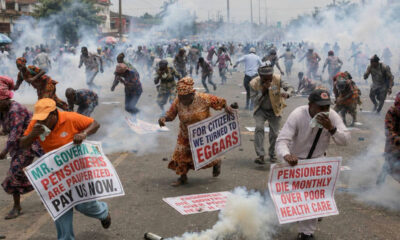
Nigerian students in Benin Republic protest against certificate ban

Nigerian students in Benin Republic protest against certificate ban
More than 650 Nigerian students enrolled at ESM University in Benin Republic have protested against the Federal Government’s decision to derecognise the university.
The recent directive from the Federal Government, which bans Nigerians from enrolling in certain universities in Benin and Togo, came after authorities discovered that over 22,500 graduate certificates issued by these institutions between 2019 and 2023 were fraudulent.
The affected students called on President Bola Tinubu to urgently intervene in the matter.
On Thursday, a large number of students and their parents staged a peaceful protest at the residence of Pastor Chibuzo Chinyere, the General Overseer of Omega Power Ministry (OPM), in Port Harcourt.
The students, who are beneficiaries of OPM scholarships, expressed deep concern about the impact of the ban on their mental health and academic future. They pleaded with President Tinubu to reverse the decision, allowing them to continue their studies.
Hycenth Ikechukwu, a final-year Business Administration student, voiced his distress upon learning of the ban just as he was about to complete his studies. He emphasized that ESM University was accredited by the Nigerian government when he enrolled in 2019.
“We are pleading with President Tinubu to intervene and instruct the Ministry of Education to revisit this abrupt decision that could derail our lives. It is unjust to force someone in their final year to start afresh at 100-level in Nigerian universities after investing years of effort and substantial funds,” Ikechukwu said tearfully.
READ ALSO:
- Dealers, forex responsible for high prices of cement — BUA
- “create your path”: Israel Adesanya warns aspiring athletes against emulating him
- Tinubu to distribute rice, fertilizer in Nasarawa
Moses Joseph, a 200-level Computer Science student, urged the government to facilitate their transfer to universities within Nigeria, suggesting that they be allowed to submit their academic transcripts to continue their education locally. “I am even willing to start from 100-level if that’s what it takes,” he added.
Another affected student, Wisdom Nweze, highlighted the negative impact the university’s derecognition has had on her mental well-being, calling on the federal government to find a resolution to the situation.
Justin Hycenth, a blind widow, expressed her deep disappointment, revealing that her son’s scholarship to study abroad had been jeopardized by the government’s decision. “I implore the government to take immediate action and reverse the ban,” she pleaded.
In response, Chinyere disclosed that the 650 affected students are part of a larger group of over 4,000 OPM scholarship recipients studying in countries such as the U.S., UK, Canada, Turkey, Ethiopia, and Cyprus. He noted that the church had verified ESM University’s accreditation and that its graduates had previously participated in the National Youth Service Corps (NYSC).
“Based on the ministry’s confirmation, we decided to enroll students in the university. OPM has invested more than N500 million in these students at ESM University, and it is unfair to invalidate our investment and their efforts,” Chinyere stated.
He further explained that OPM chose to send students abroad due to the challenges of gaining admission to Nigerian universities, citing the difficulties associated with passing JAMB and Post UTME exams.
“Rather than banning the university, the Federal Government should consider strengthening regulations surrounding foreign education. It will be challenging for us to continue sponsoring students, especially those in their final year, if this policy remains in effect,” he cautioned.
Nigerian students in Benin Republic protest against certificate ban











Education
LASU, LASUED, LASUSTECH Shut as ASUU Begins Indefinite Strike

LASU, LASUED, LASUSTECH Shut as ASUU Begins Indefinite Strike
Students at three Lagos State-owned universities are facing an indefinite interruption of academic activities after ASUU declared a strike over unresolved demands.
LASU, LASUED and LASUSTECH are affected by the industrial action announced by the union’s Joint Campus Group.
ASUU said it had given the Lagos State Government 14 days from August 31 to address its concerns. According to the union, the deadline expired without a concrete plan or meaningful dialogue.
The union had also issued a final warning on September 10, but said the September 13 deadline passed without talks.
Its main demand is for Lagos State to domesticate and implement the December 2025 Federal Government-ASUU agreement across the three institutions.
ASUU also wants the implementation of welfare provisions, including the Consolidated Academic Tools Allowance for serving and retired academic staff.
The union said the strike would continue until negotiations produce a satisfactory outcome. It also urged students and parents to remain calm.
While the dispute has led to a fresh shutdown in Lagos, another ASUU branch has suspended its strike in Plateau State.
The Plateau State University branch reached an agreement with the state government on issues including the 2025 agreement, outstanding arrears, staff accommodation and other demands. Members are expected to return to academic activities from midnight on September 16.
Meanwhile, ASUU at Taraba State University has issued a fresh 14-day ultimatum to the Taraba State Government. The notice runs from September 14 to September 28 and concerns outstanding provisions of the 2025 Federal Government-ASUU agreement.
LASU, LASUED, LASUSTECH Shut as ASUU Begins Indefinite Strike
Education
ASUU Crisis Deepens: Lagos Universities Join UNIBEN, Taraba on Indefinite Strike
ASUU Crisis Deepens: Lagos Universities Join UNIBEN, Taraba on Indefinite Strike
The Academic Staff Union of Universities (ASUU) has not declared a nationwide indefinite strike. However, the union’s national leadership has issued a fresh threat to resume its suspended national strike without notice, while at least three university branches are currently on indefinite strike over unresolved welfare disputes with state governments.
The confusion stems from a wave of branch-level industrial actions that began in early September 2026, combined with an emergency National Executive Council (NEC) resolution warning that a nationwide shutdown could be activated “within the shortest time possible” if governments fail to honour the 2025 Federal Government-ASUU agreement.
The ASUU branches at the three Lagos State-owned universities declared a total, comprehensive, and indefinite strike on September 15, 2026, after the state government allowed a 14-day ultimatum to lapse without initiating dialogue. The unions’ principal demand is the full domestication and implementation of the December 2025 ASUU-FGN agreement, including the Consolidated Academic Tools Allowance (CATA) and critical welfare protections for both active and retired academic staff. The strike has the full backing of the ASUU national leadership, and the union stated it will not be suspended until the state government signs, domesticates, and implements the applicable provisions of the agreement in full.
READ ALSO:
- Lagos Power Outage: Ikeja Electric Blames TCN as Businesses, Homes Groan
- US Court Blocks Trump Visa Rule Limiting Stay of Foreign Students, Journalists
- Sokoto Shuts Mosque After Cleric Stabbing, Names Ulamas Probe Panel
The UNIBEN ASUU branch is continuing its indefinite strike, which began on September 9, 2026, over the alleged underpayment of August 2026 salaries. A congress held on September 11 resolved that the strike would continue because the university administration failed to provide clear details of what was paid, what was outstanding, and when it would be paid. University management insists the Federal Government paid August salaries in full, and that the payment in question was CATA, not salary.
ASUU at Taraba State University resumed an indefinite strike following the state government’s failure to implement an agreement reached on January 17, 2025. On September 14, the branch issued a final 14-day ultimatum to the Taraba State Government, which will expire on September 28, 2026, if outstanding provisions are not addressed. The union had previously suspended a planned strike in August to allow the university’s combined convocation ceremonies to proceed.
The UNIZIK ASUU branch suspended its indefinite strike on September 11, 2026, after the university management paid the complete August 2026 salary. The strike had been declared on September 7 over the non-payment of full August salaries. The branch directed all members to resume academic and administrative duties immediately.
At the national level, ASUU has threatened to reactivate its suspended nationwide strike if the Federal Government and state governments fail to urgently resolve outstanding issues. This decision followed an emergency NEC meeting held at the University of Abuja on September 5, 2026. ASUU President, Prof. Christopher Piwuna, stated that unless immediate and concrete steps are taken, the union “will not accept any blame for calling out its members on a nationwide strike action within the shortest time possible”. The unresolved issues include three-and-a-half months of withheld salaries from the seven-and-a-half months withheld under the previous administration, unremitted third-party deductions (pension contributions, cooperative funds, and ASUU check-off dues) allegedly withheld for several months, breaches of university laws and autonomy, and the worsening conditions of the academic profession.
ASUU commended governors who had commenced implementation of the 2025 agreement, singling out Abia State Governor Alex Otti for praise, noting he publicly announced full adoption and apologised for bureaucratic delays. The union also listed Bauchi, Ekiti, Ogun, Benue, Yobe, Adamawa, Kebbi, Katsina, and Borno as states where implementation had commenced. It noted pledges to begin in Kano, Edo, Plateau, Taraba, Gombe, and Bayelsa in September or October 2026.
Former Vice President Atiku Abubakar challenged President Bola Tinubu to account for savings from petrol subsidy removal, arguing that the renewed university crisis exposed a contradiction in the government’s reform claims. Atiku said Nigerians had endured unprecedented cost-of-living increases while public universities remained underfunded and lecturers were again threatening to strike.
ASUU Crisis Deepens: Lagos Universities Join UNIBEN, Taraba on Indefinite Strike
Education
JAMB Moves 2027 UTME Time — Here’s What Candidates Need To Know
JAMB Moves 2027 UTME Time — Here’s What Candidates Need To Know
The Joint Admissions and Matriculation Board (JAMB) has adjusted the schedule for the first session of the 2027 Unified Tertiary Matriculation Examination (UTME), moving the arrival time for candidates from 6:30am to 7:30am.
Under the revised arrangement, candidates taking part in the first session will be expected to arrive at their designated Computer-Based Test (CBT) centres by 7:30am, while the examination will commence at 8:30am and end at 10:30am.
JAMB said the adjustment was introduced in response to concerns over the safety and convenience of UTME candidates, particularly those who travel long distances to their assigned examination centres.
The Board said the earlier 6:30am arrival requirement could force some candidates to embark on their journeys before dawn, exposing them to avoidable transportation and security risks.
The decision to move the arrival time was reached during JAMB’s 2026 Management and Information Technology Retreat, held in Ikot Ekpene, Akwa Ibom State, from September 6 to 11.
READ ALSO:
- No Lives Lost as Responders Contain Dual Fire Outbreaks Across Lagos
- ‘I Was Never the Chosen One’ — Dembele Responds to Mbappe
- Plateau Attacks: Gunmen Kill Passengers, 13 Dead Across Three LGAs
The retreat brought together JAMB management, state coordinators, heads of outstation offices and other relevant officials to review the Board’s operations and consider measures for improving the conduct of future examinations.
According to the Board, concerns had been raised about the safety implications of requiring candidates to report at examination centres as early as 6:30am, especially where candidates have to travel considerable distances.
JAMB said the one-hour adjustment would allow candidates more time to travel to their centres during daylight and could also reduce the pressure associated with early-morning transportation.
The Board also indicated that the adjustment could help reduce UTME absenteeism, as some candidates who encounter transportation difficulties or live far from their assigned centres may find it easier to arrive under the revised arrangement.
The new 7:30am reporting time applies to the first UTME session, with the examination itself scheduled to begin at 8:30am.
JAMB said other sessions would continue according to the examination schedule to be released as part of the preparations for the 2027 exercise.
The latest decision is part of broader efforts by the examination body to improve the safety, efficiency and overall experience of candidates sitting the annual university entrance examination.
JAMB has increasingly placed emphasis on the need to make its examination processes more efficient while addressing logistical challenges associated with the movement of millions of candidates across the country.
The 2027 UTME is expected to involve candidates from across Nigeria and other countries where Nigerian candidates are permitted to sit for the examination.
The adjustment will be particularly significant for candidates who are assigned to CBT centres outside their immediate communities, as the later arrival time gives them an additional hour to complete their journeys before reporting for accreditation and other pre-examination procedures.
Candidates are, however, expected to follow the specific instructions contained in their examination slips and other official communications from JAMB once the full examination schedule is released.
The Board is expected to provide further information on 2027 UTME registration, examination dates, registration centres, approved CBT centres, candidate requirements and session allocations as preparations progress.
Prospective candidates have also been advised to rely on official JAMB announcements and avoid unverified schedules circulated on social media or other unofficial platforms.
The latest change does not mean that candidates should arrive late at their assigned centres. Those scheduled for the first session will still be expected to report by 7:30am to allow sufficient time for verification and other procedures before the examination begins at 8:30am.
JAMB’s decision is therefore expected to provide some relief to candidates and families concerned about the risks associated with very early-morning travel, while helping the Board maintain an orderly start to the 2027 UTME.
JAMB Moves 2027 UTME Time — Here’s What Candidates Need To Know
-

 Politics2 days ago
2027: Northern Lecturers Back Tinubu, ASUU Disowns Endorsement
-

 metro3 days ago
Mother ‘sold daughter’s abuse videos for $300’: Nigeria child pornography case shocks nation
-

 metro2 days ago
Police Arrest Mother Over Alleged Brutal Abuse of 7-Year-Old Girl in Anambra
-

 News3 days ago
Adeleke Orders Arrests After Associate Ajagungbade Is Reportedly Killed in Ife
-

 News3 days ago
Petrol Subsidy: Presidency Rejects Atiku’s Plan, Says No Going Back
-

 Sports1 day ago
‘I Was Never the Chosen One’ — Dembele Responds to Mbappe
-

 Education3 days ago
JAMB Takes Over HND Admissions in Polytechnics, Health Institutions Nationwide
-

 News2 days ago
Nwifuru Dismisses Cubana Chief Priest as ‘Attention-Seeker’