

News
NLC threatens nationwide protests as insecurity worsens, withdraws support for Labour Party
NLC threatens nationwide protests as insecurity worsens, withdraws support for Labour Party
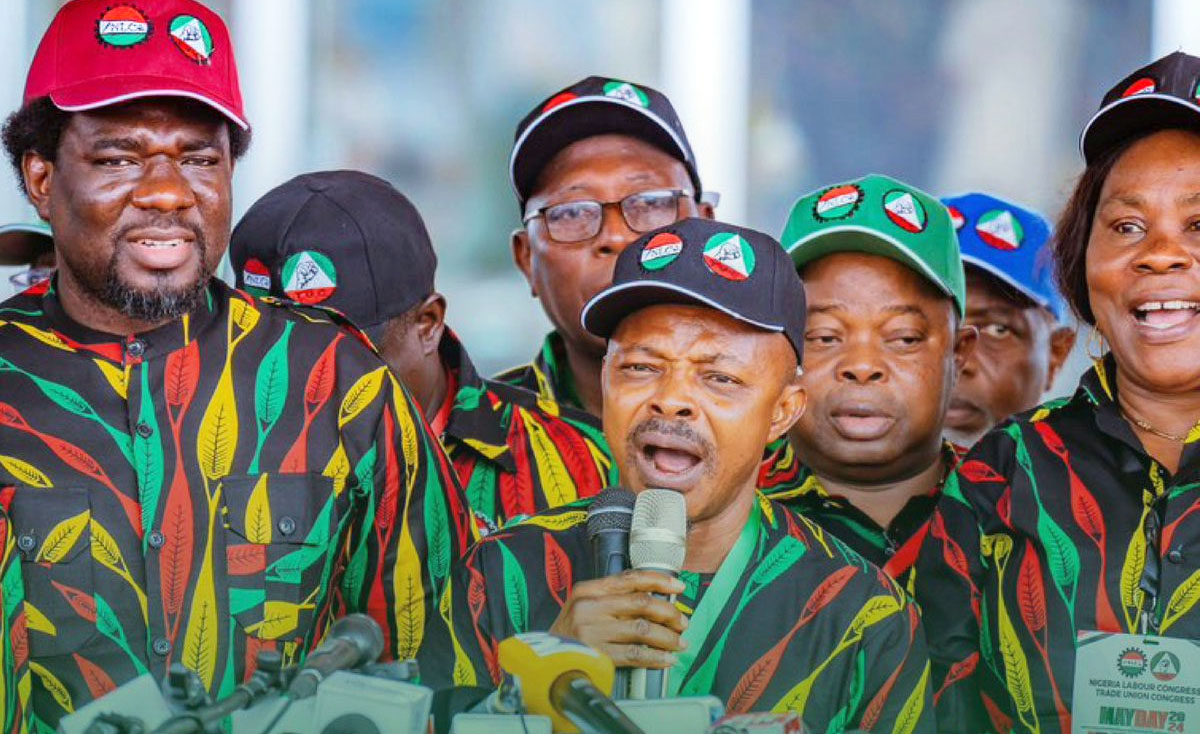
The Nigeria Labour Congress (NLC) has warned that it will no longer remain passive as criminal gangs intensify violent attacks across the country, declaring its readiness to hold a national day of mourning and mobilise nationwide protests over the escalating insecurity in Nigeria.
Speaking at the opening of the NLC’s National Executive Council (NEC) meeting in Lagos, NLC President Joe Ajaero said the country was “under siege,” condemning the latest school kidnapping and the reported withdrawal of security personnel before the attack. He demanded a full investigation to expose any possible compromise within the nation’s security architecture.
“The NLC cannot stand idly by and allow criminals to take over our country—never again. We want to know who ordered the withdrawal of security operatives from that school. We will not allow kidnappers and bandits to overrun our nation,” Ajaero said.
READ ALSO:
- Oshiomhole Seeks Tougher Regulation of Fintech Firms After Cyber Fraud Experience
- Boris Johnson Hails Kemi Badenoch as “Future UK Prime Minister” During Visit to Nigeria
- A troubling message from Guinea-Bissau, by Azu Ishiekwene
He stressed that the labour movement would soon announce details of the planned protests and national mourning, insisting the lives of teachers, students and workers were in grave danger. “It is getting out of hand. We can no longer bear this,” he added.
Ajaero also revealed that the NLC had withdrawn its representatives from the Labour Party, accusing them of pursuing personal interests rather than representing workers.
Human rights lawyer Femi Falana, SAN, who addressed the meeting, warned that the country was in “serious trouble” over rising kidnappings and attacks. He rejected calls for foreign military intervention, cautioning that such a move would undermine Nigeria’s sovereignty.
Falana criticised recent statements by former U.S. President Donald Trump, describing them as unacceptable. He urged President Bola Tinubu to take decisive action to protect citizens, saying: “We want to let the world know that we are not a conquered people.”
He called on labour unions, civil society organisations and Nigerians to prepare to resist any further decline in national security.
NLC threatens nationwide protests as insecurity worsens, withdraws support for Labour Party









News
President Tinubu Mourns 32 NAF Personnel in Ondo Jet Crash, Orders Immediate Probe
President Tinubu Mourns 32 NAF Personnel in Ondo Jet Crash, Orders Immediate Probe
President Bola Ahmed Tinubu has expressed profound grief over the crash of a Nigerian Air Force ATR-42 aircraft near a naval base in the Igbokoda area of Ondo State, which claimed the lives of all 32 personnel on board.
The tragic incident occurred on Monday morning when the aircraft, on a routine mission from Benin to Lagos, went down shortly before reaching its destination. The victims include 25 passengers and seven crew members.
In a statement released by his Special Adviser on Information and Strategy, Bayo Onanuga, the President described the incident as “a painful moment for our Armed Forces and for the entire nation.”
“Our Air Force personnel put their lives on the line every day to secure Nigeria. Their sacrifice will never be forgotten,” Tinubu said.
The President extended his deepest condolences to the families of the deceased, the Chief of the Air Staff, Air Marshal Sunday Kelvin Aneke, and the entire Nigerian Air Force community.
READ ALSO:
- Benue Boat Mishap: Catholic Priest Among Four Dead, Nine Missing
- Rivers Police Arrest OSPAC Operative Over Alleged Killing, Secret Burial
- Adeleke Signs New Law to Regulate Motor Parks Across Osun
President Tinubu revealed that he had received a briefing from the Chief of Air Staff and has directed an immediate and thorough investigation into the cause of the crash to prevent future occurrences.
“I have directed the Nigerian Air Force to immediately commence a thorough investigation into the cause of the crash to prevent future occurrences,” he stated.
The President commended the Nigerian Air Force for activating an immediate Search and Rescue operation following the accident, as well as the swift response of first responders and the Ondo State Government at the crash site.
“I pray for the repose of the souls of the gallant officers and for Almighty God to grant their families and the Nigerian Air Force the fortitude to bear the unfortunate loss,” Tinubu said.
He further assured the Nigerian Air Force of the continued support of his administration as they continue their vital role in securing the nation.
The crash marks one of the deadliest air disasters involving Nigerian military personnel in recent years, casting a shadow over the nation’s security apparatus. The Nigerian Air Force is expected to release further details as the investigation gets underway.
President Tinubu Mourns 32 NAF Personnel in Ondo Jet Crash, Orders Immediate Probe
News
BREAKING: Many Feared Dead as Helicopter Crashes in Ondo Community
BREAKING: Many Feared Dead as Helicopter Crashes in Ondo Community
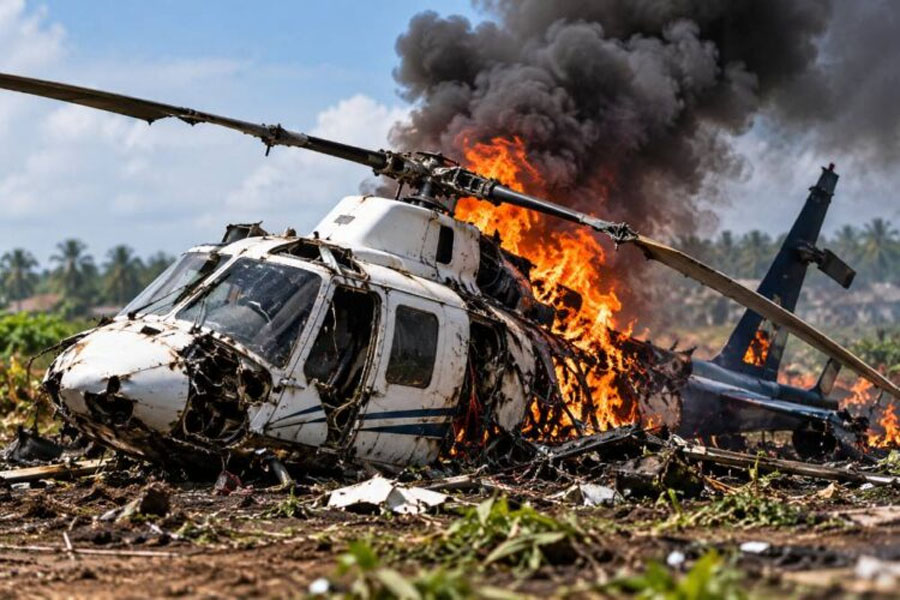
Several people are feared dead after a helicopter crashed in Igbokoda, headquarters of Ilaje Local Government Area of Ondo State, on Monday.
The incident occurred in the riverine community, triggering panic among residents as efforts began to establish the circumstances surrounding the crash and the fate of those on board.
Early reports indicate that the aircraft came down in a swampy area opposite a naval base in Igbokoda. The helicopter was reportedly badly damaged, with one local official saying military equipment was found at the scene.
The Chairman of Ilaje Local Government Area, Maurice Oripelaye, confirmed the crash when contacted by journalists but said the number of people aboard the aircraft could not immediately be established.
He reportedly said the helicopter had been burnt extensively, making it difficult to determine the number of occupants or confirm their identities.
The circumstances surrounding the crash remained unclear as of Monday afternoon. It was also not immediately established whether the aircraft was operated by the military, a private company or another organisation.
Some reports described the aircraft as a suspected military helicopter, based on the military equipment reportedly recovered from the crash site. However, authorities had not officially confirmed the identity or operator of the aircraft.
READ ALSO:
- Transporters Urge IGP Disu to Arrest Illegal Highway Tax Collectors
- Army, DSS, Amotekun Kill ISWAP Commander Planning Attacks in Southern Nigeria
- 2027: Soludo Govt Accuses Peter Obi Of Plot To Destroy APGA
The Ondo State Police Command also had not immediately confirmed the incident. Police spokesperson Abayomi Jimoh was reported to have said he was unaware of the crash when contacted and would make inquiries.
Reports from the community indicated that residents moved towards the crash area following news of the incident, while efforts were reportedly underway to assess the wreckage and establish whether there were survivors.
The number of people on board remains unknown, and no official casualty figure had been released at the time of filing this report.
The crash occurred in Ilaje, one of Ondo State’s major riverine and oil-producing areas. Igbokoda serves as the headquarters of the local government and is surrounded by waterways and swampy terrain.
The location is also used for logistics and transportation activities connected to the coastal and oil and gas industry, where helicopters are sometimes deployed to transport personnel and equipment.
The reported crash has renewed attention on the safety challenges associated with helicopter operations in Nigeria’s coastal areas, although the cause of Monday’s incident remains unknown.
Authorities are expected to establish the identity of the aircraft, its operator, flight route, number of occupants and the circumstances that led to the crash.
The Nigerian Safety Investigation Bureau (NSIB) is responsible for investigating aviation accidents and incidents within its jurisdiction, and further official information is expected as authorities assess the crash site.
For now, residents and families awaiting information about possible occupants are left without confirmed casualty figures or details of those involved.
Further updates are expected from the relevant security, aviation and emergency-response authorities as the investigation and recovery efforts continue.
BREAKING: Many Feared Dead as Helicopter Crashes in Ondo Community
News
Supreme Court Ruling: INEC Moves to Clarify Fate of 2027 Candidates
Supreme Court Ruling: INEC Moves to Clarify Fate of 2027 Candidates
The Independent National Electoral Commission (INEC) has said it will determine how the recent Supreme Court ruling on the Electoral Act 2026 affects candidates after reviewing the certified true copy of the judgment.
The development has heightened uncertainty among some political parties and 2027 election candidates, particularly those whose nominations could be scrutinised over party membership registers and the procedures used to conduct their primaries.
The Supreme Court, in its September 24 judgment, restored Sections 77(5), 77(6), 77(7) and 84(2) of the Electoral Act 2026, which had earlier been struck down by the Court of Appeal. The provisions deal principally with political party membership registers and candidate nomination procedures.
Under Section 77(5), only members whose names appear on a party’s membership register submitted to INEC at least 21 days before a primary, congress or convention are eligible to participate in the exercise.
Section 77(6) requires parties to use the membership register submitted to INEC for their primaries, congresses and conventions, while Section 77(7) provides consequences for a party that fails to submit its register within the prescribed period.
Section 84(2), meanwhile, provides for the nomination of candidates through direct primaries or consensus.
The Supreme Court’s decision did not name or automatically disqualify any individual candidate. Questions surrounding particular nominations are expected to depend on the facts of each case, including party membership records, the timing of registration or defection and how the relevant primary was conducted.
READ ALSO:
- Omokri Defends Tinubu Over Pension Record, Faults Linking President to 89-Year-Old’s Death
- Tantita Operations Push Oil Export Earnings to $9.39bn in Q2
- Fifty Years After “Africa Has Come of Age”: A Personal Reflection on Nigeria’s Silence at the United Nations
INEC has therefore refrained from announcing a blanket decision on candidates whose nominations could be affected.
The commission is expected to engage political parties and other stakeholders on October 6, while also addressing the issue publicly as preparations continue for the 2027 general elections. INEC is also expected to publish the final list of governorship and State House of Assembly candidates on October 10.
Several candidates have already attracted attention because of circumstances surrounding their party membership or nomination.
Among those mentioned are Kingsley Chinda, the APC governorship candidate in Rivers State; Isa Pantami, the PDP governorship candidate in Gombe State; Donald Duke, the PRP presidential candidate; Ovie Omo-Agege, the NDC senatorial candidate in Delta Central; and Victor Ochei, the NDC candidate for Delta North.
In Chinda’s case, questions have centred on the timing of his movement from the PDP to the APC and whether his membership status complied with the restored provisions before the party’s governorship primary.
The Rivers APC has maintained that Chinda registered with the party on April 27, ahead of the May 21 primary, and therefore met the relevant 21-day requirement.
Pantami’s case is also subject to separate legal proceedings. He left the APC for the PDP after withdrawing from the APC governorship primary and subsequently emerged as the PDP’s candidate in Gombe. A Federal High Court ruling in Gombe had already nullified his nomination and ordered a fresh primary, meaning his situation involves issues beyond the Supreme Court judgment alone.
For Omo-Agege and Ochei, attention has focused on their movement from the APC to the NDC and the waivers granted to enable them to contest the NDC nomination exercises. Their cases raise questions about the interaction between party membership, waivers and the restored provisions of the Electoral Act.
Former Inspector-General of Police Mohammed Abubakar Adamu, the SDP governorship candidate in Nasarawa State, has also insisted that his candidacy remains valid. The SDP has said he had been a member of the party for about three months before its governorship primary.
The key issue for INEC is whether nominations conducted while the disputed provisions were temporarily invalidated will be assessed under the provisions subsequently restored by the Supreme Court.
For now, the Supreme Court judgment should not be interpreted as an automatic cancellation of the affected candidates’ tickets.
The final position will depend on INEC’s review of the judgment, the relevant party records and the specific circumstances surrounding each nomination, as well as any separate court proceedings that may arise.
With the 2027 elections approaching, the commission’s forthcoming clarification is expected to provide greater certainty for political parties, candidates and other stakeholders over the status of nominations affected by the ruling.
Supreme Court Ruling: INEC Moves to Clarify Fate of 2027 Candidates
-

 metro3 days ago
NYSC Kidnap: Abductors Demand N950m for 19 Prospective Corps Members in Imo
-

 Politics3 days ago
2027: Oshiomhole Dares Opposition Over ₦500 Petrol Promise, Says APC Will Take Argument to Nigerians
-
 metro3 days ago
Amaechi: Tinubu’s Policies Made My Mother’s Drugs Unaffordable
-
 metro2 days ago
Tension as Kidnappers Threaten to Kill Abducted Oyo Corps Members
-
 metro2 days ago
‘I Thought I Was Dead’ — Hairstylist’s Daring Escape From Kidnappers After Benin-Ore Ambush
-

 metro3 days ago
N500 Petrol, Wage Award: Public Sector Workers Begin Warning Strike
-

 Entertainment3 days ago
Less Than Four Months After Wedding, Jarvis Threatens Peller With Lawsuit Over Second-Wife Plan
-

 Politics2 days ago
Wike to Amaechi: What Did You Bring to Rivers After 24 Years in Power?