
Education
Plateau poly students protest exams postponement, block highway

Students of Plateau State Polytechnic on Monday trooped out in large numbers and blocked the Yakubu Gowon way, a major highway leading in and out of Jos, as they protested the postponement of their semester examinations by the school authorities.
The postponement of the examination was said to be as a result of an indefinite strike embarked upon by the lecturers of the institution.
The lecturers had issued a notice of strike to the government over they called its inability to meet their demands of earned allowances and other sundry issues.
NAN quoted one Miss Deborah John as saying the decision of the management to postpone the examination was an attempt to truncate their academic journey.
“We came to school this morning to start our examinations only to see a circular that our lecturers have been on strike since Friday.
“We were not informed; nobody said anything to us we just discovered that we cannot start our examinations.
“This is why we are protesting and it is a peaceful protest because all we want is go in and write our examinations.
“We have spent over three years in just one semester owing to Covid-19 lockdown, but largely due to the various strikes embarked upon by our lecturers.
“We keep paying for our accommodation, school fees, and other expenses. More so, we are getting old and by the time we graduate, we can’t find jobs of because of age,” John lamented.
Another student, Isreal Longdu, decried the incessant strike by their lecturers, adding that the development has stagnated their academic progression.
“Nobody has come to address us on the issue and we feel this is not right.“We demand a proper explanation from the management on why we cannot start our examinations today.“We are tired of this back and forth; our academic journey is suffering and this is not good for us,” he decried.
When contacted, Mr John Ramadan of the Public Relations Department of the institution, promised to furnish NAN with details on the strike soon.
NAN also reports that there was heavy presence of armed security personnel at the scene of the protest to forestall the breakdown of law and order.














Education
Students expelled as police probe viral assault at Igbinedion School
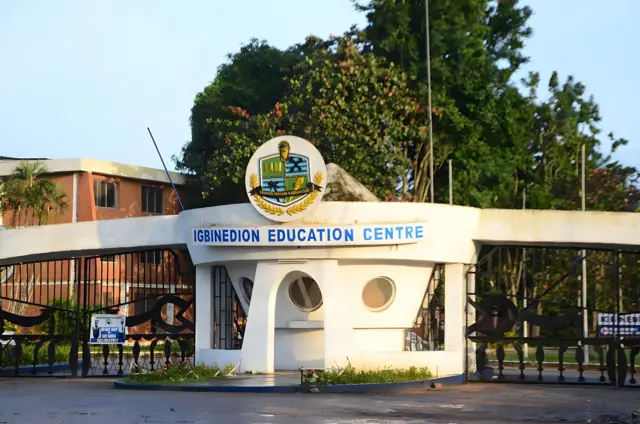
Students expelled as police probe viral assault at Igbinedion School
The Edo State Police Command has launched an investigation into a viral video showing a violent bullying incident involving students of Igbinedion Secondary School.
The footage, which has been widely circulated on social media, shows two students repeatedly beating, kicking and dragging a younger boy believed to be in a junior class across the floor.
During the assault, one of the attackers was seen using a belt to flog the victim, while another stomped on the boy’s chest as he cried out in pain.
The victim could be heard screaming while another student, who appeared to be recording the incident, pleaded with the attackers to stop.
The motive behind the assault has not yet been established.
Reacting to the incident on Sunday, the Edo State Police Command’s spokesperson, SP Eno Ikoedem, said the police were aware of the disturbing video and had commenced steps to investigate the matter.
She said the Commissioner of Police in the state, Monday Agbonika, had directed the Divisional Police Officer in charge of the area to immediately visit the school and begin a thorough inquiry.
“The Commissioner of Police has directed the Divisional Police Officer in charge of the area to proceed to the school and commence a detailed inquiry into the matter,” Ikoedem said.
She noted that although the school authorities had taken disciplinary action, the police would still carry out a comprehensive investigation into the incident.
According to her, the management of the school informed the police that the students involved in the bullying had already been expelled.
The command condemned all forms of bullying, violence and intimidation among students, warning that anyone found culpable would be dealt with in accordance with the law and in line with their ages.
Ikoedem also urged members of the public to remain calm and assist the police with credible information that could aid the ongoing investigation.
Education
Sanwo-Olu to Ban School-Age Children from Streets During School Hours

Sanwo-Olu to Ban School-Age Children from Streets During School Hours
Governor Babajide Sanwo-Olu has announced plans to issue an executive order banning school-age children from roaming the streets during school hours in Lagos State, as part of broader reforms aimed at tackling the problem of out-of-school children and improving learning outcomes.
The governor made the announcement on Friday during the launch of the Lagos Education Access Fund (LEAF) and the inauguration of the Lagos State Universal Basic Education Board (LASUBEB) in Lagos.
Sanwo-Olu said the planned executive order would reinforce existing education policies and hold parents, guardians, communities and institutions accountable for ensuring children of school age attend classes regularly.
“I will be issuing an executive order to back this up and ensure that we are putting our money where our mouth is.
No child should be seen outside between 8:00 a.m. and 4:00 p.m. unless there is a very good reason that child is not in school,” the governor said.
Alongside the proposed restriction, the Lagos State Government unveiled a $25 million outcomes-based education fund designed to improve school access, retention and measurable learning outcomes for children across the state.
According to the governor, the initiative—implemented in collaboration with the Education Outcomes Fund and development partners—will target more than 200,000 children across Lagos.
READ ALSO:
- Nigeria’s ex-Super Eagles player, 1980 AFCON hero Henry Nwosu, dies
- 12 Nigerien Soldiers, Civilian Killed in Deadly ISGS Ambush
- Iranian Missile Strike Damages Five US Refueling Tanks at Saudi Air Base
The programme is expected to enrol more than 50,000 out-of-school children aged six to 14 into mainstream education through community outreach and targeted interventions while also supporting 150,000 pupils already in school by strengthening literacy and numeracy outcomes. The plan also aims to address barriers preventing school attendance, including poverty, family instability and limited access to learning resources.
Sanwo-Olu said the initiative represents a shift from focusing solely on enrolment statistics to ensuring real learning outcomes and long-term educational success.
“This initiative is not just about funding education; it is about ensuring every investment translates into real learning, real opportunity and measurable outcomes for our children,” he said.
The governor explained that the programme builds on Project Zero (Lagos education initiative), launched in 2021 to identify and return out-of-school children to classrooms.
According to him, the initiative has already helped reintegrate more than 36,000 children into formal education across the state.
To further support families and sustain school attendance, the Lagos State Government has provided vocational training to more than 360 parents and guardians, equipping them with skills in areas such as fashion design, soap making, catering and hairdressing. The governor said the programme recognises that family economic stability plays a key role in ensuring children remain in school.
Sanwo-Olu also highlighted his administration’s investment in education infrastructure, noting that more schools and classrooms have been built in the past seven years than were constructed in the previous two decades combined.
“In one school complex alone, we are handing over 35 schools with capacity for nearly 20,000 students,” he said, describing the development as evidence of sustained commitment to improving access to education.
Speaking at the event, Amel Karboul, Chief Executive Officer of the Education Outcomes Fund and a former Tunisian minister, praised Lagos for adopting an accountability-driven model of education financing.
Karboul said governments often spend heavily on education inputs such as buildings, books and services without achieving measurable improvements in learning outcomes.
“The most important infrastructure any nation can build is educated minds,” she said.
She explained that the Education Outcomes Fund, established with support from Gordon Brown and impact-investment pioneer Sir Ronald Cohen, focuses on results-based financing where governments and partners pay for measurable outcomes rather than simply funding inputs.
According to her, Lagos is not only launching a programme but also creating a model that other governments in Nigeria and across the world could adopt.
“Lagos is not just launching a programme today; it is creating a blueprint for the world because the future of public finance is about delivering real impact,” she said.
At the event, Sanwo-Olu also inaugurated a new board for LASUBEB, appointing Hakeem Shittu as chairman to strengthen oversight and improve accountability in the state’s basic education system.
Other board members include Saheed Ibikunle, Sijuade Idowu-Tiamiyu, Sherifat Adedoyin, Owolabi Falana, Adewale Babatunde, Babatunde Williams, and Hakeem Lamidi.
Sanwo-Olu emphasised that meaningful progress in education cannot be achieved by government alone, stressing that strong partnerships, shared responsibility and community collaboration remain essential to securing the future of children in Lagos.
Sanwo-Olu to Ban School-Age Children from Streets During School Hours
Education
JAMB Disowns Lead City University Law Admissions, Warns Against Inter‑University Transfer Fraud

JAMB Disowns Lead City University Law Admissions, Warns Against Inter‑University Transfer Fraud
The Joint Admissions and Matriculation Board (JAMB) has officially disowned all admissions into the Law Faculty of Lead City University, stating that such offers are illegal, invalid, and not recognised. The board clarified that the programme remains under a five‑year suspension and that any purported admissions did not go through the Central Admissions Processing System (CAPS) — the only authorised platform for processing admissions into Nigerian tertiary institutions.
In a statement issued on Thursday by Dr. Fabian Benjamin, JAMB’s Public Communications Adviser, the board said it had received multiple complaints accusing it of negligence over the purported admissions into Lead City University’s Law Faculty. JAMB emphasised that admissions not processed through CAPS carry no legitimacy, and students who accept such offers cannot claim official recognition for academic registration, graduation, or mobilisation for the National Youth Service Corps (NYSC).
“The Board unequivocally states that the said admissions were not conducted through CAPS. Consequently, such admissions are void as they are unknown to the Board. The institution is not authorised to admit candidates into the programme until the expiration of the suspension,” JAMB said.
READ ALSO:
- NSCDC Exposes Fake NYSC Member Who Cloned Cambridge Emails to Defraud Parents
- Lawmakers Switch Allegiance: 6 Reps Join APC, 6 Join ADC
- Court Grants ICPC Access to Examine Devices Seized from El-Rufai’s Home
The examination body warned candidates not to accept offers outside CAPS, stressing that such irregular admissions are considered fraudulent and may implicate recipients as complicit in bypassing official regulations. Prospective students are advised to register for the next Unified Tertiary Matriculation Examination (UTME) to pursue legitimate admission through approved channels.
JAMB also raised concerns about alleged attempts by some universities to circumvent regulations through inter‑university transfer fraud, transferring improperly admitted candidates to other institutions. The board stressed that no inter‑university transfer will be recognised unless the initial admission was validly processed through CAPS.
The board reiterated its commitment to maintaining transparency, fairness, and integrity in Nigeria’s tertiary education system. It called on candidates, parents, and institutions to rely exclusively on official JAMB channels and CAPS to avoid falling victim to fraudulent schemes or risking invalid admissions.
JAMB’s warning reflects ongoing efforts to ensure that Nigerian universities adhere strictly to regulatory standards, with the Council of Legal Education (CLE) monitoring law programme compliance nationwide. The board continues to enforce admission rules and combat attempts to bypass the CAPS system.
JAMB Disowns Lead City University Law Admissions, Warns Against Inter‑University Transfer Fraud

-

 metro2 days ago
Viral Video: Igbinedion Education Centre Expels Students Over Assault on Classmate
-

 Railway5 hours ago
BREAKING: Several Passengers Injured as Abuja–Kaduna Train Derails After Collision
-

 metro2 days ago
Popular Pastor Agbala Gabriel Faces Fraud, Sexual Allegations
-

 International2 days ago
Iranian Missile Strike Damages Five US Refueling Tanks at Saudi Air Base
-

 metro2 days ago
Anambra Govt Arrests Native Doctor Accused of Luring Youths With Ritual Wealth
-

 International24 hours ago
Iran–Israel Conflict Escalates As IRGC Threatens To Kill Netanyahu
-

 metro2 days ago
Tonto Dikeh Admits Past Mistakes Amid ₦200M Schoolgirl Deliverance Lawsuit
-

 International2 days ago
Old Dominion University Shooting: Terrorism Suspect Had Links to Nigeria-Based ISIS