“We are going round to inspect other properties in this area.”
Vanguard
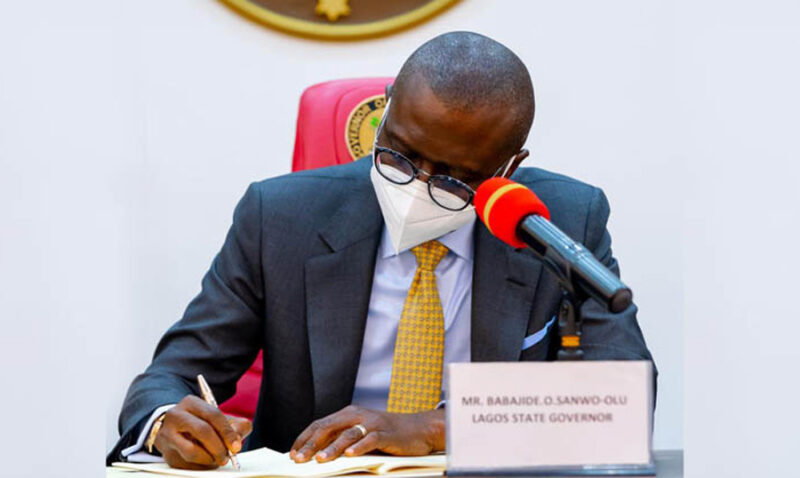
Sanwo-Olu orders demolition of 2-storey building, sealing of others in Banana Island
Lagos State Governor, Babajide Sanwo-Olu, has ordered the immediate demolition of a two-storey-building located on 310 Close, in Banana Island, Ikoyi, as well as sealing of other buildings in the area.
Sanwo-Olu, however, blamed the collapse of the earlier seven-storey-building on First Avenue, in Banana Island on what he called “reckless” operations of some developers hiding under the pretext of Federal Government agencies issuing building approvals for unsuspecting property owners.
Sanwo-Olu made the remark on Saturday, when he led a delegation of government officials for an on-the-spot accessment of the area, describing the situation as “irresponsible and unacceptable.”
Sanwo-Olu was conducted round the inspection tour by the Commissioner for Physical Planning and Urban Development, Tayo Bamigbose-Martin, Commissioner for Information and Strategy, Gbenga Omotoso, General Manager, Lagos State Building Control Agency, LABSCA, Gbolahan Oki, and other engineers.
The governor gave the demolition order while inspecting the building at 310 Close for construction without appropriate approval, while ordering the sealing of others over various infractions.
The governor also inspected an ongoing two storey building located at 303 Close which is being constructed under high tension wire.
READ ALSO:
“Like it has been reported before now, there has been a lot of investigation that is going on right now and you can see that they are still clearing the rubbles at the site.
“We have given an order to stop work, not only at this site but also in all of the construction sites in banana Island.
“I think that the exercise we are doing today is not really just about this location.
“You have all seen the extent of what I will call unapproved extension into the water. You can see that the original line for Banana Island is even not where we are.
“It’s way in front there and you can see that there are several extensions that have been granted by both the Federal Ministry of Work and Housing. These are the two federal agencies that have been culpable for those extensions.
“They have done these extensions even without our knowledge. We have the responsibility for building approvals and the rest of these.
“From what I have been told, all of the four buildings at the back have never even applied for approvals.
“The legality is real and so that is why we are going round other properties in Banana Island.
“Excuses have been given that they don’t have access and this is not acceptable. This is total recklessness of all of the developers and we will make a strong point out of this place and all around Banana Island and in other developments that we have.
“The officers that will also be similarly found culpable will also be sanctioned, if any.
7-man c’ttee
“But what we are doing right now is to set up external seven man committee. We are giving the people two weeks to independently also ascertain what has gone wrong there.
“So they should finish their work maybe towards the end of next week or thereafter.
“And so, this will also further strengthen our hand to be able to also come up with a robust work plan that we can enforce going forward.
“In all of these places, it’s heart breaking each time we have to go through these and it shows sometimes how irresponsible those developers and some of our citizens that just want to make quick money.
“And of course our own officers who are also not alive to their responsibilities.
“We have had to change staff here and there so that we can bring forward a robost and very strong monitoring offices.
“But we believe that we are still far from, we are still short on it I must say. And we will continue to do what we need to do to ensure that we keep the lives of our residents safe at all times.
“We are going round to inspect other properties in this area.”
Vanguard


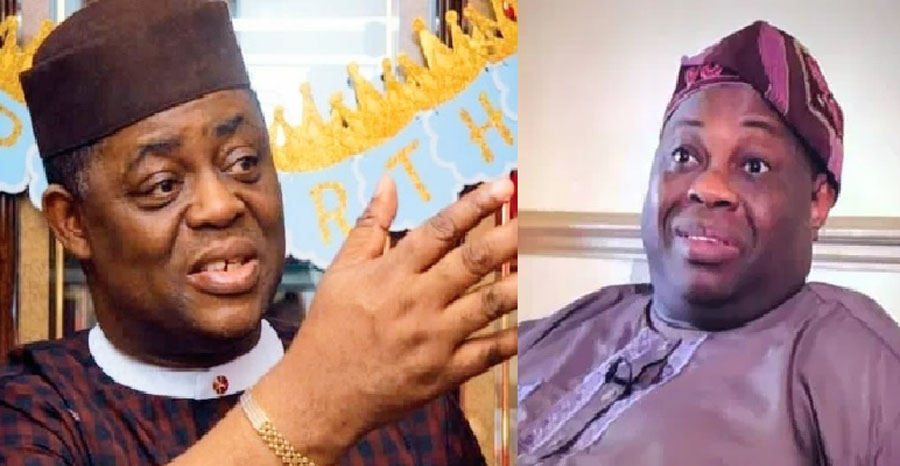
Fani-Kayode, Dele Momodu Trade Fresh Insults in Escalating Social Media Feud
A renewed war of words has broken out between former Aviation Minister Femi Fani-Kayode and veteran journalist and former presidential candidate Dele Momodu, with both men exchanging strong personal remarks on social media over political differences and past grievances.
The latest exchange began after Fani-Kayode responded to comments attributed to Momodu on Facebook, where he accused the media entrepreneur of acting as a political “sidekick” to former Vice President Atiku Abubakar. He also described Momodu in harsh personal terms, intensifying a rivalry that has played out publicly over the years.
In his remarks, Fani-Kayode dismissed Momodu’s political relevance and career trajectory, while also claiming he remains actively engaged in national affairs, referencing ongoing diplomatic engagements involving President Bola Ahmed Tinubu as evidence of his continued influence.
Momodu fired back via his X (formerly Twitter) account, characterising Fani-Kayode as a “wasted investment” and criticising what he described as a pattern of aggressive public behaviour. He argued that despite Fani-Kayode’s elite academic background, including studies at Cambridge University, his conduct in public discourse has remained controversial and confrontational.
READ ALSO:
Momodu further suggested that Fani-Kayode’s temperament changes when out of political power, describing his behaviour as inconsistent with expectations of public figures and urging a more reflective approach.
The exchange quickly gained traction across social media platforms, with users reacting to the tone and content of the remarks. Supporters of both figures amplified the debate, turning the disagreement into a trending topic and adding to the visibility of the feud.
This is not the first public clash between the two personalities, who have long occupied opposing positions in Nigeria’s political and media space. Their disagreements have often centred on political alignment, public commentary, and mutual criticism over the years.
Observers note that such exchanges reflect a broader trend of personalised political discourse in Nigeria, where disagreements between public figures frequently spill over into social media confrontations rather than formal political debates.
The latest confrontation has drawn mixed reactions, with some commentators expressing concern over the use of derogatory language by high-profile figures, while others view the exchange as part of the increasingly unfiltered nature of online political communication.
Analysts suggest that while such disputes may generate engagement online, they also risk overshadowing substantive policy discussions and contributing to heightened political polarisation.
As of the time of reporting, neither party has indicated a willingness to de-escalate, with both maintaining their positions in the ongoing public spat.
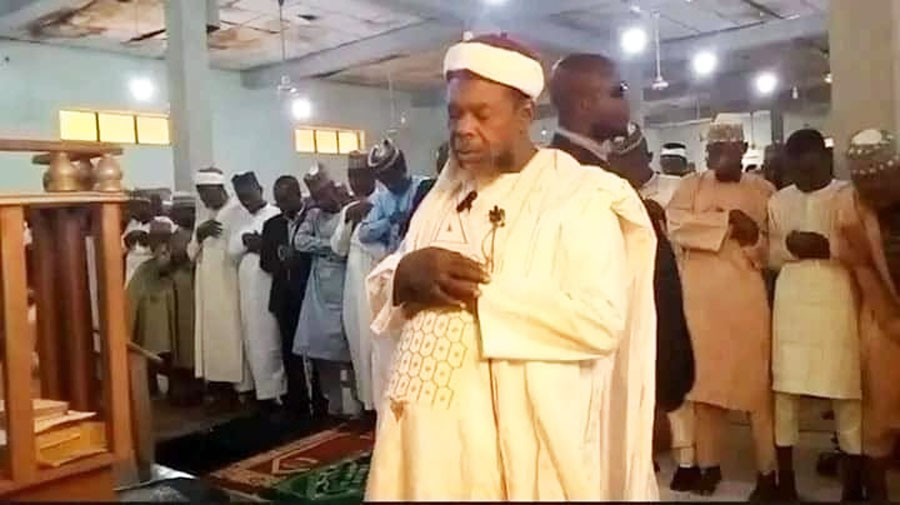
Sokoto Cleric Defies Sultan, Holds Eid al-Fitr Prayer Over Moon Sighting Dispute
A Sokoto-based Islamic scholar, Musa Lukuwa, has sparked fresh controversy after leading his followers in Eid al-Fitr prayers on Thursday, defying the official directive of the Sultan of Sokoto, Saad Abubakar, who declared Friday as the nationwide date for the celebration.
The cleric conducted the Eid prayer at his mosque in Mabera, a community in Sokoto, around 9:10 a.m., with a large turnout of worshippers who aligned with his position on the moon sighting marking the end of Ramadan.
The Sultan, who doubles as President-General of the Nigerian Supreme Council for Islamic Affairs (NSCIA), had earlier announced that the Shawwal crescent moon was not sighted anywhere in Nigeria. Based on this, Muslims across the country were instructed to complete 30 days of fasting, with Eid al-Fitr scheduled for Friday.
However, Lukuwa rejected the declaration, insisting that credible reports confirmed the moon had been sighted in neighbouring Niger Republic. According to him, geographical proximity and the reliability of those reports justified celebrating Eid earlier.
READ ALSO:
“Niger Republic is very close to us—about 100 kilometres away. If we accept reports from cities like Kano or even Lagos, which are farther away, there is no reason to reject confirmed sightings from a neighbouring country,” he stated.
The cleric emphasised that his decision was based on Islamic teachings rather than a challenge to the Sultan’s authority. He noted that while his group typically follows the Sultan’s guidance on the start and end of Ramadan, verified moon sightings must take precedence.
Lukuwa also cited historical precedents, referencing respected Islamic scholar Abubakar Mahmoud Gummi, who played a key role in moon sighting declarations before the process was centralised under the Sultan to promote unity among Muslims.
Reports indicate that Lukuwa informed his followers about the reported moon sighting around midnight and directed them to assemble for prayers the next morning. This marks another instance where the cleric and his congregation have diverged from the Sultan’s official position on Eid celebrations, reflecting ongoing debates over moon sighting practices in Nigeria.
The development highlights broader differences in Islamic jurisprudence regarding whether to rely solely on local moon sightings or accept verified reports from nearby countries. Religious authorities, including the NSCIA, have repeatedly stressed the importance of unity and adherence to centralised announcements to avoid division during major Islamic festivals.
Despite the disagreement, there have been no reports of unrest, and the majority of Nigerian Muslims are expected to observe Eid al-Fitr on Friday in line with the Sultan’s directive.

Sham Marriage, Tax Fraud: Kazeem Faces Denaturalisation in US
The administration of Donald Trump has initiated moves to denaturalise Nigerian-born Oluwatosin Kazeem, convicted of orchestrating a $12 million tax fraud scheme, despite a sentence commutation previously granted by Joe Biden.
The United States Department of Justice is seeking to revoke Kazeem’s U.S. citizenship, arguing that it was obtained through fraud, deception, and sham marriages.
Kazeem was investigated, tried, and convicted between 2015 and 2017, before being sentenced to 15 years imprisonment in June 2018 by a U.S. District Court in Baltimore, Maryland. However, his sentence was commuted to six years in December 2024, a move that reduced his jail term but did not erase his conviction.
According to U.S. prosecutors, Kazeem ran a large-scale identity theft and tax fraud operation, using stolen personal data of thousands of Americans to file fraudulent tax returns.
READ ALSO:
Investigations by the Internal Revenue Service (IRS) revealed that:
The case first came to light in 2013 after an Oregon couple reported that fraudulent tax returns were filed using their personal information, triggering a federal probe that exposed the wider scheme.
Authorities said Kazeem also trained accomplices, including his younger brother, on how to exploit stolen personal identifiable information (PII) to bypass IRS security systems.
Further investigations uncovered that Kazeem laundered proceeds of the fraud into assets in both the United States and Nigeria, including:
In an attempt to evade authorities, he allegedly transferred ownership of properties to his sister in Nigeria, but was arrested shortly after and later convicted on 19 counts, including mail fraud, wire fraud, aggravated identity theft, and conspiracy.
In addition to financial crimes, the Justice Department said Kazeem entered into sham marriages with two U.S. citizens solely to obtain permanent residency and eventual citizenship — a key factor now being used to justify his denaturalisation.
“U.S. citizenship is a privilege, and we will continue to ask courts to revoke a status that was obtained through fraud and deceit,” said Brett A. Shumate.
Legal analysts note that while Biden’s commutation reduced Kazeem’s prison sentence, it does not prevent civil proceedings such as denaturalisation or possible deportation.
If the court grants the request, Kazeem could lose his citizenship and face removal from the United States after completing his sentence.
The case highlights a broader push by the Trump administration to tighten enforcement against immigration fraud and financial crimes, particularly involving individuals who obtained citizenship under false pretences.



Just In: Federal Govt Announces Public Holidays for Eid-el-Fitr

Eid‑el‑Fitr in Nigeria Confirmed for Friday, March 20, 2026


BREAKING: Eid-el-Fitr Date Confirmed in Saudi Arabia, Nigeria Awaits Sultan’s Decision


Zakatul Fitr: Rules, Amount, Timing and Distribution Before Eid al-Fitr


Maiduguri Bombings: Shocking Trump–Tinubu Claim Goes Viral — Fact or Fabrication?


Court Confirms Nigerians’ Right to Record Police During Stop-and-Search Operations


CAF strips Senegal of AFCON title, Morocco declared winners

Fani-Kayode Slams Dele Momodu for Comparing Tinubu to Abacha