
Opinion
Tinubu: The Crowning of the Spiderman

Tinubu: The Crowning of the Spiderman
Tunde Odesola
(Published in The PUNCH, on Friday, June 2, 2023)
From football to jollof rice, and other sundry striving like music and acting, I love the healthy rivalry between Nigeria and Ghana. But truly, Ghanaians know which is the giant of the two countries just as Nigerians know that the tattered singlet of Musa at the gate is worthier that the starched khaki of the brain-lazy, woebegone retired Major-General.
Though farther than Benin Republic, Togo, Niger and Cameroon in terms of geography, Ghana is closer to Nigeria in terms of shared experience and colonial language.
“Imagination is better than knowledge,” I agree with this wisdom of Einstein, who expatiates that, “Knowledge is limited to what we know and understand, while imagination embraces the entire world, and all there will ever be to know and understand.”
Through the trickery of the Tortoise, Nigerian folklore imagines connectivity between the dead and the living, weaving together a world of equality, freedom and dignity, where intelligence trumps force.
Similarly, Ghanaian mythology imagines the world through the labyrinth of the silk-spinning Spider, whose squishy body contrasts with the carapace of the Tortoise but both creatures’ legends secure a place for the weak in the society.
However, comeuppance awaits the Tortoise or the Spider whenever either wishes to take advantage of the vulnerable through wit and cunning.
READ ALSO:
- Indefinite Strike: JOHESU insists on pharmacists consultant cadre
- EFCC boss wins SERVICOM award for quality service
- We have no plan to embark on strike over fuel subsidy removal – NLC
In the worldview of African forebears, before things fell apart, intelligence always triumphs whenever brute force runs naked, making the Yoruba say, “Ogbon ju agbara lo,” wisdom is greater than power.”
The story of former President Muhammadu Buhari and incumbent President Bola Tinubu is similar to the Ghanaian myth about Nyame and Anansi.
Anansi is a spider who wants to be the owner of all the stories known in the world, but all stories belong to Nyame, the sky god. Anansi tells Nyame of his wish to buy all the stories from him but Nyame tells the spider the price is unaffordable.
When Anansi insists, Nyame attempts to outfox him, saying Anansi could have all the stories of the world if he could capture the four most dangerous creatures in the world. An excited Anansi assures Nyame that he would capture all the four creatures, and even offers his own mother, Ya Nsia, to boot!
The four creatures include Onini, the python; Osebo, the leopard; Mmoatia, the Fairy; and a hive of Mmoboro Hornets.
Anansi has a beautiful wife, Aso, who is super cunning, and whom he listens to. With his wife’s advice, Anansi beguiles all four creatures, one after the other.
To capture Onini, his wife devises a plan, and they both set out for the brook where Onini lives. There, they began to argue loudly about Onini’s length. Onini comes out and Anansi tells him about their argument.
Onini brooks no contest with the majesty of its length, it quickly stretches out beside the branch which Anansi brought with him. To get an accurate measurement of Onini, Anansi advises that one end of the python be tied to the palm tree branch while the other end should be tied against the other end of the tree branch.
After tying the head of the snake to the branch, it was easy to persuade the snake to have its tail tied to the other end of the stick. And the python became more vulnerable than a sitting duck.
To capture the leopard, Anansi digs a hole in the ground along the path which Osebo treads, covering it up with brushwood. Returning home after dark, Osebo falls into the pit. Anansi, the Good Samaritan, offers to get Osebo out of the hole through his web. But when the leopard got out of the hole, he remained a prisoner in Anansi’s web and was subsequently carried to Nyame’s palace.
The spider entraps the Mmoatia Fairy by making a doll covered in glue and placing it in the prairie where the fairy plays. She sees the doll and gets attracted to it, touches it with both hands and becomes glued.
READ ALSO:
- We were forced to sign election result sheets, Atiku, PDP’s witness tells tribunal
- Tinubu warns service chiefs against working at cross purposes
- Elon Musk dethrones French multi-billionaire, reclaims his position as the world’s richest man
Anansi lures the Mmoboro hornets into his gourd by pouring water on himself and telling the hornets that a dangerous rain that had beaten him in another community, was fast approaching. He advises them to get into his gourd for safety. They obliged and became Anansi’s victims.
The Spider goes to Ya Nsia, his mother, and reminds her about the promise he made to the Sky god. Ya Nsia agrees to go with Anansi to Nyame.
Boxed in by the Spider’s achievements, Nyame summons the elders and his army, tells them about Anansi’s conquests, which no one else or kingdom could do, and thus pledges all stories to Anansi, the Spider. So, every story became known as a Spider story.
I’m almost sure scaling the hurdles wouldn’t have been smooth sailing for Anansi. There might have been moments of despair and frustration when he angrily shouted, “E gbe awon stories yi wa, EMI LOKAN!”
Unlike the world of Buhari and Tinubu, the world of Anansi was a law-abiding world, where crime was punished, and virtue rewarded.
It was a world, where the elephant, though mighty, couldn’t usurp the rights of the ant, and the lion, despite being the king of the jungle, dared not take what didn’t belong to him.
It was a world that would ‘open the calabash’ of death to a brainless, callous and nepotistic king who recently plundered the land for eight years of misgovernance – just like they ‘opened the calabash’ for wicked kings in the old Oyo Empire.
In the olden days when the Tortoise and the Spider counted among the wise men, people voted without let or hindrance, and their votes counted. The electoral umpire, even if it was the glasses-wearing YAK, dared not fail to upload the results of the presidential election as ARTICUlated in the electoral law.
During the days of the fabled Tortoise and the Spider, Umpire YAK dared not cause disaffection within the polity, as he did yesterday, without being summoned to the king’s palace, and bagging an outright banishment to the Evil Forest or the severance of his head from his neck at Imogun, the Place of Skulls.
If Yak followed the electoral process through, the Articulate and the Obidients would probably not go to the Court of Judges to lay their grievances over why the Bat was crowned the king without announcing his victory through the Kakaaki, as required by the law of the land.
Things have turned upside down today. Thorns have grown on the throne in Ife, and the king can no longer sit on the stool of his forebears but go about looking for plastic chairs in Owambe parties, allowing Pete, Tom, Dick and Harry to hug him.
In those days of the Tortoise and the Spider, when the blind Baba Fakunle predicted in Ola Rotimi’s ‘The gods are not to blame’, that King Odewale would marry his mother and kill his father, it came to pass.
Today, Christian and Muslim clerics have turned the church and the mosque into casinos, where forecasts are churned out like locusts in flight, with none coming to pass.
A cleric predicted that he was the incoming President Number 16 and that Buhari would hand over to him. Another one warned witches and wizards not to come to Abuja – as if witches and wizards ever amounted to anything or as if they are the problems of Nigeria.
Many Nigerian pastors and imams are fake men of God who brag about power over all infirmities but none has ever cured either a cough or a headache, not to talk of HIV/AIDS or COVID-19.
The removal of petroleum subsidy is a step in the right direction but the President must not behave like the Tortoise who got all the wisdom of the world in a gourd, which he tied to his neck, without knowing how to get the gourd to the top of a tree. Tinubu must exhibit cleverness and be be prepared to go to war against the oil cabal.
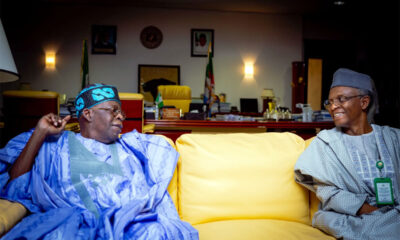
Online reactions trailed the presence of President Tinubu’s wife, Remi, for being present at an official meeting the president held with some officials on Wednesday.
Did Aso, the wife of Anansi, not help her Spider husband solve his riddles? If you don’t know the meaning of presidential monarchy, go to court.
Email: tundeodes2003@yahoo.com
Facebook: @Tunde Odesola
Twitter: @tunde_odesola








Opinion
Oshiomhole: Behold the 13th disciple of Christ

Oshiomhole: Behold the 13th disciple of Christ
Opinion
AFCON 2025: Flipping Content Creation From Coverage to Strategy

AFCON 2025: Flipping Content Creation From Coverage to Strategy
By Toluwalope Shodunke
The beautiful and enchanting butterfly called the Africa Cup of Nations (AFCON) emerged from its chrysalis in Khartoum, Sudan, under the presidency of Abdelaziz Abdallah Salem, an Egyptian, with three countries—Egypt, Sudan, and Ethiopia—participating, and Egypt emerging as the eventual winner.
The reason for this limited participation is not far-fetched. At the time, only nine African countries were independent. The remaining 45 countries that now make up CAF’s 54 member nations were either pushing Queen Elizabeth’s dogsled made unique with the Union Jack, making supplications at the Eiffel Tower, or knocking at the doors of the Palácio de Belém, the Quirinal Palace, and the Royal Palace of Brussels—seeking the mercies of their colonial masters who, without regard for cultures, sub-cultures, or primordial affinities, divided Africa among the colonial gods.
From then until now, CAF has had seven presidents, including Patrice Motsepe, who was elected as the seventh president in 2021. With more countries gaining independence and under various CAF leaderships, AFCON has undergone several reforms—transforming from a “backyard event” involving only three nations into competitions featuring 8, 16, and now 24 teams. It has evolved into a global spectacle consumed by millions worldwide.
Looking back, I can trace my personal connection to AFCON to table soccer, which I played alone on concrete in our balcony at Olafimihan Street—between Mushin and Ilasamaja—adjacent to Alafia Oluwa Primary School, close to Alfa Nda and Akanro Street, all in Lagos State.
Zygmunt Bauman, the Polish-British sociologist who developed the concept of “liquid modernity,” argues that the world is in constant flux rather than static, among other themes in his revelatory works.
For the benefit of Millennials (Generation Y) and Generation Z—who are accustomed to high-tech pads, iPhones, AI technologies, and chat boxes—table soccer is a replica of football played with bottle corks (often from carbonated drinks or beer) as players, cassette hubs as the ball, and “Bic” biro covers for engagement. The game can be played by two people, each controlling eleven players.
I, however, enjoyed playing alone in a secluded area, running my own commentary like the great Ernest Okonkwo, Yinka Craig, and Fabio Lanipekun, who are all late. At the time, I knew next to nothing about the Africa Cup of Nations. Yet, I named my cork players after Nigerian legends such as Segun Odegbami, Godwin Odiye, Aloysius Atuegbu, Tunji Banjo, Muda Lawal, Felix Owolabi, and Adokiye Amiesimaka, among others, as I must have taken to heart their names from commentary and utterances of my uncles resulting from sporadic and wild celebrations of Nigeria winning the Cup of Nations on home soil for the first time.
While my connection to AFCON remained somewhat ephemeral until Libya 1982, my AFCON anecdotes became deeply rooted in Abidjan 1984, where Cameroon defeated Nigeria 3–1. The name Théophile Abéga was etched into my youthful memory.
Even as I write this, I remember the silence that enveloped our compound after the final whistle.
It felt similar to how Ukrainians experienced the Battle of Mariupol against Russia—where resolute resistance eventually succumbed to overwhelming force.
The Indomitable Lions were better and superior in every aspect. The lion not only caged the Eagles, they cooked pepper soup with the Green Eagles.
In Maroc ’88, I again tasted defeat with the Green Eagles (now Super Eagles), coached by the German Manfred Höner. Players like Henry Nwosu, Stephen Keshi, Sunday Eboigbe, Bright Omolara, Rashidi Yekini, Austin Eguavoen, Peter Rufai, Folorunsho Okenla, Ademola Adeshina, Yisa Sofoluwe, and others featured prominently. A beautiful goal by Henry Nwosu—then a diminutive ACB Lagos player—was controversially disallowed.
This sparked outrage among Nigerians, many of whom believed the referee acted under the influence of Issa Hayatou, the Cameroonian who served as CAF president from 1988 to 2017.
This stroll down memory lane illustrates that controversy and allegations of biased officiating have long been part of AFCON’s history.
The 2025 Africa Cup of Nations in Morocco, held from December 21, 2025, to January 18, 2026, will be discussed for a long time by football historians, raconteurs, and aficionados—for both positive and negative reasons.
These include Morocco’s world-class facilities, the ravenous hunger of ball boys and players (superstars included) for the towels of opposing goalkeepers—popularly dubbed TowelGate—allegations of biased officiating, strained relations among Arab African nations (Egypt, Algeria, Tunisia, and Morocco), CAF President Patrice Motsepe’s curt “keep quiet” response to veteran journalist Osasu Obayiuwana regarding the proposed four-year AFCON cycle post-2028, and the “Oga Patapata” incident, where Senegalese players walked off the pitch after a legitimate goal was chalked off and a penalty awarded against them by DR Congo referee Jean-Jacques Ndala.
While these narratives dominated global discourse, another critical issue—less prominent but equally important—emerged within Nigeria’s media and content-creation landscape.
Following Nigeria’s qualification from the group stage, the Super Eagles were scheduled to face Mozambique in the Round of 16. Between January 1 and January 3, Coach Eric Chelle instituted closed-door training sessions, denying journalists and content creators access, with media interaction limited to pre-match press conferences.
According to Chelle, the knockout stage demanded “maximum concentration,” and privacy was necessary to protect players from distractions.
This decision sparked mixed reactions on social media.
Twitter user @QualityQuadry wrote:
“What Eric Chelle is doing to journalists is bad.
Journalists were subjected to a media parley under cold weather in an open field for the first time in Super Eagles history.
Journalists were beaten by rain because Chelle doesn’t want journalists around the camp.
Locking down training sessions for three days is unprofessional.
I wish him well against Mozambique.”
Another user, @PoojaMedia, stated:
“Again, Eric Chelle has closed the Super Eagles’ training today.
That means journalists in Morocco won’t have access to the team for three straight days ahead of the Round of 16.
This is serious and sad for journalists who spent millions to get content around the team.
We move.”
Conversely, @sportsdokitor wrote:
“I’m not Eric Chelle’s biggest supporter, but on this issue, I support him 110%.
There’s a time to speak and a time to train.
Let the boys focus on why they’re in Morocco—they’re not here for your content creation.”
From these three tweets, one can see accessibility being clothed in beautiful garments. Two of the tweets suggest that there is only one way to get to the zenith of Mount Kilimanjaro, when indeed there are many routes—if we think within the box, not outside the box as we’ve not exhausted the content inside the box.
In the past, when the economy was buoyant, media organisations sponsored reporters to cover the World Cup, Olympics, Commonwealth Games, and other international competitions.
Today, with financial pressures mounting, many journalists and content creators seek collaborations and sponsorships from corporations and tech startups to cover sporting events, who in turn get awareness, brand visibility, and other intangibles.
As Gary Vaynerchuk famously said, “Every company is a media company.” Yet most creators covering AFCON 2025 followed the same playbook.
At AFCON 2025, most Nigerian journalists and content creators pitched similar offerings: on-the-ground coverage, press conferences, team updates, behind-the-scenes footage, analysis, cuisine, fan interactions, and Moroccan cultural experiences.
If they were not interviewing Victor Osimhen, they were showcasing the stand-up comedy talents of Samuel Chukwueze and other forms of entertainment.
What was missing was differentiation. No clear Unique Selling Proposition (USP). The result was generic, repetitive content with little strategic distinction. Everyone appeared to be deploying the same “Jab, Jab, Jab, Hook” formula—throwing multiple jabs of access-driven content in the hope that one hook would land.
The lesson is simple: when everyone is jabbing the same way, the hook becomes predictable and loses its power.
As J. P. Clark wrote in the poem “The Casualties”, “We are all casualties,” casualties of sameness—content without differentiation. The audience consumes shallow content, sponsors lose return on investment, and creators return home bearing the “weight of paper” from disappointed benefactors.
On November 23, 1963, a shining light was dimmed in America when President John F. Kennedy was assassinated.
As with AFCON today, media organisations sent their best hands to cover the funeral, as the who’s who of the planet—and if possible, the stratosphere—would attend. Unconfirmed reports suggested that over 220 VVIPs were expected.
While every newspaper, radio, and television station covered the spectacle and grandeur of the event, one man, Jimmy Breslin, swam against the tide. He chose instead to interview Clifton Pollard, the foreman of gravediggers at Arlington National Cemetery—the man who dug John F. Kennedy’s grave.
This act of upended thinking differentiated Jimmy Breslin from the odds and sods, and he went on to win the Pulitzer Prize in 1986.
Until journalists and content creators stop following the motley and begin swimming against the tide, access will continue to be treated as king—when in reality, differentiation, aided by strategy, is king.
When every journalist and content creator is using Gary Vaynerchuk’s “Jab, Jab, Jab, Hook” template while covering major sporting events, thinkers among them must learn to replace one jab with a counterpunch—and a bit of head movement—to stay ahead of the herd.
Toluwalope Shodunke can be reached via tolushodunke@yahoo.com
Opinion
“Christian Genocidization” of the Kaiama massacre, By Farooq Kperogi

“Christian Genocidization” of the Kaiama massacre, By Farooq Kperogi
“Christian Genocidization” of the Kaiama massacre, By Farooq Kperogi
Kperogi is a renowned Nigerian columnist and United States-based professor of Journalism

-

 metro2 days ago
IKEDC Sets Feb 20 Deadline for Customers to Submit Valid IDs or Face Disconnection
-

 Education2 days ago
Supreme Court Affirms Muslim Students’ Right to Worship at Rivers State University
-

 metro23 hours ago
Lagos Police Launch Manhunt for Suspect in Brutal Ajah Murder
-

 Business3 days ago
Dangote Refinery Slashes Petrol Price to ₦774, Ends PMS Bonus Window
-

 News23 hours ago
Aso Rock Goes Solar as Tinubu Orders National Grid Disconnection
-

 Business2 days ago
Naira Could Trade Below ₦1,000/$ With Dangote Refinery at Full Capacity — Otedola
-
 metro3 days ago
Kwara, Katsina Bloodshed: TMC Condemns Attacks, Dismisses ‘Jihadist Preacher’ Claims
-

 metro2 days ago
Army University Professor Dies in Boko Haram Captivity After Nearly One Year