Oshiomhole: Behold the 13th disciple of Christ - Newstrends
Connect with us

Opinion

Oshiomhole: Behold the 13th disciple of Christ
Published

on

Tunde Odesola
Oshiomhole: Behold the 13th disciple of Christ
Tunde Odesola
(Published in The PUNCH, on Friday, February 13, 2026)
Friday, February, 13, 1976: A libidinous soldier, Lieutenant-Colonel Buka Suka Dimka, waited in ambush for a black Mercedes-Benz, counting down to the zero hour, caressing his gun, ready for the whistle from death. Dimka was not alone. He was in company with fellow coupists and treasonable felons.
Today, Friday, February 13, 2026, marks exactly 50 years since assassin bullets pierced the unarmoured body of the black Benz to pierce the body of the Nigerian Head of State, General Murtala Ramat Muhammed, seated at the back of his official car, snaking its way through Lagos traffic. That was a period when Nigerian Heads of State commuted in just one official car; no convoy, no siren, no madness.
It was a death most gruesome for the 37-year-old General, bubbling with life by 8a.m, stone-dead by nine. His aide-de-camp, Lieutenant Akintunde Akinsehinwa, and driver, Sergeant Adamu Michika, were killed in the Dimka-led ambush on George Road, Ikoyi, Lagos, en route to their Dodan Barracks place of work.
The gunshots pumped into Murtala were still echoing when the coup bit the dust. His body had not gone cold when federal forces rose to quench the coup. Dimka’s comrades-in-harms, Minister of Defence, Major-General I.D. Bisalla; the first military Governor of defunct Benue-Plateau State, police commissioner Joseph Gomwalk; Major Ibrahim Rabo, Captain M. Parvwang, Lieutenant William Seri, and 32 others were rounded up, tried, tied to the stakes and shot. An eye for an eye. A bullet for a bullet.
But Dimka fled Lagos, the scene of his crime, and headed to the East, his newfound refuge, to live in subterfuge. To book hotel accommodation, Dimka shed his lieutenant-colonel khaki and wore the garb of a faceless Mr C Godwin. If Dimka could kill Murtala on the eve of Valentine’s Day, only God knows what he did on Lovers’ Day, as he was caught on May 5, 1976, with a prostitute in Afikpo at a police checkpoint when fleeing to Cameroon.
Before escaping through the toilet window when he suspected police presence, Dimka holed up at Friendship Hotel, smoking, drinking and cooling his hot blood off in the bosom and thighs of luscious daughters of Eve. Cold blood needs warm blood.
READ ALSO:
What kind of man would kill on the eve of Valentine’s Day and cuddle Eves on Valentine’s Day? Ha! Dimka got balls. Some men do. What must have been going through Dimka’s mind, watching and listening to reports of his coup and his manhunt, while he sipped beer and kissed and caressed? Daylight coldbloodedness.
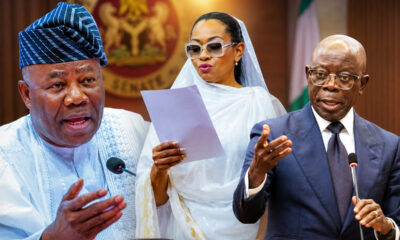
On February 3, 2026, as the alleged dalliance of the representative of Edo-North senatorial district in the National Assembly, Senator Adams Aliyu Oshiomhole, shook the internet, I hissed at the ignorance of Nigerians who rose in anger, calling for his head.
I hissed because a lot of those stomping on social media streets against Osho Baba are hypocrites ready to trade places with the husband of Lara Fuentes, the Cape Verdean model he married in 2015 after the death of his beautiful wife, Clara, who led him to Christ, and purportedly adopted a Christian name, Eric, upon conversion. Sadly, Clara lost a battle with breast cancer in 2010, aged 54.
Oshiomhole is a man of moral rhymes. From Clara in 2010 to Lara in 2015, there was a period of five long years. So, the born-again Eric waited five long years before looking another woman in the eye. That was honour. That was respect. That was fidelity. How many Nigerian men can wait that long? How many Nigerian septuagenarians are as hot as the ex-defender of the masses? How many possess his handsome looks? How many possess his fit and proper body? When you see Oshiomhole in the gym, you will know he is on a mission.
Dimka dimmed the light of Nigeria’s governance in 1976, throwing the nation into darkness. Despite all of the manhunt and national uproar against his action, however, he remained ensconced in carnal cares, nourishing his whims and the stiffness of his phallus. Some other leaders wouldn’t make it out of Lagos, let alone go as far as Afikpo. But Dimka did with aplomb. That was the hallmark of grit and greatness, something missing in today’s Nigerian leadership.
Although Osho Baba has come out to rebut the viral video displaying his image massaging the foot of a South African goddess, ‘adult content creator’ and ‘professional sugar baby’, Lashaan Dagama, I would have advised against such a move because I know some nosy Nigerians would run veracity checks on the controversial 30-second video.
READ ALSO:
Here’s the finding of an online newspaper, The Whistler, which deployed multiple deepfake detection tools to determine the authenticity of the love-in-the-air video shot aboard a luxury aircraft thousands of feet above a grounded country, whose citizens grope in darkness on empty stomachs amid worsening insecurity. The tools deployed by The Whistler included Deepware Scanner, Zhuque AI Detection Assistant, AU Video Detector, Sight Engine, and Hive AI Deepfake Detection.
The Whistler did a story on its multiple checks. Please, read: “These tools analysed for visual artefacts (such as hand/finger inconsistencies, lip-sync mismatch, unnatural facial blending, or lighting errors), audio patterns, metadata inconsistencies, and provenance signals.
“The scans showed no detectable hallmarks of generative AI manipulation, with high confidence scores indicating the video is authentic footage rather than synthetically created or significantly altered by current AI video generation methods.”
The report returned with a verdict which dismissed Oshiomhole’s AI claim as false, stressing that “the claim that the video is AI-generated lacks supporting evidence and is contradicted by the woman’s public response implying the event occurred, the absence of detectable AI artefacts in the clip, and results from deepfake detection tools confirmed no signs of AI generation or manipulation.”
Do not compare Dimka with Oshiomhole, please; one is a soldier, the other is a democrat. One is a killer, the other is a caresser. One gripped the trigger; the other groped a foot. One exfoliated life; the other moisturised it. Please, do not compare apples with oranges.
But the coping mechanism and survival strategy of Dimka is a lesson in military adaptability, just as Oshiomhole’s transfiguration should be a topic of interest to students of Nigerian politics. Adams transmutation from a poor background in Iyamho, near Auchi, working as a textile hand, joining textile politics before emerging as the President, Nigeria Labour Congress, demanded great coping capacity, courage and consistency.
In February 1999, Oshiomhole rose to labour peak at the dawn of Nigeria’s Fourth Republic, leading the NLC to national greatness and acceptability, organising government-shaking rallies to protest lack of electricity, fuel price hike, rising food costs, and harsh economic policies – all on behalf of an applauding masses. By the time he completed two terms in 2007, Oshiomhole had done more than enough to engrave himself in the hearts of Nigerians who spread palm fronds on the ground for the donkey-riding Messiah on his way to the Edo State Government House.
READ ALSO:
Even while he was Governor of Osun State between 1999 and 2003, the Baba Isale of the All Progressives Congress, Chief Bisi Akande, had called Oshiomhole names when labour idealism looked politics in the eye. Since crossing over to politics, however, Oshiomhole seems to have acquired 3D glasses which beautify ugly spectacles. He now dines at the same table with Akande, on whose face sits a plastered smile.
If I were in the inner caucus of Osho Baba, I would have told him to damn the naysayers and encouraged him to strut on the runway, exhibiting his 73-year-old masculinity, locking his hands up in a flex, like Mr Universe. I would have sincerely told him that the lovey-dovey Dagama video was a big opportunity to set Nigerian eyes ogling and tongues wagging, distracting the masses from the existential issues of poverty, insecurity, electricity, homelessness, waterlessness, healthlessness and schoollessness. I would have urged the Comrade to treat the foot massage issue like Sage Bola Tinubu described power, saying, “Osho Baba, a model as beautiful as Lashaan Dagama is not served a la carte, you should own her, fight for her, grab her, snatch her and run with her.”
Lady Dagama lives her life on online street. She knows the potential damage her silence on Oshiomhole’s disclaimer could do to her brand, hence her annoyance over the rebuttal was understandable. For an adult content creation business driven by flesh and personage, Osho Baba was a large fish caught by Dagama’s hook, so the attempt to wriggle off the hook made her burst out in frustration, “Your senator is the problem; go, be mad at him, not me.” She went a mile further to proclaim her truth, saying, “The video wasn’t AI, but okay, believe your senator,” when the former APC national chairman maintained the video was AI-generated.
For the multitude ignorantly calling for the head of Oshiomhole because he dedicated precious time and energy to Dagama’s beautiful foot, here are the Yoruba and the Jewish worldviews on foot. In their wisdom, the Yoruba say the head and the feet are interconnected. They affirm the interconnectivity in this proverb, “Ori wo ibo rere gbe mi ya, ese wo ibi rere gbe re.” Thus, it is the belief of the Yoruba that the head and the legs are capable of taking an individual to a fortunate or unfortunate place.
The Yoruba, they are never done; they also say, “Adiye kii ti ibi ese ku,” meaning: the chicken never dies from an injury to its feet.” This is why you never see a chicken walking on a prosthesis. No matter the severity of its leg injury, you will see the chicken hobbling on, at least, one foot, but certainly not with crutches. Oshiomhole understands Yoruba. He knows the curative powers of long, sexy legs. He knows. He knows. He knows.
READ ALSO:
The spartan-looking comrade emerged general secretary of the National Union of Textile Garment and Tailoring Workers of Nigeria in 1982, a time when over 450,000 textile workers ran the 180 mills across the country. Today, the mills have thinned down to about 20. I’m sure Oshiomhole cannot be happy with this shameful decline because he was at the helm of labour affairs when Nigeria was good, and he is at the corridor of power now that Nigeria is bad.
For a born-again Christian about to climb the 74th year on life’s almanac, Osho Baba reads his Bible diligently, fully aware this world is not his home, he’s just a pilgrim. Despite eyeing heaven, Oshiomhole is also as wise as the serpent and as gentle as a dove – two biblical injunctions necessary to dominate and conquer the earth. Oshiomhole is the serpent; he is also the dove. But he is only following biblical commandments.
Osho Baba worships God in deed and in truth. He believes in Jesus Christ as his personal lord and Saviour. The way he placed Dagama’s foot gently on his lap and anointed it with alabaster oil shows that he has read and missed nothing in the story of Jesus washing the feet of his disciples.
In ancient Jewish tradition, foot washing symbolises respect, honour, hospitality, service, purification and humiliation. Servants or juniors are expected to wash the feet of their masters or superiors. But Jesus changed the social order when he, the Master, washed the feet of his disciples, including the treacherous Judas Iscariot, to teach unconditional love. So, the former labour lion is punctual in church. He knows the feet-washing story, and he wants to go to heaven. So, what is wrong with him washing the feet of Dagama to fulfil all righteousness and earn a place in paradise?
Still talking Jewish tradition. A woman described as a sinner washed the feet of Jesus during a banquet. Some Bible scholars have come to identify her as Mary Magdalene, while some call her Mary of Bethany. The act is recorded in the Books of Luke 7:36-50 and John 12: 1-8. Here is St John’s version: “Then Mary took about a pint of pure nard, an expensive oil; she poured it on Jesus’ feet and wiped his feet with her hair. And the house was filled with the fragrance of the oil.” Mary washed Jesus’ feet with her tears, wiped them with her hair, kissed them, and anointed them with alabaster oil. Now, Nigerians who want to see Oshiomhole in paradise must tell him to produce the full, unedited, un-AI-ed version of his encounter with Dagama. They must ask if he washed, shed tears, kissed and anointed Dagama’s foot. Oshiomhole is bald; otherwise, I would have urged his teeming supporters to ask if he wiped Dagama’s foot with his hair.
And I did not see Dagama’s shoes on the floor. I wonder where she flung them. I had thought ‘bata’ was a Yoruba word for shoes. This was until I discovered that a Czechoslovakian footwear company, Bata Shoe Company, set foot in Nigeria in 1932. So, I looked up the history of Bata in the Czech Republic. Google dumped pages of history on my lap. It says, “In the Czech Republic, Bata is a renowned, historic brand of shoes and apparel founded in Zlín in 1894 by siblings Tomas, Antonín, and Anna Bata. Bata is considered a household name in the Czech Republic, synonymous with shoes.”
With its factory in Ojota, Lagos, Bata Shoe Factory was to later open retail outlets across the country. Where are Dagama’s shoes, Senator Oshiomhole? As you ponder providing an answer to this question, Your Excellency, permit me I ask another: as Chairman, Senate Committee on Interior, and a former general secretary of the National Union of Textile, Garment and Tailoring Workers of Nigeria, why is it difficult to establish a shoe-manufacturing company in the country?
I love you, Comrade-Senator. I love you with the love of God. I know you know the love of God is also called agape love. Being from humble beginnings like our Lord Jesus Christ, however, I wish to sing you a song by ghetto boy, Daddy Showkey. I’m sure you will remember the song, and you will love it.
“If you see Adamso, Hosanna
Tell am say o, Hosanna
I dey Igbajo, Hosanna
I no get problem, Hosanna
E get one women, Hosanna
Her name na Lashaan, Hosanna
Oh, Lashaan baby, Hosanna
Lashaan fine well, well, Hosanna
I say she fine well, well, Hosanna
Oh Lashaan baby, Hosanna
Adamso carry Lashaan, Hosanna
E put am for jet, Hosanna
E rub im leg o, Hosanna
E sweet am well-well, Hosanna
Naija pipu come vex, Hosanna
Dem vex for Adamu, Hosanna
Dem vex for Dagama, Hosanna
Dem vex for dem, Hosanna
Naija pipu ask Adamu, Hosanna
Why im kari woman, Hosanna
When Naija no smile, Hosanna
Adamu deny, Hosanna
Dagama come vex, Hosanna…
Facebook: @Tunde Odesola
X: @Tunde_Odesola

Oshiomhole: Behold the 13th disciple of Christ

Opinion

The world dislikes the weak, by Hakeem Baba-Ahmed

Published

on

Former Northern Elders Forum spokesperson, Hakeem Baba-Ahmed

The world dislikes the weak, by Hakeem Baba-Ahmed

The world dislikes the weak, by Hakeem Baba-Ahmed

Continue Reading

Opinion

Our children must be kept away from Obi’s mob

Published

on

Vincent Akanmode
Vincent Akanmode

Our children must be kept away from Obi’s mob

Any Nigerian with an iota of conscience would be miffed at the content of a video that trended on the social media during the week. It was the motion picture of three children whose age ranged between 10 and 12 professing to be supporters of former Anambra State governor and presidential candidate of the Labour Party (LP) in the 2023 presidential election, Mr. Peter Obi. Oblivious in their pristine innocence that they were being initiated into the triple crimes of lying, cheating and forgery by those who contrived the issuance of voter cards to them, they heartily flaunted the cards meant only for adults above 18 years, threatening to vote Obi in the 2027 elections like they did three years ago.

Instructively, it was Obi’s supporters, led by the then Chief Spokesperson for the Labour Party Presidential Campaign Council, Dr. Yunusa Tanko, who embarked on a peaceful protest in Abuja against alleged registration of underage voters in the build-up to the 2023 elections.

During the campaign rallies that preceded the 2023 elections, the world had watched with bated breath as a 15-year-old boy identified as Alabi Quadri jumped into the road arms outstretched as Obi’s convoy approached during a campaign rally in Lagos. I was personally alarmed at the stupidity of young man’s action, seeing the possibility of him being hit by the advancing convoy of vehicles. But while I thought it was the dumbest act anyone could muster, Obi, rather than rebuke Quadri’s foolery, alighted from his vehicle, walked towards the scallywag and embraced him in the full glare of cameras. Obviously, the Labour Party presidential candidate was in full agreement that the rascal did very well staking his life for his (Obi’s) presidential ambition.

READ ALSO:

Obi, who had earlier prided himself with not giving shishi (a dime), reportedly rewarded Quadri’s foolhardiness with an unspecified sum of money, which later put him into trouble with his colleagues and earned him a stay in Kirikiri prison for about three months after an alleged frame-up for armed robbery by some thugs in his Amukoko (Lagos) neighbourhood, who were said to be angry that Quadri did not deem them fit for a slice of Obi’s cake. They handed him over to the police, who kept him in custody until some human rights activists intervened and secured his release.

Not surprisingly, many other admirers of Obi celebrated Quadri’s display of obtuseness as a heroic act worthy of emulation by anyone worth the helm of the presidential aspirant’s black gown. Little wonder the teenager’s example has since caught on among his followers with other dumb actions and utterances. Last week, another youthful follower of the mob took the malady to the precincts of blasphemy, saying that Jesus Christ would lose if he contests an election with Obi in Nigeria. And rather than condemnation, this reckless delivery has enjoyed the approval of many Obidient members in a country where religion is as sensitive as the mimosa plant.

And before the dust generated by the sacrilegious utterance could settle, another teenager identified as Mc Aha from Imo State said he would gladly sacrifice his father and mother if that was all Obi needed to become the President of Nigeria. Commendably, the teenager’s obviously embarrassed father did not allow his son’s misguided utterance to go without a consequence. Convinced that the teenager’s outburst bordered more on crime than insanity, he ignored psychiatrists and psychologists and promptly handed his errant son over to the police.

I felt a sense of vindication on learning about the young man’s utterance, because a day or two earlier, I had been viciously attacked on Facebook for sarcastically posting that I once thought of becoming an Obidient but was discouraged by the long and tortuous process of having to undergo a surgery that would remove my brain and replace it with sawdust!

The question then arises: what exactly is the Obidient movement teaching our youths? What impact do Obi and his followers hope to make on the impressionable minds of innocent young boys and girls with the negative messages being passed to them by their mostly reckless, aggressive and abrasive older colleagues? A group that has turned discourtesy into an art. A group that has no place for the African culture of respect for the elder. A group to which age means nothing but sheer number. They address the elderly the same manner they do their apprentices and attack statesmen and eminent public office holders with the venom of a snake. A group whose leader is making a career of de-marketing his country and presenting his land of birth as the heaviest burden the rest of the world bears. What impact?

Our children must be kept away from Obi’s mob

Continue Reading

Opinion

History and psychoanalysis of El-Rufai’s troubles with Ribadu – Farooq Kperogi

Published

on

Kperogi is a renowned columnist and United States-based Professor of Journalism 
Farooq Kperogi

History and psychoanalysis of El-Rufai’s troubles with Ribadu – Farooq Kperogi

Given the depth and intensity of the friendship they cultivated over decades, many people are befuddled by why the personal conflict between former Kaduna State governor Nasir El-Rufai and National Security Adviser Nuhu Ribadu has burst into the open with such virulence. As I’ll show, it’s inspired by deep-seated envy, ego trip and bruised self-construal.

Both were born in 1960 (with El-Rufai being about nine months older), graduated from ABU in the 1980s (with El-Rufai graduating three years earlier), have a reputation for boldness and outspokenness, and were stars of the Olusegun Obasanjo administration.

From the outside looking in, it appears to me that although both men had mutual admiration for each other, the scale tilted a little in favor of El-Rufai. I say this for at least two reasons.

One, according to a recent social media post by presidential aide Gimba Kakanda, who appears to be close to both men, Ribadu named his son in honor of El-Rufai. I am not aware that El-Rufai requited Ribadu’s gesture even though he has had boys. If my assumption is wrong, I apologize. If it’s right, that bespeaks a deep, unspoken, but nonetheless significant inequality in admiration.

Second, on page 358 of El-Rufai’s 2013 autobiography titled The Accidental Public Servant, which has made the social media rounds, El-Rufai revealed that when the late Umaru Musa Yar’Adua sought Ribadu’s support to be president and said Obasanjo had already endorsed him, Ribadu rebuffed Yar’Adua, saying, “Well, Obasanjo has not told me, and as far as the presidency is concerned, I have my candidate for president, and that is Nasir El-Rufai. I am going to have to speak to Obasanjo about this.”

So, El-Rufai internalized the asymmetry in their admiration for each other. He took for granted that Ribadu thought higher of him than he did of Ribadu. There can be no greater endorsement of this fact than Ribadu’s perception that El-Rufai was the best Nigerian qualified to succeed Obasanjo.

READ ALSO:

However, in 2011, when Bola Ahmed Tinubu was shopping for a young northern candidate to fly the flag of the ACN, he commissioned a public opinion poll to determine which northern candidate enjoyed the most national acceptance, according to Akin Osuntokun’s February 20, 2026, Arise News interview.

Osuntokun not only worked with both men during the Obasanjo presidency, he is also friends with them. Plus, I’ve heard this story from several people close to El-Rufai and Ribadu, but this is the first time it’s out in the open.

Osuntokun’s revelation that the national poll showed Nuhu Ribadu with a significantly higher rating (about 45 percent) compared to Nasir El-Rufai (around seven percent) is consistent with what I’ve heard.

Based on that result, Tinubu backed Ribadu’s candidacy within the ACN. It also marked the beginning of Ribadu’s relationship with Tinubu.

El-Rufai’s exaggerated self-construal of his superiority over Ribadu was badly shattered, and he couldn’t take it. But I am not surprised by the outcome of the poll. It occurred at the height of Ribadu’s popularity in the country.

As I pointed out in a past column, my own paternal uncle, a UK-educated health professional, named his son Ribadu, not Nuhu, in honor of Nuhu Ribadu’s exploits at the EFCC. When I told him Ribadu is the name of a town in Adamawa State where Nuhu hails from, he was surprised. We still laugh over it.

El-Rufai’s ego was badly bruised because he had a hard time accepting that Ribadu, who didn’t think of himself as presidential material in 2007 and who instead thought El-Rufai should succeed Obasanjo, should be considered worthier of being president in 2011 by more Nigerians. As a result, the previously impregnable walls of friendship between them began to collapse irretrievably.

By 2015, El-Rufai rode on the coattails of Muhammadu Buhari to become governor of Kaduna State. According to people familiar with the dynamics of their relationship, El-Rufai studiously used his influence in the Buhari government to exclude Ribadu.

But by 2023, when Tinubu became president, Ribadu got his groove back. El-Rufai believes that the rejection of his ministerial nomination by the Senate on “security” grounds was inspired by Ribadu, who was retaliating for El-Rufai’s own underhanded exclusion of Ribadu during the Buhari presidency.

READ ALSO:

Most regular people with no hangups would take it in their stride and wait for their “time.” But El-Rufai isn’t a “regular” person. He must be in on the action or everything must be scattered. So, he set out to do at least three things to get at Ribadu: 1. Show that Ribadu is dangerous and vindictive. 2. Show that he is incompetent. 3. Show that he is a craven fellow who can’t return, much less match, El-Rufai’s lethal rhetorical salvos.

These points overlap. If you are vindictive but are afraid of being seen as such, then you’re a coward. If you’re a coward and you control the security of the country, then you’re also incompetent. If you don’t respond to my personal attacks, it’s because you fear that I’ll reveal more damaging information and also lack the rhetorical and intellectual firepower to fight back, which harkens back to your fitness for the job of protecting the country.

Of course, El-Rufai knows that Ribadu is anything but a coward. In The Accidental Public Servant, El-Rufai recounts an incident from their undergraduate days at Ahmadu Bello University to illustrate what he presents as Ribadu’s boldness.

According to El-Rufai, Ribadu was confronted by an armed robber who pointed a gun at him. Instead of complying or retreating, Ribadu slapped the robber and challenged him.

El-Rufai told the anecdote as an example of Ribadu’s fearlessness and impulsive self-confidence during their student years and to sketch Ribadu’s temperament early on, suggesting that Ribadu’s later public persona as an anti-corruption crusader was consistent with traits visible even as an undergraduate.

In his only public reaction to El-Rufai’s constant personal attacks, Ribadu was conciliatory and even-tempered. “Despite the incessant baiting and attacks, I have never spoken ill of Nasir on record anywhere,” he wrote on February 24, 2025. “This is out of respect for our past association and our respective families. I will not start today.”

El-Rufai’s supporters read the statement, whose grace should have disarmed anyone, as evidence of cowardice. But had he attacked El-Rufai back in the fashion that El-Rufai savaged him, the public, which tends to side with the underdog (in this case anyone outside the orbit of the reigning government), would see El-Rufai as the victim and Ribadu as the villain.

This gave El-Rufai the illusion that he was winning the war and led him to dig in even deeper with that self-sabotaging Arise News interview, which overstepped the bounds of reasonableness and landed him in the hot water he is in now.

In spite of people’s natural predilection to sympathize with the underdog, outside of partisan political circles, El-Rufai’s troubles aren’t eliciting the profusion of support, outrage and empathy anyone else would have received. And it’s because he is being given a taste of his own medicine.

For those who want to sympathize with him, which is perfectly legitimate, I leave you with these words he uttered on January 22, 2012, at the Yar’Adua Center, Abuja, at a presentation at the T2T (Transformed To Transform) Nigeria Conference for Youth Corps Members:

“We have no politics of public interest or public good. And you know the politicians proudly tell you that politics is about interest. If they don’t get what they want, they’re ready to collapse the system.

“Every military coup in Nigeria’s history was engineered by civilians. They have lost elections, right or wrongly. If a politician contests for a position and he doesn’t get it, he’ll not support a party member that got the nomination.

“He would rather move to the opposition and ensure that the person that defeated him fair and square loses the election. So, we have a political culture where the primacy of personal interest trumps everything else.

“Now, what is the difference between human beings and animals? So it is with most Nigerian politicians: everyone for himself, no one for the country, no one even for the party. It’s an interesting political culture. And it’s ingrained. Politicians believe that is the way, that is politics, and to change it will take quite an effort. This is a problem.”

History and psychoanalysis of El-Rufai’s troubles with Ribadu – Farooq Kperogi

Kperogi is a renowned Nigerian columnist and United States-based Professor of Journalism.

Continue Reading
HostArmada Affordable Cloud SSD Shared Hosting
HostArmada - Affordable Cloud SSD Web Hosting

Trending