

metro
Fake miracles, bogus grants: How clerics allegedly fleece Nigerians of millions

Fake miracles, bogus grants: How clerics allegedly fleece Nigerians of millions
ABUJA/LAGOS — Nigerians seeking solutions to financial difficulties, health challenges, family problems and other personal troubles are increasingly falling victim to alleged religious scams, with some self-styled clerics accused of collecting millions of naira in exchange for miracle products, spiritual interventions, fake investments, grants and promises of overseas travel.
Accounts documented in an investigation by The PUNCH showed how some worshippers and religious followers allegedly surrendered substantial portions of their savings to clerics who promised divine breakthroughs, protection, healing or financial prosperity.
The cases cut across both Christian and Muslim religious settings, with law enforcement agencies prosecuting or investigating some of the alleged schemes.
One of the victims, identified as Oluremi Sokoya, a pseudonym, said she was drawn into the activities of a Pentecostal church in Ikorodu, Lagos, after joining in January 2022.
The 28-year-old entrepreneur said she became a member of the church and later worked on the pastor’s protocol team. According to her account, the pastor began paying particular attention to her because of her regular tithes and offerings.
She alleged that the cleric subsequently encouraged her to contribute to church projects and repeatedly used testimonies about people who supposedly received blessings after making “sacrificial” donations.
Sokoya claimed that the pastor eventually gained significant control over her finances, including allegedly taking her debit card to purchase items for himself and members of his family.
She estimated that she spent almost N500,000 on the pastor within a few months, while also buying groceries, clothing and shoes for him and his family.
READ ALSO:
- US Blockade Tightens As CENTCOM Redirects 100 Commercial Ships From Iranian Ports
- Five Islamic Clerics Abducted After Tinubu Re-Election Prayer At Yari’s Zamfara Residence
- Obafemi Martins Plans Six-Zone Football Tournament for Tinubu’s Re-election
She further alleged that the cleric sexually harassed her on several occasions, including an incident in which she said he attempted to touch her inappropriately inside his office.
The matter was reportedly reported to the police in May 2023, while about N400,000 was later refunded to her in instalments.
Sokoya said the experience eventually made her stop attending the church.
Another couple, identified as Sam and Mary Udofia, recounted an experience dating back to 2006, when they were introduced to a self-styled prophet during a period they described as a spiritual crisis.
The Ibadan-based couple alleged that the prophet gradually became deeply involved in their family affairs, dictating who they could associate with, where they could go and whom they should regard as enemies.
Sam said the cleric repeatedly collected money from the family while allegedly using fear and claims of spiritual attacks to maintain influence over them.
He said his doubts intensified in 2009 when he became seriously ill and the prophet did not visit him, despite being informed of his condition.
According to him, his wife eventually took him to another church, where prayers were offered without payment and he recovered.
The couple later became suspicious after learning that the prophet had built a house despite having no known conventional employment.
Mary said the family could not accurately calculate how much money they had given the cleric over the years.
She said they remained tenants for years while continuing to give money to the prophet, who allegedly claimed that people around them were spiritual agents.
The couple eventually stopped seeking spiritual solutions from self-styled prophets and focused on rebuilding their lives.
Beyond individual testimonies, the cases point to a wider pattern in which religious fraud allegedly takes several forms, including fake investment opportunities, non-existent grants, visa promises, miracle products and compulsory or heavily pressured “seed” offerings.
Some self-styled religious leaders allegedly promote fake real estate, forex and business ventures, asking followers to invest their savings with promises of extraordinary returns.
READ ALSO:
- NANS Threatens ‘Mother of All Protests’ Over Ondo Varsity Strike
- Former PDP Chairman Bamanga Tukur Dies at 90
- Police Arrest Woman Over Alleged Drug Trafficking in Delta
Others reportedly claim to operate international foundations or grant programmes, collecting registration or processing fees from desperate applicants.
There are also alleged visa and travel scams, in which clerics claim to have received divine revelations that particular worshippers will relocate abroad, before demanding money for supposedly guaranteed foreign visas.
The Economic and Financial Crimes Commission has prosecuted several cases involving religious figures.
In 2023, EFCC arrested Apostle Theophilus Ebonyi, the General Overseer of Faith on the Rock Ministry International, over an alleged N1.3bn fake grant scheme.
The commission alleged that Ebonyi demanded $1,300 from victims to access a supposed $20bn grant from the United States-based Ford Foundation.
The EFCC said the Ford Foundation had no relationship or grant arrangement with Ebonyi or his organisation and had publicly disclaimed any connection with them.
The commission also alleged that properties linked to Ebonyi were acquired from the proceeds of the scheme.
In April 2026, the Federal High Court in Lafia, Nasarawa State, ordered the final forfeiture of several landed properties linked to him to the Federal Government after the EFCC established them as proceeds of crime.
Another case involved Enugu-based self-styled prophet Godwin Cheya, popularly known as Prophet Sunday Koboko.
A woman, Jane Ngene, reportedly petitioned the EFCC, alleging that Cheya convinced her that he could raise her late husband from the dead.
She alleged that she paid N6.7m in connection with the purported resurrection and an investment scheme promoted by the ministry.
Another petitioner, Okey Uwakwe, alleged that the cleric promised to use spiritual means to influence his brother, who had lived outside Nigeria since 1997, to return home.
Uwakwe reportedly paid N6.2m for the alleged spiritual intervention.
Following petitions from several individuals, the EFCC investigated Cheya’s activities and found allegations involving the sale of various spiritual and material products.
Among the products allegedly sold to followers were “miracle stickers”, purportedly for financial breakthroughs, “spiritual dragons” for spiritual battles and “Holy Ghost thunder” for protection.
In July, the EFCC secured Cheya’s conviction before the Enugu State High Court.
He pleaded guilty to charges that included obtaining N136m from church members under the false claim that he had won N30bn in the Baba Ijebu lottery.
He had allegedly promised investors dividends based on the amount they contributed to the scheme.
Justice H. O. Eya sentenced him to one year in prison, with an option of a N500,000 fine.
READ ALSO:
- Dangote raises petrol price 6.7% to N1,350/litre
- Anambra Police Arrest Woman Over Alleged Sexual Abuse of Child, Rescue Four
- MURIC fires back at Peter Obi: Forget Sallah ceremony, free Nigerian Muslims
The court also ordered the forfeiture of his landed property to the Federal Government through the EFCC, directing that proceeds from its sale be used to compensate victims.
The alleged scams are not limited to Christian clerics.
In June last year, the Nigeria Police Force arraigned two self-styled Islamic clerics, Saheed Aremu and Tolani Osuolale, over an alleged N280m fraud involving a medical doctor.
The police alleged that the defendants convinced the victim that his money needed spiritual fortification before he could use it for a property investment.
They allegedly collected $200,000, said to be about N270m at the time, in three instalments.
The defendants faced charges including advance fee fraud, obtaining by false pretences, impersonation, conspiracy and stealing.
In another case, an Islamic cleric, Olaide Ajala, was charged before an Ibadan magistrates’ court over alleged N7.6m fraud.
The prosecution alleged that Ajala collected N7m from a complainant under the pretence of conducting prayers over his business problems.
Ajala pleaded not guilty and was granted bail of N1m with two sureties.
The growing number of cases has also attracted concern from the EFCC leadership.
EFCC Chairman Ola Olukoyede disclosed in April that several religious leaders were in the commission’s custody over alleged fraudulent activities.
He stressed that corruption and financial crimes were not restricted to any particular religion, noting that both Christian and Muslim religious institutions could be vulnerable to abuse.
Olukoyede also revealed that the EFCC had previously investigated Pastor Jerry Eze, founder of Streams of Joy International, over suspected money laundering after intelligence reports raised questions about substantial inflows into his accounts.
He said the investigation lasted six months and involved tracing foreign transactions from countries including the United States, Colombia, Sri Lanka and Togo.
However, Olukoyede said investigators found no evidence of wrongdoing against Eze.
He has also previously warned that some religious organisations could face serious accountability questions over the source and use of their funds.
The issue has prompted condemnation from religious leaders who argue that fraudulent individuals should not be allowed to use Christianity or Islam as cover for exploiting vulnerable people.
Pastor Daniel Okunoye of Multiply Christian Network described religious financial exploitation as an expression of greed and excessive love of money.
He said Christian leaders were expected to maintain high moral standards and urged worshippers to be discerning, particularly when clerics begin attaching monetary demands to miracles or divine blessings.
Muslim cleric Ismaila Bello also condemned Islamic leaders who allegedly exploit their positions of trust to obtain money through deception.
He argued that Islam does not permit people to take another person’s property through fraud or false pretences and said clerics demanding excessive amounts for supposed spiritual interventions were not representing the teachings of Islam.
For Professor Jacob Ayantayo, a University of Ibadan academic who specialises in the sociology and ethics of religion, the problem is partly driven by religious vulnerability, limited theological understanding, greed, impatience and economic hardship.
He argued that many Nigerians, including educated people, can be vulnerable to manipulation when they believe religious figures possess special access to spiritual mysteries.
Ayantayo also linked the phenomenon to the wider economic and social uncertainties facing Nigerians, saying the lack of confidence in the future encourages some people to seek instant solutions rather than pursue gradual economic progress.
He said the expectation of receiving sudden financial breakthroughs could make people susceptible to individuals promising “miracle” wealth.
The professor called for greater public education and stronger scrutiny of religious activities while urging the government to avoid politicising religion.
The cases underline the importance of distinguishing legitimate religious giving, worship and spiritual counselling from fraudulent financial schemes disguised as religious activities.
For victims, the consequences can extend beyond financial losses to broken families, emotional distress, loss of trust and, in some cases, withdrawal from religious communities.
Law enforcement authorities have continued to prosecute individuals accused of using religious influence to obtain money through false representations, but the persistence of such cases suggests that desperate Nigerians remain vulnerable to promises of instant wealth, healing, protection and supernatural intervention.
The growing concern, therefore, is not about legitimate religious practice but about individuals allegedly turning faith, fear and desperation into tools for financial exploitation.
Fake miracles, bogus grants: How clerics allegedly fleece Nigerians of millions








metro
Ondo Air Tragedy: Soldiers, Families Among 32 Killed In NAF Crash
Ondo Air Tragedy: Soldiers, Families Among 32 Killed In NAF Crash
A Nigerian Air Force (NAF) aircraft has crashed in Igbokoda, Ondo State, killing all 32 people on board, including military personnel, family members and seven crew members.
The aircraft, an ATR-42, was carrying 25 passengers and seven crew members when it crashed into a swampy area opposite the Naval Base in Igbokoda, Ilaje Local Government Area, on Monday morning.
The aircraft was reportedly travelling from Benin, Edo State, to Lagos on a routine military mission when communication with air traffic controllers was lost at about 9:13 a.m.
Efforts to re-establish contact with the aircraft reportedly failed before the aircraft disappeared from radar. Its wreckage was later located in the difficult-to-access swamp near the naval facility.
The victims included Nigerian military personnel and members of their families, with reports indicating that some of the family members were children returning to school. The presence of family members on the flight has added to the grief surrounding the Ondo plane crash.
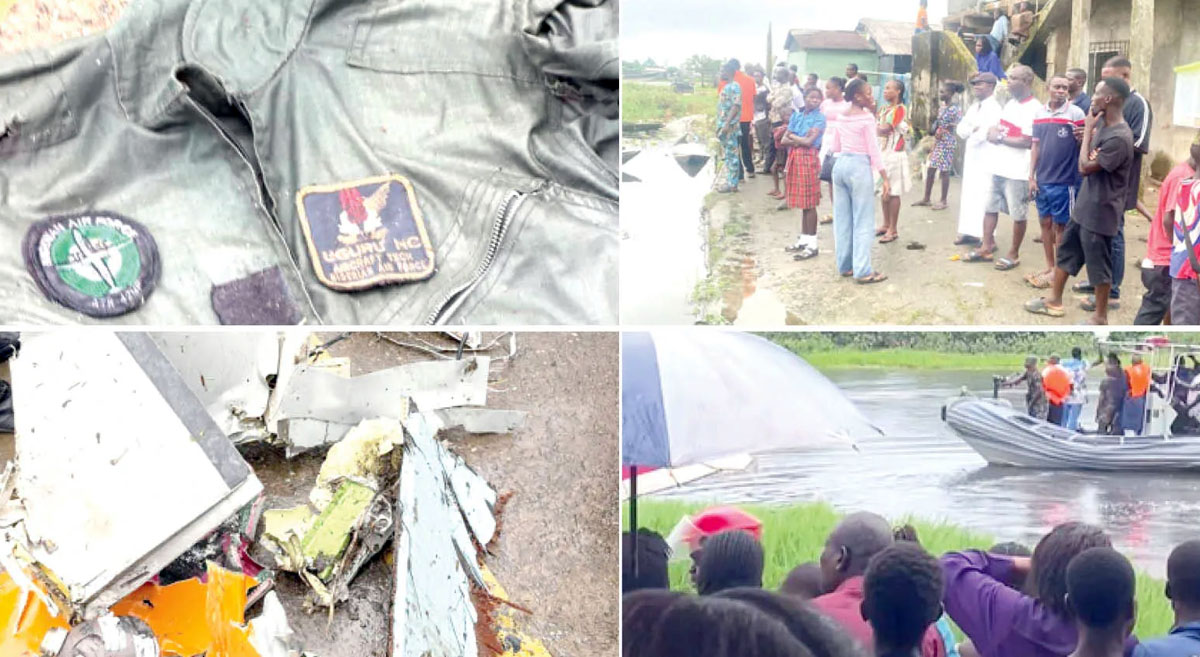
The crash site, located in a swampy and waterlogged area, posed significant challenges to rescuers and recovery teams. Military personnel, emergency responders and local residents were involved in efforts to reach the wreckage and recover the victims.
Ondo State Governor Lucky Aiyedatiwa confirmed that no survivor had been found at the crash site. Responders reportedly recovered parts of the aircraft, military uniforms and identity cards from the area while efforts continued to retrieve the wreckage.
READ ALSO:
- Court Orders NDLEA to Produce Enugu Airport Duty List in Abba Kyari Cocaine Trial
- President Tinubu Mourns 32 NAF Personnel in Ondo Jet Crash, Orders Immediate Probe
- Tragedy Strikes FMC: Medical Director Loses Two Daughters—A Doctor and a Pharmacist—Within 48 Hours
The exact cause of the NAF aircraft crash remains unknown.
Early reports raised the possibility of adverse weather conditions, while another account suggested that the aircraft could have suffered a technical or mechanical problem. Neither explanation has been established as the cause of the crash, and officials have urged the public to await the outcome of the investigation.
The loss of communication between the aircraft and air traffic controllers is expected to form a major part of the investigation, alongside the aircraft’s maintenance history, technical condition, weather conditions, flight-control communications and data from the aircraft’s flight recorder.
President Bola Ahmed Tinubu has ordered a thorough investigation into the NAF plane crash, directing the Nigerian Air Force to establish what led to the tragedy.
Tinubu expressed condolences to the families of the victims and the Nigerian Armed Forces, describing the incident as a painful loss to the country.
The President also declared three days of national mourning for the Air Force personnel killed in the crash and directed that national flags be flown at half-mast across the country.
The Nigeria Safety Investigation Bureau (NSIB) has indicated its readiness to provide technical assistance to the military investigation if requested. Because the aircraft was operated by the military, the primary investigation is expected to be handled by the Nigerian Air Force.
Investigators are expected to examine the aircraft’s flight data, maintenance records and communication with air traffic control to determine what happened during the final stages of the flight.
The Nigerian Air Force is also expected to release the names of the deceased after completing the process of notifying their families.
The Ondo NAF crash is one of the deadliest recent military aviation accidents in Nigeria and has renewed concerns about the safety, maintenance and operational readiness of military aircraft.
For now, attention remains focused on the recovery of the victims, identification of those who died and the investigation that will determine how the aircraft carrying 32 people came down in the Ondo wetlands.
Ondo Air Tragedy: Soldiers, Families Among 32 Killed In NAF Crash
metro
Court Orders NDLEA to Produce Enugu Airport Duty List in Abba Kyari Cocaine Trial
Court Orders NDLEA to Produce Enugu Airport Duty List in Abba Kyari Cocaine Trial
The Federal High Court in Abuja has ordered the Chairman of the National Drug Law Enforcement Agency (NDLEA) to produce the duty roster of personnel deployed to Akanu Ibiam International Airport, Enugu, on January 19, 2022—the day a cocaine consignment central to the Abba Kyari drug trial was intercepted. The ruling marks a significant development in a case that has drawn national attention and raised questions about airport security and inter-agency coordination in Nigeria’s fight against drug trafficking.
Justice Emeka Nwite issued the order on Monday during the continuation of the trial of suspended Deputy Commissioner of Police Abba Kyari and four other suspended officers of the Police Intelligence Response Team (IRT). The defendants are facing charges of alleged tampering with 21.35kg of cocaine and are standing trial on counts of conspiracy and obstruction in the illegal dealing and importation of the substance. They have all pleaded not guilty.
Julius Mba, counsel to Kyari and Inspector Simon Agirgba, told the court that the defence had filed a subpoena duces tecum—a legal order requiring a person or organisation to produce specific documents or evidence. The subpoena directs the NDLEA boss to present certified true copies of the duty roster for personnel deployed to the Enugu airport on the date in question. According to Mba, the document is essential to help the defence establish its case and demonstrate how the cocaine consignment allegedly passed through airport security.
READ ALSO:
- Benue Boat Mishap: Catholic Priest Among Four Dead, Nine Missing
- Rivers Police Arrest OSPAC Operative Over Alleged Killing, Secret Burial
- Adeleke Signs New Law to Regulate Motor Parks Across Osun
The court session also addressed the absence of the defence’s second witness, John Nwonke, who was expected to continue his testimony. Nwonke, who had been subpoenaed to appear, was not in court. His lawyers presented a letter dated October 2 stating that he was ill and unable to attend. The development prompted a sharp exchange between the defence and prosecution.
NDLEA counsel Joseph Sunday strongly opposed the adjournment request, urging the court to foreclose Nwonke’s evidence. He argued that the defence had failed to comply with an earlier order directing the witness to appear on Monday. Sunday also questioned the medical letter, noting that it did not disclose the nature of the illness or the hospital where Nwonke was receiving treatment. He told the court the prosecution was “not aware of any subpoena,” adding: “We don’t conduct trial by ambush.”
In his ruling, Justice Nwite declined to foreclose the witness’s evidence immediately. While he observed that Nwonke’s letter was not convincing enough to justify the adjournment, he adjourned the case until October 7, 2026, in the interest of justice. The judge warned that failure of the witness to appear on that date would lead to the foreclosure of his testimony. He also directed counsel to the first to fifth defendants to submit the names of witnesses they intend to call before the next hearing.
The trial had resumed after an indefinite adjournment in May due to Justice Nwite’s shortlisting for elevation to the Court of Appeal. The defence has been calling witnesses in an effort to establish that NDLEA operatives facilitated the passage of convicted drug traffickers through airport security. In a video played in court in March, convicts Chibunna Umeibe and Emeka Ezenwanne alleged that their photographs were sent ahead to NDLEA officers at the airport to ensure they were cleared without proper screening. The testimony forms part of the defence’s broader argument that the defendants were not the architects of the alleged obstruction.
Kyari and his co-defendants—Sunday Ubua, Bawa James, Simon Agirgba, and John Nuhu—remain at the centre of one of the most closely watched corruption and drug trafficking trials in Nigeria’s recent history. The case has sparked widespread debate about accountability within Nigeria’s law enforcement agencies and the effectiveness of inter-agency cooperation in combating drug crime.
The case was adjourned to October 7, 2026, for further defence proceedings.
Court Orders NDLEA to Produce Enugu Airport Duty List in Abba Kyari Cocaine Trial
metro
No Survivors Found in Ondo NAF Plane Crash — Ondo Governor
No Survivors Found in Ondo NAF Plane Crash — Ondo Governor
The Nigerian Air Force plane crash in Ondo State has ended in tragedy, with Governor Lucky Aiyedatiwa confirming that no survivors were found at the crash site in Igbokoda. The NAF ATR-42 aircraft went down on Monday morning near the Nigerian Navy Forward Operating Base in Ilaje Local Government Area, killing all 32 people on board—25 passengers and seven crew members. The confirmation came during an interview on Channels Television’s Politics Today, where the governor described the scene as devastating.
Governor Aiyedatiwa said rescue workers recovered debris from the Ondo plane crash site, including wing fragments, identity cards, and military uniforms, which helped confirm that a military aircraft had gone down. “So far, no single life was rescued,” the governor said. “They could not find anybody alive in that aircraft.” His words confirmed the worst fears of a nation that had spent hours hoping for a miracle.
The governor revealed that he received news of the NAF crash at about 10:30 a.m. through the chairman of Ilaje Local Government Area. Initial information was sketchy, with residents across the river reporting a loud sound and vibrations resembling an earthquake. Witnesses later saw the aircraft plunge into a swampy area. Aiyedatiwa said Nigerian Navy personnel initially kept their distance after arriving nearby because they were unsure whether the crash would trigger an explosion or fire. Only after confirming there was no fire or explosion did the Navy personnel move toward the crash site to attempt to rescue those on board.
READ ALSO:
- President Tinubu Mourns 32 NAF Personnel in Ondo Jet Crash, Orders Immediate Probe
- Tragedy Strikes FMC: Medical Director Loses Two Daughters—A Doctor and a Pharmacist—Within 48 Hours
- BREAKING: Many Feared Dead as Helicopter Crashes in Ondo Community
Personnel from the Ondo State Emergency Management Agency (SEMA), local residents, and the Amotekun security network also joined the rescue operation. Aiyedatiwa said he had been in constant contact with officials in Igbokoda and had received updates from his Senior Special Adviser on Security Matters and the Nigerian Air Force. The Air Force is also conducting its own assessment to determine the cause of the crash.
The governor described the incident as a “painful development,” especially because it involved military personnel “sent to protect the territorial integrity of Nigeria.” “Today is a very sad situation,” Aiyedatiwa said. “We are all sad as Nigerians. And it happened in my own state, not just my own state, but even my own local government area.” His voice carried the weight of a tragedy that has struck close to home for the people of Ondo State.
The traditional ruler of Igbokoda, Oba Afolabi Odidiomo, expressed relief that the aircraft did not crash into the town. “I was praying and afraid that this must not be an aircraft because the casualty figure would have been too high,” Odidiomo said. “We first of all thank God Almighty that it did not drop in the town.” He added that the plane crashed in bushes and a waterlogged area across the river, and that the presence of water may have prevented the aircraft from catching fire after impact.
Minister of Aviation and Aerospace Development Festus Keyamo had earlier said the aircraft, with registration number NGR 931, lost contact with air traffic control at about 9:13 a.m. during a routine mission from Benin City to Lagos. Nigerian Air Force spokesman Ehimen Ejodame confirmed that search and rescue operations had been activated in coordination with relevant authorities and emergency response agencies.
Governor Aiyedatiwa has directed SEMA, the Ministry of Health, and relevant security agencies to deploy personnel and resources to support the Air Force and other emergency responders at the crash site. He also ordered security agencies to cordon off the area to prevent unauthorized persons from interfering with rescue operations. The measures reflect the urgency of a situation that has gripped the entire nation.
President Bola Tinubu has ordered the Nigerian Air Force to immediately commence a thorough investigation into the cause of the crash to prevent future occurrences. The President extended his deepest condolences to the families of the victims, the Chief of the Air Staff, Air Marshal Sunday Kelvin Aneke, and all officers, airmen, and airwomen of the Nigerian Air Force.
No Survivors Found in Ondo NAF Plane Crash — Ondo Governor
-

 Politics3 days ago
2027: Oshiomhole Dares Opposition Over ₦500 Petrol Promise, Says APC Will Take Argument to Nigerians
-

 metro3 days ago
NYSC Kidnap: Abductors Demand N950m for 19 Prospective Corps Members in Imo
-

 metro2 days ago
‘I Thought I Was Dead’ — Hairstylist’s Daring Escape From Kidnappers After Benin-Ore Ambush
-
 metro3 days ago
Amaechi: Tinubu’s Policies Made My Mother’s Drugs Unaffordable
-

 metro3 days ago
Tension as Kidnappers Threaten to Kill Abducted Oyo Corps Members
-

 metro3 days ago
N500 Petrol, Wage Award: Public Sector Workers Begin Warning Strike
-

 Entertainment3 days ago
Less Than Four Months After Wedding, Jarvis Threatens Peller With Lawsuit Over Second-Wife Plan
-

 Politics3 days ago
Wike to Amaechi: What Did You Bring to Rivers After 24 Years in Power?