

News
UK varsity expels Nigerian students over unpaid fees
UK varsity expels Nigerian students over unpaid fees
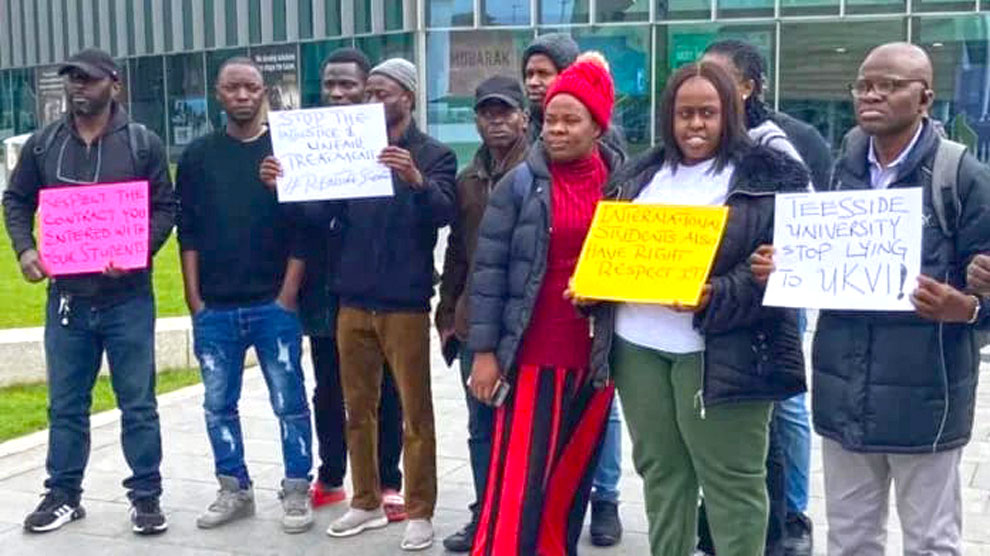
Nigerian students at Teesside University have been forced to leave their courses and face deportation after a currency crisis in Nigeria left them unable to pay their tuition fees on time.
The sharp depreciation of Nigeria’s naira has severely impacted their savings, leading to significant financial hardship.
Some students, speaking to the BBC, expressed feelings of despair and accused the university of being “heartless” in handling their financial difficulties. The university, however, maintained that it had no choice but to report non-paying students to the Home Office, as failure to pay tuition fees breaches visa sponsorship requirements. The Home Office reiterated that visa sponsorship decisions lie with the educational institution.
Nigeria is currently experiencing its worst economic crisis in a generation, with average inflation nearing 34%. A recent attempt by the Nigerian president to replace old currency exacerbated the situation, causing the naira to depreciate by over 100% against the dollar within a year. This devaluation has severely depleted the funds students had initially shown to secure their visas and commence their studies.
The financial problems were compounded when Teesside University changed its tuition fee payment plan from seven installments to three, making it even more challenging for affected students to meet their financial obligations. As a result, several students found themselves frozen out of university accounts, involuntarily withdrawn from their courses, and reported to debt collection agencies.
READ ALSO:
- Tragedy as truck crushes soldier to death in Lagos
- Police arrest man for allegedly defrauding Thai woman $216,000, N30m
- FRSC gets new corps marshal
One such student, Adenike Ibrahim, was close to completing her dissertation after two years of study when she missed a payment. Despite subsequently paying her outstanding fees, she was not re-enrolled and was told she must leave the UK with her young son. “It has been heartbreaking for my son especially,” she said, describing the experience as “horrendous.”
The Home Office letters to students, seen by the BBC, state that their permission to stay in the UK has been canceled due to their cessation of studies, with no right of appeal against the decision. This has led to severe emotional distress among the students, with one anonymous master’s degree student admitting to suicidal thoughts.
Esther Obigwe, another affected student, said she had repeatedly tried to discuss her financial struggles with the university but received no response until she was blocked from her studies and told to leave the country. “I’m a very active student,” she said, now on antidepressants and struggling to eat or sleep due to the stress.
Jude Salubi, studying to be a social worker, was midway through a placement when he was told he would have to leave the UK. Despite working weekends to pay off his fees, he still owed £14,000. “I need guarantees that I will be re-enrolled and my visa restored,” he said.
Teesside University stated that it had made “every effort” to support affected students, offering bespoke payment plans and individual meetings with specialist staff. However, some students still defaulted on these revised plans. The university emphasized its commitment to supporting a robust immigration system, noting that visa issuance and compliance are subject to strict external regulations.
As the Home Office can no longer intervene in the visa process for those who have managed to pay their outstanding fees, the affected students are left in a precarious situation, highlighting the profound impact of Nigeria’s economic crisis on its international students.
UK varsity expels Nigerian students over unpaid fees
(BBC)










News
Tinubu’s Visit: One Feared Dead, Several Injured as APC Women’s Bus Collides With Security Vehicle in Uyo

Tinubu’s Visit: One Feared Dead, Several Injured as APC Women’s Bus Collides With Security Vehicle in Uyo
UYO, Akwa Ibom State – A tragic road accident involving a bus conveying supporters of the All Progressives Congress (APC) has reportedly claimed one life and left several others injured in Uyo, Akwa Ibom State.
The accident occurred on Friday, November 6, when the bus, reportedly conveying APC women to participate in activities marking President Bola Ahmed Tinubu’s visit to the state, collided with a security vehicle along Oron Road.
The incident happened amid heightened security arrangements for the President’s visit to Akwa Ibom, where he was scheduled to commission several projects executed by Governor Umo Eno’s administration and attend political activities.
According to reports, the bus, identified as belonging to the Akwa Ibom State Transport Corporation (AKTC), was conveying the women towards the reception venue when it collided with a Toyota Hilux security vehicle.
The impact reportedly left the bus badly damaged, triggering panic as passers-by, motorists and security personnel rushed to assist the victims.
A video circulating on social media showed the wreckage of the bus at the accident scene, with people gathering around the damaged vehicle as rescue efforts continued.
The injured victims were reportedly evacuated and taken to hospitals in Uyo for medical attention.
The Guardian reported that one person had died in the accident, while several others sustained injuries. However, another local media report said no death had been confirmed as of the time of its publication.
The exact casualty figure and the identities of the victims had yet to be officially established.
The accident has raised concerns about the safety of transportation arrangements for political supporters mobilised to participate in high-profile presidential events.
President Tinubu arrived in Akwa Ibom on Friday as part of a two-state visit to Akwa Ibom and Rivers states. His itinerary included the inauguration of major infrastructure projects and engagement with political stakeholders.
As of the time of filing this report, further details about the circumstances surrounding the collision and the condition of the injured victims were still emerging.
Tinubu’s Visit: One Feared Dead, Several Injured as APC Women’s Bus Collides With Security Vehicle in Uyo
News
Sex Trafficking: ‘They Took Us To Native Doctor, Shaved Our Private Parts Before Leaving Edo’ – Survivor

Sex Trafficking: ‘They Took Us To Native Doctor, Shaved Our Private Parts Before Leaving Edo’ – Survivor
A survivor of human trafficking, Piana Shua Kimari, has recounted how she was subjected to disturbing traditional rituals before being trafficked out of Nigeria at the age of 15.
Kimari, who shared her experience during a media appearance, disclosed that she and other young girls were taken to a traditional practitioner in Ekpoma, Edo State, where parts of their bodies were shaved before they were transported out of the country.
Recounting the frightening experience, she said the traffickers subjected them to the rituals before leaving Ekpoma.
“Before we left Ekpoma in Edo State, they took us to a powerful native doctor. They shaved our armpits, private parts and head hair,” she recalled.
Her revelation has brought renewed attention to the disturbing methods allegedly employed by human trafficking syndicates to recruit, intimidate and control vulnerable young women and girls.
The practice of subjecting trafficking victims to traditional oaths and rituals is a recognised method of psychological intimidation used by some trafficking networks, particularly in cases involving cross-border sexual exploitation.
In some instances, victims are made to believe that revealing the identities of their traffickers, escaping or refusing to repay alleged trafficking debts could expose them or their families to spiritual attacks, madness or death.
Such threats often leave victims traumatised and afraid to seek help, even when they have opportunities to escape.
Kimari further recounted how their journey took them beyond Nigeria, with movements through areas around the Seme border and towards Mali, before she fully understood the dangerous situation she had found herself in.
According to her account, what initially appeared to be an opportunity turned into a nightmare when she realised she had fallen into the hands of human traffickers.
Her experience highlights the vulnerability of young girls to trafficking networks that exploit poverty, unemployment, deception and the desire for better opportunities abroad.
Nigeria, particularly Edo State, has long been identified as an important source area for victims of human trafficking, with some victims recruited and transported through international routes for sexual and other forms of exploitation.
The survivor’s account also underscores the importance of community awareness, early intervention and effective collaboration among security agencies, anti-trafficking organisations and relevant authorities.
There are growing calls for stronger efforts to identify and prosecute individuals involved in trafficking networks, including recruiters, transporters and collaborators who facilitate the exploitation of vulnerable persons.
Beyond rescuing victims, human rights advocates have consistently stressed the need for rehabilitation, psychological support, vocational training and reintegration programmes to help survivors rebuild their lives.
Kimari’s testimony serves as another reminder of the dangers confronting vulnerable Nigerian girls and the need for families and communities to remain vigilant against deceptive offers of overseas employment and travel opportunities.
Sex Trafficking: ‘They Took Us To Native Doctor, Shaved Our Private Parts Before Leaving Edo’ – Survivor
News
2027: Abati Takes On Keyamo Over Atiku, ADC Court Judgment, Says ‘Stop Celebrating’

2027: Abati Takes On Keyamo Over Atiku, ADC Court Judgment, Says ‘Stop Celebrating’
ABUJA — Veteran journalist and Arise Television presenter, Dr Reuben Abati, has taken a swipe at the Minister of Aviation and Aerospace Development, Festus Keyamo, over his celebration of the Federal High Court judgment that nullified the David Mark-led leadership of the African Democratic Congress (ADC) and invalidated the emergence of former Vice President Atiku Abubakar as the party’s presidential candidate for the 2027 general election.
Abati, who spoke on Friday during Arise Television’s Morning Show, cautioned Keyamo against celebrating what he described as an unresolved legal battle, insisting that the ADC leadership and Atiku’s supporters still have the opportunity to challenge the ruling at the Court of Appeal.
“Stop celebrating, Keyamo. The matter is not over yet. They will go to the Appeal Court,” Abati declared.
The journalist’s intervention followed Keyamo’s reaction to Thursday’s judgment delivered by Justice Peter Lifu of the Federal High Court in Abuja.
The court had ruled against the caretaker leadership of the ADC led by former Senate President David Mark, declaring its emergence illegal and setting aside decisions taken under its leadership, including the party primary that produced Atiku as its presidential candidate for the 2027 election.
Reacting to the judgment, Keyamo, a Senior Advocate of Nigeria (SAN), had criticised opposition figures accusing the ruling All Progressives Congress (APC) of influencing the judiciary.
In a post on his official X account, the minister described as a warped argument the suggestion that whenever an opposition party loses a court case, the ruling party must be responsible.
Keyamo argued that the court’s decision was based on facts and evidence rather than political sentiments, insisting that the Mark-led leadership could not take control of a party without complying with its constitutional provisions.
However, Abati questioned the minister’s enthusiasm in celebrating a judgment that remains subject to appellate review.
According to the former presidential spokesman, the concerns being raised by Nigerians are not necessarily about the right of the court to determine disputes but the timing, circumstances and public reactions surrounding judgments that affect opposition parties.
He maintained that the legal process had not reached its conclusion, noting that the Court of Appeal could still examine several issues surrounding the judgment.
Abati specifically identified questions bordering on procedure, timing, technicalities and the admissibility of evidence as matters that could feature prominently in the appeal.
He also questioned why a serving minister whose official responsibilities have little connection with electoral politics would become one of the loudest voices celebrating a judgment that effectively knocks out an opposition presidential candidate.
The Arise Television presenter warned that such public celebrations could fuel suspicions about the relationship between political power and judicial decisions, even as he cautioned against jumping to conclusions about external interference in the judiciary.
The controversy stems from a suit instituted by Nafiu Bala Gombe, a former ADC National Deputy Chairman, who challenged the process through which Mark and other members of the caretaker leadership assumed control of the party.
Bala argued that he was constitutionally entitled to assume leadership following the resignation of the party’s former National Chairman, Ralph Nwosu.
Justice Lifu subsequently ruled against the Mark-led leadership and invalidated its decisions, including the process that produced Atiku as the ADC’s presidential flagbearer.
The ruling has created fresh uncertainty around the opposition party’s preparations for the 2027 presidential election, particularly as Atiku had already commenced political mobilisation following his emergence as the party’s candidate.
Meanwhile, Atiku and the ADC have rejected the judgment and vowed to challenge it at the Court of Appeal.
Atiku’s camp has also indicated plans to seek appropriate legal relief, including a stay of execution where applicable, while pursuing the appeal.
The former vice president has described the development as an attempt to frustrate his presidential ambition, while the ADC has questioned the circumstances surrounding the judgment.
The emerging confrontation between Abati and Keyamo has added another dimension to the political controversy, with the 2027 presidential election gradually becoming a battleground for legal arguments, political accusations and competing interpretations of judicial decisions.
For now, the fate of Atiku’s ADC presidential ticket and the party’s leadership structure remains a major legal and political issue.
Whether the Court of Appeal will uphold or overturn Justice Lifu’s decision is expected to play a significant role in determining the next chapter of the ADC crisis and Atiku’s 2027 presidential ambition.
2027: Abati Takes On Keyamo Over Atiku, ADC Court Judgment, Says ‘Stop Celebrating’
-

 metro2 days ago
Bandits Demand Over ₦100m Ransom for 15 Abducted Islamiya Students in Niger
-

 International3 days ago
Trump Shocks Israel, Announces End To $4bn Annual US Military Aid
-

 metro2 days ago
FG’s N50,000 Relief: OPay Details Eligibility Check Process, Issues Strong Warning Against Scams
-

 metro2 days ago
Tears In Ebonyi Community As Newlyweds, Groom’s Mother, Seven Others Perish In Crash
-

 International2 days ago
Australia Under Pressure To Scrap $368bn US-UK Nuclear Submarine Deal As Inquiry Warns Of China War
-

 International2 days ago
Musk Breaks Silence After $458M Gamble Backfires in Historic Democratic Sweep
-

 Politics2 days ago
DSS Denies Plot to Disrupt ADC Rally, Orders Probe into Atiku’s Allegations
-

 metro2 days ago
‘I Went to My Pastor for Deliverance, Ended Up in Bed With Him’ – Lady Recounts Encounter