
Education
UniAbuja names 41-year-old law professor Aisha Maikudi acting vice-chancellor

UniAbuja names 41-year-old law professor Aisha Maikudi acting vice-chancellor
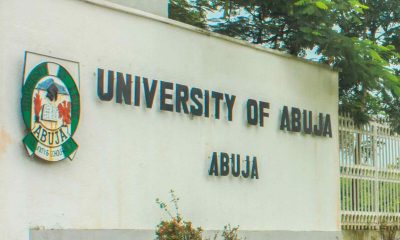
The Senate of the University of Abuja has appointed Prof. Aisha Sani Maikudi as the Acting Vice Chancellor, pending the inauguration of the University Council and the appointment of a substantive Vice Chancellor.
The announcement was made on the university’s official Facebook page on Thursday.
Prof. Maikudi, a distinguished professor of International Law, previously served as the Deputy Vice Chancellor (Academic) before this recent appointment. Her selection followed a nomination at the valedictory Senate meeting held on Wednesday.
Outgoing Vice Chancellor Prof. Abdul-Rasheed Na’Allah, whose tenure concludes on June 30, 2024, stated that Maikudi’s appointment is in a temporary capacity, effective after his tenure and awaiting ratification by the Governing Council.
READ ALSO:
- Yahaya Bello wants court to try him in Kogi
- NSCDC recovers stolen armoured cables, arrests four vandals in Abuja
- Six killed in attack on Imo community, IPOB suspected
In her acceptance speech, Maikudi expressed her gratitude to the Senate members for their trust and support. “I want to extend my deepest respect and appreciation to you all for the strong support and unwavering commitment that you have accorded me,” she said.
Born on January 31, 1983, Maikudi is recognized as the youngest female professor of Law in Northwestern Nigeria and at the University of Abuja. She attended Queens College, Lagos, for her secondary education before proceeding to the University of Reading, where she obtained her LLB in 2004. She earned her LLM from the London School of Economics & Political Science in 2005 and later completed a PhD in International Law at the University of Abuja in 2015.
Prof. Maikudi joined the University of Abuja as a Lecturer II on September 4, 2008, and rose to the rank of professor in 2022.
UniAbuja names 41-year-old law professor Aisha Maikudi acting vice-chancellor








Education
NELFUND Refutes UniAbuja Loan Diversion Claims

NELFUND Refutes UniAbuja Loan Diversion Claims
The Nigerian Education Loan Fund (NELFUND) has strongly refuted recent claims that officials of the University of Abuja (UniAbuja), including the vice‑chancellor and senior administrators, diverted or misappropriated student loan funds intended for indigent students.
In a detailed statement, NELFUND clarified that no verified evidence exists to support allegations that UniAbuja unlawfully withheld or diverted loan disbursements. The Fund said the speculation circulating in some media reports — which implicated the university’s vice‑chancellor, the Dean of Students’ Affairs, and other officials in the alleged diversion of multibillion‑naira funds — is unfounded and misleading.
The reports also suggested that UniAbuja failed to reimburse residual balances to students whose actual tuition fees were lower than the amounts disbursed by NELFUND on their behalf. In response, NELFUND maintained that its structured disbursement and reconciliation framework ensures that funds released for student loans are properly applied in line with its statutory mandate.
READ ALSO:
- NRC, Entertainers Finalise Plans for 2026 Valentine Train Ride
- 2027 General Elections: INEC Announces February 20 for Presidential Poll
- EFCC Nabs Three in Borno Over Viral ₦500 Naira Mutilation Video
Mrs. Oseyemi Oluwatuyi, NELFUND’s Director of Strategic Communications, emphasised that the Fund’s operations are governed by formal verification, compliance, and reconciliation protocols. According to her, loan funds are released through established institutional channels, and strict accountability mechanisms are in place to safeguard both student and institutional interests.
The Fund acknowledged that discrepancies or timing issues sometimes arise in the process of crediting student or institutional accounts, but said these are typically resolved through direct engagement with the relevant institutions, in accordance with due administrative processes.
“Where concerns arise regarding timelines of crediting student accounts or institutional reconciliation processes, NELFUND engages directly with the relevant institution to clarify and resolve such matters administratively and in accordance with due process,” the statement read.
NELFUND reiterated its commitment to transparency, accountability, and rigorous audit procedures, which include reliance on verified documentation and formal reconciliation mechanisms when addressing any issue related to its student loan disbursements.
The Fund also reaffirmed its dedication to protecting the interests of eligible Nigerian students and ensuring that all disbursements are applied lawfully and effectively to support access to tertiary education.
NELFUND Refutes UniAbuja Loan Diversion Claims
Education
Supreme Court Affirms Muslim Students’ Right to Worship at Rivers State University

Supreme Court Affirms Muslim Students’ Right to Worship at Rivers State University
The Supreme Court of Nigeria has ruled in favor of Muslim students at Rivers State University (RSU), affirming their constitutional right to practice Islam and perform religious activities on campus. The landmark judgment, delivered on February 10, 2026, closes a legal battle that has lasted for over a decade.
The ruling reinforces Section 38 of the 1999 Constitution (as amended), which guarantees freedom of thought, conscience, and religion for all Nigerians.
The Muslim Students’ Society of Nigeria (MSSN), Rivers State Area Unit, hailed the judgment as a historic affirmation of constitutional rights and the rule of law.
READ ALSO:
- Malami’s EFCC Trials Face Procedural Delay as Judge Steps Aside
- Umahi Vows to Quit if Road Project Fails Independent Quality Test
- NUFBTE Workers Occupy NAFDAC Lagos Office Over Sachet Alcohol Ban
The case traces back to 2012, when a mosque on the university campus was demolished, leaving Muslim students without a dedicated place of worship. The matter passed through the Federal High Court in 2013 and the Court of Appeal in 2017, before finally reaching the Supreme Court.
In a statement, the MSSN emphasized that the ruling is not a victory for one religion over another but a triumph for constitutionalism, equity, and justice. The society commended Muslim students for their discipline, resilience, and peaceful conduct throughout the legal process and acknowledged the efforts of its legal team and community leaders.
The MSSN called on Rivers State University management and relevant authorities to implement the ruling promptly by providing a dedicated and befitting place of worship for Muslim students on campus. The organization also urged students to respond with gratitude and maturity, emphasizing peaceful coexistence and mutual respect within the university community.
Experts believe this decision will have far-reaching implications for religious accommodation and inclusivity in public tertiary institutions across Nigeria.
Supreme Court Affirms Muslim Students’ Right to Worship at Rivers State University
Education
UI Don Develops KoEDE App to Revive Yoruba Language Learning Among Children

UI Don Develops KoEDE App to Revive Yoruba Language Learning Among Children
A computer scientist at the University of Ibadan (UI), Dr. Ronke Sakpere, has developed a mobile application, KoEDE, aimed at strengthening Yoruba language learning among children through gamified digital tools and innovative pedagogy.
Sakpere disclosed this in Ibadan while speaking on the motivation behind the project, noting that the initiative responds to growing concerns about the decline in fluency in indigenous languages among Nigerian children, especially in urban areas where English dominates communication at home and in schools.
Addressing Declining Indigenous Language Fluency
Nigeria is home to over 500 indigenous languages, yet experts have continued to warn about weakening intergenerational transmission, as many children increasingly struggle to speak their mother tongues fluently.
Although the National Policy on Education recommends the use of mother tongue instruction in the early years of schooling, implementation has remained inconsistent due to structural, curriculum, and resource challenges.
Dr. Sakpere explained that the idea for KoEDE was conceived in 2022 during her participation in the Empowering The Teacher (ETT) Fellowship Programme at the Massachusetts Institute of Technology (MIT), United States.
“I enrolled in a technology design course at the MIT Media Lab, which required us to develop a project. After reflection, I realised that many children back home do not speak their native languages fluently,” she said.
READ ALSO:
- City Boy Movement Receives Bus Donations from Zenco, Obi Cubana for Tinubu’s Campaign
- Gunmen Abduct Five from Edo Health Centre, Demand ₦100 Million Ransom
- Manchester City Defeat Fulham 3‑0 to Narrow Gap on Arsenal
She added that a pilot study she conducted confirmed the urgency of the problem, prompting her to design a technology-driven intervention to support African children in learning their indigenous languages.
Gamification and Constructivist Learning Approach
According to Sakpere, KoEDE was built using gamification principles and constructivist pedagogy, making language learning interactive, engaging, and learner-centred.
The app features:
- Puzzles and word games
- Sentence formation exercises
- Touch-and-drag interactive tasks
- Structured learning across beginner, intermediate, and expert levels
- Audio pronunciation guides and visual illustrations
She explained that the app includes a reward-based system, where learners earn points for correct answers. Unlike traditional rigid assessment models, it does not heavily penalise wrong responses, encouraging sustained participation and confidence-building.
“It also allows learners to study at their own pace, supported with visuals and audio to strengthen pronunciation and comprehension,” she noted.
Collaboration and Funding Support
The final phase of the four-year development project was executed in collaboration with the Yoruba Centre, University of Ibadan, an institution renowned for teaching Yoruba both locally and internationally.
Sakpere revealed that the project initially faced funding constraints until 2024, when it received a grant from AlumNode, under the auspices of the Klaus Tschira Stiftung, a German foundation. She described the funding as critical in enhancing the app’s technical infrastructure and covering human resource costs.
Public Launch and Future Expansion
The KoEDE app has been uploaded to the Google Play Store and has undergone internal testing by more than 20 students ahead of its official public launch scheduled for February 23.
Currently focused on Yoruba language education, Sakpere disclosed plans to expand the platform to other major Nigerian languages, including Igbo and Hausa, in subsequent versions.
“In the next version, we hope to introduce synchronous learning features that will allow learners to interact in real time. We also intend to integrate relevant Artificial Intelligence (AI) tools to personalise learning,” she said.
Strengthening Indigenous Languages Through EdTech
Education stakeholders say initiatives like KoEDE highlight the growing role of Educational Technology (EdTech) in preserving indigenous languages and promoting cultural identity in a rapidly digitising world.
By combining technology, pedagogy, and cultural heritage, KoEDE represents a significant step toward ensuring that the Yoruba language remains vibrant and accessible to younger generations.
UI Don Develops KoEDE App to Revive Yoruba Language Learning Among Children

-

 metro1 day ago
IKEDC Sets Feb 20 Deadline for Customers to Submit Valid IDs or Face Disconnection
-

 Education1 day ago
Supreme Court Affirms Muslim Students’ Right to Worship at Rivers State University
-

 metro15 hours ago
Lagos Police Launch Manhunt for Suspect in Brutal Ajah Murder
-

 Business3 days ago
Dangote Refinery Slashes Petrol Price to ₦774, Ends PMS Bonus Window
-

 Business1 day ago
Naira Could Trade Below ₦1,000/$ With Dangote Refinery at Full Capacity — Otedola
-

 metro2 days ago
Kwara, Katsina Bloodshed: TMC Condemns Attacks, Dismisses ‘Jihadist Preacher’ Claims
-

 News15 hours ago
Aso Rock Goes Solar as Tinubu Orders National Grid Disconnection
-

 News3 days ago
Trump Approves Deployment of 200 U.S. Soldiers to Support Nigeria’s Fight Against Terrorists