

metro
₦110.4bn Fraud Trial: EFCC Witness Traces Company Inflows To Kogi LG Accounts
₦110.4bn Fraud Trial: EFCC Witness Traces Company Inflows To Kogi LG Accounts
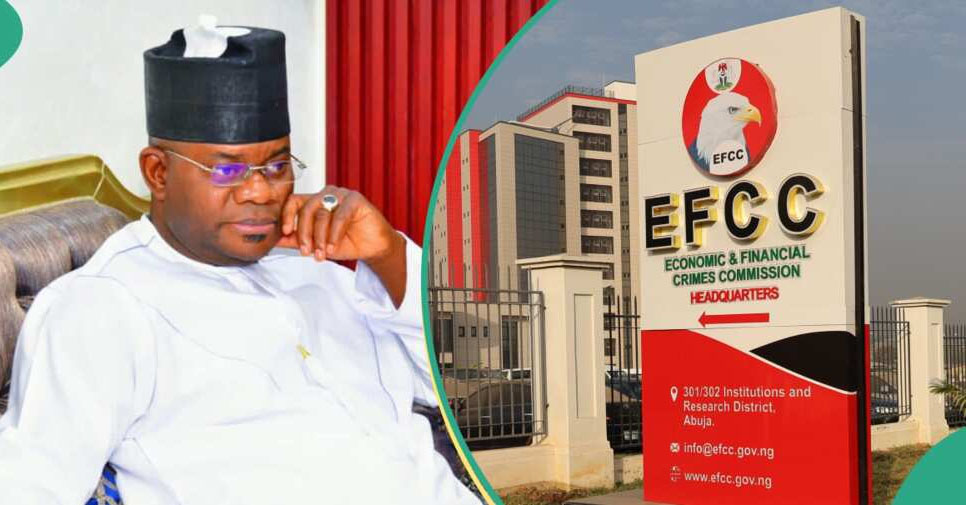
An operative of the Economic and Financial Crimes Commission (EFCC) has told an Abuja court that companies under investigation in the alleged ₦110.4 billion fraud case involving former Kogi State Governor Yahaya Bello received regular inflows from local government accounts in the state.
The witness, John Justice, made the disclosure on Tuesday, October 27, 2026, while testifying as the 20th prosecution witness before Justice Maryanne Anineh of the Federal Capital Territory High Court in Maitama, Abuja.
Bello is standing trial alongside Umar Shuaibu Oricha and Abdulsalami Hudu on a 16-count charge bordering on alleged criminal breach of trust and money laundering involving ₦110.4 billion. The defendants have denied the allegations.
Led in evidence by prosecution counsel Kemi Pinheiro, a Senior Advocate of Nigeria (SAN), Justice said investigators obtained and analysed bank records to trace the movement of funds through several companies suspected of benefiting from transactions involving Kogi State local governments.
He told the court that an examination of the account statement of Forza Business Enterprise showed that most of the funds credited to the company came from local government accounts in Kogi State on a monthly basis.
“Most of the funds coming into the account were funds from Kogi State Local Government accounts coming on a monthly basis,” the witness told the court.
READ ALSO:
- US Extradites Nigerian Over Alleged $100m Tax Refund Fraud
- Panic as Gunmen Storm Kaduna Estate at Midnight, Abduct Residents
- AutoFast By CFAO Assures Former Moove Drivers of Continued After-Sales Support, Free Diagnostics
Justice said the investigation also identified Keyless Ventures as a company that benefited from proceeds traced to the businesses under scrutiny.
According to him, the EFCC’s analysis showed that funds flowed from Kogi State into the companies’ accounts, with some of the transactions recorded as cash withdrawals.
The investigator said the commission became concerned about the large sums recorded as cash withdrawals and subsequently invited officials of Access Bank and Zenith Bank to assist with the investigation.
The EFCC also requested closed-circuit television (CCTV) footage from the banks to establish whether the money had actually been withdrawn in cash.
Justice told the court that the footage showed that customers did not physically take the recorded sums out of the banking halls.
He explained that some transactions involved customers completing a cheque withdrawal for one account and a deposit slip for another account, allowing the money to be transferred without being physically collected as cash.
The testimony suggested that transactions recorded as cash withdrawals in the companies’ account records included movements of funds into other accounts.
Justice said the investigation began after the EFCC’s Procurement Fraud Section received intelligence concerning the activities of local governments in Kogi State.
He identified several companies mentioned in the intelligence, including Hayzma, Bibas Energy, Forza Oil and Gas, and Keyless Ventures.
The witness said investigators conducted Bank Verification Number (BVN) searches and wrote to the relevant banks to obtain transaction records. The responses were subsequently analysed to establish the movement of funds among the accounts.
While identifying documents presented in court, Justice confirmed that some of the exhibits related to Hayzma Business Enterprise, Keyless Nature and Forza Business Enterprise.
He further told the court that a BVN search relating to Keyless Nature returned the name Abba Adaudu, while earlier searches had returned the names Yakubu Siyaka Adebenege and Iyadat Sa’adat.
Justice said he had worked as an EFCC operative for more than nine years and had received training in asset tracing, internet fraud, anti-money laundering and advance-fee fraud.
The prosecution alleges that the transactions form part of a wider scheme involving the diversion of public funds during Bello’s tenure as Kogi State governor between January 2016 and January 2024.
The EFCC has alleged that some of the funds were used to acquire properties in Abuja and make payments for school fees. Bello and his co-defendants have denied the allegations, and the prosecution must establish its case in court.
The trial was adjourned until November 24, 2026, for continuation.
The latest testimony adds to evidence presented by previous prosecution witnesses concerning transfers from Kogi local government accounts to private companies and the subsequent movement of the funds. However, the allegations remain subject to determination by the court.
₦110.4bn Fraud Trial: EFCC Witness Traces Company Inflows To Kogi LG Accounts











metro
₦70,000 Transport Allowance: Who Qualifies as Informal Workers Raise Questions

The Federal Government’s agreement with the Nigeria Labour Congress (NLC) to provide a ₦70,000 monthly transport allowance for six months has raised questions about who will benefit from the intervention, particularly workers in Nigeria’s large informal sector.
The payment is scheduled to begin in November 2026 and is intended for public service workers across all levels, according to reports on the agreement signed by the Federal Government and the NLC.
However, the agreement has not provided a comprehensive breakdown of eligible employees or explained how the money will be disbursed. This has left important questions about the implementation of the scheme unanswered.
The central clarification is that the intervention is aimed at public servants, not every Nigerian worker or citizen. While the agreement refers to workers across all levels, the precise arrangements for federal, state and local government employees have not been fully spelt out.
State and local governments have been urged to participate in the implementation process, while labour unions are expected to press for the agreement to be honoured at their respective levels. The extent to which employees in different tiers of government will receive the allowance, and the administrative process for accessing it, will depend on further implementation details.
The agreement also does not expressly extend the ₦70,000 transport support to private-sector employees, self-employed people, traders, artisans, market vendors, commercial drivers or other informal-sector workers. However, the absence of these groups from the stated arrangement should not be interpreted as confirmation that they are excluded from every other form of government assistance.
READ ALSO:
- OPC Arrests Three Suspected Kidnappers Around Old Oyo National Park, Recovers Rifles
- 19 Suspected Fraudsters Arrested, Five Exotic Cars Recovered in EFCC Lekki Raid
- ₦110.4bn Fraud Trial: EFCC Witness Traces Company Inflows To Kogi LG Accounts
For now, the available details do not establish a complete list of beneficiaries, the payment dates within each month or the mechanism through which eligible workers will receive the money. Further clarification from the government and the relevant authorities is therefore needed before individual categories of public servants can be definitively confirmed as eligible.
The intervention comes amid continuing concerns about the cost of transportation and the wider pressure of living expenses on Nigerian workers. For people whose earnings depend on daily sales, casual jobs or self-employment, the lack of a clearly stated provision for informal workers has renewed questions about how government relief measures can reach people outside the formal public service.
Until detailed implementation guidelines are released, the most accurate conclusion is that the ₦70,000 monthly transport allowance is intended for public service workers, while the full eligibility criteria and payment arrangements remain unclear. Informal workers should not be described as formally excluded from all government support on the basis of this agreement alone.
₦70,000 Transport Allowance: Who Qualifies as Informal Workers Raise Questions
metro
OPC Arrests Three Suspected Kidnappers Around Old Oyo National Park, Recovers Rifles
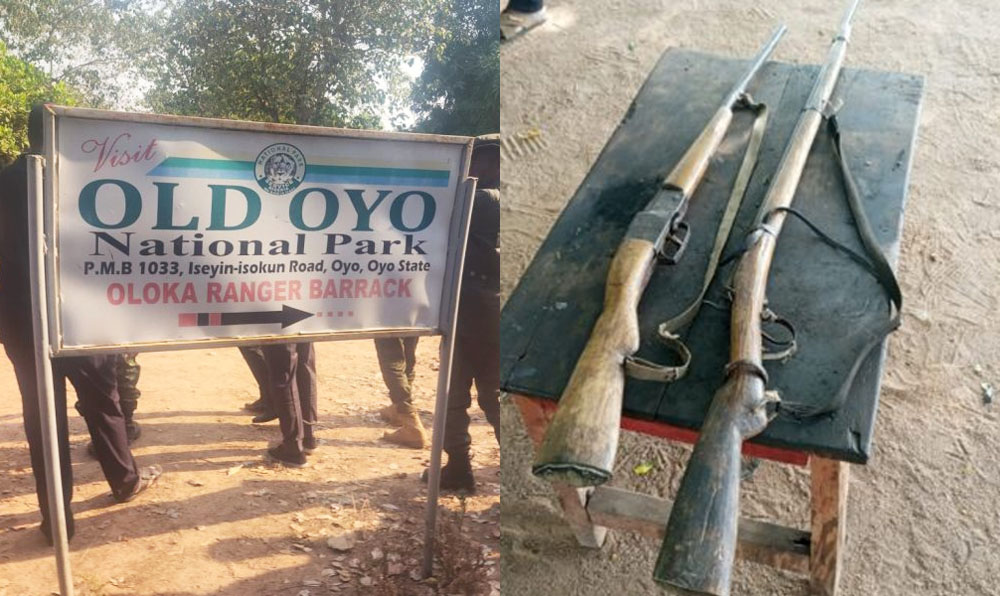
Members of the Oodua Peoples Congress (OPC) have arrested three suspected kidnappers accused of terrorising communities around Old Oyo National Park, with the suspects reportedly found in possession of sophisticated rifles.
The arrests were carried out at different times during patrol operations in Eseke village, Oriire Local Government Area, and Igbeti, Olorunsogo Local Government Area, both in Oyo State.
Kehinde Zaccheus, the OPC coordinator in Eseke, disclosed the development to journalists on Tuesday, October 27, 2026.
According to Zaccheus, one suspect was arrested in Eseke, while two others were apprehended in Igbeti. He said the suspects were allegedly found with sophisticated firearms when they were arrested.
The suspects were subsequently handed over to the police at Ikoyi-Ile and Igbeti for further investigation.
The arrests come amid persistent security concerns around the national park and neighbouring communities, where residents have faced threats from suspected kidnappers and armed groups.
READ ALSO:
- 19 Suspected Fraudsters Arrested, Five Exotic Cars Recovered in EFCC Lekki Raid
- ₦110.4bn Fraud Trial: EFCC Witness Traces Company Inflows To Kogi LG Accounts
- US Extradites Nigerian Over Alleged $100m Tax Refund Fraud
Old Oyo National Park spans 10 local government areas in Oyo State and one in neighbouring Kwara State, making security across its extensive forest terrain a major challenge for law enforcement agencies.
In January 2026, gunmen attacked the park’s administrative facility in the Oloka area of Oriire Local Government Area, killing five forest guards and other personnel. The attackers reportedly sought to free suspected criminals previously detained by forest guards.
Following investigations into the attack, the Oyo State Police Command announced the arrest of seven suspects, including an alleged mastermind of the incident. Police said intelligence-led operations were continuing to track other suspected members of the gang.
Separately, reports in May 2026 indicated that 39 students and seven teachers had been abducted from communities in Oriire Local Government Area, with the victims allegedly held by kidnappers operating around the park. The incident further heightened concerns about the safety of residents and travellers in the area.
The latest OPC arrests represent another development in efforts to address insecurity around the park. However, it remains unclear whether the three suspects are connected to the January attack, the reported school abductions or other criminal incidents in the area.
The police are expected to investigate the allegations against the suspects and establish whether the recovered weapons are linked to any reported crimes.
The suspects have not been convicted of any offence and remain presumed innocent unless proven guilty in court.
OPC Arrests Three Suspected Kidnappers Around Old Oyo National Park, Recovers Rifles
metro
₦2.7bn Fraud: Court Jails Ex-Banker 39 Years

A Lagos court has sentenced former banker Christopher Jackson Edeh to a total of 39 years’ imprisonment over a ₦2.7 billion fraud involving the alleged alteration of bank account details belonging to customers and government-related entities.
Justice O.O. Abike-Fadipe of the Special Offences Court sitting in Ikeja delivered the judgment on Tuesday, October 27, 2026, after finding Edeh guilty on nine counts bordering on fraudulent false accounting and unauthorised access to a computer system.
The case was prosecuted by the Lagos Zonal Directorate 1 of the Economic and Financial Crimes Commission (EFCC). Edeh was arraigned on February 28, 2024.
According to the charges, he altered account details belonging to several customers and organisations with the intention of defrauding them. The affected accounts included those of the Kano State Government Power Intervention Fund, NNPC Trading Limited, Stallion Vision Limited, the Lagos State Government Blue Line project, the State Contributory Pension Account and Chukwuemeka Odumegwu Ojukwu University.
READ ALSO:
- 19 Suspected Fraudsters Arrested, Five Exotic Cars Recovered in EFCC Lekki Raid
- ₦110.4bn Fraud Trial: EFCC Witness Traces Company Inflows To Kogi LG Accounts
- US Extradites Nigerian Over Alleged $100m Tax Refund Fraud
During the trial, prosecution counsel Z.B. Atiku called three witnesses and tendered documentary evidence to establish the case. The defence called one witness.
In her judgment, Justice Abike-Fadipe held that the prosecution had proved its case beyond reasonable doubt and convicted Edeh on all nine counts.
The court sentenced him to five years’ imprisonment without an option of fine on each of the first seven counts relating to fraudulent false accounting. He also received two years’ imprisonment without an option of fine on each of the remaining two counts involving unauthorised access to a computer system to facilitate criminal activity.
Although the individual sentences add up to 39 years, the judge ordered that they run concurrently, meaning Edeh will serve the terms at the same time rather than one after another. Consequently, the effective prison term is five years.
The conviction followed an EFCC investigation into the alleged manipulation of account details and transactions involving the affected customers and institutions.
₦2.7bn Fraud: Court Jails Ex-Banker 39 Years
-

 metro1 day ago
Cancelled Wedding: Man Sues Ex-Fiancée’s Father Over Unpaid ₦70,000 Dowry
-

 International3 days ago
France Deploys 70,000 Police as Cost-of-Living Protests Intensify
-

 Politics3 days ago
Atiku Condemns Attack on Edo Comedian Over Refusal to Support Tinubu
-

 Auto1 day ago
Car of the Year, other top honours up for grabs as NAJA Awards race begins
-
 News3 days ago
Bill Clinton condemns anti-Muslim prejudice, cites Qur’an’s message of coexistence
-

 metro2 days ago
IKEDC Blames National Grid for Two-Week Power Crisis in Ishaga, Oke-Ayo
-

 Politics3 days ago
2027: Shettima Urges North to Repay Tinubu’s Support With Re-election
-

 Sports1 day ago
KANE ENDS 25-YEAR WAIT! England Captain Wins 2026 Ballon d’Or After Stunning 73-Goal Season