
Politics
2023 election will hold as scheduled, INEC assures Nigerians

The Chairman of the Independent National Electoral Commission (INEC), Prof Mahmood Yakubu, says the commission is not contemplating any adjustment to the election timetable, let alone postponing the 2023 general election.
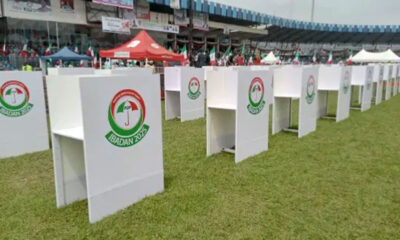
Yakubu stated this at the presentation of an electronic copy of the 93,469,008 voter register to leaders of political parties on Wednesday in Abuja.
He said that more than ever before, the commission was more prepared for the 2023 general elections and had now successfully implemented 11 out of the 14 activities on schedule for the elections.
“Already, substantial quantities of sensitive and non-sensitive materials have been deployed to various locations across the country.
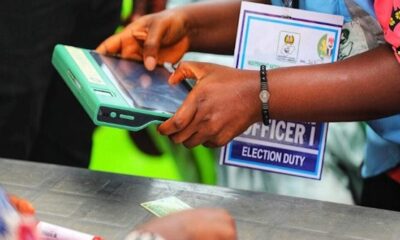
“The last batch of the Bimodal Voter Accreditation System (BVAS) has been received while the ongoing configuration of the critical technology in readiness for elections will soon be completed.
“In the last two days, we commenced the airlifting of other sensitive materials to States across the country.
READ ALSO:
- Edo Train Attack: 13 victims still in train attackers’ captivity
- Court voids law prohibiting unmarried police officers from getting pregnant
- Fire razes mosque, 4 rooms in Kwara
“Already, some of the materials for 17 States in three geo-political zones have been delivered. Furthermore, 13,868,441 Permanent Voters’ Cards (PVCs) have been printed, delivered to States and are being collected by citizens as new voters or by existing voters who applied for transfer or replacement of cards as provided by law,” he said.
He added that similarly, following the display of the voters’ register nationwide and the conclusion of claims and objections by citizens, a new national register of voters has been compiled.
“In short, at no time in the recent history of the Commission has so much of the forward planning and implementation been accomplished 44 days ahead of a General Election.
“Therefore, the commission is not contemplating any adjustment to the election timetable, let alone the postponement of the General Election.
“For the avoidance of doubt, the Presidential and National Assembly elections will hold on Saturday, Feb. 25, 2023, while Governorship and State Assembly elections will hold two weeks later on Saturday, March 11, 2023.
“The repeated assurance by the security agencies for the adequate protection of our personnel, materials and processes also reinforces our determination to proceed.
“The 2023 General Election will hold as scheduled. Any report to the contrary is not the official position of the Commission.’’
Ineligible persons on voters’ register
On the registered voter, Yakubu said after the cleaning up of the data from the last Continuous Voter Registration (CVR) from June 2021 to July 2022, where 9,518,188 new voters were added to the existing 84,004,084 voters, the preliminary register of voters was 93,522,272.
READ ALSO:
- Tension as tanker drivers block Zaria-Kano highway over ‘killing’ of colleague
- Two Access Bank workers Jailed for N9.4m fraud
- NNPP deputy governorship candidate sold his ticket, abandoned party – Prof. Alkali
He said that when the register was presented to Nigerians for claims and objections as required by law, INEC received 53,264 objections from Nigerians to the prevalence of ineligible persons on the register by virtue of age, citizenship or death, which were verified and removed from the register.
“Consequently, the register of voters for the 2023 General Election stands at 93,469,008. Of this cumulative figure, 49,054,162 (52.5 per cent) are male while 44,414,846 (47.5 per cent) are female.
“The distribution by age group shows that 37,060,399 (39.65 per cent ) are youth between the ages of 18 and 34; 33,413,591 (35.75 per cent ) are middle-aged persons between the ages of 35 and 49; 17,700,270 (18.94 per cent ) are elderly voters between the ages of 50 and 69 while 5,294,748 (5.66%) are senior citizens aged 70 and above.
“In terms of occupational distribution, students constitute the largest category with 26,027,481 (27.8%) of all voters, followed by 14,742,554 (15.8 per cent ) Farmers/Fishermen and 13,006,939 (13.9 per cent) housewives.
“The data on disability was not collected for previous registration. However, the cumulative figure of 85,362 persons from the recent CVR indicates that there are 21,150 (24.5 per cent ) persons with Albinism; 13,387 (15.7 per cent ) with physical impediment and 8,103 (9.5 per cent) are blind.”
Yakubu said that the softcopy of the breakdown and analysis would be uploaded to the INEC website and social media platforms shortly.
He reiterated INEC’s commitment to a transparent, credible and inclusive 2023 General Election, saying INEC would continue to take every step to protect the sanctity of the votes cast by citizens and to deal with infractions. (NAN)/Daily Trust






Politics
Atiku Has Less Than 1% of Tinubu’s War Chest — Dele Momodu

Atiku Has Less Than 1% of Tinubu’s War Chest — Dele Momodu
A chieftain of the African Democratic Congress (ADC), Dele Momodu, has said former Vice President Atiku Abubakar does not possess the financial strength required to compete effectively with Bola Ahmed Tinubu in the 2027 presidential election. Momodu, publisher of Ovation International magazine and a former presidential aspirant, made the remarks during a guest appearance on Politics Today, a political programme on Channels Television, where he discussed Nigeria’s political climate ahead of the next general election.
During the interview, Momodu warned that Nigeria risks drifting toward a one-party state, comparing the current political atmosphere to the era of former military ruler Sani Abacha. According to him, the ruling All Progressives Congress (APC) currently enjoys overwhelming political and financial advantages, which could make it difficult for opposition figures to mount a strong challenge. “I will describe this moment as being worse than that of the Abacha government. Many people are worried that we now have virtually a one-party state,” Momodu said. He further argued that President Tinubu commands enormous financial and political resources that potential challengers may struggle to match. “Atiku does not have one per cent of Tinubu’s war chest. No, he doesn’t have it. You can imagine how much Tinubu can generate from Lagos State alone, not to talk of the nation. And when you have an absolute ruler, everything is available to him,” he added.
READ ALSO:
- Peter Obi a Political Liability in the North, Says Reno Omokri
- NCDC Raises Alarm as 37 Health Workers Contract Lassa Fever in 2026
- AfDB Approves $5.52m Grant to Boost Tax Administration Across West Africa
Despite his comments on the financial gap between the two camps, Momodu insisted that his support for Atiku remains genuine and rooted in his belief in strong opposition politics in Nigeria. He dismissed speculation that he might betray the former vice president or secretly align with the ruling party, saying he had never attended any covert meeting without Atiku’s knowledge. “It’s easier for me to move to Tinubu than to move to Atiku. I’m one million times closer to Tinubu than to Atiku. In fact, people were telling Atiku that Dele is Tinubu’s spy till today. Don’t trust him,” Momodu said. “But there is nothing to spy on. I have not attended any secret private meeting without Atiku. If I’m with Atiku, that should show you that we are people who have a genuine interest in the country.”
Momodu also rejected claims that opposition figures are afraid of President Tinubu, arguing instead that the administration may be worried about public dissatisfaction over economic hardship. “You asked who is afraid of Tinubu. I would like to answer that question. It is Tinubu who is afraid of Nigerians. That is why they are cooking all kinds of cocktails, which you call strategy,” he said. He criticised the government’s handling of economic challenges, claiming many Nigerians are facing severe hardship while the administration appears disconnected from the realities on the ground. “Nigerians are suffering. I think the Tinubu government is living on another planet. They are not being realistic and have their own delusion of grandeur,” he added.
Momodu’s comments come as political discussions intensify ahead of the 2027 presidential election, with opposition parties exploring alliances and strategies that could challenge the dominance of the APC. In the 2023 presidential election, Tinubu defeated Atiku of the Peoples Democratic Party (PDP) and Peter Obi of the Labour Party, in a tightly contested race that reshaped Nigeria’s political landscape. Political analysts say the debate over funding, coalition-building, and candidate selection is likely to intensify in the coming years as opposition figures attempt to consolidate support across Nigeria’s diverse political and regional blocs.
Atiku Has Less Than 1% of Tinubu’s War Chest — Dele Momodu
Politics
Peter Obi a Political Liability in the North, Says Reno Omokri
Peter Obi a Political Liability in the North, Says Reno Omokri
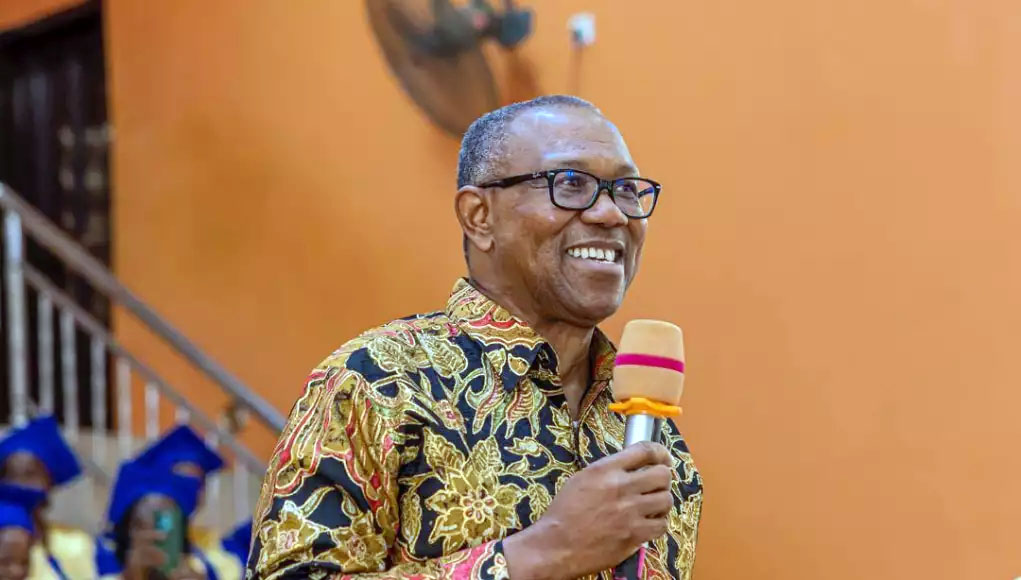
Former presidential aide Reno Omokri has described former Labour Party presidential candidate Peter Obi as a political liability, warning that selecting him as a running mate could weaken the political prospects of former Vice President Atiku Abubakar in the 2027 presidential election.
Omokri, who served as a media aide to former President Goodluck Jonathan and is Nigeria’s ambassador-designate to Mexico, made the remarks in a post on X (formerly Twitter) while reacting to comments by media entrepreneur Dele Momodu about possible opposition alliances ahead of the next general election.
In his post, Omokri warned that a potential Atiku–Obi ticket could alienate voters in northern Nigeria, including in Atiku’s home state of Adamawa, due to what he described as lingering political and religious sensitivities in the region.
“With all due respect, if Waziri Atiku Abubakar makes the mistake of running with Peter Obi in 2027, he may lose even Adamawa because of the political liability that Peter Obi has become in the North,” Omokri wrote.
He added that although he holds Atiku in high regard, the suggestion that an Atiku–Obi ticket could defeat President Bola Tinubu misunderstands the political realities of northern Nigeria, where religion, identity, and past events often influence electoral decisions.
READ ALSO:
- NCDC Raises Alarm as 37 Health Workers Contract Lassa Fever in 2026
- AfDB Approves $5.52m Grant to Boost Tax Administration Across West Africa
- BREAKING: Several Passengers Injured as Abuja–Kaduna Train Derails After Collision
According to Omokri, some voters in Adamawa State still harbour resentment over Obi’s reaction to the 2021 killing of Ahmed Gulak, a former presidential aide who was shot dead by gunmen in Owerri, Imo State.
Gulak, a politician from Adamawa, was attacked while travelling to the airport during a visit to the state. The incident sparked national outrage and intensified security concerns in the South-East.
Omokri also referenced the 2022 killing of Harira Jubril and her children in Anambra State, arguing that Obi’s reaction to the incident contributed to negative perceptions among some northern communities.
He claimed that the murder, which authorities linked to criminal elements suspected to have connections with the Indigenous People of Biafra (IPOB) and its armed wing, the Eastern Security Network (ESN), heightened tensions and influenced political sentiment in the North.
“Now add that to the repeat of the same behavior after the murder of Harira and her underage children by suspected IPOB/ESN elements in Peter Obi’s home state and his refusal to condemn the incident, and anybody tying themselves to Peter Obi is playing with fire,” Omokri wrote.
He further argued that symbolic political gestures such as visits to mosques or community donations would not necessarily erase past grievances among some northern voters.
“Nigeria, as one of the most multicultural, multireligious, multiethnic and multiracial countries on Earth, needs leaders who are sensitive to these differences,” he added.
The comments come amid growing discussions among opposition figures about possible alliances ahead of the 2027 presidential election, following the 2023 poll won by Bola Ahmed Tinubu of the All Progressives Congress (APC).
Political observers say the debate reflects the ongoing realignment within Nigeria’s opposition bloc as parties and political actors consider coalition strategies that could challenge the ruling party in the next electoral cycle.
Supporters of Peter Obi, however, have repeatedly dismissed such criticisms, pointing to the “Obidient movement”, which mobilised millions of young voters and helped the Labour Party achieve significant electoral gains in the 2023 general election.
Analysts note that any potential opposition alliance ahead of 2027 would likely require complex negotiations across regional, religious and political lines in Nigeria’s highly diverse political landscape.
Peter Obi a Political Liability in the North, Says Reno Omokri
Politics
ADC: Appeal Court Did Not Sack David Mark, Aregbesola

ADC: Appeal Court Did Not Sack David Mark, Aregbesola
The African Democratic Congress (ADC) has dismissed claims that its National Chairman, David Mark, and National Secretary, Rauf Aregbesola, were removed from office following a recent judgment by the Court of Appeal of Nigeria.
In a statement issued on Saturday, the party described the reports as misleading and inaccurate, insisting that the appellate court did not make any ruling that affects the current leadership of the party.
The ADC’s National Publicity Secretary, Bolaji Abdullahi, clarified that the court only addressed procedural issues in the case and did not determine the substantive dispute over the party’s leadership.
According to him, the lawsuit challenging the emergence of David Mark as National Chairman and Rauf Aregbesola as National Secretary is still pending before the Federal High Court of Nigeria and has not yet been heard on its merits.
Abdullahi explained that the Court of Appeal judgment did not grant any relief to the plaintiff and did not issue any directive affecting the leadership structure of the party.
“Having carefully studied the judgment, we wish to state unequivocally that the Court of Appeal did not determine the substantive dispute regarding the leadership of the ADC,” Abdullahi said.
READ ALSO:
- Nigerians Among 141 Injured As UAE Intercepts Iranian Missiles
- Old Dominion University Shooting: Terrorism Suspect Had Links to Nigeria-Based ISIS
- Heartbreaking Video: Mother of Nigerian Soldier Curses Govt Over Poor Troop Welfare
He added that the court instead directed all parties involved in the matter to maintain the status quo, meaning that the current leadership structure of the African Democratic Congress remains unchanged until the case is fully determined by the Federal High Court.
The party therefore urged members and supporters not to panic or be misled by misinterpretations of the judgment, stressing that the ruling does not affect the legitimacy or tenure of the current national leadership.
Abdullahi also noted that internal legal disputes are not unusual in political organisations, adding that such matters should not be interpreted as a collapse of the party’s leadership.
He said the ADC remains united and focused on strengthening its political structures ahead of future elections, despite what he described as attempts by “anti-democratic forces” to destabilise opposition parties.
David Mark, a former President of the Senate of Nigeria, and Rauf Aregbesola, a former governor of Osun State and former Minister of Interior, currently lead the national structure of the African Democratic Congress as part of the party’s efforts to reposition itself in Nigeria’s political landscape.
The party reiterated that the directive to maintain the status quo means the existing leadership remains fully in place until the Federal High Court delivers a final judgment on the matter.
ADC: Appeal Court Did Not Sack David Mark, Aregbesola

-

 metro8 hours ago
Just In: Federal Govt Announces Public Holidays for Eid-el-Fitr
-

 Railway2 days ago
BREAKING: Several Passengers Injured as Abuja–Kaduna Train Derails After Collision
-

 metro1 day ago
Court Screens Video Showing NDLEA Allegedly Helping Cocaine Smugglers at Enugu Airport
-
 International2 days ago
Iran–Israel Conflict Escalates As IRGC Threatens To Kill Netanyahu
-

 News16 hours ago
Maiduguri Bombings: Shocking Trump–Tinubu Claim Goes Viral — Fact or Fabrication?
-
 metro2 days ago
Tinubu Orders Nationwide Free Rice Distribution for Ramadan, Lent Support
-
 Education2 days ago
Students expelled as police probe viral assault at Igbinedion School
-
 International2 days ago
Netanyahu dispels death rumours, appears in video from Coffee Shop