960 APC members defect to NNPP in Kano - Newstrends
Connect with us

Politics

960 APC members defect to NNPP in Kano

Published

on

960 APC members defect to NNPP in Kano

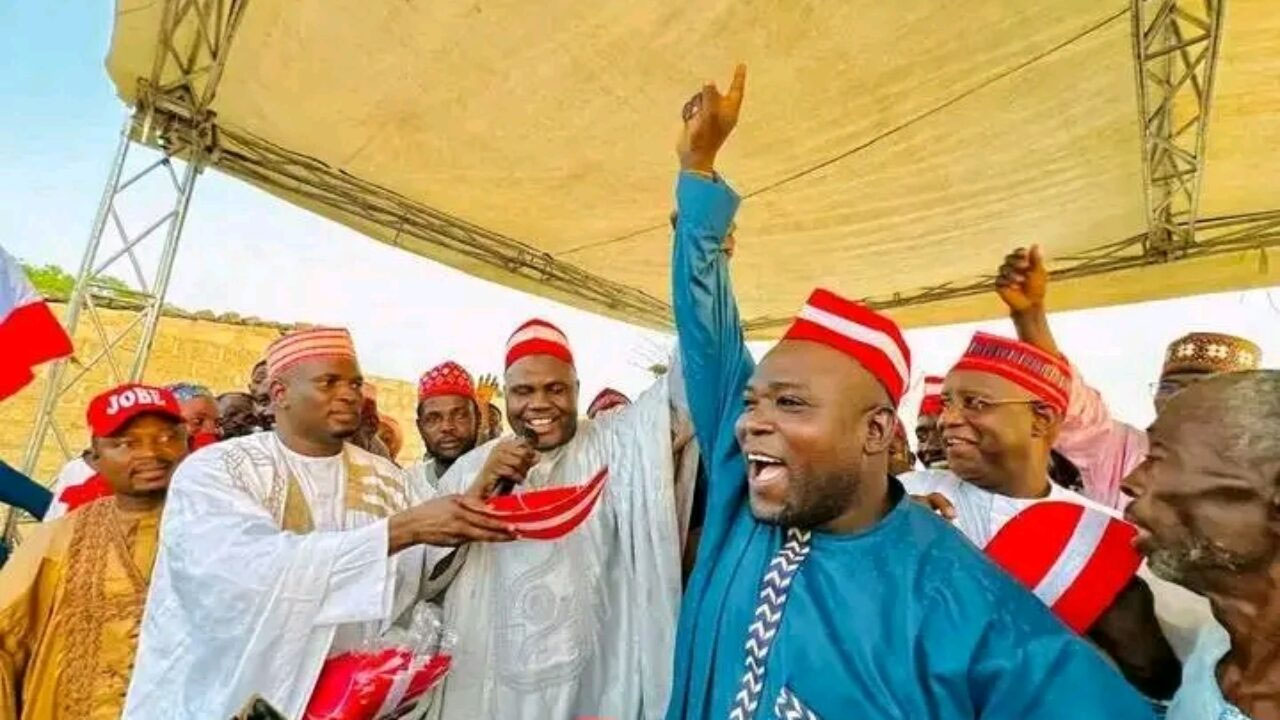
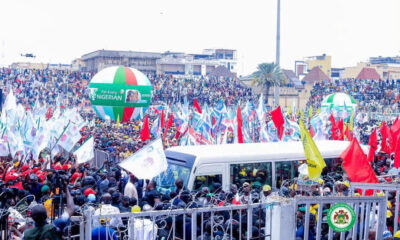
In a significant political shift in Kano State, over 960 members of the All Progressives Congress (APC), led by Alhaji Baba Sabiu, Chairman of the party in Dala Local Government Area, have defected to the New Nigeria Peoples Party (NNPP).

The defection comes ahead of the upcoming local government elections slated for October 26.

The defectors, including former councillors from 12 wards in the Dala LGA, cited a need for progressive change as their reason for joining the NNPP.

Alhaji Sabiu, speaking on behalf of the group, expressed confidence in the NNPP’s ability to bring about meaningful reforms and bolster its chances in the polls.

READ ALSO:

Senator Rabiu Musa Kwankwaso, the National Leader of the NNPP, warmly welcomed the new members, assuring them that they would be treated equally within the party.

He reiterated the NNPP’s commitment to fostering socio-economic and political advancement for Nigeria, with a clear focus on the 2027 agenda.

“NNPP is dedicated to promoting unity and driving Nigeria towards greater progress,” Kwankwaso stated, urging Kano residents and Nigerians nationwide to rally behind the party’s candidates in the forthcoming elections.

He called on voters to come out en masse and support the NNPP, emphasizing the party’s vision for a stronger, united Nigeria.


960 APC members defect to NNPP in Kano

Loading

Politics

Tinubu hits Atiku hard, says: ‘I’m clearing the mess you created’

Published

on

Tinubu hits Atiku hard, says: ‘I’m clearing the mess you created’
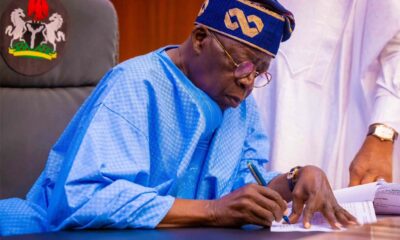
President Bola Tinubu and Former Vice President, Atiku Abubakar

Tinubu hits Atiku hard, says: ‘I’m clearing the mess you created’

President Bola Tinubu has intensified his criticism of African Democratic Congress (ADC) presidential candidate Atiku Abubakar, accusing the former vice president of leaving behind huge unpaid pension liabilities after overseeing the privatisation of federal government enterprises during the administration of former President Olusegun Obasanjo.

The President said his administration is now paying pension arrears and addressing long-standing obligations neglected for years, insisting that Nigerians are more interested in economic stability and improved social welfare than political rhetoric.

Tinubu made the remarks on Friday at the Presidential Villa, Abuja, during separate meetings with members of the Nigerian Diaspora Medical Association (NDMA) and leaders from the North-East, who visited to appreciate him for retaining Vice President Kashim Shettima as his running mate ahead of the 2027 presidential election.

Speaking on his administration’s economic reforms, Tinubu said the government remains committed to stabilising the economy despite inheriting significant fiscal and structural challenges.

According to him, the difficult policy decisions taken since assuming office are aimed at restoring investor confidence, strengthening public finances and creating a more sustainable economy for Nigerians.

“The old age is here now. If you can stabilise the economy, Nigerians are not asking for too much—simple stability and social welfare,” Tinubu said.

Without initially mentioning Atiku by name, the President accused one of his expected political challengers of supervising the privatisation of government-owned enterprises while failing to ensure workers received their pension entitlements.

“Somebody among my prospective opponents privatised government investment in public entities but forgot to pay the pension. I’m clearing the pensioners now, so clearing the mess they created,” Tinubu stated.

READ ALSO:

The remarks are widely seen as a direct reference to Atiku, who served as Nigeria’s Vice President between 1999 and 2007 and chaired the National Council on Privatisation (NCP) under the Obasanjo administration.

During that period, the council supervised the sale, concession or commercialisation of more than 100 federal government enterprises, including Nigeria Airways, NITEL, Nigerian Telecommunications Limited, Nigerian National Shipping Line and several manufacturing, hospitality and utility companies.

While the privatisation programme was designed to improve efficiency and reduce government spending, it also resulted in the restructuring or closure of several public enterprises. Thousands of workers exited the organisations, with labour unions and affected employees raising concerns over delayed pensions, gratuities and severance benefits that remained unresolved for years.

Successive administrations have continued to make payments to clear some of the outstanding liabilities.

Tinubu maintained that his administration is committed to resolving inherited challenges while implementing reforms aimed at rebuilding the economy.

The President also called for greater national unity in addressing security challenges, particularly terrorism and banditry in the North-East.

He urged political leaders, traditional rulers and community stakeholders to work together in supporting ongoing efforts by security agencies to restore peace across affected communities.

“The leadership of the North-East is challenged because of terrorism and banditry. I could see a collaboration that would work together. Only if we stick together, work together and face the challenges the best way possible as a united country,” he said.

Tinubu also reflected on his professional experience in the United States before returning to Nigeria, describing his years in accounting and finance as instrumental in shaping his approach to leadership.

“There is nowhere like home. I have experienced being in America and have taken the best of America in my chosen profession, accountancy and finance. Where can I apply it best after initial training with Deloitte & Touche? I can’t forget the Standard Oil Building in Chicago and my first week there,” he said.

The President’s comments come amid escalating political exchanges between the Presidency and Atiku’s camp over Tinubu’s decades-old civil forfeiture case in the United States.

Earlier on Friday, Atiku’s Special Adviser on Public Communication, Phrank Shaibu, challenged the Presidency to release documentary evidence instead of issuing public statements defending the President.

In a post on X directed at Presidential spokesman Bayo Onanuga, Shaibu argued that the matter had become “a contest of evidence” and urged the Presidency to publish documents it believes would settle the controversy.

His remarks followed Onanuga’s allegation that Atiku spent $1.2 million on American lobbyists to revive Tinubu’s 1993 civil forfeiture case. The Presidency has dismissed the renewed controversy, insisting that the matter was resolved decades ago and that the President remains focused on governance and delivering his reform agenda.

With political activities gathering momentum ahead of the 2027 general election, the latest exchange underscores the growing rivalry between Tinubu and Atiku as both camps continue to trade accusations over governance, accountability and Nigeria’s economic future.

Tinubu hits Atiku hard, says: ‘I’m clearing the mess you created’

Loading

Continue Reading

Politics

Atiku denies Obasanjo’s N5m bribery claim, links accusation to 2027 presidential race

Published

on

Atiku denies Obasanjo’s N5m bribery claim, links accusation to 2027 presidential race
Atiku Abubakar and Olusegun Obasanjo

Atiku denies Obasanjo’s N5m bribery claim, links accusation to 2027 presidential race

Former Vice President and African Democratic Congress (ADC) presidential candidate, Atiku Abubakar, has rejected allegations by former President Olusegun Obasanjo that he bribed the late Speaker of the House of Representatives, Ghali Umar Na’Abba, with N5 million to initiate impeachment proceedings against him, describing the claims as politically motivated and aimed at rewriting history ahead of the 2027 general election.

Atiku made the remarks in a statement titled “The Grave Is Not A Witness Box,” issued on Friday by his Senior Special Assistant on Public Communication, Phrank Shaibu, in response to allegations made by Obasanjo during the public presentation of his newly released memoir.

The former Vice President expressed concern that Obasanjo chose to raise the allegation only after the death of Na’Abba, arguing that the late lawmaker was no longer alive to either confirm or deny the claims.

According to Atiku, invoking a deceased person as the principal witness in such a serious allegation denies Nigerians the opportunity to hear the full account of events.

“As Africans, we understand the solemn duty of speaking truthfully about the dead. It is therefore deeply troubling that former President Obasanjo has chosen this moment to allege that I gave the late Rt. Hon. Ghali Umar Na’Abba a bribe to impeach him,” Atiku said.

He questioned why the allegation was never made while Na’Abba was alive.

“If this allegation were true, why did he never make it while Rt. Hon. Na’Abba was alive? Why wait until the only man who could confirm or refute the claim has departed this world? By invoking a deceased man as the principal witness to such a grave allegation, former President Obasanjo has denied Nigerians the opportunity of hearing the other side of the story.”

The ADC presidential candidate maintained that if such a bribery incident had truly occurred during the Obasanjo administration, appropriate legal and institutional measures would have followed.

He argued that no criminal investigation, prosecution, judicial pronouncement or official report had ever established that he bribed Na’Abba or orchestrated an impeachment plot against the former President.

READ ALSO:

Atiku further alleged that the timing of the accusation, coming as political alignments ahead of the 2027 presidential election gather momentum, suggested an attempt to influence public opinion and weaken his political standing.

“Coming at a time when the political landscape ahead of the 2027 general election is taking shape, the obvious objective is to besmirch my person and reputation and confer an undeserved political advantage on the former President’s kinsman. Nigerians, however, know better. They are too discerning to be distracted by stale allegations resurrected for political convenience.”

The former Vice President also revisited the political disagreements that marked his relationship with Obasanjo while they served in office, insisting that their fallout stemmed largely from his opposition to the former President’s controversial third-term agenda.

According to Atiku, he chose to defend constitutional democracy and the rule of law instead of supporting any move to extend presidential tenure beyond constitutional limits.

“My offence was that I stood firmly against the unconstitutional third-term agenda. As a democrat, I chose the path of constitutionalism and the rule of law. Rather than surrender democratic principles on the altar of personal ambition, I defended the Constitution and successfully asserted my rights through the courts in a series of landmark legal victories against a sitting President.”

He added that those legal battles had become an important chapter in Nigeria’s democratic history and suggested that lingering political differences continued to shape Obasanjo’s perception of him.

Atiku said he would not allow disputes from more than two decades ago to distract attention from the pressing challenges facing Nigerians, including rising inflation, food insecurity, public debt, unemployment and insecurity.

“The task before leaders today is not to rewrite history but to rescue the future. Nigerians are more interested in knowing why food prices continue to soar, why public debt continues to rise despite increased revenues, and why scandal after scandal continues to trail the current administration than in revisiting political disagreements from over two decades ago.”

He also stated that Obasanjo was entitled to support any candidate in the 2027 presidential election, but urged the former President to openly declare his preferred aspirant rather than make allegations he described as unfounded.

“If former President Obasanjo has chosen to take a political position ahead of 2027, he should simply declare it and allow Nigerians to make their judgment based on the issues, records and vision presented by those seeking to lead the country.”

The response followed comments made by Obasanjo during the unveiling of his memoir, in which the former President alleged that Atiku secretly backed an impeachment plot against him during his first term in office.

Obasanjo claimed that Atiku invited the late Speaker, Ghali Umar Na’Abba, to his office while he was away from Abuja and allegedly handed him N5 million to commence impeachment proceedings. According to the former President, the alleged meeting was later reported to him by his then Chief of Staff, whom he described as a professional intelligence officer.

The renewed exchange has brought back one of the most enduring political rivalries in Nigeria, with both leaders once serving on the same presidential ticket before their relationship deteriorated during Obasanjo’s second term in office.

As political activities ahead of the 2027 general election continue to gather pace, the latest war of words between the two prominent politicians is expected to fuel fresh debate over Nigeria’s political history, accountability and leadership.

Atiku denies Obasanjo’s N5m bribery claim, links accusation to 2027 presidential race

Loading

Continue Reading

Politics

Court Stops EFCC’s “Fishing Expedition” as Makinde Links Probe to APC Warning Over 2027 Election

Published

on

Court Stops EFCC's "Fishing Expedition" as Makinde Links Probe to APC Warning Over 2027 Election
Governor of Oyo State, Engr. Seyi Makinde

Court Stops EFCC’s “Fishing Expedition” as Makinde Links Probe to APC Warning Over 2027 Election

Oyo State Governor, Seyi Makinde, has alleged that a chieftain of the All Progressives Congress (APC) warned him against contesting the 2027 presidential election against President Bola Tinubu, just one day before the Economic and Financial Crimes Commission (EFCC) requested extensive financial records from his administration.

Makinde disclosed this in his July 2026 monthly newsletter while reacting to Wednesday’s judgment of the Federal High Court sitting in Ibadan, which restrained the EFCC from proceeding with aspects of its planned investigation into the finances of the Oyo State Government. The governor said the warning came on June 1, 2025, shortly after President Tinubu had been endorsed by the APC as its sole presidential candidate for the 2027 election.

According to Makinde, the sequence of events began after he appeared on Channels Television on April 15, 2025, where he responded to a question on his presidential ambition, stating that he had the capacity to occupy the highest office in the country, although he had not formally declared his intention to run. The governor said political reactions followed the interview, and on June 1, 2025, an APC chieftain publicly warned him against contesting the presidency, describing such a candidacy as “an exercise in futility” and advising the opposition not to waste its time. The warning came shortly after the APC endorsed President Bola Tinubu as its sole presidential candidate for the 2027 election. “The following day, 2 June 2025, the EFCC wrote to the Accountant-General of Oyo State demanding copies of every contract involving the Oyo State Government and details of all transactions and payments made to contractors from 2021 to the date of its letter. No contractor was identified. No company was named. No questionable transaction or alleged offence was stated.” Makinde said his administration did not refuse to cooperate with the anti-graft agency but instead asked the EFCC to specify the contractors, companies, or transactions under investigation so that the relevant documents could be provided. “The EFCC did not respond, prompting the Oyo State Government to seek judicial interpretation of whether such a broad request was lawful,” he added.

READ ALSO:

The Federal High Court delivered judgment in suit number FHC/IB/CS/61/2025, filed by the Oyo State Government against the anti-graft agency. Justice Nkeonye Maha, who delivered the judgment on Wednesday, July 22, 2026, acknowledged the EFCC’s statutory powers to investigate financial crimes but held that such powers must be exercised in accordance with the Constitution and the rule of law. According to a statement by Makinde’s Special Adviser on Media, Sulaimon Olarenwaju, the court found that “The EFCC’s proposed investigation into Oyo State’s finances, particularly the demands contained in its letter of 2 June 2025, was speculative and amounted to a fishing expedition. His Lordship noted that the constitutional rights of the plaintiffs to fair hearing could not be trampled upon under the guise of investigation.” The court held that any request for information by the EFCC must be reasonable and linked to identifiable allegations or offences under the EFCC Act. Justice Maha ruled that Section 38 of the EFCC Act empowers the Commission to obtain information only for the purpose of investigating offences within its jurisdiction and does not authorise speculative or blanket investigations into the affairs of individuals or institutions. The judge set aside the EFCC’s letter dated June 2, 2025, and declared that any request by the Commission must be reasonable and tied to specific allegations.

Makinde stressed that his administration was not opposed to accountability or legitimate scrutiny and that no government should be shielded from investigation. However, he argued that such probes must be based on identifiable facts. “Accountability must be evidence-based,” he said, warning against broad investigations conducted merely in the hope of discovering wrongdoing. The governor described the court’s judgment as “a victory for the rule of law, not against the EFCC,” saying it reinforces the principle that government institutions, including law enforcement agencies, must operate within established constitutional and legal boundaries. “No government should be beyond legitimate investigation. Our administration is not beyond scrutiny, and we have never asked to be. But accountability must be based on evidence. An investigation should not begin with a blanket search through years of records in the hope that something incriminating might eventually be found.” Makinde said he would not speculate on the motive behind the EFCC’s letter but invited Nigerians to consider the sequence of events and draw their own conclusions. “Perhaps the timing of the EFCC’s letter was coincidental. I will not speculate about motives. Nigerians can consider the chronology and reach their own conclusions.”

Meanwhile, the Oyo State chapter of the APC has condemned the court ruling, describing it as a setback for accountability. The party’s Publicity Secretary, Wasiu Sadare, alleged that Governor Makinde was making desperate efforts to prevent the EFCC from examining the financial records of his administration. “The question on the lips of many patriots now is: Why would a governor be afraid to render an account of resources entrusted to him for the benefit of the citizenry? What size of skeleton does Governor Makinde have in the cupboard that he is keeping away from us?” the APC stated. The APC listed several projects it claimed would eventually come under investigation, including the exercise book printing contract, rehabilitation of the Lekan Salami Stadium, the Circular Road project, renovation of the Agodi Government House, construction of bus terminals, upgrade of Alakia Airport, and alleged unremitted deductions from workers’ salaries. “The truth is that he can only run but he cannot hide. EFCC and other anti-graft agencies will do their work at the appropriate time, and all the lid will be blown open,” the party added. In response, Makinde’s administration dismissed the allegations, insisting that its decision to approach the court was not an attempt to stop any investigation but to seek judicial clarification. The government stated that Governor Makinde has managed the state’s resources prudently and has nothing to hide. “Seeking judicial interpretation of the EFCC’s powers is neither cowardice nor an act of fear. Governor Makinde and the Oyo State Government are not afraid of the EFCC or any other federal agency. The state’s account books will be made available whenever a proper and lawful request is made.” The government added that the APC’s claim that Makinde’s decision to seek judicial intervention amounts to avoiding investigation is “both misleading and legally unfounded. Resorting to the courts is not an admission of guilt but a constitutional right guaranteed under Nigerian law.” The governor also addressed speculation about his presidential ambition, saying: “Let me be clear: I did not step forward in order to step down. I am going forward. I am going forward because Nigerians deserve better.” He added that Nigerians deserve institutions that serve the law rather than political interests and leaders who will defend the public interest even when doing so is inconvenient.

Court Stops EFCC’s “Fishing Expedition” as Makinde Links Probe to APC Warning Over 2027 Election

Loading

Continue Reading

Trending