
Business
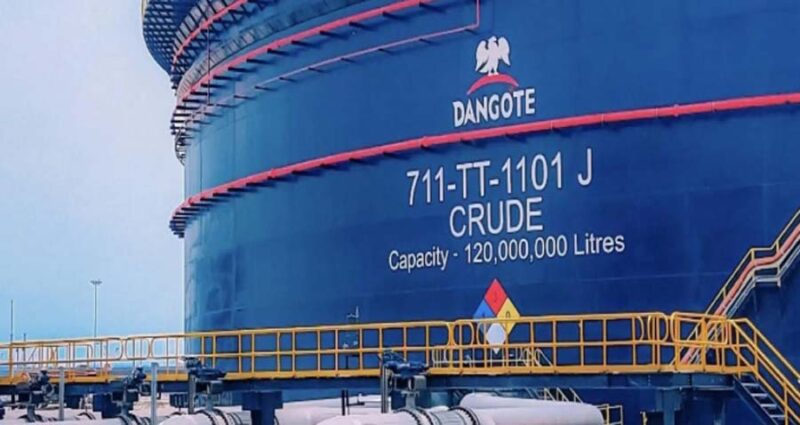
Dangote says his refinery currently stores N600bn petrol
Dangote says his refinery currently stores N600bn petrol
President of Dangote Industries Limited (DIL), Aliko Dangote, has assured that the Dangote Petroleum Refinery has sufficient Premium Motor Spirit (PMS), commonly known as petrol, in storage to meet Nigeria’s domestic demand.
Speaking over the weekend, Dangote disclosed that the refinery currently holds more than half a billion litres of petroleum products, valued at over N600 billion.
He stated, “…as we speak right now we have more than half a billion litres. The Refinery is producing enough refined products, like gasoline, diesel, and kerosene, to meet 100 per cent of Nigeria’s requirements.”
Dangote emphasized that the refinery project is not solely for Nigeria but serves the African continent as well. He said, “This refinery is not only for Nigeria; it is for Africa. We must sustain the African Continental Free Trade Area (AfCFTA) deal. We are trying to see how we trade with other African countries.”
His remarks followed a tour of the refinery complex by a delegation from Zambia, led by the country’s Minister of Energy, Mr. Makozo Chikote. The visit was aimed at exploring potential collaborations in the energy sector.
READ ALSO:
- Army destroys 18 illegal refineries in Niger Delta
- US agencies resist Musk’s employee accountability mandate
- Makinde warns APC against turning Osun to wild, wild west
After the tour, Chikote commended Dangote’s vision, saying, “In Zambia, we created an environment for the private sector to participate in the growth and development of our country. Currently, 100 per cent of our petroleum is done by the private sector. We are targeting increased productivity in mining, agriculture, and other sectors. Your presentation is an immediate solution to our energy needs. We are trying to promote competition among our private players.”
He further stated, “We are looking at Dangote coming on board, which would lead to efficient, reliable, quality, and competitive products, and we want these done like yesterday.”
Expressing optimism about intra-African trade, Chikote added, “From what we have seen, we need to promote trade within Africa to promote each other. We need these countries together to make Africa efficient, and a reliable trade hub. We have seen here that we can learn from what Dangote has done, and this would lead Africa and Africans to stand on their feet and not depend on overseas support in terms of trade.”
Another member of the Zambian delegation, Samuel Maimbo, Vice President of Budget, Performance Review, and Strategic Planning at the World Bank Group, echoed similar sentiments, emphasizing the need for private-sector-led development.
“There is also not enough government funding to develop Africa. The only way we can finance Africa’s growth at a pace and scale that solves our problem is by working through the private sector, which is why we are here today, to learn and to see what an ambitious programme looks like,” he stated.
READ ALSO:
- Gunmen shoot pastor, abduct 6 worshippers in Delta
- Truck ban will reduce fuel supply to North, NARTO warns FG
- 2025 hajj: NAHCON, Saudi company amend contract agreement
Speaking on the refinery’s production capacity, the Vice President of Dangote Industries Limited, Edwin Devakumar, highlighted its ability to produce high-quality refined products.
“The project concept was to process the crude from Nigeria and add value. But we also wanted to provide some flexibility to process most of the African crudes and some of the Middle Eastern crudes,” he said.
Devakumar explained, “In another concept, what we did was maximum value extraction. That is a process where every barrel of crude which goes in, the value addition should be the best.”
According to him, the refinery is well-positioned to supply both local and international markets. “The Refinery can meet all our requirements. 44 per cent can meet the entire requirements of Nigeria, and 56 per cent of the production would be exported. Every day, we produce lighter products of 104 million litres; 57 million litres of petrol every day; 20 million litres of jet fuel; and 27 million litres of diesel production.”
He further noted, “The local consumption is just around 46 million litres, and the remaining 58 million litres will be exported daily.”
The visit by the Zambian delegation underscores the growing recognition of Dangote Refinery’s role in Africa’s energy landscape and the potential for greater intra-African trade in the petroleum sector.
Dangote says his refinery currently stores N600bn petrol









Business
Cash vs Digital: Nigeria’s Cashless Dream Meets Street Reality

Cash vs Digital: Nigeria’s Cashless Dream Meets Street Reality
By Dr Ramanathan Murugesan, FCA, CPA
On a humid afternoon in Lagos, 24-year-old Adaeze sways inside a crowded danfo bus—one hand clinging to a metal rail, the other navigating her phone. Within seconds, she transfers her fare to the conductor. No notes. No coins. No delay.
A few kilometres away, at a roadside fruit stall, the future stalls.
A customer reaches for his phone. “Transfer?” he asks.
The vendor doesn’t hesitate. “No network. Bring cash.”
In that moment lies the paradox of modern Nigeria.
Digital payments are booming, yet cash refuses to fade. After more than a decade of policy reforms and fintech disruption, Africa’s largest economy is not cashless. It is something far more complex—a nation suspended between innovation and infrastructure, trust and uncertainty.
Policy spark, behaviour shift
Nigeria’s cashless journey began in 2012, when the Central Bank of Nigeria rolled out policies to curb cash usage and modernise payments.
On paper, the transformation is undeniable.
Data from the Nigeria Inter-Bank Settlement System shows electronic transactions rising steadily year after year. The NIBSS Instant Payment platform has become the backbone of real-time transfers, powering everything from salary payments to street-level commerce.
Traditional banks—Access Bank, Guaranty Trust Bank (GTBank), Zenith Bank, and United Bank for Africa (UBA)—have reinvented themselves as digital-first institutions. Alongside them, fintech disruptors like Flutterwave, Paystack, Opay, and PalmPay have democratised payments, turning smartphones into wallets.
READ ALSO:
- NAF Releases DSSC 34/2025 Successful Candidates List, Announces Training Date
- Netanyahu Condemns ‘Christian Persecution’ in Nigeria in Easter Message
- Gunmen Attack Kaduna Churches During Easter, Kill 7, Abduct Worshippers
In Nigeria’s cities, cash is no longer king—it is contested territory.
Fintech’s quiet revolution
If policy lit the spark, fintech fanned the flames.
For decades, millions of Nigerians existed outside the formal banking system. Fintech changed that—swiftly and at scale. With minimal paperwork and mobile-first platforms, financial services reached markets banks had long ignored.
Nowhere is this more visible than in the explosion of PoS agents. Across urban streets and rural corners alike, small kiosks double as micro-banks, handling deposits, withdrawals, and transfers.
For small businesses, this shift has been transformative. Digital payments reduce the risks of holding cash, expand customer options, and streamline operations.
Yet the revolution is uneven.
While Lagos and Abuja surge ahead, large parts of rural Nigeria remain on the margins—held back not by resistance, but by access.
Pandemic acceleration, structural exposure
Then came COVID-19—a crisis that doubled as a catalyst.
Lockdowns and health concerns pushed millions toward contactless payments. What began as necessity quickly hardened into habit, particularly among younger Nigerians.
E-commerce surged. Digital wallets swelled. Platforms like Flutterwave and Paystack recorded spikes in transaction volumes as businesses rushed online.
But beneath the growth lay fragility.
The system expanded faster than the infrastructure supporting it.
The naira redesign stress test
That fragility was laid bare during the 2022–2023 naira redesign.
As old notes were withdrawn and new ones rationed, Nigeria plunged into a cash crisis. ATMs ran empty. Banking halls overflowed. Frustration boiled over.
In desperation, millions turned to digital channels.
Transaction volumes surged—but so did failures.
Across banking apps and fintech platforms, transfers hung in limbo. Alerts delayed. Systems crashed under pressure. From GTBank to Opay, the message was the same: Nigeria’s digital rails were not yet built for shock.
The episode was more than a policy misstep—it was a stress test the system failed.
Infrastructure: The Achilles’ heel
At the heart of Nigeria’s cashless struggle lies a stubborn truth: infrastructure still lags ambition.
Unreliable electricity disrupts devices, servers, and networks. Patchy internet connectivity turns simple transfers into uncertain gambles. For millions, “transaction failed” is not an exception—it is routine.
For a roadside trader, a failed payment is not a technical glitch. It is lost income.
Cash, by contrast, is brutally simple. It works—every time.
Trust: The currency behind the currency
Beyond infrastructure lies an even more delicate issue: trust.
Digital systems promise speed, but not always certainty. Fraud, phishing, and account breaches continue to erode confidence. When transactions fail, reversals are often slow and opaque.
For many Nigerians—especially those outside the tech-savvy demographic—this uncertainty is costly.
Cash offers something digital still struggles to replicate: finality.
No pending alerts. No reversals. No doubt.
The informal economy’s quiet resistance
Any conversation about Nigeria’s payment future must confront its informal economy—vast, dynamic, and deeply cash-driven.
From open markets to roadside workshops, a significant share of economic activity operates beyond formal systems. Here, cash is not just convenient—it is strategic.
Digital payments leave trails. Cash offers discretion.
For many, the choice is not about technology, but about control.
Bringing this sector into the digital fold will require more than apps and policies. It will demand trust, incentives, and a system that works reliably at the last mile.
A nation split by access
Nigeria’s digital transition is also generational—and geographical.
Urban youth have embraced fintech with speed and ease. Smartphones, apps, and instant transfers are second nature.
But in rural communities and among older populations, adoption lags. Limited access to devices, connectivity, and digital literacy continues to widen the gap.
The result is not a unified shift, but a fragmented transition.
Cashless or cash-light?
So, has Nigeria gone cashless?
Not quite.
What has emerged instead is a “cash-light” economy—one where digital payments thrive, but cash remains indispensable.
Consumers toggle between both worlds. When networks are stable, digital wins. When systems falter, cash takes over.
This duality is not a failure. It is a reflection of reality.
The road ahead
Nigeria’s path to a truly cashless economy will not be decided by policy alone.
It will depend on power supply that does not fail, networks that do not drop, and systems that do not crash under pressure. It will require stronger consumer protection, faster dispute resolution, and deeper financial literacy.
Most importantly, it will demand trust—earned not through promises, but through performance.
An economy in motion
Nigeria is no longer where it was a decade ago. Digital payments have moved from the margins to the mainstream.
But cash remains embedded—resilient, reliable, and, for many, indispensable.
For now, the country exists between two financial realities—neither fully digital nor entirely cash-based.
It is an economy in motion, where the future of money is being shaped not just in boardrooms and policy circles, but in buses, markets, and roadside stalls.
And in Lagos, that future is decided every day—in a simple, familiar choice: Pay with a phone, or pay with cash.
Cash vs Digital: Nigeria’s Cashless Dream Meets Street Reality
Insurance
Lasaco Assurance Launches N18.47bn Rights Issue to Strengthen Capital Base
Lasaco Assurance Launches N18.47bn Rights Issue to Strengthen Capital Base
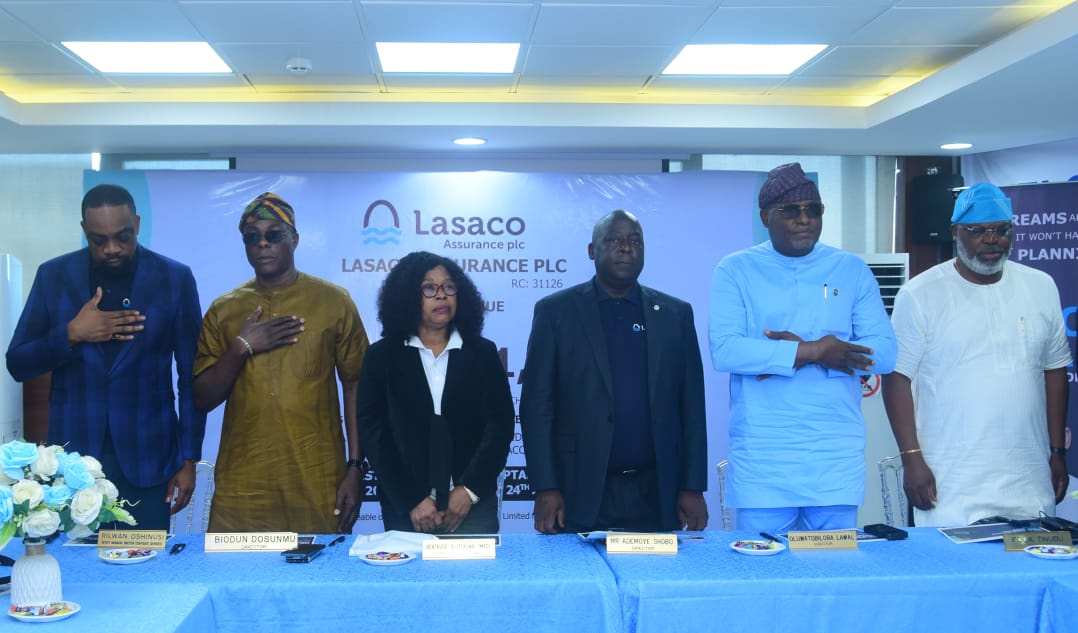
Lasaco Assurance Plc has unveiled a ₦18.47 billion rights issue, announcing plans to offer 9,236,321,546 ordinary shares as part of efforts to reinforce its capital base and drive future growth.
The announcement was made during a signing ceremony held at the company’s head office in Lagos, following approvals from the Nigerian Exchange Group (NGX) and the Securities and Exchange Commission (SEC).

Lasaco Assurance Plc
Prior to this development, the company had secured shareholder backing at an extra general meeting, where investors approved the move to raise fresh capital through a rights issue.
Under the terms of the offer, shares are priced at ₦2.00 per share, with each share having a nominal value of 50 kobo. The rights issue is structured on the basis of five new shares for every six existing shares held by shareholders.
According to details released by the insurer, eligibility is limited to shareholders whose names appeared on the company’s register as of the close of business on February 20, 2026. The acceptance list opened on April 2, 2026, and will close on April 24, 2026.
READ ALSO:
- ADC Crisis Deepens as Bala Denies Resignation, Insists on Chairmanship
- Ghana Sweeps Top Three Positions in 2025 WASSCE, Outshining Nigeria, Others
- Tinubu Approves 1,000 Forest Guards, Orders 5,000 CCTV Cameras to Boost Security in Plateau
The capital raise is expected to generate approximately ₦18.47 billion, which will be used to strengthen the company’s underwriting capacity and position it for expansion within Nigeria’s highly competitive insurance industry.
In addition, the rights offered will be tradable on the floor of the Nigerian Exchange Limited, allowing shareholders the flexibility to either subscribe to their allotted shares or sell their rights during the offer period.
Financial advisers to the transaction include Meristem Capital Limited as the Lead Issuing House and PAC Capital as Joint Issuing House.
The move aligns with broader efforts across the insurance sector to meet regulatory capital requirements, enhance balance sheets, and improve capacity to underwrite large-ticket risks across various sectors of the economy.
Speaking on the development, the Managing Director of Lasaco Assurance Plc, Mr. Ademoye Shobo, stated:
“At Lasaco, we will continue to ensure that our capital is always robust, so that we’re able to deliver on the mandates to the general public.”
Lasaco Assurance Launches N18.47bn Rights Issue to Strengthen Capital Base
Auto
Soaring Fuel Prices Drive Nigerians Toward Electric Vehicles
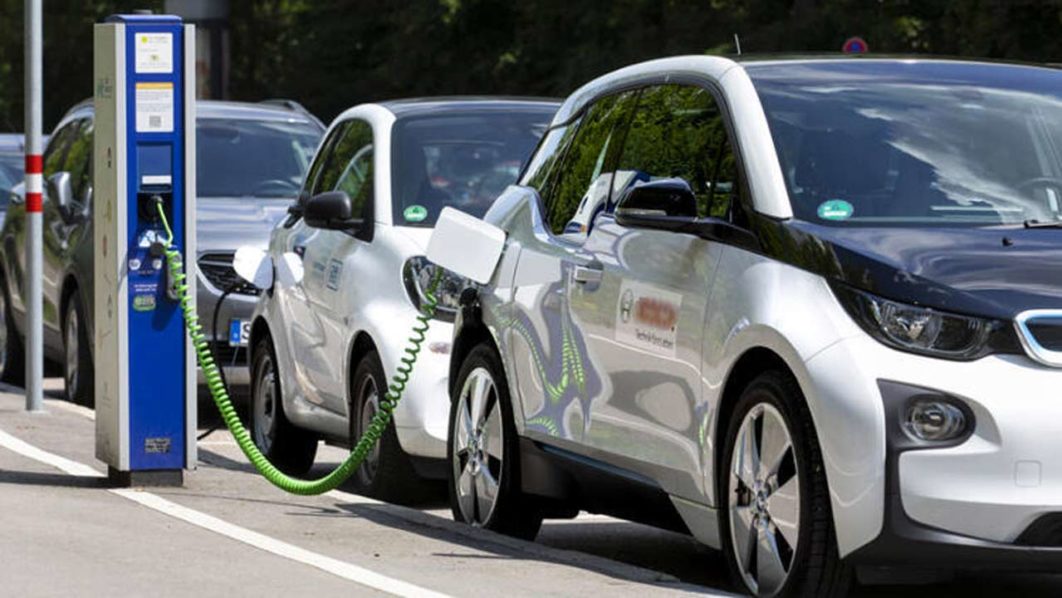
Soaring Fuel Prices Drive Nigerians Toward Electric Vehicles
Rising fuel prices in Nigeria are accelerating interest in electric vehicles (EVs) as households, transport operators, and businesses seek cost-effective alternatives to petrol- and diesel-powered cars. Experts say the spike in petrol costs is no longer just an economic concern but a turning point, pushing electric mobility from a futuristic idea into a practical solution for everyday commuting and commercial use.
At the Abuja Compact on Electric Mobility Roundtable, stakeholders highlighted how increasing transport expenses are reshaping decisions, especially among commercial drivers and small business owners. Rising fuel costs are prompting many Nigerians to see EVs as a survival strategy rather than a luxury option.
Chairman of the Presidential Initiative on Compressed Natural Gas and Electric Vehicles (Pi-CNG & EV), Ismaeel Ahmed, explained that the removal of fuel subsidies has widened the cost gap between petrol-powered vehicles and EVs. Charging an EV for a 200-kilometre journey costs around ₦4,500, compared to roughly ₦22,500 for petrol vehicles — a difference that offers a “strong economic incentive” influencing consumer choices. Ahmed added that the federal government is pursuing a balanced transition strategy supporting both compressed natural gas (CNG) and electric vehicles to encourage sustainable energy alternatives.
Financial solutions are helping Nigerians overcome the high upfront costs of EVs. Mohammed Abdul, Divisional Head at Alternative Bank, noted that lease-to-own, pay-as-you-go, and partnership schemes are making EVs accessible to drivers in the informal transport sector. These financing models allow gradual adoption while easing financial burdens.
READ ALSO:
- Ogun Partners with NAHCON, Names Key Hajj Leadership Team
- Timi Frank: INEC Actions Threaten Democracy, Calls on Trump to Support Nigeria
- ADC Defies INEC, Moves Ahead with Congresses, Convention
Industry leaders also see wider economic benefits from EV adoption. Yusuf Suleiman, CEO of Bankrol Camel EV and Blue Camel Energy Ltd, said EV investments could improve energy access, boost industrial growth, and reduce Nigeria’s reliance on imported fossil fuels. Ahmed Garba Ahmed, COO of Bankrol Camel EV, added that EVs can cut energy costs per kilometre by up to 60%, benefiting ride-hailing drivers, logistics companies, and fleet operators.
Dapo Adesina, President of the Electric Mobility Promoters Association of Nigeria (EMPAN), explained that EV adoption can strengthen Nigeria’s power sector. Solar-powered charging hubs can simultaneously power vehicles and supply electricity to nearby communities, particularly in underserved areas. Private sector initiatives are also supporting Nigeria’s EV transition. Companies like SolarCity Gas are deploying superfast EV charging stations across key urban hubs and petrol stations, expanding the country’s charging infrastructure to meet growing demand.
Despite growing adoption, electric mobility in Nigeria faces challenges such as limited electricity infrastructure and inconsistent power supply. Analysts warn that significant investments in charging networks and supportive policies are necessary for sustainable EV growth. Nevertheless, with fuel prices remaining high, EVs are increasingly viewed as economically smart and environmentally friendly alternatives, offering Nigerians a viable solution to rising transport costs.
Soaring Fuel Prices Drive Nigerians Toward Electric Vehicles

-

 metro2 days ago
Pastor Found Dead in Guest House After Night Out With Married Female Church Member
-
 metro3 days ago
Tinubu Approves 1,000 Forest Guards, Orders 5,000 CCTV Cameras to Boost Security in Plateau
-

 Health1 day ago
Men Encouraged to Ejaculate More to Reduce Prostate Cancer Risk
-

 International2 days ago
Iran Announces ‘Bounty’ on US Pilots After Claiming Downing of Fighter Jet
-

 Politics1 day ago
Adeleke’s Aide Anisu Resigns, Defects to APC
-

 Politics2 days ago
Wike: PDP Not Financially Ready for 2027 Presidential Election
-

 Sports3 days ago
UEFA Threatens to Strip Italy of Euro 2032 Hosting Rights
-

 Africa2 days ago
Nigeria Apologises Over ‘Igbo King’ Controversy in South Africa as Protests Turn Violent