

International
Israeli blockade: Food running out, Gaza community kitchens warn

Israeli blockade: Food running out, Gaza community kitchens warn
A hot meal is hard to come by in the Gaza Strip, but a lunch for needy families in the south is about to be delivered by donkey and cart.
Today’s dish is koshari – made with lentils, rice and a zesty tomato sauce – in a set of huge cooking pots in one of two community kitchens run by American Near East Refugee Aid (Anera), a US-based humanitarian organisation.
“People rely on our meals; they have no source of income to buy what’s left in the local markets and many foods are not available,” says Sami Matar, who leads the Anera team.
“In the past we used to cook rice with meat – with protein. Now, because of the closure, there’s no type of meat, no fresh vegetables.”
Two months ago, Israel shut all crossings to Gaza – preventing all goods, including food, fuel and medicines from entering – and later resumed its military offensive, ending a two-month ceasefire with Hamas. It said these steps were meant to put pressure on Hamas to release the hostages it still holds.
Recently, the UN’s World Food Programme and Unrwa, the agency for Palestinian refugees, said they had used up all their stocks of food aid.
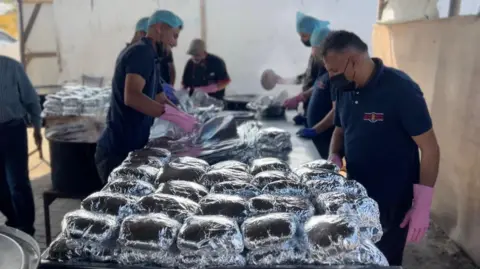
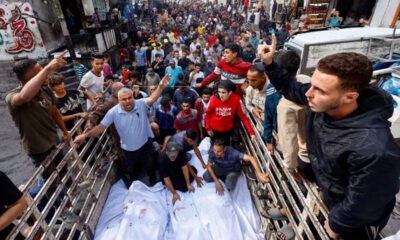
Hundreds of thousands of Palestinians are relying on community kitchens for their survival
There is growing international pressure on Israel to lift its blockade, with warnings that mass starvation could be imminent and that intentionally starving civilians is a war crime.
READ ALSO:
- Bandits kill abducted Imam, 2 sons, grandson in Zamfara
- ICPC investigates reported students’ loan scandal
- Amotekun officer macheted to death in Osun
“Aid, and the civilian lives it saves, should never be a bargaining chip,” the UN’s humanitarian chief, Tom Fletcher, warned on Thursday.
“Blocking aid starves civilians. It leaves them without basic medical support. It strips them of dignity and hope. It inflicts a cruel collective punishment. Blocking aid kills.”
Hundreds of thousands of Gazans depend on a few dozen remaining kitchens for sustenance. The one run by Anera in Khan Younis feeds some 6,000 people a day.
But if Israel does not lift its blockade, by far the longest it has ever imposed on Gaza, the kitchens – a last lifeline for so many – will soon have nothing to distribute. Food stockpiled during the ceasefire at the start of this year, has all but run out.
“The coming days will be critical. We expect we have two weeks’ supply, maybe less,” Mr Matar says as he shows a local BBC journalist around the vast, empty Anera warehouse.
“We used to receive more than 100 trucks every week – trucks of food parcels and hygiene kits. Now we don’t have anything.
“We struggle to provide food such as rice, lentils, pasta, cooking oil and salt, for our community kitchens. It’s very expensive to buy 1kg of wood and we need over 700kg a day for cooking.”
Israel has accused Hamas of stealing and storing humanitarian aid to give to its fighters or sell to raise money. The UN and other agencies deny aid has been diverted and say that they have strict monitoring mechanisms.
“We work hard to avoid any interference from any parties. We have an accurate and strong distribution process,” says Mr Matar, inspecting lists of aid recipients on his computer.
READ ALSO:
- LP crisis deepens as more chieftains defect to PDP in Enugu
- Why I left Tinubu administration – Hakeem Baba-Ahmed
- Civil servants earning under N1m annually to be exempted from tax – Senator
“We have a database of hundreds of thousands of people, including their names, ID numbers and addresses – the co-ordinates of the camps. This avoids duplication with the work of other non-governmental organisations and ensures transparency.”
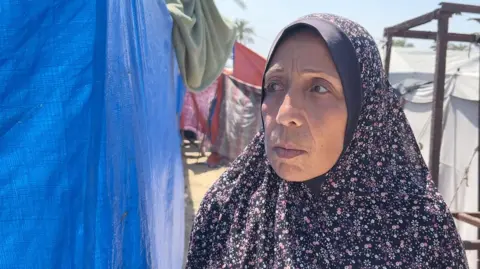
A displaced mother said there was no cooking gas or food to make meals for her family
Back in the outdoor kitchen, Mr Matar tests the food from the steaming pots to check its quality. Parcels are wrapped up for distribution; each can serve up to four people.
All the workers receive food for their own hungry families.
The rest is soon transferred on the donkey cart through the bustling streets to al-Mawasi, a crowded tent camp for displaced people on the coast, where dozens of field monitors supervise the hand-out.
An elderly man walking with crutches looks relieved as he clutches two parcels of koshari to feed his family of seven. “Thank God, this will be enough,” he says.
“Don’t even ask me about the situation,” he goes on. “We’re only alive because death hasn’t taken us yet. I swear I was searching for a loaf of bread since the morning, and I found none.”
“The situation is tragic, and it keeps worsening,” comments a weary looking mother. “Life is humiliating here. We have men who are unable to work. There is no income, and all the products are so expensive. We’re unable to buy anything.”
“At this time, this is excellent,” she says of the warm meal she has just been given. “Because there is no cooking gas, no food. When we want to have a cup of tea, I collect leaves to start a fire.”
It has now been more than a year and a half since the war in Gaza began, triggered by the Hamas-led attacks on southern Israel. That assault killed around 1,200 people and more than 250 people were taken hostage. Some 59 are still held captive, with up to 24 of those believed to be alive.
READ ALSO:
- Police arrest 400 in Turkey over May Day protests
- Trump’s national security adviser Mike Waltz steps down
- May Day: TUC demands immediate withdrawal of proposed Tax bill
Israel’s military campaign has killed more than 52,400 people in Gaza, mostly women, children and the elderly, according to the Hamas-run health ministry. More than 90% of the 2.1 million population has been displaced – with many forced to flee multiple times.
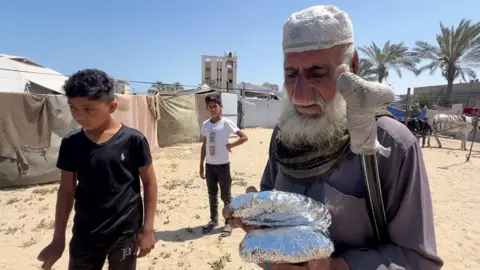
Each of the parcels of food can serve up to four people
The UN has warned that the current situation “is likely the worst it has been” due to the blockade, the renewed offensive and evacuation orders that have displaced some 500,000 people since 18 March.
There is growing international pressure on Israel to lift its blockade, with warnings that intentionally starving civilians is a potential war crime. The UN says that Israel has a clear obligation under international law as an occupying power to allow and facilitate aid for Gazans.
Last Friday, US President Donald Trump said he had told Israel’s Prime Minister, Benjamin Netanyahu that “we’ve got to be good to Gaza” and pushed him to allow more food and medicine into the strip.
There was no official response to that, but earlier in the week, the Israeli foreign ministry rejected criticism from the UK, France and Germany, which described the blockade as “intolerable” in a joint statement and insisting “this must end.”
The ministry said more than 25,000 lorries carrying almost 450,000 tonnes of goods had entered Gaza during the ceasefire. It added: “Israel is monitoring the situation on the ground, and there is no shortage of aid.”
Israeli officials have indicated they plan to overhaul the aid distribution system.
For now, supplies are piling up at Gaza’s border crossings waiting to be brought in, while inside the territory, aid workers carefully ration what is left of their stock.
In al-Mawasi camp, children gather playfully around Sami Matar and the Anera workers giving out the last of the day’s food parcels.
Many are painfully thin, with new warnings of acute malnutrition in Gaza – especially among the young.
“I don’t know what will happen if our supplies end,” says Mr Matar, weighed down by the responsibility of his work.
“The feeling of having to stop this vital help to people would be so stressful and depressing to me and my staff.”
“We have an urgent appeal,” he continues. “Look at us, see our desperation, understand that time is running out. Please we just need to open the crossings again.”
Israeli blockade: Food running out, Gaza community kitchens warn
BBC










International
400 French Schools Shut as Students Protest Teacher Shortages, Poor Facilities
400 French Schools Shut as Students Protest Teacher Shortages, Poor Facilities
Students across France have staged demonstrations over what they describe as deteriorating conditions in the country’s public schools, including overcrowded classrooms, teacher shortages, poor facilities and inadequate funding.
The protests, which began in the Paris region, have spread to several cities, including Marseille, Strasbourg, Lyon, Lille, Rennes and Toulouse, disrupting activities in hundreds of schools.
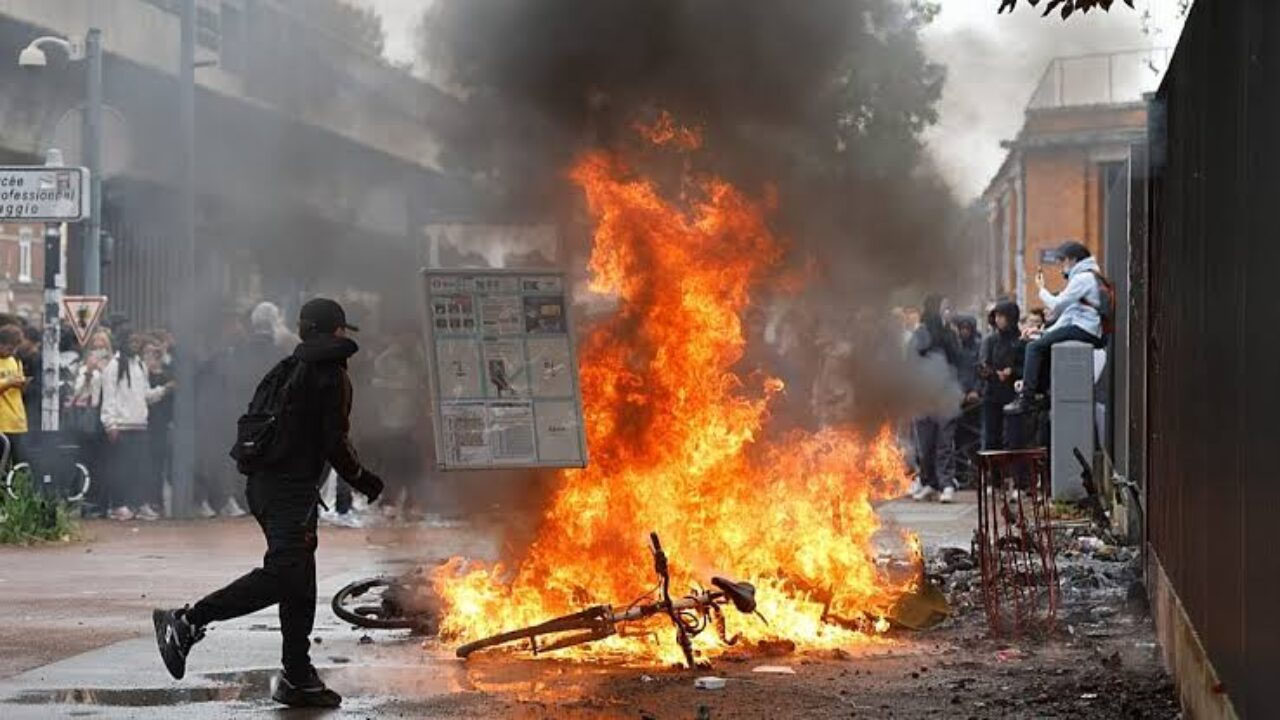
Students have blocked school entrances and staged demonstrations outside their schools, while some protests have escalated into clashes with police, vandalism and fires.
Authorities said the unrest had affected more than 1,000 high schools, with about 400 schools expected to remain closed because of blockades or damage.
The students’ complaints centre on several issues affecting their daily learning experience. They have reported classrooms with as many as 35 to 40 students, shortages of teachers and other school staff, damaged buildings and inadequate classroom facilities.
Some students have also complained about long school days, staff absences and periods without teachers for particular subjects.
At some schools, students and parents have raised concerns about the condition of buildings, including leaks and other maintenance problems. Complaints have also been made about uncomfortable classroom temperatures during periods of hot weather.
READ ALSO:
- 10 Things to Know About Amos Dangut, Nigerian Appointed WAEC Registrar
- Olu Jacobs Laid to Rest in Lagos as Dignitaries, Nollywood Stars Honour Screen Icon
- Court Remands Man Accused of Impersonating JAMB Registrar in Kuje Prison
The demonstrations have, however, been accompanied by incidents of violence and vandalism in some locations. Police have reported confrontations with protesters, while some school entrances and surrounding property have been damaged.
France’s Education Ministry said 65 education workers, including 40 school heads, had been injured during the unrest. Police officers have also sustained injuries in some clashes.
French authorities said more than 2,000 people had been arrested since the protests began, with most of those detained reported to be teenagers.
The government has acknowledged concerns about school conditions and education resources, while condemning acts of violence and destruction. Officials have also warned that violent groups could exploit the demonstrations.
Education Minister Édouard Geffray has announced plans for discussions involving students, teachers’ unions and parents to address concerns raised during the protests.
The unrest has also brought attention to France’s proposed 2027 education budget. The planned allocation is expected to increase by 1.7 per cent to about €65.53 billion, excluding teacher pensions, although the increase is below the current inflation rate.
Teachers’ unions have separately announced a nationwide strike, adding pressure on the government to address concerns over staffing, working conditions and education funding.
While students have continued to demand improvements in their schools, the authorities are working to restore normal operations in affected institutions and prevent further violence.
The protests have placed France’s education system under renewed scrutiny, with the availability of teachers, classroom sizes, school infrastructure and education funding emerging as central issues in the dispute.
400 French Schools Shut as Students Protest Teacher Shortages, Poor Facilities
International
Trump Threatens Iran With ‘Very Hard’ Response Over Flydubai Attack

Trump Threatens Iran With ‘Very Hard’ Response Over Flydubai Attack
US President Donald Trump has warned that Iran would face a “very hard” response if investigators establish that Tehran was connected to the attempted attack on a Flydubai passenger aircraft bound for Israel.
Trump made the statement on Thursday as authorities continued investigating the motive behind the Flydubai cockpit attack, in which the co-pilot allegedly stabbed the captain and caused the aircraft to plunge thousands of feet before passengers and other crew members intervened.
Asked at the White House whether the co-pilot had links to Iran, Trump indicated that investigators were examining the possibility.
“Based on what I’m hearing, yes,” Trump said, while stressing that the matter was still being investigated. He later warned that Iran would be hit “very hard” if Tehran was found to have been involved.
The incident occurred on Flydubai flight FZ1073, which was travelling from Dubai in the United Arab Emirates to Tel Aviv, Israel, on September 30.
READ ALSO:
- Phyna Knocks Out Nkechi Blessing in Fourth Round, Wins ₦50m, New Car
- NDC Protests Police Cancellation of Obi-Kwankwaso March in Akwa Ibom
- 2027 Hajj: Nigeria Secures 10,000 Extra Slots, Allocation Hits 60,000
The aircraft was carrying more than 170 passengers when the co-pilot, identified by Israeli authorities as an Omani national, allegedly attacked the captain in the cockpit. The aircraft then entered a steep descent, dropping more than 14,000 feet in about 30 seconds, according to reports.
The injured captain managed to open the cockpit door, allowing passengers to enter and overpower the co-pilot. Passengers and crew then helped stabilise the aircraft, while reserve pilots aboard the flight took control.
The aircraft eventually made an emergency landing in Tabuk, Saudi Arabia, where the injured captain received medical attention and the suspect was taken into custody.
The incident has generated competing assessments over the possible motive. Israeli Prime Minister Benjamin Netanyahu has said the co-pilot appeared to have been radicalised, but he also indicated that it was too early to determine whether Iran was involved.
The United Arab Emirates has launched an investigation into the circumstances of the incident, including whether it involved terrorism, prior planning or direction from an outside actor. Authorities have yet to publicly establish an Iranian role.
Reuters reported that the motive remained unclear, while investigators from several countries were examining the incident. Flydubai has also suspended its flights between Dubai and Israel as investigations continue. (Reuters)
The incident comes amid heightened US-Iran tensions, with Washington already increasing its military presence in the Middle East. Trump’s warning has therefore added to concerns that confirmation of an Iranian connection could trigger further escalation.
For now, however, the alleged Iran-Flydubai link remains under investigation, and no publicly released evidence has established that Tehran directed or supported the cockpit attack. (AP News)
Trump Threatens Iran With ‘Very Hard’ Response Over Flydubai Attack
International
Israeli Actor, Flight Instructor Among Two Killed In California Plane Crash

Israeli Actor, Flight Instructor Among Two Killed In California Plane Crash
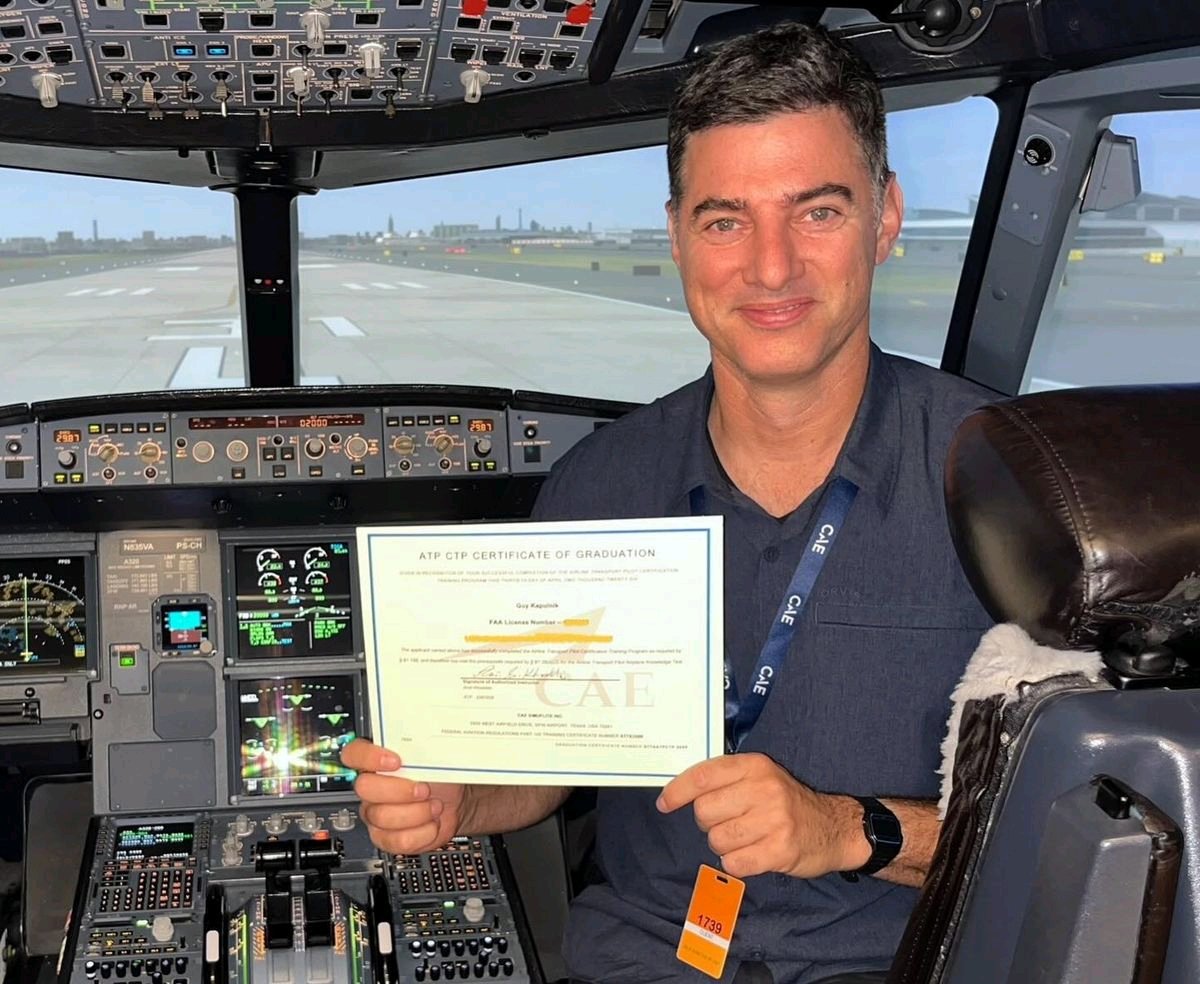
Israeli actor and flight instructor Guy Kapulnik, 46, and his passenger, Taylor Laska, 33, have died after a light aircraft crashed into a field in California, United States.
The fatal crash occurred on Thursday, September 24, 2026, near Hesperia in San Bernardino County.

Emergency responders were alerted to the crash shortly before 10am after the small aircraft went down in an open field.
Both occupants were pronounced dead at the scene.
READ ALSO:
- Flood Cuts Off Part of Agbarho-Ughelli Road, Strands Commuters in Delta
- Dangote Draws Battle Lines as Fuel Import Fight Heads Back to Court
- Tinubu Returns After 30 Days in Europe, Says ‘I’m Healthy and Ready to Work’
The aircraft, identified as a single-engine Aeronca 7AC Champion, crashed near Summit Valley Road and Telephone Canyon Road, about three miles from Hesperia Airport.
Authorities have launched an investigation into the incident, but the cause of the crash had not been established as of Wednesday.
Kapulnik was not only a pilot and flight instructor but also an actor who appeared in several Israeli and international film productions.
He trained at the Nissan Nativ Acting Studio in Jerusalem before building a career in the entertainment industry. His acting credits included Room 514, Salsa Tel Aviv, Watch Over Me and Lebanon.
After moving to Los Angeles, Kapulnik continued acting while pursuing his passion for aviation. He obtained his pilot’s licence and later became a certified flight instructor.
His aviation career saw him teach aspiring pilots, with friends and former students describing him as passionate about flying and committed to helping others learn.
Kapulnik had also previously served as an officer in Israel’s elite Unit 669, a specialised search-and-rescue unit.
His death has triggered an outpouring of tributes from friends, colleagues and people who knew him through aviation and acting.
Those who knew him remembered him as an adventurous and energetic man who pursued several passions throughout his life, including acting, flying and life at sea.
The passenger, Laska, was also killed in the crash.
Investigators from the relevant aviation authorities are continuing to examine the wreckage and circumstances surrounding the incident to determine what caused the aircraft to crash.
Kapulnik’s funeral is expected to take place in Israel.
Israeli Actor, Flight Instructor Among Two Killed In California Plane Crash
-

 metro1 day ago
Workers to Begin Nationwide Warning Strike Over Petrol Price, Wage Award
-

 metro3 days ago
$2.1m Land Suit: Court Orders Wike’s Son to Produce American Passport
-

 metro3 days ago
Osogbo Food Bonanza: Angry Customers Loot Warehouse After Operators Vanish
-

 News3 days ago
Tinubu Returns After 30 Days in Europe, Says ‘I’m Healthy and Ready to Work’
-

 metro3 days ago
Two Nigerians Jailed 15 Years Over $2.4m US Cyber Fraud
-
 metro3 days ago
Flood Cuts Off Part of Agbarho-Ughelli Road, Strands Commuters in Delta
-

 Business1 day ago
Dangote Sets 40-Month Deadline for $16bn East Africa Refinery in Kenya
-

 Politics2 days ago
2027: Amaechi Recalls How APC Defeated PDP, Orders ADC Mobilisation