

Business
Sell petrol below N800/litre, IPMAN tells Dangote
Sell petrol below N800/litre, IPMAN tells Dangote
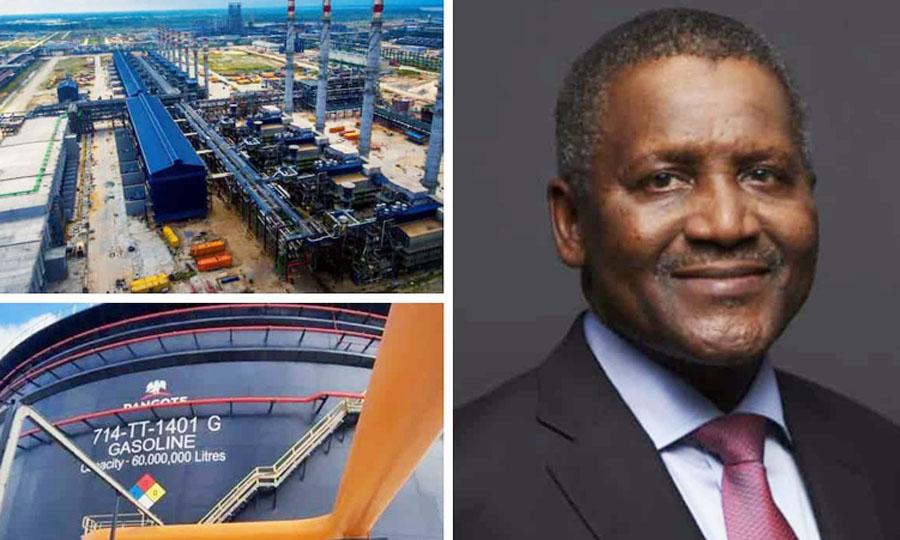
The Independent Petroleum Marketers Association of Nigeria (IPMAN) has said the Dangote Petroleum Refinery should sell Premium Motor Spirit (petrol) below the current N825 per litre price being sold by the Lekki-based plant.
Speaking during an interview, IPMAN Publicity Secretary Chinedu Udadike indicated that the refinery possessed the required enabling components to sell petrol at a lower price than the present ex-depot.
Ukadike was responding to a claim made by Aliko Dangote, President of the Dangote Group, saying the refinery contributed to the continual decline in fuel prices to the point where Nigerians pay roughly 55% of what other West Africans pay for petrol.
Dangote recently told ECOWAS officials and President Bola Tinubu that the Federal Government’s naira-for-crude strategy had a favourable impact on the price of refined petroleum products.
Though Ukadike acknowledged that the present petrol price was lower than in other West African countries, he believed the product could be much cheaper in Nigeria, selling for around N750.
According to him, several of these West African countries do not produce crude oil or have refineries that process it in local currencies.
READ ALSO:
- Ohanaeze urges Igbos to stay away from June 12 protests
- I didn’t collect car from MC Oluomo — Actress Aisha Lawal
- Military officer shoots UNIPORT student dead – Police
“I agree that petrol is cheaper in Nigeria than in other West African countries. Notwithstanding, those African countries Dangote was comparing us with are not crude oil-producing countries.
“We’re a crude oil-producing state. PMS should be far lower, as the president has also decided to give him crude in naira. So, most of the foreign exchange brouhaha and the exchange costs are no more; we should also enjoy it as Nigerians,” he said.
Ukadike stated that what Dangote had conquered for Nigerians was the issue of fuel scarcity, which used to cause queues at filling stations. He called on the federal government to strengthen the naira to make fuel more affordable.
“What I believe he (Dangote) has conquered for Nigerians is availability. On price, we’ll still get there. Once the government works very hard to ensure that the rate of naira to the dollar is reduced and the strength of our naira is stable, you’ll find out that the price will go down. This is another factor that determines the price of petroleum products,” he noted.
Speaking on if he meant that Dangote’s petrol was not cheap enough, he replied, “Well, I’m not saying it’s cheap enough in line with the facilities, amenities and the enabling environment that have been given to him.
“For me, I don’t feel it’s cheap. I think the petrol will go as low as around N770. That’s my own permutation. I’m not an expert in oil refining. But with what I have gathered — the refinery production costs and the landing at the depot cost — petrol should not be more than N780 or N750, in line with the dollar rate.
“So, if the federal government can ensure that we continue to strengthen the naira, I believe that the price of petroleum products will go down further. What is keeping it up now is the exchange rate,” he posited.
IPMAN predicted that if the naira appreciated to N1,100 against the dollar, petrol should be sold below N750 per litre.
“I don’t know how much the dollar will go down, so I cannot forecast. The dollar is around N1,600 now. So, if the dollar can come down to N1,200, I want to tell you that the price of PMS at the pumps will go below N750,” he added.
Sell petrol below N800/litre, IPMAN tells Dangote





Auto
Jetour Targets Abuja Market with X70 PHEV as Nationwide Expansion Gathers Pace
Jetour Targets Abuja Market with X70 PHEV as Nationwide Expansion Gathers Pace
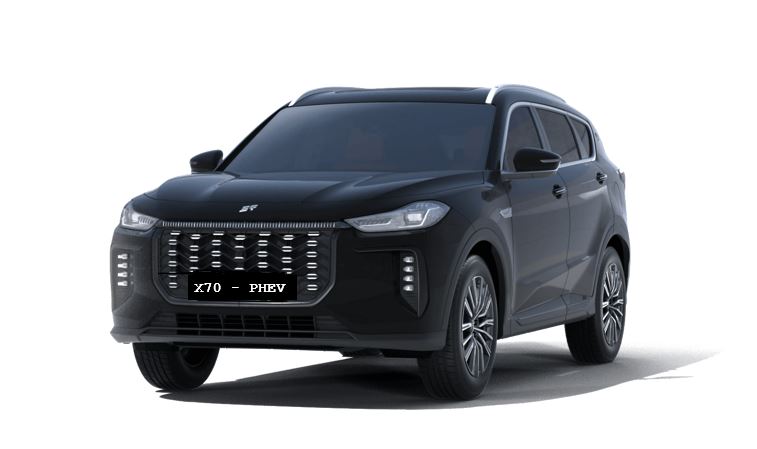
Jetour Nigeria is taking its hybrid SUV offensive to Abuja, with the X70 Plug-in Hybrid Electric Vehicle (PHEV) set to headline the three-day Jetour Experience from September 22 to 24 as the automaker accelerates its drive to expand its footprint and capture a larger share of Nigeria’s fast-evolving mobility market.
The Abuja showcase, coming on the heels of a strong Lagos edition that generated significant consumer interest, test drives and sales enquiries, is designed to bring Jetour’s latest technologies closer to customers in the Federal Capital Territory and neighbouring states.
The event at Maha Event Centre, Area 8, will give prospective buyers and auto enthusiasts the opportunity to test-drive the X70 PHEV and other Jetour models while interacting with product specialists and experiencing their technology, safety features, performance and comfort firsthand.
According to the company, expanding the showcase to the Federal Capital Territory was a direct response to rising demand from residents in Abuja and neighbouring states.
READ ALSO:
- ASUU Crisis Deepens: Lagos Universities Join UNIBEN, Taraba on Indefinite Strike
- Lagos Power Outage: Ikeja Electric Blames TCN as Businesses, Homes Groan
- US Court Blocks Trump Visa Rule Limiting Stay of Foreign Students, Journalists
To bolster buyer confidence, Jetour Nigeria—the country’s sole authorised distributor—backs the X70 PHEV with a five-year or 150,000-kilometre warranty.
The distributor operates through an accredited nationwide dealer network, including: Elizade Nigeria Limited,
New Era Auto Vehicle Services Limited, Kojo Motors, Germaine Auto Centre, Tab Autos Limited, R.T. Briscoe Motors, and Mandilas Autos.
The X70 PHEV pairs a 1.5-litre turbocharged engine with a 19.43kWh battery and a dedicated hybrid transmission. Designed to balance performance with fuel efficiency, the vehicle supports fast, slow, engine, and regenerative braking charging options—reducing reliance on external charging infrastructure.
Jetour’s rapid growth in the Nigerian market has earned both private and corporate patronage, driven by competitive pricing, high specification levels, and an expanding service footprint. The brand was named “Fastest Growing Auto Brand of the Year” at the 2024 Nigeria Auto Journalists Association (NAJA) Awards.
With the X70 PHEV leading the Abuja showcase, Jetour aims to deepen customer engagement and consolidate its position in the local automotive market.
Jetour Targets Abuja Market with X70 PHEV as Nationwide Expansion Gathers Pace
Business
Sanwo-Olu Joins Dangote as Historic N2.15tn Refinery IPO Opens on Nigerian Exchange
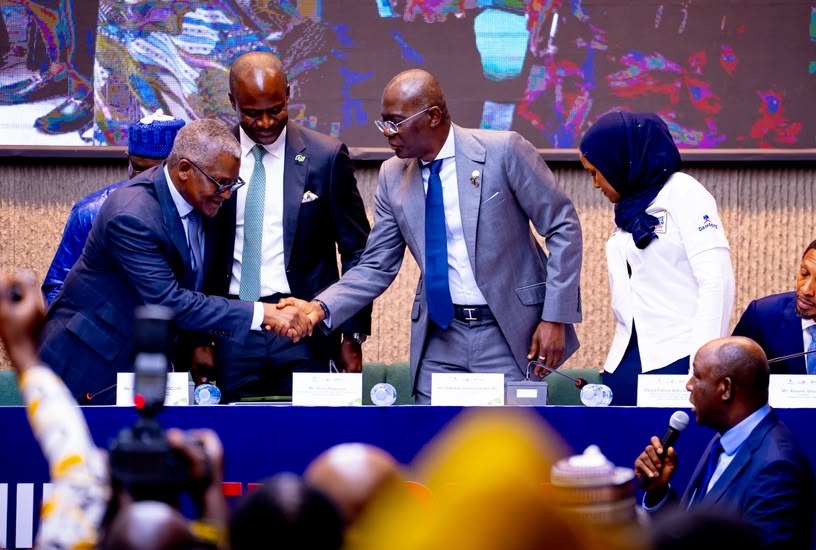
Sanwo-Olu Joins Dangote as Historic N2.15tn Refinery IPO Opens on Nigerian Exchange
Lagos State Governor, Babajide Sanwo-Olu, on Monday joined business leaders, investors and capital-market stakeholders as the Initial Public Offering of the Dangote Petroleum Refinery and Petrochemicals formally opened on the Nigerian Exchange, NGX, in Lagos.
The landmark transaction, which could raise about N2.15 trillion, marks one of the biggest capital-market transactions in Nigeria’s history and gives Nigerians and other investors an opportunity to acquire a stake in Africa’s largest oil refinery.
Sanwo-Olu attended the opening ceremony at the NGX Group building in Marina, Lagos, where Dangote Industries President and Chief Executive Officer, Aliko Dangote, sounded the gong to formally commence the public offer.
The IPO comprises 4.1 billion ordinary shares priced at N525 each, with investors allowed to subscribe for a minimum of 10 shares, valued at N5,250. The offer will remain open until October 13, 2026.
The development represents a major milestone for Nigeria’s capital market, as the Dangote Refinery becomes the first refinery to be offered for public subscription on the Nigerian stock market in the 66-year history of the NGX.
The ceremony attracted an array of prominent figures from government, business and the financial sector, including NGX Group Chairman Umaru Kwairanga, NGX Group Managing Director and Chief Executive Officer Temi Popoola, Zenith Bank founder Jim Ovia, Coronation Group Chairman Aigboje Aig-Imoukhuede and Ooni of Ife, Oba Adeyeye Ogunwusi.
Also present were senior executives of Dangote Industries and representatives of the capital-market community.
Dangote described the offer as a “people’s IPO”, stressing that its primary objective was to broaden ownership of the refinery and allow ordinary Nigerians and investors across the world to participate in the wealth created by the massive industrial project.
According to him, the public offer was not primarily about raising funds for the Dangote Group, which he said already had substantial capital available for its expansion plans, but about democratising wealth creation.
The refinery is currently designed to process 700,000 barrels of crude oil per day, while Dangote Industries plans to expand its capacity to 1.4 million barrels per day over the coming years. Proceeds from the IPO are expected to support the refinery’s expansion and strengthen its capacity for future growth.
The public offer follows a $2.5 billion private placement earlier in the year, which attracted strong institutional interest. Reuters reported that the refinery is valued at about $47.6 billion, making the IPO one of the most significant equity offerings ever undertaken in Africa.
The refinery has increasingly become a strategic component of Nigeria’s energy security drive, reducing the country’s dependence on imported refined petroleum products while positioning Nigeria as a potential major exporter of refined products.
The opening of the IPO also comes at a time when the Dangote refinery has reported a sharp improvement in its financial performance. Reuters reported that the company recorded a $1.82 billion net profit in the first half of 2026, alongside revenue of more than $13 billion.
Dangote has also sought to make the offer accessible to ordinary Nigerians, with subscriptions available through digital investment platforms and other authorised channels. The minimum subscription of 10 shares means an investor can enter the offer with N5,250.
The NGX has described the transaction as an important development for the Nigerian capital market, particularly in broadening retail participation and deepening the investment culture.
For Lagos, where the refinery is located and where the historic IPO was formally launched, the development further reinforces the state’s position as Nigeria’s dominant commercial and financial centre.
With the offer running until October 13, investors will now determine whether the historic transaction achieves its N2.15 trillion target and establishes a new benchmark for public participation in Nigeria’s industrial sector.
Auto
X90 Plus Leads Jetour’s Abuja Drive for Bigger SUV Market Share
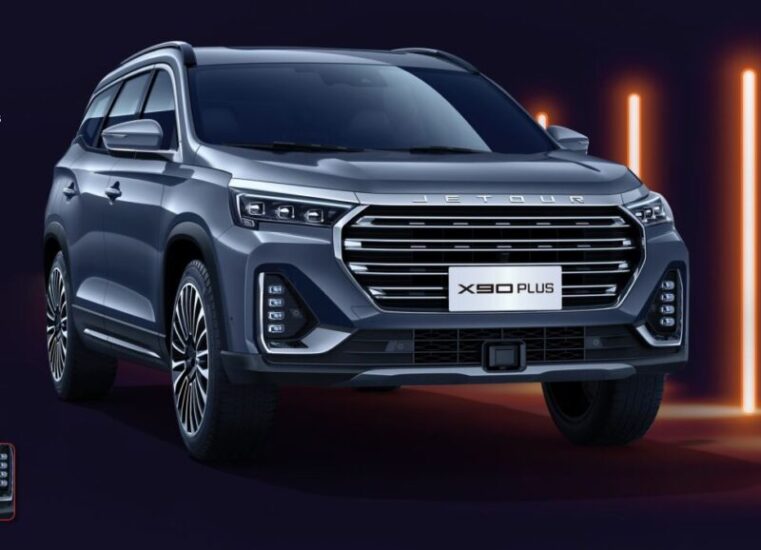
X90 Plus Leads Jetour’s Abuja Drive for Bigger SUV Market Share
Jetour Nigeria is taking its premium SUV battle to Abuja, with the seven-seater X90 Plus set to headline the Jetour Experience Abuja from September 22 to 24, as the automaker moves to capture a larger share of Nigeria’s fast-growing high-end family SUV market.
The three-day motoring showcase will give prospective buyers, families and auto enthusiasts in the Federal Capital Territory and neighbouring states an opportunity to experience the X90 Plus and other models in the Jetour range through test drives and hands-on demonstrations.
The Abuja showcase follows the success of the brand’s earlier Jetour Experience in Lagos, where strong customer interest, inquiries and sales momentum reportedly encouraged the company to take the initiative to the Federal Capital Territory.
Jetour Nigeria said growing demand from customers in Abuja and neighbouring states was a major factor behind the decision to expand the experience to the northern market.
Positioned as a full-sized family SUV, the X90 Plus is designed for executives and families seeking a combination of space, technology, performance and comfort without the price tag associated with some luxury SUVs.
The model is offered with 1.6-litre and 2.0-litre turbocharged engines paired with a seven-speed dual-clutch transmission. The powertrain produces up to 254 horsepower and 390Nm of torque.
Inside the cabin, the X90 Plus features a 12.3-inch LCD touchscreen infotainment system, panoramic sunroof, Sony premium audio system and wireless charging.
Its safety and driver-assistance features include a 360-degree panoramic camera, Forward Collision Warning, Lane Departure Warning and electronic stability systems.
Jetour’s growing profile in Nigeria has also earned the brand recognition from the Nigeria Auto Journalists Association (NAJA), which named it Fastest Growing Auto Brand, while it was also recognised as Auto Brand of the Year at the Nigeria Transport Lecture.
To support its expanding customer base, Jetour Nigeria, the sole authorised distributor, operates through seven accredited dealer partners across the country: Elizade Nigeria Limited, Mandilas Autos, R.T. Briscoe Motors, Germaine Auto Centre, Kojo Motors, Tab Autos Limited and New Era Auto Vehicle Services Limited.
The Abuja Experience is expected to provide Jetour with another platform to engage potential customers and reinforce its position in Nigeria’s increasingly competitive SUV market.
-
 News2 days ago
SERAP Threatens Legal Action Over ₦126bn INEC Electoral Funds
-
 Politics3 days ago
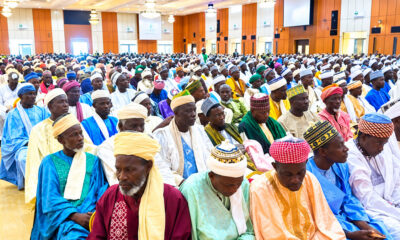
Five Islamic Clerics Abducted After Tinubu Re-Election Prayer At Yari’s Zamfara Residence
-

 Opinion3 days ago
‘Tinubu Will Win Again in 2027’ — Charismatic Bishops’ Secretary
-
 Politics1 day ago
2027: Northern Lecturers Back Tinubu, ASUU Disowns Endorsement
-

 metro2 days ago
Mother ‘sold daughter’s abuse videos for $300’: Nigeria child pornography case shocks nation
-

 Sports3 days ago
‘Unacceptable’ — Arteta Furious Over Sunderland Penalty in Arsenal Win
-

 News2 days ago
Petrol Subsidy: Presidency Rejects Atiku’s Plan, Says No Going Back
-
 News2 days ago
Nwifuru Dismisses Cubana Chief Priest as ‘Attention-Seeker’