

Business
Lagos to set up housing trust fund

…..Proposed Workers’ Village gathers steam
By Dada Jackson
In a bid to make housing accessible to the less privileged in Lagos State,and in line with the transformation agenda of the Mr. Babajide Olusola Sanwo-Olu administration, especially in the area of housing, the Lagos State Government is working on plans to increase access to decent and quality homes for them.
This is as the state government is planning to providing houses for some of its workers to be known as Workers’ Village.
The Commissioner for Housing, Hon. Moruf Akinderu-Fatai disclosed this during a site inspection of some of the ongoing State owned Housing Schemes.
His words “Having successfully completed and commissioned 10 housing estates in the past two year, and working hard to deliver our various ongoing schemes, we are moving forward to implement strategies that will improve access to decent homes in the State”.
According to him,the State Government had completed various Housing schemes located at Igando, Lekki Phase1, Lekki Phase 2, Igbokushu, Nob Oluwa, Idale Badagry, Iponri, Igbogbo amongst others,adding that work on six others sited at Odo-Onasa/Ayandelu, Resettlement Scheme Agbowa, Sangotedo Phase1, Omole Magodo, Gbagada and Ibeshe which is being built by the Lagos State Property Development Corporation were nearing completion.
The Commissioner pointed out,that hopefully, the six schemes that are at various stages of completion in Odo Onasa-Ayandelu, Agbowa Resettlement Scheme, Sangotedo,Omole/Magodo, Gbagada and Ibeshe would soon be commissioned while others at LASU Ojo, Egan- Igando and Sangotedo Phase2 were also receiving attention towards a speedy completion.
He said that these schemes with others at Itamarun Epe and Ajara in Badagry as well as joint venture schemes would yield over 7000 homes by the third anniversary of the present Administration.
He said that the positive impact of governmental intervention is hampered by the twin issue of high cost of funding for investors and people seeking home ownership through mortgage.
The Housing Commissioner noted that the State Government was looking into the issue of accessibility of decent homes through a multidimensional approach that would reduce these financial barriers to housing.
He disclosed that the State Government is fine tuning a financial mechanism tagged Lagos Affordable Housing Development Trust Fund. This according to him is a financial product that would bring succour to both property developers and intending home owners.
Akinderu-Fatai said ‘ the Fund will reduce the challenge of
financing housing development as well as empower people particularly the low and medium income earners to access housing without undue financial stress.
He underscored the fact that the housing challenge in Lagos is complex because of the continued and uncontrollable influx of people from all over the nation. He noted that given the rate at which the population of the State is increasing, there must be proactive measures to ensure that governmental interventions result in substantial positive impacts in the lives of the people.
He also reiterated that the Lagos Affordable Housing Development Trust Fund which is being prepared in collaboration with Arctic Infrastructures is the State’s response to the need for financing products that are domesticated to solve it’s peculiar housing challenges.
He said while global financing models are attractive, they may not address the unusual problems of Lagos State.
The Commissioner pointed out that provision of mass and social housing is a key agenda of the State government but the impact can only be felt when there is a structured financing mechanism that is based on predictable population growth.
Apart from the Rent to Own scheme which gives opportunity of repayment over a period of 120 months, the State is also looking at more workable financing options that will help the informal sector.
” We have to formalize the informal sector through cooperative associations and artisans guilds so that majority of our people can take advantage of a financing product that supports instalmental payments”.
The Commissioner also said that the fund would encourage more vertical construction of homes by government and private investors to optimize the land space available in the state.
Akinderu Fatai siezed the opportunity to point out that the commitment of the State government is unequivocal and that “Lagos State would continue to work relentlessly until more Lagosians are brought on the home ownership ladder. Building more homes is our way of improving standard of living , increasing economic engagement through provision of construction jobs and also opening up our rural areas”
He said the State Government plans to construct two workers villages as part of a global plan to transform the State into a 21st century economy that is distinct and comparable to others in the world.
“In line with our passion for progress in the sector, funding is needed and assistance from our development partners will be highly appreciated.” he said
The Permanent Secretary Ministry of Housing Mr Wasiu Akewusola, said that “the uniqueness of the financing package is the fact that it will be targeted at low income earners and the informal sector and can be accessed by both construction companies and homeseekers and will be made up of contributions made by both public and private sector. The fund will also cater to training and capacity building and upgrading of artisans, development of innovative building technology, sustenable housing developments and renewable of slums. The suggested funding from government is expected to be sourced from contributions by local governments, subventions, infrastructure development charge, Housing fund surcharge and Lagos Pension fund. Private sector contributions can be in form of grants and donations from both local and international organizations. ”
In disbursing the fund, Akewusola said, “part of the financing would be used as Housing loans with repayment plan of 20years. This will channeled through micro finance banks with cooperative societies serving as intermediaries”. “Construction fund will also be granted to developers having vertical construction with sustenable energy idea, he discloses.
He noted that the idea of a Trust for the financial product is to ensure accountability, credibility and sustenablity.
Other plans that are being worked out by the State include an allocation structure that will reach the masses so that homes are not hijacked by the rich, continued maintenance of existing schemess to prevent rapid dilapidation, provision of homes for young professionals, introduction of cost saving techniques to reduce cost of building homes and increasing sustenability of future Housing schemes.

Auto
X90 Plus Leads Jetour’s Abuja Drive for Bigger SUV Market Share

X90 Plus Leads Jetour’s Abuja Drive for Bigger SUV Market Share
Jetour Nigeria is taking its premium SUV battle to Abuja, with the seven-seater X90 Plus set to headline the Jetour Experience Abuja from September 22 to 24, as the automaker moves to capture a larger share of Nigeria’s fast-growing high-end family SUV market.
The three-day motoring showcase will give prospective buyers, families and auto enthusiasts in the Federal Capital Territory and neighbouring states an opportunity to experience the X90 Plus and other models in the Jetour range through test drives and hands-on demonstrations.
The Abuja showcase follows the success of the brand’s earlier Jetour Experience in Lagos, where strong customer interest, inquiries and sales momentum reportedly encouraged the company to take the initiative to the Federal Capital Territory.
Jetour Nigeria said growing demand from customers in Abuja and neighbouring states was a major factor behind the decision to expand the experience to the northern market.
Positioned as a full-sized family SUV, the X90 Plus is designed for executives and families seeking a combination of space, technology, performance and comfort without the price tag associated with some luxury SUVs.
The model is offered with 1.6-litre and 2.0-litre turbocharged engines paired with a seven-speed dual-clutch transmission. The powertrain produces up to 254 horsepower and 390Nm of torque.
Inside the cabin, the X90 Plus features a 12.3-inch LCD touchscreen infotainment system, panoramic sunroof, Sony premium audio system and wireless charging.
Its safety and driver-assistance features include a 360-degree panoramic camera, Forward Collision Warning, Lane Departure Warning and electronic stability systems.
Jetour’s growing profile in Nigeria has also earned the brand recognition from the Nigeria Auto Journalists Association (NAJA), which named it Fastest Growing Auto Brand, while it was also recognised as Auto Brand of the Year at the Nigeria Transport Lecture.
To support its expanding customer base, Jetour Nigeria, the sole authorised distributor, operates through seven accredited dealer partners across the country: Elizade Nigeria Limited, Mandilas Autos, R.T. Briscoe Motors, Germaine Auto Centre, Kojo Motors, Tab Autos Limited and New Era Auto Vehicle Services Limited.
The Abuja Experience is expected to provide Jetour with another platform to engage potential customers and reinforce its position in Nigeria’s increasingly competitive SUV market.
Business
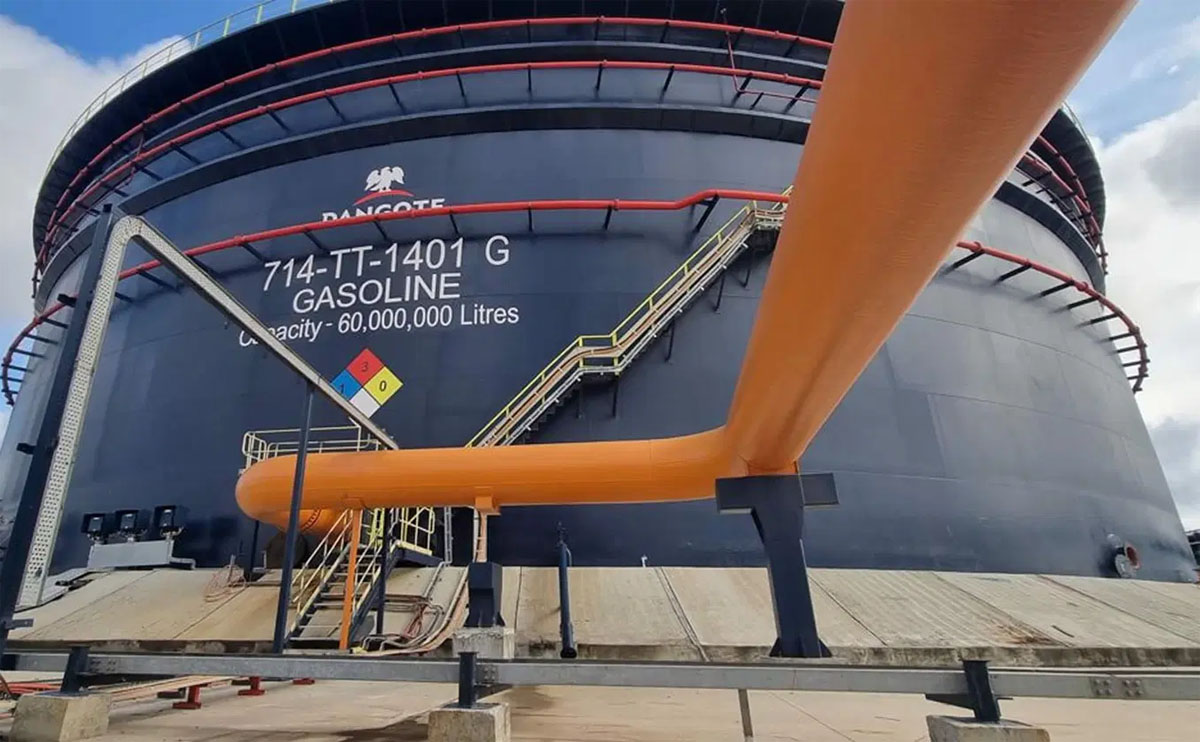
Dangote raises petrol price 6.7% to N1,350/litre
Dangote raises petrol price 6.7% to N1,350/litre
The Dangote Petroleum Refinery has increased its Premium Motor Spirit (PMS), popularly known as petrol, gantry price by 6.7 per cent, raising it from N1,265 to N1,350 per litre, with the new price taking effect from September 12, 2026.
The latest adjustment represents an N85 increase per litre and is the fourth upward review of Dangote Refinery’s petrol price since August 21, further raising concerns about the possible impact on petrol pump prices, transportation costs and the wider cost of living.
The refinery also increased its coastal price from N1,669,543 to N1,783,530 per metric tonne, representing an increase of N113,987, or about 6.8 per cent.
In a memo to customers, Dangote Petroleum Refinery announced the revised prices and directed customers with existing loading arrangements to return their Authority to Collect (ATC) documents for repricing.
The refinery said new volume contracts would subsequently be issued to allow loading to resume under the revised prices.
The latest increase means Dangote’s petrol price has risen by N185 per litre, or about 15.9 per cent, in 22 days.
The refinery had increased its gantry price from N1,165 to N1,185 per litre on August 21. It subsequently raised the price to N1,200 on August 26 and then to N1,265 on August 29, before the latest increase to N1,350.
The development comes amid renewed pressure in the international crude oil market, with Brent crude recently trading above $100 per barrel as geopolitical tensions and disruptions to oil supplies in the Middle East continue to affect global energy markets.
The pressure on global fuel markets is also being felt by refiners and petroleum traders as disruptions to Middle Eastern refining capacity and shipping routes create concerns over the availability of crude and refined petroleum products.
Dangote Refinery’s management recently said global fuel shortages could persist beyond the current Iran conflict because of damage to refining infrastructure, high refinery utilisation rates and the need to rebuild fuel inventories.
READ ALSO:
- Anambra Police Arrest Woman Over Alleged Sexual Abuse of Child, Rescue Four
- MURIC fires back at Peter Obi: Forget Sallah ceremony, free Nigerian Muslims
- Fani-Kayode Condemns Fresh Killing of Two Nigerians in South Africa
For Nigeria, the increase comes as the downstream petroleum market continues to operate under deregulation, meaning petrol prices are largely determined by market conditions rather than a fixed government-controlled price.
The Nigerian Midstream and Downstream Petroleum Regulatory Authority (NMDPRA) recently identified crude oil sourcing, refinery delivery timelines, imported cargoes, transportation, logistics and taxes among the factors influencing movements in petrol prices.
NMDPRA Head of Public Affairs George Ene-Ita said petrol prices are fully deregulated and therefore exposed to fluctuations across the supply chain.
Consequently, the new Dangote price does not necessarily mean motorists across Nigeria will immediately pay exactly N1,350 per litre at filling stations.
The price consumers pay will depend on the cost at which individual marketers obtain their supplies, transportation and distribution expenses, depot charges, operating costs, location, competition and profit margins.
However, the increase in the refinery’s gantry price is expected to put additional pressure on marketers who source petrol from Dangote Refinery, particularly as they replenish existing stocks.
Recent reports indicate that petrol prices in several parts of the country had already moved higher, with pump prices in some locations reaching the N1,310-N1,350 per litre range before the latest Dangote adjustment.
The latest price review could therefore trigger another round of adjustments by petroleum marketers, especially if the higher wholesale acquisition cost persists.
READ ALSO:
- FG Targets 2 Million Creative Jobs by 2030
- Donnarumma: Two Jailed Over Violent Paris Burglary of Man City Goalkeeper, Wife
- Police Clarify IGP Disu’s Position on Recording Officers
The development is also significant because Dangote Refinery has become an increasingly important source of locally refined petrol as Nigeria seeks to reduce its dependence on imported petroleum products.
The refinery has secured at least 16 million barrels of Nigerian crude for October delivery, equivalent to roughly 520,000 barrels per day, according to Reuters. The purchases represent a substantial portion of the refinery’s current 700,000-barrel-per-day capacity and underline its growing role in Nigeria’s domestic fuel supply.
Despite the increase in petrol prices, Dangote Refinery is pursuing plans to expand its capacity significantly. The company announced a $14.3 billion expansion programme that is expected to increase its processing capacity from about 700,000 barrels per day to 1.4 million barrels per day by 2029.
The refinery is also preparing for a major initial public offering (IPO) aimed at raising about N2.15 trillion, with the offer scheduled to run from September 14 to October 13.
For consumers and businesses, the immediate concern remains the potential effect of the latest petrol price increase on transportation, logistics and the cost of goods and services.
Petrol remains a major input for transportation and commercial activities in Nigeria. Any sustained increase in its price can raise the cost of moving people and goods and increase operating expenses for businesses that depend on petrol-powered vehicles and equipment.
The extent of the impact of the new N1,350 per litre Dangote petrol price, however, will depend on how marketers respond and whether international crude prices remain elevated.
For now, the latest adjustment establishes a higher wholesale benchmark for customers buying petrol from Dangote Refinery, while the retail market is expected to respond according to prevailing supply, distribution and competitive conditions.
Dangote raises petrol price 6.7% to N1,350/litre
Auto
Jetour Takes Award-Winning Dashing, Other SUVs to Abuja

Jetour Takes Award-Winning Dashing, Other SUVs to Abuja
Motorists in Abuja are set for a close encounter with Jetour’s award-winning Dashing and other models as Jetour Nigeria moves to deepen its foothold in the nation’s capital with the Jetour Experience Abuja, beginning September 22.
The three-day motoring event, which runs until September 24, is expected to draw prospective buyers and automobile enthusiasts to a hands-on experience featuring test drives, product demonstrations and direct engagement with Jetour’s seven authorised dealers and product specialists.
The participating dealer network comprises Elizade Nigeria Limited, Kojo Motors, Mandilas Autos, Germaine Auto Centre, R.T. Briscoe, Tab Autos and New Era Auto Vehicle Services Limited.
READ ALSO:
- Police Arrest Woman Over Alleged Drug Trafficking in Delta
- Dangote raises petrol price 6.7% to N1,350/litre
- Anambra Police Arrest Woman Over Alleged Sexual Abuse of Child, Rescue Four
The Abuja Experience follows the success of the Lagos edition, which attracted thousands of visitors for test drives and direct engagement with product specialists. According to the organisers, strong demand and inquiries from motorists in Abuja and neighbouring states prompted the expansion of the event to the Federal Capital Territory.
The Dashing has gained attention in Nigeria’s competitive compact SUV segment for its combination of modern styling, technology, performance and competitive pricing.
The SUV is available with 1.5-litre and 1.6-litre turbocharged engines, producing up to 145kW of power and 290Nm of torque, paired with six- or seven-speed dual-clutch transmissions.
Its features include a 15.6-inch central touchscreen infotainment system, panoramic sunroof, wireless charging and smartphone integration.
For safety, the vehicle comes with a 360-degree surround-view camera, automatic emergency braking, lane departure warning, blind-spot detection and multiple airbags.
Beyond vehicle sales, the authorised dealers provide warranty, genuine spare parts and after-sales support to Jetour customers across their respective locations.
The Abuja Experience is expected to strengthen customer engagement and give motorists in the FCT a closer look at Jetour’s growing range of vehicles, while further expanding the brand’s footprint in the northern market.
Jetour Takes Award-Winning Dashing, Other SUVs to Abuja
-

 metro3 days ago
Woman disguises as Muslim woman in Niqab to steal in Ado-Ekiti market, video sparks outrage
-

 metro2 days ago
Ondo Herbal Drink Tragedy: Survivor Vows Never to Drink Again as Death Toll Tops 30
-
 Business2 days ago
Dangote: ₦525 Refinery Shares Could Rise to ₦10,000
-

 metro2 days ago
Sokoto Cleric Stabbed Twice in Neck After Juma’at Prayer, Attacker Killed
-
 News1 day ago
SERAP Threatens Legal Action Over ₦126bn INEC Electoral Funds
-

 metro2 days ago
MURIC fires back at Peter Obi: Forget Sallah ceremony, free Nigerian Muslims
-

 metro2 days ago
Abia Police Arrest Father, Three Others Over Alleged Attempt to Sell 16-Month-Old Daughter
-

 International2 days ago
Trump Tells Supporters to ‘Cheat Like Hell’ Ahead of US Election