

metro
Cooking gas price drops, supply rises, govt projects further decrease

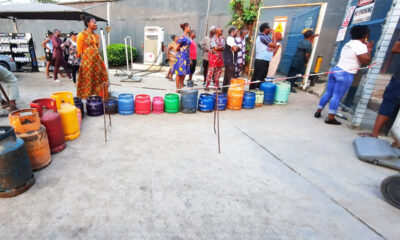
The Federal Government on Thursday said it was putting measures in place to ensure further reduction in the cost of Liquefied Petroleum Gas, popularly called cooking gas.
It disclosed this while reacting to the recent marginal drop in the cost of cooking gas.
According to findings, the price of 12.5kg LPG has dropped from N8,800 to between N8400 and N8200. In some outlets, the price of the commodity dropped to between N7,800 and N8,000 as of Thursday.
In November, The PUNCH exclusively reported that the cost of LPG kept rising in 2021, jumping by more than 240 per cent between January and October 2021.
The development forced some LPG users to shift to charcoal or firewood, as consumers of the commodity raised the alarm over the persistent hike in its price.
The product had increased by 240 per cent for 12.5kg, moving up from N3,000 to N10,200 within the first 10 months of 2021.
“It is in government’s interest for the price to go down consistently and there are certain initiatives that are being taken at the moment, which hopefully will see to further drops in price regardless of the international cost,” the Programme Manager, National LPG Expansion Implementation Plan, Office of the Vice President, Dayo Adeshina, stated.
READ ALSO:
- NAF airstrikes force notorious bandit Turji out of Zamfara
- Nollywood actress raises alarm as driver steals her Range Rover car
- Gunmen abduct six ex-SSG’s children, escort, driver in Taraba
When asked to state one of such initiatives, he replied, “The discussions are still ongoing and there are certain things that you can do to stimulate the market which will have an effect. One of them also has to do with storage.”
About 65 per cent of the LPG is imported into Nigeria, while domestic production accounts for 35 per cent, hence the cost of the commodity in the global market affects the price locally.
Adeshina told our correspondent that the international price of the LPG had risen so high in October last year, but dipped towards the end of 2021 into January 2022, as this also contributed to the recent drop in the LPG price across the country.
He said, “If you look at the international pricing of the LPG, and that might change again because it is not a fixed price, in January last year, it was $250 per tonne.
“It rose to $875 per tonne by the end of October and started dropping by the end of November into December, and came down to around $500 per tonne at some point but went up again in December to $708 per tonne.”
He added, “Now, as of the third of January this year, that figure is $744 per tonne. So you can see there is a drop from about $800 around November to $700 in January. The issue here is that the price has been fluctuating.
“Yes you have the effects of Customs and the position of the VAT that made people pay tax for what they imported even in 2019 and 2020. Of course, some importers stopped importing, but there is a resolution going on to resolve that aspect.”
Punch






metro
Grand Chief Imam calls for professional communication structure for Rabitoh 1964
Grand Chief Imam calls for professional communication structure for Rabitoh 1964
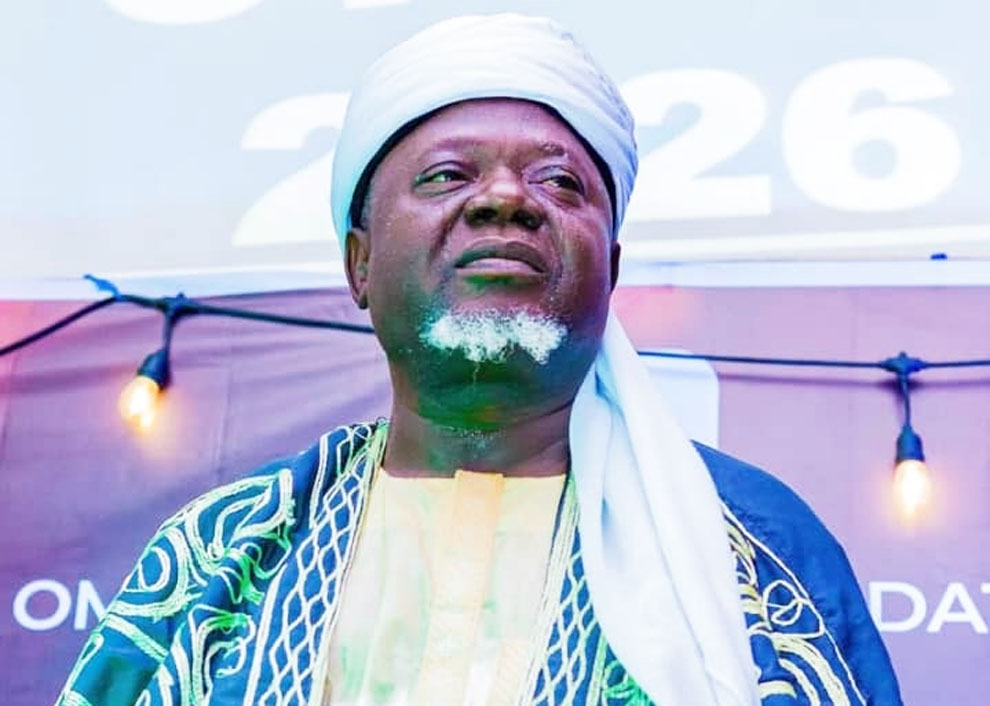
OYO, September 14, 2026 — The Grand Chief Imam of Oyo Land, Sheikh Al-Imam Bilal Husayn Akinola Akeugberu, has called on the leadership of Rabitoh 1964 to strengthen its public communication structure to ensure that its positions are clearly and accurately conveyed to the Muslim Ummah and the wider public.
Akeugberu said the organisation should consider appointing a seasoned media professional with experience across print, electronic and digital platforms to coordinate its public communication.
The recommendation was contained in a statement issued on Monday by the Director of Media and Publicity to the Grand Chief Imam, Mallam Ibrahim Agunbiade.
According to the statement, clearer communication would help reduce the burden on the leadership of Rabitoh 1964, particularly the Mudeer Markaz, while ensuring that official positions are properly articulated, contextualised and presented to the public.
The Grand Chief Imam said this would also minimise the risk of statements being misunderstood, distorted or interpreted outside their intended context.
He urged Rabitoh 1964 to preserve its character as a broad and unifying Islamic platform rather than allowing it to be identified with any particular ideological sect, jurisprudential school or group within the Muslim Ummah.
Akeugberu said the organisation’s positions should be guided by the Qur’an and authentic Sunnah of Prophet Muhammad, while recognising legitimate differences of opinion in matters of Islamic jurisprudence.
READ ALSO:
- “Not as Corrupt as the World Thinks”: Reno Omokri Defends Nigeria’s Image and Safety
- FBI investigated people linked to Tinubu, not President — Omokri
- 2027: Sowore Promises ₦500,000 Minimum Wage, Free Education, 24-Hour Electricity
He specifically cited issues surrounding the commencement and termination of Ramadan, sighting of the crescent moon and whether Sha‘ban should be completed with 30 days as matters requiring knowledge, wisdom, consultation and responsible communication.
According to him, disagreements over such issues should not be allowed to create the impression that Rabitoh 1964 belongs exclusively to a particular sect, creed or ideological tendency.
The Grand Chief Imam also stressed the need for openness and consultation in the affairs of the organisation, rejecting any perception of Rabitoh 1964 as a closed association.
“Islam is an open religion,” the statement said, emphasising the importance of transparency, consultation and collective responsibility in institutions established to serve the Muslim community.
Akeugberu said decisions on matters affecting the Ummah should follow adequate consultation and, once reached, should be presented clearly as the agreed position of the organisation.
He further said Rabitoh 1964 should maintain an effective presence across newspapers, radio, television, online platforms and social media, while responding promptly to misinformation or inaccurate attribution of positions to the organisation.
He said improved communication would strengthen the relationship between the organisation and the wider Muslim Ummah in Yorubaland, promote understanding of its objectives and contribute to the unity and dignity of the Muslim community.
The Grand Chief Imam therefore urged the leadership to constitute a competent and professionally led communication structure capable of translating the decisions and positions of the organisation into clear, responsible and authoritative public messages.
The objective, he said, should be for Rabitoh 1964 to speak with a clear and responsible voice without compromising the legitimate diversity of jurisprudential opinions within the Muslim Ummah.
The statement was issued to journalists by Agunbiade on behalf of the Grand Chief Imam of Oyo Land.
Grand Chief Imam calls for professional communication structure for Rabitoh 1964
metro
FBI investigated people linked to Tinubu, not President — Omokri

FBI investigated people linked to Tinubu, not President — Omokri
Nigeria’s Ambassador-designate to Mexico, Reno Omokri, has acknowledged that the United States Federal Bureau of Investigation (FBI) conducted an investigation involving individuals connected to President Bola Ahmed Tinubu, but insisted that the Nigerian leader was not the subject of the probe.
Omokri made the clarification during an interview on Channels Television’s Sunday Politics, amid renewed controversy over FBI and Drug Enforcement Administration (DEA) records being sought in a United States court in connection with Tinubu’s past dealings and a 1990s investigation.
He said reports suggesting that the President himself was investigated by the FBI were misleading, arguing that the records being discussed relate to people whose financial activities came under scrutiny.
“There was an investigation. Bola Ahmed Tinubu was not the subject of that investigation,” Omokri said, adding that the President was working as an accountant at the time and had money belonging to clients who were subsequently investigated.
According to him, the funds became part of the investigation because of their connection to the individuals under scrutiny. He said that when the matter was brought to Tinubu’s attention, the then accountant agreed to the forfeiture of the funds.
Omokri stressed that the forfeiture related to the accounts and not to the President personally.
The controversy has intensified following a Freedom of Information Act (FOIA) case filed in the United States by transparency activist Aaron Greenspan, who has sought access to records held by US agencies concerning Tinubu.
READ ALSO:
- 2027: Sowore Promises ₦500,000 Minimum Wage, Free Education, 24-Hour Electricity
- Desmond Elliot Apologises to Gbajabiamila, Seeks Return to APC
- ‘Jobs Must Not Be Based on Connections’ — Oyintiloye Tells FCC
The case, filed as Civil Action No. 23-1816 before the US District Court for the District of Columbia, followed FOIA requests submitted in 2022 to several American government agencies.
The FBI and DEA remain involved in the litigation after other agencies were removed from the case following rulings that allowed them, in certain circumstances, to neither confirm nor deny the existence of requested records.
The Presidency has repeatedly maintained that the proceedings are a civil records-disclosure dispute, not a criminal prosecution of Tinubu. It has also stressed that no US court has found the President guilty of criminal wrongdoing.
According to the Presidency, the FBI and DEA have produced hundreds of pages of records in the litigation, with portions withheld or redacted under exemptions provided by US law. The exemptions include protections for grand-jury information, law-enforcement investigations, confidential sources, investigative techniques, attorney-client privilege and personal privacy.
Tinubu was also permitted to participate in the case as an intervenor to protect his privacy interests in the records being sought by Greenspan.
The latest controversy followed the submission of FBI records to US District Judge Beryl Howell on August 28 for review under seal. The materials were submitted ex parte and in camera, meaning they were provided to the judge for private judicial review rather than released publicly.
Omokri, however, argued that the existence of FBI records bearing Tinubu’s name should not automatically be interpreted as evidence of a criminal investigation against him.
He referred to a 2003 FBI records check, which he said showed that there was no criminal arrest record, outstanding warrant or similar criminal record against Tinubu at the time.
The ambassador-designate also rejected the characterisation of the documents as evidence that Tinubu had a criminal record in the United States.
He said FBI records can contain information about individuals for several reasons and that the mere existence of a file or reference to a person’s name does not, by itself, establish criminal culpability.
Omokri also questioned the wisdom of releasing all the records publicly, arguing that some of the material could contain sensitive personal information.
The Presidency had earlier explained that Tinubu himself invoked privacy protections under the FOIA process, while insisting that his participation in the case should not be interpreted as an indication that he was facing criminal charges in the United States.
The dispute has nevertheless continued to generate political controversy in Nigeria, particularly as parties and political groups position themselves ahead of the 2027 presidential election.
Opposition figures and critics of the administration have repeatedly demanded greater transparency over the records, while supporters of Tinubu have argued that the US court proceedings should not be presented as evidence of criminal wrongdoing.
With the legal dispute still before the US District Court for the District of Columbia, the contents of the records submitted under seal have not been fully made public. The court will ultimately determine what, if any, additional material can be disclosed under US law.
For now, Omokri’s position is that while an FBI investigation involving people connected to Tinubu took place, there is a crucial distinction between that investigation and an allegation that the President himself was the target of a criminal probe.
The ambassador-designate said that distinction was being lost in the political debate surrounding the records.
FBI investigated people linked to Tinubu, not President — Omokri
metro
NDLEA Intercepts 44kg UK-Linked Cannabis, Drugs Hidden in Bread, Speakers
NDLEA Intercepts 44kg UK-Linked Cannabis, Drugs Hidden in Bread, Speakers
Operatives of the National Drug Law Enforcement Agency, NDLEA, have intercepted two consignments of synthetic cannabis, popularly known as Colorado or “Colos,” shipped from the United Kingdom, while recovering more than 2.3 tonnes of assorted illicit drugs in coordinated operations across eight states.
The latest operations also uncovered consignments of illicit drugs concealed in music speakers and loaves of bread, highlighting the increasingly sophisticated methods allegedly being used by drug trafficking networks to move controlled substances within and outside Nigeria.
The NDLEA said its operatives at the import shed of the Murtala Muhammed International Airport (MMIA), Ikeja, Lagos, intercepted a UK-bound consignment containing 27 parcels of Colorado weighing 32.20kg.
A real estate agent, Abideen Jide Salami, was arrested on September 9 after allegedly arriving to collect a large luggage containing the illicit substance. According to the agency, Salami used a secret collection code reportedly sent to him by his brother based in the United Kingdom.
A follow-up operation linked to another UK consignment led to the arrest of 44-year-old Nurudeen Abiodun Kadiri, the designated recipient of another 12.25kg of Colorado. The suspect reportedly told investigators that his brother in the UK sent him the consignment.
The two UK-linked seizures amounted to 44.45kg of synthetic cannabis.
The NDLEA‘s Directorate of Operations and General Investigation also intercepted another consignment of Colorado concealed inside a music speaker at a motor park in Maza-Maza, Lagos.
READ ALSO:
- Driver Flees With Employer’s Car Two Days After Employment
- Boris Johnson Caught in Russian Drone Strike Scare Near Poland Border
- South Africa: Two Women Arrested Over Alleged Rape, Kidnap of E-Hailing Driver
The agency said the speaker contained three packs of the illicit substance and was allegedly being transported to Abidjan, Côte d’Ivoire, with Liberia as the eventual destination.
A sting operation at a nearby eatery resulted in the arrest of 41-year-old tour agent Ifeanyi Obed Augustine and 46-year-old Obasi Ugochukwu, identified by the agency as the alleged owner of the consignment.
In another operation at Iddo Park, Lagos, NDLEA operatives arrested Ifeanyi Nwokolo Henry on September 11 while he was allegedly attempting to dispatch 2.1kg of Colorado to Kano.
The nationwide crackdown extended beyond cannabis and synthetic drugs to pharmaceutical substances, including pregabalin, tramadol, diazepam, pentazocine, codeine and flunitrazepam.
In Kano State, NDLEA operatives raiding the Sabon Gari area arrested 20-year-old Saidu Adamu with 785,000 capsules of pregabalin weighing 669.425kg.
In a separate stop-and-search operation along the Zaria-Kano-Hadejia Road, officers recovered 1,700 tablets of diazepam allegedly concealed inside loaves of bread. A 28-year-old suspect, Habibu Sabitu, was arrested.
In Plateau State, operatives arrested 51-year-old Chinedu Uzor at Katako Market in Jos with 157,100 capsules of tramadol.
In Delta State, separate operations in Ughelli and Asaba resulted in the seizure of pentazocine injections, codeine syrup, tramadol, diazepam, flunitrazepam, also known as Hypnox, and MDMA, popularly known as Molly.
The agency said some of the substances were concealed inside music speakers. Two suspects, Emeka Oji and Chukwuebuka Anedi, were arrested in connection with the seizures.
The NDLEA also intensified its campaign against cannabis cultivation and distribution.
In Edo State, operatives destroyed 4,832.56kg of skunk, a form of cannabis, during raids on cannabis farms in Usen Forest, Igwe-Oke Forest and Ogboha Forest, covering parts of Ovia South-West, Owan East and Owan West Local Government Areas.
READ ALSO:
- Four-Storey Building Collapses in Enugu, Workers Trapped Inside
- 27-Year Wait Ends as Construction Begins on New Dutse Emir’s Palace
-
Mother ‘sold daughter’s abuse videos for $300’: Nigeria child pornography case shocks nation
A 39-year-old suspect, Sunday Segun, was arrested during the operation on September 11.
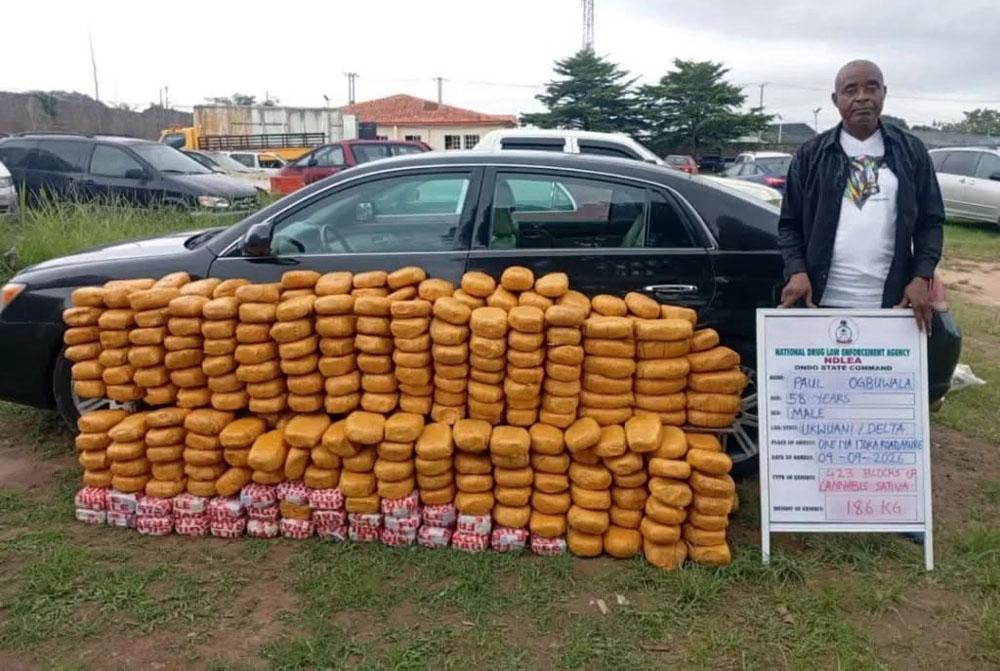
In Ondo State, intelligence-led operatives raided a residence along Oke-Iya, Ijoka Road, Akure, where they recovered 186kg of skunk allegedly concealed in the boot of a Toyota Avalon car.
The agency arrested 58-year-old Paul Ogbuwala, who was allegedly preparing to move the consignment to Jos for onward distribution.
In Kaduna State, NDLEA operatives arrested Hannah Michael at Gonin Gora with 369.6kg of cannabis.
Another major seizure was recorded in Bayelsa State, where four suspects were arrested at Ovom, Yenagoa, with 110 bags of cannabis weighing 876kg.
Those arrested were identified as 70-year-old Godwoman Gboriye, Motombo Silver, 44, Pere Andrew, 39, and Keme Andrew, 43.
The NDLEA said the latest operations were carried out across Lagos, Ondo, Edo, Delta, Kaduna, Plateau, Bayelsa and Kano states, resulting in the recovery of more than 2.3 tonnes of assorted illicit drugs and the arrest of several suspects.
The interceptions underline the wide range of channels allegedly being exploited by drug trafficking networks, including international consolidated cargoes, motor parks, road transportation and concealed compartments in everyday items.
The use of ordinary products such as bread and music speakers to conceal controlled substances also demonstrates the challenges faced by law enforcement authorities in identifying illicit consignments before they reach their destinations.
NDLEA Chairman and Chief Executive Officer, Brig. Gen. Mohamed Buba Marwa (retd.), commended the officers involved in the operations and urged them to maintain pressure on drug trafficking networks across the country.
Marwa charged the agency’s personnel to continue shutting down trafficking routes through airports, seaports, land borders and cannabis-producing areas in the hinterland.
The NDLEA has also continued its War Against Drug Abuse (WADA) campaign, combining enforcement operations with public awareness, prevention and community-based sensitisation.
The latest seizures come as the agency continues its efforts to disrupt both domestic and international drug supply chains and prevent controlled substances from reaching Nigerian communities and foreign destinations.
For the suspects arrested in the various operations, the allegations remain subject to investigation and prosecution in accordance with Nigerian law.
NDLEA Intercepts 44kg UK-Linked Cannabis, Drugs Hidden in Bread, Speakers
-

 metro3 days ago
Woman disguises as Muslim woman in Niqab to steal in Ado-Ekiti market, video sparks outrage
-

 metro2 days ago
Ondo Herbal Drink Tragedy: Survivor Vows Never to Drink Again as Death Toll Tops 30
-

 metro2 days ago
Sokoto Cleric Stabbed Twice in Neck After Juma’at Prayer, Attacker Killed
-
 Business2 days ago
Dangote: ₦525 Refinery Shares Could Rise to ₦10,000
-

 Africa3 days ago
Murder of Nigerian Bishop in South Africa Sparks Outcry Over Unsolved Killings
-

 metro2 days ago
MURIC fires back at Peter Obi: Forget Sallah ceremony, free Nigerian Muslims
-

 News3 days ago
AI on the Roads: LASTMA Turns to China to Fix Lagos Traffic
-
 News20 hours ago
SERAP Threatens Legal Action Over ₦126bn INEC Electoral Funds