

metro
Updated: NDLEA arrests Autonation Motors chairman, recovers N8bn Tramadol, two SUVs

Over 13 million pills of Tramadol 225mg worth N8.86bn have been recovered by operatives of the National Drug Enforcement Agency from a mansion belonging to a billionaire drug baron, Ugochukwu Nsofor Chukwukadibia, in the Victoria Garden City, Lekki, Lagos.
Director of Media and Advocacy of the NDLEA, Femi Babafemi, disclosed this in a statement on Monday.
Ugochukwu, who is the Chairman of Autonation Motors Limited, was also picked up in connection with the hard drug.
The NDLEA said its operatives on September 30, 2022 stormed the Plot A45 Road 2 home of the 52-year-old billionaire drug baron in the VGC.
It stated that a search of the expansive mansion led to the discovery of 443 cartons of Tramadol Hydrochloride 225mg, which contains 13,451,466 pills of the drug, while some cartons were already burnt in a fire incident in the house same day.
Before his arrest, Ugochukwu, who hails from Ihiala Local Government Area of Anambra State, had been on the agency’s watch list as one of those behind the tramadol drug cartel in Nigeria.
Preliminary investigation showed that he has about six mansions within the VGC, one of which he uses to warehouse the tramadol consignment, while he lives in the one at Plot Z-130, Road 67 and another as his office.
Five exotic vehicles have also been located in two of his mansions, out of which two SUVs, including a bullet proof jeep, have been removed to the agency’s facility.
Chairman/Chief Executive of the NDLEA, Brigadier General Mohamed Buba Marwa (retd), commended the officers and men involved in the operation for their diligence, while also appreciating Nigerians for supporting the Agency in its arduous task of ridding the country of the menace of drug abuse and illicit drug trafficking.
Marwa said, “I’ll like to reassure Nigerians and other stakeholders wherever they are located across the country and beyond of our preparedness to work with them on this onerous task of saving our people from the drug scourge.
“This partnership is a further warning to the drug barons and cartels that there is no hiding place for them anymore, because we remain on their trail and we’ll always get them.










metro
NiDCOM confirms release of Nigerian girls detained in Mauritius

NiDCOM confirms release of Nigerian girls detained in Mauritius
The Nigerians in Diaspora Commission (NiDCOM) has confirmed the release of Nigerian girls who were reportedly detained at an airport in Mauritius, following public concern and calls for intervention by Nigerian authorities.
NiDCOM said the girls had regained their freedom and were travelling back to Nairobi, Kenya, while efforts were ongoing to address the circumstances surrounding their detention and prevent a recurrence.
The incident gained public attention after a video showing the girls in detention circulated on social media, prompting Nigerians to call on relevant government agencies and diplomatic authorities to intervene.
An Instagram user identified as #Queenbethia shared the video on Sunday and appealed to authorities to take urgent action, alleging that the girls had been held at the Mauritius airport since July 31, 2026.
The post generated widespread reactions, with many social media users expressing concern over the welfare of the girls and demanding clarification on why they were being held.
In a statement issued on Monday through its Digital Media Unit, NiDCOM announced that the girls had been released and were already on their way back to Nairobi.
“The Nigerians in Diaspora Commission (NiDCOM) wishes to inform the public that the Nigerian girls who were previously detained have been released.
“They are currently on their way back to Nairobi,” the commission stated.
READ ALSO:
- Power Struggle Threatens Peter Obi-Kwankwaso Alliance Ahead of 2027 Polls
- Gumi: Clerics who join politics are better than those praying for politicians
- FRSC Boss: Tinubu’s CNG, EV Drive Creating Jobs, Attracting Investment
NiDCOM said its Chairman and Chief Executive Officer, Abike Dabiri-Erewa, was engaging the relevant Nigerian diplomatic mission, which had formally taken up the matter with the authorities in Mauritius.
According to the commission, the engagement is intended to establish accountability, clarify the circumstances surrounding the detention and help prevent similar incidents involving Nigerian travellers.
“The Chairman/CEO of NiDCOM, Hon. Abike Dabiri-Erewa, is actively engaging the relevant Nigerian Embassy, who have formally taken up this matter with the authorities of the country concerned, to ensure full accountability and prevent any recurrence,” the statement added.
The commission reaffirmed its commitment to protecting the welfare and interests of Nigerians living, working, studying or travelling outside the country.
NiDCOM said the intervention aligned with the Federal Government’s Renewed Hope Agenda, which places emphasis on the welfare and protection of Nigerians at home and abroad.
“NiDCOM, in line with Mr President’s Renewed Hope Agenda, remains committed to the welfare and protection of all Nigerians home and abroad,” the commission said.
However, the commission did not disclose the identities or number of the girls, the exact circumstances that led to their detention, or whether the matter was connected to immigration documentation, travel requirements or other airport procedures.
NiDCOM also did not provide details about when the girls were expected to arrive in Nairobi or whether they would later return to Nigeria.
As of the time of filing this report, there was no official public statement from the Mauritius government, immigration authorities or airport officials explaining why the Nigerian travellers were held.
The incident has renewed discussions about the experiences of Nigerian travellers at foreign airports and the importance of timely consular support when citizens encounter immigration, travel or other challenges outside the country.
The release of the girls has brought relief to their families, friends and concerned Nigerians who had called for urgent intervention. Further details are expected as Nigerian diplomatic authorities continue engagement with their Mauritian counterparts over the incident.
NiDCOM confirms release of Nigerian girls detained in Mauritius
metro
Nigerian Navy Intensifies Offensive Against Criminal Networks, Destroys Militant Camp in Cross River
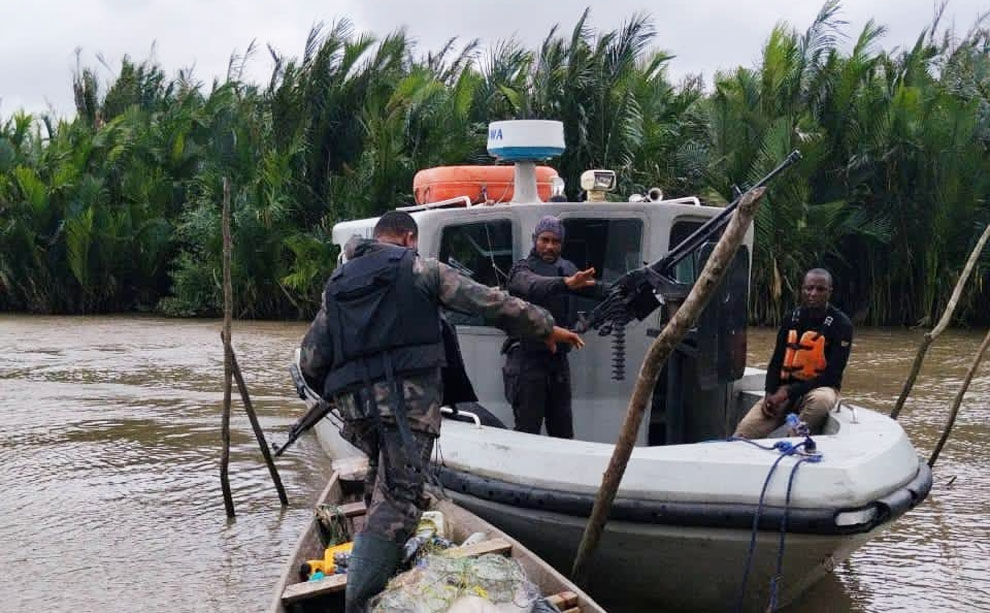
Nigerian Navy Intensifies Offensive Against Criminal Networks, Destroys Militant Camp in Cross River
NNS Victory continues sustained pressure on militant elements as troops recover weapons, military gear, and intelligence documents in Bakassi LGA operation
The Nigerian Navy Ship (NNS) Victory has sustained its offensive against militant elements in Cross River State, destroying another suspected camp at the Ine Ikoridung coastal settlement in Bakassi Local Government Area. The raid, conducted on August 2, 2026, followed credible intelligence indicating that militants had relocated to the remote settlement after sustained patrols forced them out of their former base at Dayspring Island. This operation represents the latest phase in a broader campaign by the Nigerian Navy to dismantle militant networks and restore safety to the Calabar waterways and surrounding maritime environment.
According to a statement by the Base Information Officer, Lt. Com. Sulaiman Bala, troops moved into the creeks aboard NNS Victory patrol gunboats. On sighting the approaching vessels, the suspects fled, prompting naval personnel to cordon off the area and conduct thorough searches of the identified huts. The operation yielded significant recoveries, including five empty cartridges, one military camouflage vest, one police camouflage vest, one military pullover, one pair of military jungle boots, and a notebook containing records of suspected militant fighters and the correctional facilities where they are serving prison terms. To deny criminals future safe havens, troops destroyed the identified huts in the settlement.
READ ALSO:
- Power Struggle Threatens Peter Obi-Kwankwaso Alliance Ahead of 2027 Polls
- Gumi: Clerics who join politics are better than those praying for politicians
- FRSC Boss: Tinubu’s CNG, EV Drive Creating Jobs, Attracting Investment
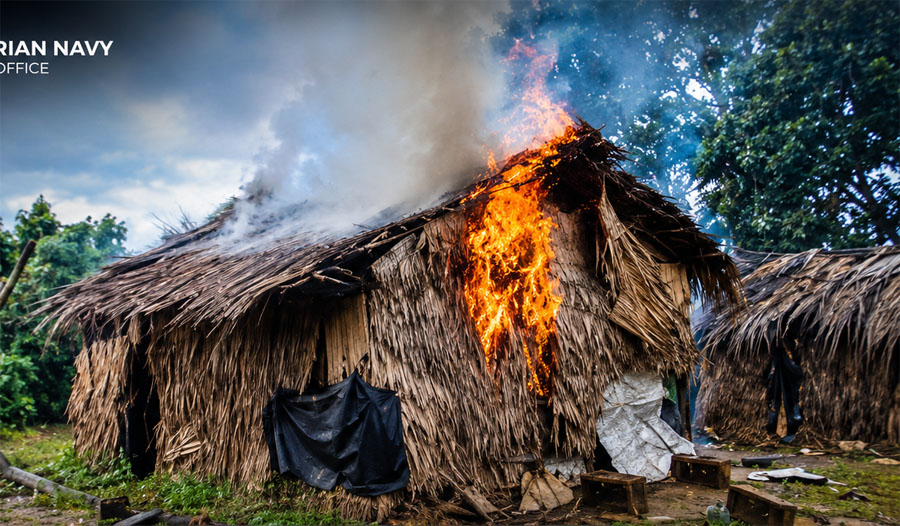
Nigerian Navy Intensifies Offensive Against Criminal Networks
Lt. Com. Bala noted that the relocation of the group to a remote coastal settlement was a direct result of continuous operational pressure from the Nigerian Navy, which is restricting their freedom of action and forcing them to abandon established hideouts. He stated that the relocation of the group to a remote coastal settlement is a result of continuous operational pressure from the Nigerian Navy, which is restricting their freedom of action and forcing them to abandon established hideouts. He added that NNS Victory would continue to sustain maximum pressure on criminal elements until total security is restored to the maritime environment.
This latest operation forms part of a wider offensive targeting not just militant fighters but also the financial and logistical networks that sustain their activities. In a related operation on Dayspring Island in June 2026, naval personnel disrupted a suspected militant financing network operating within the Ini Abasi fishing settlement in Akpabuyo Local Government Area. During that operation, troops recovered several wraps of suspected cannabis sativa and a handwritten ledger containing names and monetary entries amounting to ₦5.529 million. The Director of Naval Information, Commodore Abiodun Folorunsho, explained that preliminary assessments suggested the document was used to record illegal levies imposed on fishermen and maritime transport operators in the area. The proceeds from these extortion activities were believed to serve as a significant source of funding for militant operations and other criminal enterprises within the Dayspring Island axis. By targeting illicit revenue streams, the Nigerian Navy continues to degrade the operational capability of criminal elements and deny them the resources required to sustain their activities.
The Nigerian Navy has maintained a sustained presence in the Calabar waterways, with NNS Victory conducting multiple operations against militancy, piracy, smuggling, and illegal oil bunkering in the region. In May 2026, naval personnel launched a major offensive against militants and kidnappers along the Calabar-Oron channel, destroying a hideout linked to a wanted militant kingpin known as “Juju” on Dayspring Island. That operation, conducted in collaboration with troops of the Nigerian Army 13 Brigade, forced suspected militants to flee their camps while securing key waterways and restricting their movement. The Navy has also targeted support networks, recently handing over a suspected militant collaborator, Mr Ubong Clement, to the Department of State Services (DSS) in Cross River State. Intelligence linked the suspect to a notorious militant identified as Steven Joseph, alias “Juju,” and revealed that he allegedly acted as a conduit for the disposal of goods stolen from market boats intercepted by militants.
Following operations, naval personnel have consistently engaged community leaders and residents, reassuring them of the Nigerian Navy’s commitment to maintaining a sustained security presence and conducting intelligence-driven operations aimed at restoring lasting peace within the waterways. The Navy reaffirmed its resolve to sustain aggressive patrols, targeted raids, and community-focused engagements to eliminate criminal elements, disrupt their support networks, and ensure that legitimate economic activities thrive within Nigeria’s maritime domain.
Nigerian Navy Intensifies Offensive Against Criminal Networks, Destroys Militant Camp in Cross River
metro
Terrorists kill six soldiers, 12 civilians in Zamfara, Sokoto attacks
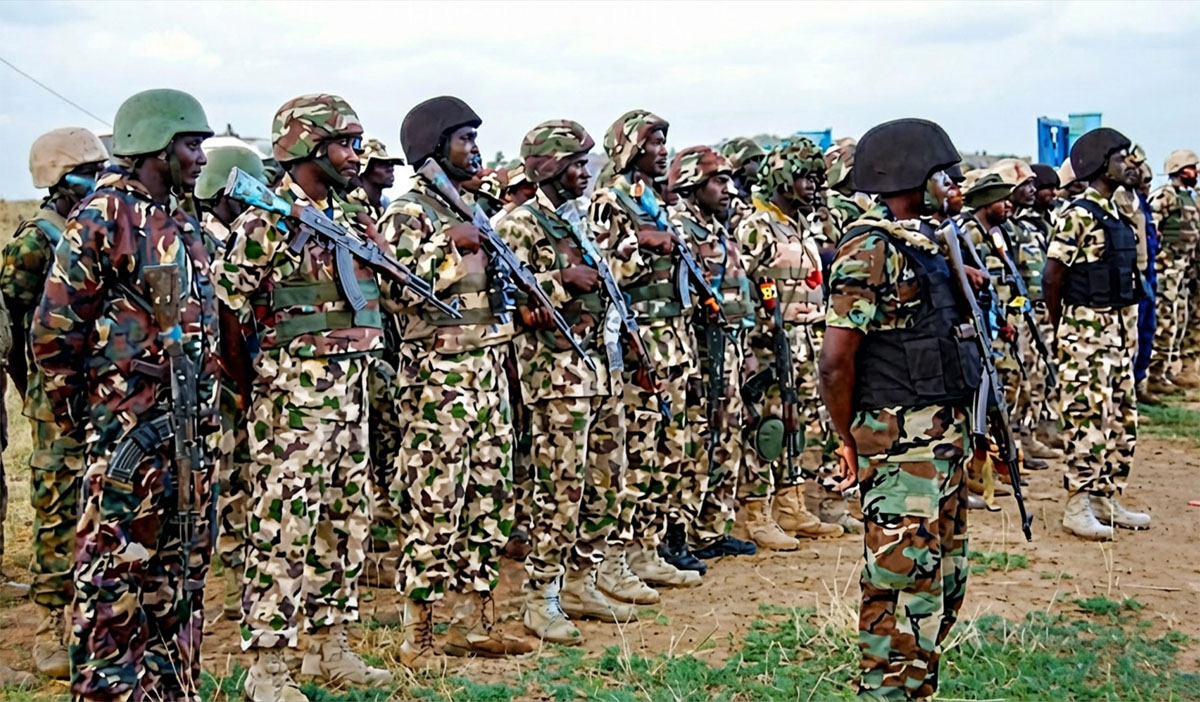
Terrorists kill six soldiers, 12 civilians in Zamfara, Sokoto attacks
At least six soldiers and 12 civilians were reportedly killed in separate attacks by suspected terrorists in Zamfara and Sokoto states, while more than 70 residents were abducted during a raid on Kasuwar Daji community in Kaura-Namoda Local Government Area of Zamfara State.
The coordinated attacks, which occurred late Saturday, have renewed concerns over the worsening security situation in parts of the North-West, where rural communities continue to face killings, mass abductions, livestock rustling and repeated attacks by armed groups.
In Zamfara State, residents said heavily armed attackers invaded Kasuwar Daji at about 11:30 p.m., opening fire and reportedly overrunning a military outpost in the community.
Local sources said at least six soldiers were killed during the attack, although the casualty figure had not been officially confirmed by military authorities as of the time of filing this report.
The attackers were also said to have abducted at least 75 residents and taken them into the forest after raiding the community.
A resident, Alhaji Aminu Kasuwar Daji, said the gunmen arrived in large numbers and began firing indiscriminately as they moved through the area.
He appealed to the Zamfara State Government and the Federal Government to strengthen security across the state, warning that residents were increasingly concerned about their safety.
“Our call to the Zamfara State and Federal Governments is to come to the aid of Zamfara people generally over the insecurity bedevilling the state,” he said.
“We are really in danger if terrorists can overpower the military and succeed in their attacks on innocent citizens.”
Former Deputy Speaker of the Zamfara State House of Assembly, Namadi Kasuwar Daji, also confirmed that the community had been attacked.
READ ALSO:
- State police: Shari’ah Council urges caution, wider consultations
- CAF Suspends Two Super Falcons Stars Ahead of Decisive Egypt Clash in WAFCON 2026
- NYSC Issues Fresh Camp Rules, Warns Against Night Travel, Document Errors
He said he was outside the state when relatives informed him that the attackers had invaded the area, looted shops and abducted an unspecified number of residents.
Namadi said he was informed that soldiers were killed during the attack but could not independently confirm the exact number of military casualties.
He added that the attackers reportedly carted away food items, drinks and other valuables before taking abducted residents into the bush.
The Zamfara State Police Command had yet to issue an official statement on the incident.
The command’s spokesperson, DSP Yazid Abubakar, said he was not aware of the attack and promised to contact police officers in the affected area for verification. However, no further response had been received as of the time of filing this report.
In Sokoto State, at least 12 people were reportedly killed after suspected terrorists attacked Lajinge village in Sabon Birni Local Government Area.
Residents said the attackers entered the community at about 11 p.m. on Saturday and operated for several hours, with the attack reportedly continuing until about 3:30 a.m. on Sunday.
According to residents, 11 people died from gunshot wounds, while a woman identified as Agada reportedly died after suffering severe shock during the attack.
Six people were also reportedly burnt alive after the attackers surrounded a room where they had taken refuge.
Residents said the gunmen ordered those inside the room to come out. When they refused, the attackers allegedly poured petrol around the building, set it on fire and opened fire on those who attempted to escape.
Those reportedly killed in the fire included the head of the household, Mallam Wauro, popularly known as Mallam Roro; his two sons, Ukasha and Mujaheed; two relatives identified as Sufyanu and Sani Shanbami; and an internally displaced person who had been staying in the house.
Another resident, identified as Lawwali, was reportedly shot dead at the entrance of the same house while attempting to flee, bringing the number of people killed in the compound to seven.
READ ALSO:
- Presidency Slams Onaiyekan for “Abuse of Clerical Privilege” Over Tinubu Meeting
- FAAN Debunks Fire Scare at Lagos Airport Terminal 2, explains cause of smoke
- Oil Prices Slide as Trump Announces Fresh Iran Talks, Easing Supply Fears
Residents said other victims were shot while trying to escape from different parts of the village.
They included a resident identified as Yusuf and three internally displaced persons who had sought safety in Lajinge after fleeing violence in other communities.
A member of the community’s local vigilante group said residents were keeping watch near the village primary school when they suddenly heard heavy gunfire.
He said the vigilante members were unable to withstand the attackers and were forced to flee as the gunmen moved through the community.
“We were at the primary school guarding the village when we suddenly heard heavy gunfire,” the resident said.
“We all ran for safety and kept moving from one hiding place to another whenever the shooting came closer.”
The attackers were reportedly able to move from house to house, stealing cattle and sheep while firing weapons to keep residents away.
A resident said one of the gunmen positioned a rifle at a strategic location while others entered homes and seized livestock.
The attackers later moved to the residence of Mallam Wauro, where he and two of his sons were killed.
Residents also said two of his wives were abducted and that the attackers took away cattle and other livestock from the household.
The exact number of people abducted during the Sokoto attack could not immediately be established.
Residents said several people were taken away, but some, particularly children, were later released by the attackers.
Community members alleged that no security reinforcement arrived during the attack despite repeated distress calls.
They also claimed that security personnel stationed in nearby Unguwar Lalle and Dan Tudu communities, which are about two kilometres from Lajinge, did not respond while the attack was ongoing.
“The bandits stayed in our village for hours without any intervention,” one resident said.
“They even walked along the main road laughing and smoking cigarettes as if they had conquered the community.”
The residents said they had repeatedly appealed to the government to deploy security personnel to the area but that their requests had not been met.
They added that eight people were killed in an earlier attack on the community about three weeks ago, increasing fears among residents over continued violence.
“We are Nigerians and we have voter cards. We elected the government to protect our lives and property,” a resident said.
“We are pleading with the authorities to deploy security personnel to safeguard our communities.”
The Sokoto State Police Command had also not issued an official confirmation of the attack as of the time of filing this report.
Police spokesperson, DSP Ahmad Rufai, said he was not aware of the incident and would verify the report after reaching his office. No further update had been provided at press time.
The latest attacks have again highlighted the security challenges facing rural communities in Zamfara and Sokoto, where residents continue to demand improved intelligence gathering, stronger security deployment and faster responses to distress calls.
The reported killings and abductions have also renewed calls for closer coordination among the military, police, intelligence agencies and community-based security groups to prevent further attacks.
As of the time of publication, authorities had not released final official casualty figures or confirmed the number of people abducted in either state.
Terrorists kill six soldiers, 12 civilians in Zamfara, Sokoto attacks
-

 Education2 days ago
ICYMI: Court orders JAMB, CBT centre to pay ₦10m over forced removal of candidate’s hijab during UTME
-

 News13 hours ago
Oloyede clears air on JAMB’s ₦36m ‘snake swallowed money’ controversy
-

 Auto2 days ago
Policy Bottlenecks Threaten Nigeria’s Clean Mobility Drive, LCCI Warns
-

 Education2 days ago
Oyo Muslim Leaders Receive Saudi Delegation, Intensify Drive for Muslim College of Nursing
-

 News13 hours ago
475 Police Officers Recalled After Controversial Retirement, Ordered for Mandatory Induction
-

 metro3 days ago
Catholic Priest Found Dead in Kogi After Machete Attack as Police, Govt Launch Investigations
-

 metro3 days ago
Osun Guber: IGP Deploys New Election CP as INEC Identifies 11 Flashpoint LGAs
-

 News3 days ago
CJN orders lawyers to stop using ‘Barrister’ before their names