

Opinion
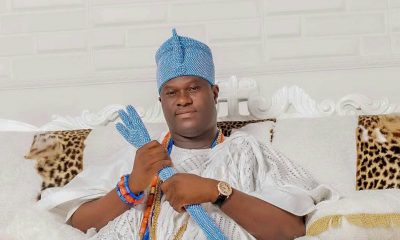
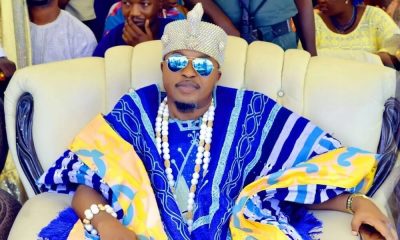
Ooni: The public displays of a king (1)

Ooni: The public displays of a king (1)
Tunde Odesola
(Published in The PUNCH, on Friday, June 9, 2023)
Nature was enveloped in darkness as dawn quickened in the womb of time, pushing towards the birth canal, carrying on its head daylight.
The cock, being nature’s timekeeper, knew the water was about to break. So, it sounded the flute in its throat, cookooorooocooo! And nature stirred awake.
Upon hearing the cock crow at the crack of dawn, the fox bolted madly up the mountain, panting and shivering. Again, the cock flapped its wings and crowed. The fox ran farther up the mountain, dreading death.
The cock jumped down from the branch of the iroko and went after the fox. The fox ran and ran and ran, and came to a precipice, stopping to weigh its options: fall from a mountaintop or death by fire. It chose the second option because, with fire, escape was still possible. So, it waited as the cock strutted majestically toward it.
Resplendent in gold, brown and black plumage, the cock smiled as it neared the shivering fox which laid flat on all fours, sinking its claws into the ground, wondering what language the earthworm speaks that makes the earth open up.
“Is this how far you can run?” the cock teased.
“I wasn’t running, sir,” the fox replied.
“I know you weren’t running, you were flying,” the cock said, asking, “Why’re you always running away from me when we should be friends?”
Fox: “It’s the fire! The fire!
Cock: The fire? Which fire?
Fox: The fire on your head!
Cock: Fire!? Fire on my head?
Fox: Yes, sir! It’s right there, burning. See! See it! On your head!
The cock touched its comb with its leg. “Is this what you call fire?” “Yes,” the fox replied, still terrified. The cock burst into a fit of laughter, tears rolling down its eyes. “Foolish fellow, this is no fire. It’s my comb; come touch it, touch it,” the cock said, moving towards the fox.
The fox felt the meaty comb of the cock, took a deep breath and yanked off the cock’s head, crunching the comb and cranium.
I knew when the Ooni of Ife, Alayeluwa Oba Adeyeye Ogunwusi, the Ojaja II, was at King’s College, Ile-Ife, for the three-month seclusive tutoring in ‘Ipebi’, where royal secrets and etiquettes are taught to would-be kings.
However, I do not know how long he stayed there. I also do not know if Ooni Ogunwusi passed all the courses on rites of passage, discretion, dignity and tact before he was released to mount the throne of his forebears.
But being a legend himself, I’m certain the Ooni knows the legend of the cock and fox I just told. As the second-in-command to the gods, I’m sure the king can see through the stupidity of the cock. As a wise monarch, who knows the importance of bloodline and lineage, I know Oba Enitan is likely to spare a thought for the generations of the cock that has gone down the throats of foxes into oblivion.
Being a true Yoruba son, it doesn’t lie in my mouth to say many of the public displays of Ooni Ogunwusi fall short of royal expectation and dignity. I shouldn’t say that. Because no one rebukes the masquerader when it misses the road; you say, my lord, the road you took is a cul-de-sac. “A kii so fun eegun wipe o s’ina. Baba, ko s’ona nibe yen ni won n wi.” Who am I to teach the Ooni how to be a king?
In the olden days, Yoruba beaded crowns were Almighties. They combine executive powers with judicial authority and legislative functions in a trinity of crown, sword and sceptre. Because they ensured security, monarchs of yore worked closely with hunters who double as police and army. Perhaps, the immediate past Ooni of Ife, Oba Okunade Sijuwade, ‘jingbinni bi atekun’, supernaturally saw that my forebears were hunters, so he made me, an obscure subject, a distant little friend.
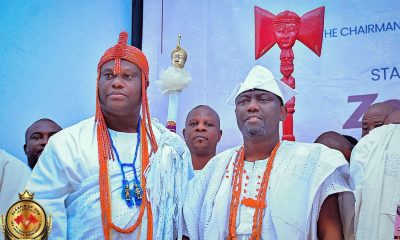
After watching the controversial video of how Ooni Ogunwusi exchanged greetings with a Nollywood old-timer, Pete Edochie, and another Nollywood veteran, Kanayo O. Kanayo, I decided to peep into the lives of royals in and outside Nigeria – to see if the Ooni desecrated the stool of Oduduwa by his incessant star-struck public displays.
Memory lane. In what appears like a coronation celebration in 1980 when Sijuwade became Ooni, an old video shows a brand new Oba and his guests being serenaded by Juju superstar, King Sunny Ade. In a combination of prostration and kneeling, KSA and his boys sang all through the time Sijuwade was on the dance floor. Neither KSA nor any of his boys got up all through the performance.
Ooni Sijuwade was simply majestic; he didn’t gyrate, he was just there, swaying, solid and confident, soaking in the songs of praise.
Nobody dared ‘spray’ Baba Tokunbo with money. But guests sprayed the queen dancing with him. Everyone maintained a respectable distance from Sijuwade, nobody turned Sijuwade’s ears into a microphone, neither did he behave like an usher or MC, ushering people to seats, telling them about the latest isi-ewu joints in town and where to get ladies in desperate search of husbands – like Oba Atilawi.
In England, there are protocols that even the high and mighty must observe when they are in the presence of the throne of England. Former US First Lady, Michelle Obama, caused a stir, in 2009, when she put her arm around Queen Elizabeth. You don’t touch the Queen!
There are other non-steadfast rules to observe when you come before the Queen. You don’t show up empty-handed. You should bring a gift. “Ko si gberu mi laafin,” is a Yoruba proverb that equates to this English royal protocol. No one carries goods out of the palace, be it in England or Yoruba land. But you can bring gifts into the palace.
You must stand at attention when the Queen enters the room. Don’t eat before she does. Don’t leave before the does. Never turn your back on the Queen. You don’t call her by her first name or nickname. Speak only the Queen speaks to you. A lady must curtsey (bend at the knees) while a man must bow. These same rules apply to the King of England.
“Oba kii m’eje, iyi ni oba n fi ori bibe se,” says a Yoruba proverb. The king doesn’t drink blood, he beheads to affirm his glory.
Modern royalty, some may argue, is an extension of feudalism. Feudalism was abolished on August 4, 1789. But royalty has survived, albeit, with one kidney, one lung and an enlarged heart. In Nigeria, kings, queens, regents and the palace are the custodians of culture and tradition. It goes to say that each tribal royalty has its dos and don’ts.
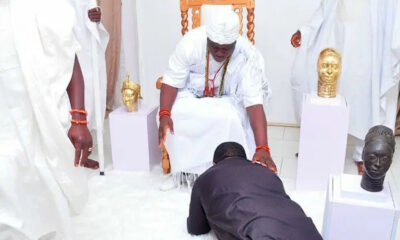
In the second part of this article, I shall analyse Ooni Ogunwusi’s unkingly display when he publicly met some celebrities, particularly when he became the MC during the birthday of a celebrity named Elizabeth Itunuayo Jack-Rich.
Ooni: The public displays of a king (1)
To be continued.







Opinion
Osun election: Àtàọ́ja should stop running joro-jara-joro
Osun election: Àtàọ́ja should stop running joro-jara-joro
Tunde Odesola
(Published in the PUNCH, on Friday, July 24, 2026)
It’s midmorning in Àtàọ́ja’s palace. The sun beamed a friendly smile, quite different from the furious furnace it was preparing for the afternoon. As gently as the breeze caressed the trees in the palace, two pigeons landed on silent feet in the courtyard. They were on a joint mission. To scavenge. Looking right and left, up and down, beaks at work, wings at the ready, the bouncy birds pecked food in the palace soil. For the male and female pigeons, danger lies not in flying; it lies in walking. Sycophancy walks naked on the palace grounds.
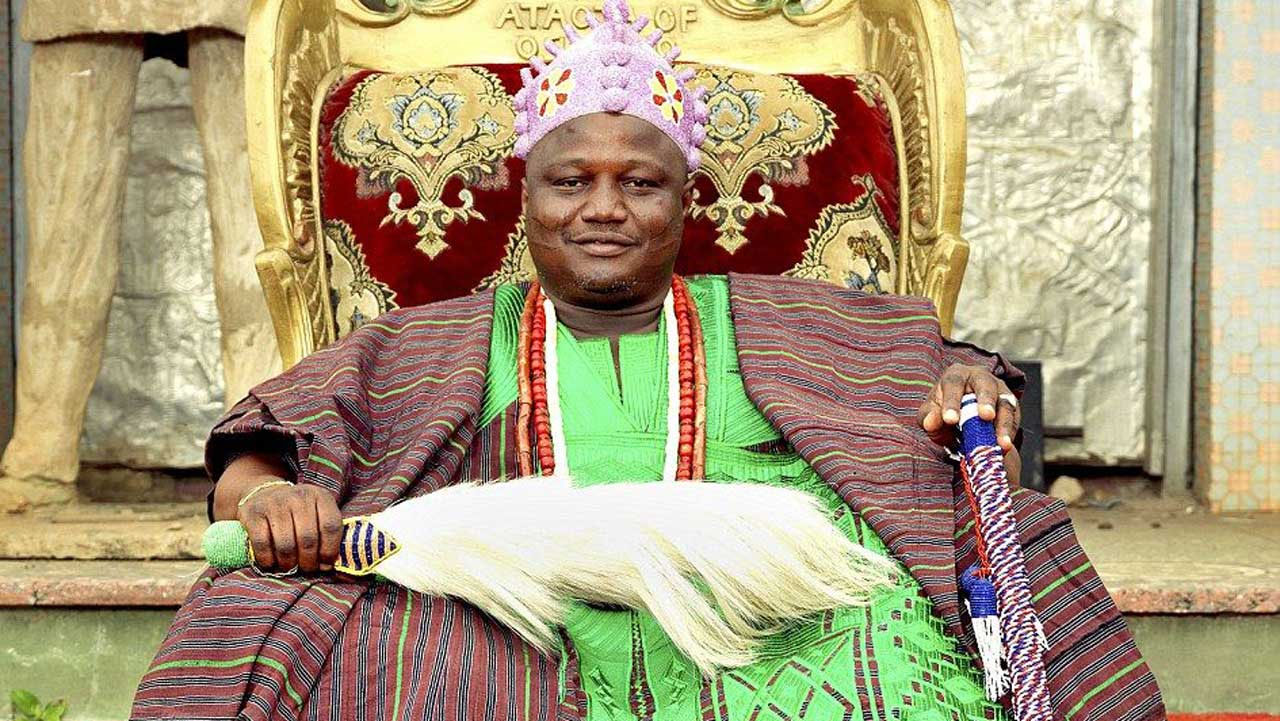
Even the king’s kààakí was caught unawares. It couldn’t herald what was about to happen because everything occurred at a dizzying speed. The Àtàọ́ja, Oba Jimoh Olanipekun, ran out from the inner recess of the palace, his agbada òfì billowing in the Osogbo wind; kira-kita, kira-kita, the king bolted like Usain Bolt. Where is the king running to?
In his breakneck flight, Àtàọ́ja Osogbo forgot to wear his neck beads! I-m-a-g-i-n-e! But he luckily remembered to wear his cap. I suspect it was ancestral forefathers known as ‘àwọn alálẹ̀’ who reminded him to wear his shoes. Otherwise, the king might have appeared out of sorts at the state government event he was fleeing to.
Thankfully, when Àtàọ́ja Olanipekun reached his destination, he still had some breath in his lungs. He sat down, resplendent in white and blue agbada, clenched the microphone and confessed in Yoruba, “Ẹ̀ ri pé ń ò kólẹ̀kẹ̀ ọ́rùn? Mo sáré dé hin ni. Tí a bà á wá, wọ́n á ní, ‘Háà, kò mọ̀ le bọ́ta mọ́!’ Gbogbo ohun tí wọ́n ń sọ là ń gbọ́.”
I’ll translate the king’s speech in English: “Can’t you see that I am not wearing my royal beads? (It is because) I ran to this event. Because if I did not come, they would say, ‘Ha! He cannot come out again!’ We hear everything that they (opposition) are saying. I will not stop eulogising Adeleke Jackson Nurudeen for his excellent performance in Osun State.”
Unfortunately, Olanipekun thinks that by singing himself hoarse on the praise of ebullient Governor Ademola Adeleke, he is giving the re-election bid of the Asiwaju of Ede a boost. No, he is not. If he was, the apex socio-cultural association of Osogbo sons and daughters, the Osogbo Progressive Union, would not openly criticise him for publicly canvassing support for Adeleke and attacking the opposition on many occasions.
The penis of the bird does not dangle outside; it is tucked inside the bird, says a Yoruba proverb. This proverb preaches decorum. If the king had been decorous like other Osun kings, who, though, have their favourites among the governorship candidates, but who have kept their support within the ambit of decency, the OPU wouldn’t have embarrassed him with a public disclaimer.
The Timi of Ede, Oba Muniru Adesola Lawal, had been an exemplar in his support for Adeleke, who hails from his domain. The Timi had been regal: zero aggression, zero hate words, zero campaign against other parties. Oba Timi has shown emotional intelligence while fully supporting Adeleke, his son. That is how to be a father to all subjects. Of course, if Timi was blindfolded at the polling booth on election day, his royal thumb would still locate Accord Party on the ballot, whereas some carricachop from another land is claiming to know Ọ̀ṣọ́ more than Ọ̀ṣọ́’s mother.
READ ALSO:
- Dollar to Naira Exchange Rate Today: Naira Holds Steady as Fuel Importer Demand Mounts
- Senate Bill Requiring Social Media Offices in Nigeria Gains Stakeholder Support at Public Hearing
- Army Declares Soldier Wanted Over Alleged Sale of Military Uniforms to Terrorists
It’s undignifying for the elderly to run helter-skelter, says a Yoruba proverb distilled in these words, “Gbàmí, gbàmí ò ye àgbà.” Another proverb that cautions against kùrùkẹrẹ movement says, “Ẹní wọ bàtà ẹsẹ̀ òsì méjì, ó níbití ó ń lọ.”
The importance of royal objects such as crown, beads and staff is interrogated in the seminal work, “Yoruba: Nine Centuries of African Art and Thought,” written by Henry J. Drewal et al, and published by The Centre for African Art, New York, in 1989. Similarly, the royal totems – crown, beads and staff – are also a subject of scholarship in Rowland Abiodun’s “Yoruba Art and Language: Seeking the African in African Art,” published by Cambridge University Press in 2014.
Drewal and Abiodun aver that in Yoruba thought, the crown, beads and staff are sacred totems that signify divine authority, spiritual protection, leadership, ancestral continuity, and the king’s covenant with the people and the gods.
In both books, the crown is regarded as a sacred emblem containing the spiritual essence that connects the present with the past. Royal beads signify dignity and prestige, abundance and prosperity, and spiritual energy. The staff is an instrument of authority, justice, fairness, and protection.
Joro-jara-joro is an onomatopoeic word that means helter-skelter. Onomatopoeic words are words that sound like their meanings. Examples: buzz, hiss, slap, sleep, twinkle, jab, splash, tear, bang, etc. Joro-jara-joro was amplified by Afrobeat creator Fela Anikulapo-Kuti in his 1976 song, “Zombie”, which mocks Nigerian soldiers’ blind allegiance to dictatorship.
In “Zombie”, Fela caricatures Nigerian soldiers as unthinking brutes whose sole skill is to chaotically rove joro-jara-joro against the masses, like zombies on the mission to “go and kill, go and quench, go and die”. Fela sings, “Zombie way na one way; joro-jara-joro/No break no jam, no sense; Na joro-jara-joro….”
There would have been no reason to write this article because I had made my intention clear enough in an earlier article entitled, “Governor Adeleke and a tale of three Àtàọ́jas,” published in The PUNCH on Friday, July 17, 2026. My preoccupation in the article was to call the attention of the monarch to some of his unkingly utterances. My intention wasn’t political. But an insinuation, especially from some irritating ‘e-rats’ and ‘data boys’, who attempted to paint my intervention in political colours, made this sequel inevitable.
In line with their zombie mentality, a particular ‘e-rat’ along with his fellow ‘data boys’ accused me of meddlesomeness and maintained that it lies within the rights of the Àtàọ́ja to express support for any candidate of his choice.
Clearly, the accusation of meddlesomeness was borne out of dripping ignorance. If not, an enlightened mind would see that the actions of the Àtàọ́ja diminish his traditional stool that represents the Yoruba worldview of unity, morality, justice, fairness and equity. The allegation that the Àtàọ́ja had the right to support any candidate of his choice is valid to the extent that such a right must not violate the principles of fair play, rule of law and decency.
By openly calling the opposition names in a viral video, did the Àtàọ́ja adhere to the principles of fairness and tolerance? By his vitriolic speeches, was he not stoking the embers of strife? If I could be provided with the evidence of one Osun traditional ruler who had been as politically intolerant as the Àtàọ́ja, against the ruling party, I shall tender an apology in my next article.
In one of the bad-taste videos, the Àtàọ́ja arrogantly disclosed how he rejected wise counsel by a concerned citizen, who told him the danger in his public support for Adeleke over other candidates. His words, “One of my people asked me why I am so audacious to the extent of overly supporting one candidate (Adeleke) over others; what if he doesn’t win?”
The king answered the worried citizen. Àtàọ́ja opened his mouth and played god, declaring with finality: “He will win.” Olanipekun’s divisive posture is most unbecoming of an ọba, whose palace should be an abode to seek conflict resolution by his subjects, including politicians. Àtàọ́ja should not be the epicentre of conflict.
In the recent past, I have ventilated my views on the actions of the Ooni of Ife, Oba of Lagos, Apetu of Ipetumodu, Alapomu of Apomu, Oluwo of Iwo, and Emir of Ilorin, among other traditional rulers. I strongly believe that it behoves the citizen to hold traditional rulers to the highest standards because the traditional institution embodies the ethos and pathos of a race.
For ‘e-rats’ and ‘data boys’, whose stock-in-trade is abuse, there is a lesson in the conduct of a member of the House of Representatives, Bamidele Salam. Salam is my friend of over 20 years. Though we have had moments of sharp disagreement, emotions never boiled over to name-calling.
One day, BS, that’s Salam’s nickname, saw my Facebook post on Governor Adeleke. In the post, I advised the governor against excessive dancing and to shear off some personalities who were following him about like houseflies following the wound on a dog’s ears. In the Facebook post about three years ago, I cautioned that the image of the governor dancing to the faintest of drumbeats amid a retinue of hangers-on was not good.
As soon as BS saw the post, he reached out to me on the phone and said, “Ọ̀rẹ́, ọ̀rọ̀ ò rí bẹ́yẹn o. Your post does not reflect the great work Adeleke is doing in Osun…” I smiled from the other end of the phone because Bamidele was pushing Adeleke’s narrative while ignoring the kernel of my Facebook post. When I insisted on the need for the governor to do better in regard to dancing, Bamidele said every man was a work in progress, including me. Bamidele’s example is how to engage intelligently; a lesson government and opposition ‘e-rats’ and ‘data boys’ should learn.
The demarcation between a ruling party and an opposition party is nebulous. Practically speaking, ideological philosophies among Nigeria’s political parties are nonexistent. This is why Àtàọ́ja should be careful in his untraditional support for Adeleke. The Adeleke he sees in the Accord Party today could be in the All Progressives Congress tomorrow. Olanipekun should not burn the bridge of friendship today because he might need to use the bridge tomorrow.
This is the lesson Àtàọ́ja Olanipekun should see in his recent visit to President Bola Tinubu in Abuja. When politicians do their thing, a respectable ọba should maintain a dignified distance. He should not be in the fray.
Are you shocked that Kabiyesi Olanipekun was in Aso Rock a few days ago? Yes, he was. As a guest of President Bola Tinubu. This is the story of how the monarch used one stone to kill two birds. Àtàọ́ja’s daughter was graduating from the Law School in Abuja. An influential Osun State indigene, worried by the king’s intolerant posture against the Osun All Progressives Congress, had arranged for the king to meet with the President. It took some time for the king to meet the President.
During their meeting, the President expressed worry over Àtàọ́ja’s political remarks against the APC in Osun, urging him to allow for a level playing field. I gathered that Àtàọ́ja told the President that he was sold on the Adeleke ticket. Personally, I do not fault Àtàọ́ja’s position – supporting a candidate of his choice; it’s his brickbat approach that is reproachable.
If Tinubu could open his doors to Olanipekun and sit down to dialogue with him, who says there cannot be a dialogue between Tinubu and Adeleke? And if a dialogue occurs between the two and an agreement is struck, would the king not feel uneasy relating with his ‘enemies’ in the APC? The king should always spare a thought for the flip side of things. That is what the wise do.
“Àgbàlagbà kìí ṣe lángbá, lángbá,” is a cautionary proverb for reckless elders. The pit of animosity must not be dug too deep because the digger might fall into it. A word is enough for the wise.
Kabiyesi Àtàọ́ja, kara o le o.
///
Email: tundeodes2003@yahoo.com
Facebook: @Tunde Odesola
X: @Tunde_Odesola
Osun election: Àtàọ́ja should stop running joro-jara-joro
Opinion
UI, UCH and the Question of Inclusive Leadership

UI, UCH and the Question of Inclusive Leadership
By Mallam Ibrahim Agunbiade
agunbiadeib@gmail.com
July 23, 2026
The appointment of Professor Peter Olamakinde Olapegba as the 14th substantive Vice-Chancellor of the University of Ibadan (UI), effective November 1, 2026, is deserving of congratulations. I wish him a successful tenure as he takes on the responsibility of leading Nigeria’s premier university.
The reported competitive process through which he emerged—following the assessment of eight candidates and the shortlisting of five for the final stage—is commendable, provided it was conducted transparently and strictly on merit.
However, this development also raises an important question that deserves honest and constructive discussion: When will a qualified Muslim have the opportunity to emerge as Vice-Chancellor of the University of Ibadan?
This question is not directed at Professor Olapegba or his Christian faith. If he emerged as the best candidate through a fair and transparent process, then he deserves the support of all Nigerians. My concern is whether qualified Nigerians of different faiths enjoy equal opportunities to compete for the highest leadership positions in our national institutions.
The same question applies to the University College Hospital (UCH), Ibadan, where a change in leadership is expected in the coming months. It is therefore time for stakeholders to begin constructive conversations about the appointment of the next Chief Medical Director (CMD).
READ ALSO:
- How to apply for FG’s YouthCred loan and qualify for up to ₦2 million
- Ondo Speaker given Sunday deadline to resign or face impeachment
- Trump praises Tinubu’s anti-terror efforts as Presidency cites security progress
I believe that qualified and competent Muslim professionals should be encouraged and given a fair opportunity to compete for the position. If the best candidate happens to be a Muslim, there should be no hesitation in appointing that individual. Equally, if the best candidate is a Christian or belongs to another faith, the same principle of merit should apply.
This is not a call for religious quotas or preferential treatment. Rather, it is a call for a level playing field.
A Muslim should not be appointed simply because he is a Muslim, just as a Christian should not be appointed simply because he is a Christian. Leadership must be based on competence, integrity, experience, and the capacity to deliver.
However, merit can only be meaningful when every qualified candidate has a genuine opportunity to compete without bias or discrimination.
The University of Ibadan and UCH are national institutions that belong to all Nigerians. Their leadership should therefore reflect the principles of fairness, inclusiveness, equal opportunity, and merit.
As Professor Olapegba prepares to assume office, I congratulate him once again and wish him a successful tenure. At the same time, I believe this is the right moment to ask whether our leadership selection processes truly provide equal opportunities for all qualified Nigerians.
As the succession process at UCH approaches, I urge stakeholders to ensure that no qualified candidate is excluded—consciously or unconsciously—because of religious identity. Let the process be transparent, competitive, and firmly anchored on merit.
I am not asking for a Muslim to be appointed simply because he is a Muslim. I am asking that no qualified Muslim should be denied the opportunity to lead simply because of his religious identity.
The same principle should apply to every Nigerian, regardless of faith or background.
Let merit prevail. Let competence prevail. Let fairness prevail.
UI, UCH and the Question of Inclusive Leadership
Opinion
Case for replicating the Oyo kidnap-rescue template nationwide, By Farooq Kperogi

Case for replicating the Oyo kidnap-rescue template nationwide, By Farooq Kperogi
Case for replicating the Oyo kidnap-rescue template nationwide, By Farooq Kperogi
Kperogi is a renowned columnist and United States-based professor of journalism
-
 metro2 days ago
PFICP scandal: How ₦1.3bn ‘fake agency’ traced to Buhari’s government entered 2026 budget
-
 Politics3 days ago
Atiku denies Obasanjo’s N5m bribery claim, links accusation to 2027 presidential race
-

 metro2 days ago
Dalung gives Mutfwang 72-hour ultimatum to withdraw apology to Igbos over civil war role
-

 Education3 days ago
Oluwo Urges Youths to Pair Degrees with Skills, Commends Westland University’s Excellence
-
Politics1 day ago
2027 election: Atiku accuses Obasanjo of reviving false allegations to favour preferred candidate
-

 metro12 hours ago
NDLEA intercepts ₦10bn worth of cocaine, Loud, opioids in Lagos
-

 metro3 days ago
Police Detain 4 Officers Over Viral Ethnic Profiling Video on Lagos–Benin Expressway
-
 Sports1 day ago
Anthony Joshua stuns Kristian Prenga with dramatic knockout to revive career