

Education
Varsity workers declare indefinite strike from Feb 5
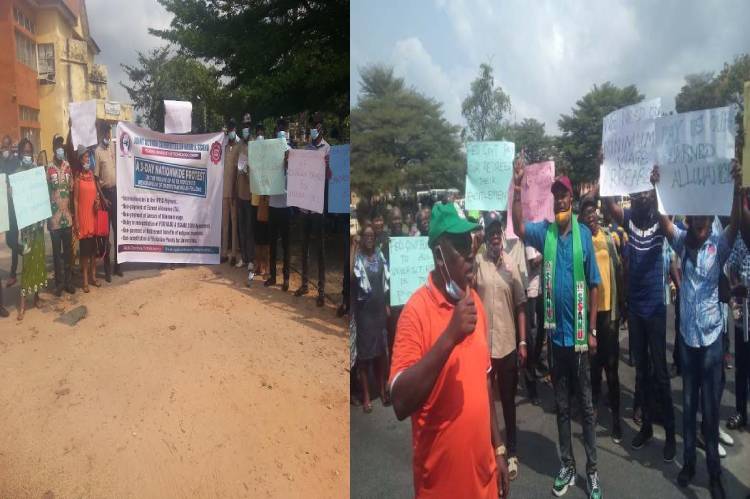
Barely one month after university lecturers called off a nine-month strike, another industrial action has been declared by the Non-Academic Staff of Educational and Associated Institutions (NASU) and the Senior Staff Association of Nigerian Universities (SSANU) with effect from February 5.
The two unions coming under the Joint Action Committee (JAC) have given the government a 14-day ultimatum to meet their demands bordering on welfare package and changes in the university system or risk an “indefinite, comprehensive and total strike”.
The leadership of the unions made the announcement at a press conference in Abuja on Friday, stressing that if the government failed to address all the issues, the strike would commence from the midnight of February 5.
General Secretary of NASU, Peters Adeyemi, who spoke on behalf of JAC leadership, said 90 per cent of NASU members in all its branches across the country were in support of the strike.
He also said 83 per cent of SSANU members had expressed support for the strike; 11 per cent were against strike, adding that six per cent were indifferent.
Adeyemi said, “It is in line with the resolution of our members nationwide that the leadership of the Joint Action Committee of NASU and SSANU hereby resolves as follows: That members of NASU and SSANU shall embark on an indefinite, comprehensive and total strike with effect from midnight of Friday 5th February, 2021.
“That two weeks’ notice effective from today, Friday 22nd January, 2021, is hereby given to government and relevant stakeholders of this development.”
He said JAC of NASU and SSANU had signed an understanding with the Federal Government on Tuesday 20 October, last year on all the contentious issues affecting the university system and the welfare of their members.
The issues, according to him, are inconsistencies in IPPIS payment; non-payment of earned allowances; non- payment of arrears of national minimum wage; delay in renegotiation of FGN/NASU and SSANU 2009 agreements.
Other are non-payment of retirement benefits of former members; teaching staff usurping headship of non-teaching units in violation of conditions of service and establishment procedures; neglect and poor funding of state universities; and non-constitution of visitation panels for universities.
Adeyemi said, “Having painstakingly taken you through all the issues as agreed upon in the October 2020 memorandum of understanding with government, it should be easy for you to deduce that out of the seven items upon which agreements were reached, only one item – constitution of visitation panels has been implemented. Even that item was not implemented within the timeline as agreed upon and is still only partially implemented.
“It was against this background that the national protests were embarked on the January 12 to 14, 2021, with a view to drawing the attention of necessary stakeholders to the issues and seeking redress as appropriate. Sadly, till date, no response has been got and it would seem that the government played deaf to our protests and lamentations.”
He added: “As stated earlier, the Joint Action Committee of NASU and SSANU had been very circumspect about embarking on strike action. It has never been our style to undertake strike actions at the drop of a hat. Sadly, it would appear that our non-belligerent modes of engagement have been taken for weakness and our belief in civil engagement and dialogue has been taken for granted.
“It is against this backdrop and in a democratic spirit that the leadership of the Joint Action Committee (JAC) of NASU and SSANU threw back the decision after the three- day protests to the various memberships across branches on the way forward and the resolutions have been overwhelming.”








Education
FG opens six-month teacher certification for BSc, HND, ND holders – How to Apply

FG opens six-month teacher certification for BSc, HND, ND holders – How to Apply
The Federal Government has opened applications for a six-month professionalisation programme designed to help Nigerians who are currently teaching without formal professional teaching qualifications obtain recognised education credentials and become eligible for Teachers Registration Council of Nigeria (TRCN) registration.
The programme, known as the Accelerated Teacher Professionalisation Pathway (ATPP), is being implemented by the Federal Ministry of Education in collaboration with the National Teachers’ Institute (NTI) and the Teachers Registration Council of Nigeria (TRCN).
The initiative is targeted at non-professional teachers who already possess academic qualifications but lack formal pedagogical training and professional certification.
Applications for Cohort 1 of the 2026–2027 ATPP programme are currently open and are scheduled to close on September 18, 2026.
The programme offers two major qualification pathways: the Postgraduate Diploma in Education (PGDE) for eligible holders of non-education bachelor’s degrees or HNDs, and the Professional Diploma in Education (PDE) for eligible holders of ND or OND qualifications.
Who can apply for the ATPP?
The programme is designed primarily for serving teachers who are already working but do not have professional teaching qualifications.
Eligible applicants may be teaching in public and non-state schools, as well as in early childhood care, development and education, primary and secondary schools, technical and vocational education and training, non-formal education and alternative learning settings.
Community instructors and volunteer educators are also among those covered by the programme.
However, applicants seeking admission through the qualification pathways are required to have at least 24 months of classroom teaching experience.
This requirement means the programme is primarily intended to professionalise people who are already actively engaged in teaching rather than graduates seeking to enter the teaching profession for the first time.
READ ALSO:
- How I Sold My Twins for N300,000, Stole 13 Other Children — Suspect
- No More Embassy Visits: Step-by-Step Guide to Nigeria’s Contactless Passport Renewal
- Lagos police arrest four suspected robbers, recover 25 phones in Mushin
BSc and HND holders
Nigerians who hold a non-education bachelor’s degree or HND and are currently teaching can apply for the Postgraduate Diploma in Education (PGDE) pathway.
The PGDE runs for six months, comprising four months of hybrid coursework and two months of supervised teaching practice.
The programme carries 40 credit units and is designed to provide participants with the pedagogical knowledge and practical skills required for professional teaching.
Applicants are required to provide a valid National Identification Number (NIN), their bachelor’s degree or HND certificate and evidence that they are currently teaching.
Acceptable evidence of teaching may include an employment or appointment letter, an attestation from a headteacher, principal or relevant school authority, or appropriate pay records.
ND and OND holders
Holders of a National Diploma (ND) or Ordinary National Diploma (OND) in a non-education field who are currently teaching can apply through the Professional Diploma in Education (PDE) pathway.
The PDE also runs for six months, consisting of four months of coursework and two months of supervised teaching practice.
The programme carries 37 credit units and is designed to equip participants with professional teaching knowledge, classroom skills and the competencies required to meet established teaching standards.
Applicants must provide a valid NIN, their ND or OND certificate and evidence of teaching experience.
What will ATPP participants study?
The ATPP says its PGDE and PDE programmes are aligned with the TRCN Professional Standards for Teachers.
The curriculum covers areas including professional knowledge, professional practice, professional values and ethics, professional engagement and continuing professional development.
Participants will also study foundations of education, educational psychology, curriculum and pedagogy, inclusive education and safeguarding, assessment and quality assurance, digital and blended learning, and subject methodology and specialisation.
The programme combines academic learning with supervised teaching practice to give participants both theoretical knowledge and practical classroom experience.
How to apply for FG’s six-month teacher certification programme
Eligible applicants can apply through the official ATPP application portal.
Applicants are required to create an account, provide their personal information, email address and telephone number, select the appropriate qualification pathway and submit the required documents.
READ ALSO:
- Benue Govt Blasts Obi Over ‘Unapproved’ Visit: ‘He Is Looking For Our Trouble’
- Yamal Fires Back at Mbappé: “I’m Not Going to Beg” for Ballon d’Or
- Osun Police Arrest Woman After Vigilante Member Dies During Sexual Encounter in Ile-Ife
Applicants applying on behalf of another person are advised to use the applicant’s own email address because the email may be required for password recovery and other application-related communication.
Prospective applicants should carefully check the eligibility requirements and ensure that the information and documents submitted are accurate before completing the application.
The deadline for ATPP Cohort 1 applications is September 18, 2026.
What happens after the six-month programme?
Completing the ATPP does not automatically mean that a participant immediately becomes a fully registered or licensed teacher.
Candidates are required to complete the prescribed credit units, successfully undertake their supervised teaching practice, demonstrate professional conduct and satisfy the assessment requirements of their institution.
They must also sit for and pass the TRCN Professional Qualifying Examination (PQE).
Candidates who successfully meet the relevant requirements and pass the qualifying examination can then become eligible for TRCN registration in the appropriate category.
Where will the programme be offered?
The ATPP is being delivered through accredited institutions and study centres across Nigeria.
Institutions listed under the programme include the National Teachers’ Institute, Nnamdi Azikiwe University, University of Lagos, University of Port Harcourt, University of Ilorin, Ahmadu Bello University, University of Maiduguri, National Open University of Nigeria, MIVA Open University, Meadow Hall College of Education and Babcock University.
The use of multiple institutions and study centres is intended to make the programme accessible to serving teachers in different parts of the country.
How much does the ATPP cost?
The programme website lists the ATPP fee at ₦200,000 per teacher.
Applicants are advised to follow only the official application and payment procedures provided through the ATPP platform and to avoid making payments to individuals or unofficial platforms claiming to represent the programme.
The Accelerated Teacher Professionalisation Pathway is part of the Federal Government’s broader effort to strengthen teacher professionalisation and improve standards in Nigeria’s education sector.
For eligible BSc, HND, ND and OND holders who are already teaching, the six-month programme provides a structured route to obtain professional education qualifications and progress towards TRCN registration.
With the September 18, 2026 deadline approaching, eligible applicants are encouraged to complete the application process early and ensure that all required information and documents are properly submitted.
FG opens six-month teacher certification for BSc, HND, ND holders – How to Apply
Education
FG Opens N2.5bn Grant Window For 50 Student Innovators Under “Next Moonshot Initiative”

Education
JAMB Releases Underage UTME Results, Sets Strict Conditions for Admission

JAMB Releases Underage UTME Results, Sets Strict Conditions for Admission
The Joint Admissions and Matriculation Board (JAMB) has officially released the 2026 Unified Tertiary Matriculation Examination (UTME) results for candidates under the age of 16. However, the board has made it clear that these results are for viewing purposes only and do not guarantee admission into any tertiary institution.
In a statement issued on Saturday in Abuja, JAMB’s Public Communication Adviser, Dr. Fabian Benjamin, explained that while the results are now accessible, only a select group of exceptionally performing underage candidates who meet strict requirements will be considered for admission.
For the 2026 admission cycle, JAMB defines an underage candidate as any applicant who will be less than 16 years old by September 30, 2026. This age benchmark is non-negotiable and serves as the foundation for all admission eligibility decisions regarding younger candidates.
According to the board, the primary reason for releasing the results is to allow candidates, parents, and guardians to view their performance. This transparency is intended to help families assess academic progress and make informed decisions about next steps. However, JAMB stressed that the release does not confer automatic eligibility for admission. The results cannot be used for admission or any other official purpose unless the candidate meets the prescribed conditions for exceptional consideration.
READ ALSO:
- Delta Police Arrest Minor, Five Others Over Alleged Illicit Drug Sales
- BREAKING: OPay Warns Customers Against Viral Shutdown Message, Threatens Legal Action
- Ghana Launches Marrify App to Let Users Verify Partner’s Marital Status Before Marriage
Candidates can check their results by sending the word “RESULT” via SMS to 55019 or 66019. This must be done using the same phone number and SIM card that were used during the UTME registration process. No other method has been authorized for result viewing.
JAMB has outlined a rigorous, multi-stage process for underage candidates who wish to be considered for admission. The requirements are intentionally strict to ensure that only genuinely exceptional candidates are admitted. To qualify, an underage candidate must meet all of the following: a minimum UTME score of 320 out of 400; at least 80% performance in relevant Senior Secondary School Certificate Examination (SSCE) subjects, where applicable; compliance with the Post-UTME requirements of their chosen institution, even if the general Post-UTME exercise has been suspended; and successful completion of a final assessment by experts, designed to evaluate academic maturity and readiness for tertiary education. Dr. Benjamin explained that these measures are in place to distinguish truly gifted candidates from those who may have simply performed well in the UTME but lack the overall academic maturity for university-level studies.
Not yet. JAMB has confirmed that the admission process for exceptionally performing underage candidates is still ongoing. The board is currently awaiting the release of this year’s National Examinations Council (NECO) results to allow candidates awaiting these results to present them for verification. A date for the final stage of assessment will be announced as soon as the NECO results are released. JAMB emphasized that no candidate will be admitted until all stages of assessment and verification are concluded.
JAMB has issued a strong advisory to parents, guardians, and candidates: do not present underage UTME results to any institution for admission unless you meet the exceptional criteria; and beware of fraudsters who claim they can secure admission for underage candidates outside the official process. The board reiterated that participation in the UTME does not guarantee admission, especially for candidates who have not attained the prescribed age. The board also noted that in the 2025 admission cycle, only 85 out of over 41,000 underage applicants qualified for exceptional admission, underscoring how competitive and selective the process truly is.
JAMB has assured the public that the exceptional admission process will remain transparent, rigorous, and merit-based. The board is committed to protecting the integrity of the admission system and ensuring that only candidates who genuinely satisfy all established requirements are admitted.
JAMB Releases Underage UTME Results, Sets Strict Conditions for Admission
-

 metro3 days ago
APC rally: Suspected thugs attack journalists, smash Radio Nigeria vehicle in Kano
-

 Education3 days ago
FG Opens N2.5bn Grant Window For 50 Student Innovators Under “Next Moonshot Initiative”
-

 Politics2 days ago
Peter Obi, Others Challenging Tinubu Cannot Transform Nigeria — Datti Baba-Ahmed
-

 Politics3 days ago
Kano Political Earthquake: Kwankwaso Loyalists Dump NDC, Defect to APC in Major 2027 Blow
-

 Entertainment3 days ago
Wizkid Mocks Davido’s Family Wealth: “Rich and Empty” — Afrobeats Feud Escalates
-

 metro2 days ago
Socialite Igho ‘Tiny’ Ubiribo Dies After Penis Enlargement Surgery
-

 Auto2 days ago
Kaduna to Lead Govt Patronage of Local Vehicles as Sani Unveils Peugeot 5008
-

 Entertainment3 days ago
Kneeling to Propose Is Why Western Marriages Fail — Pete Edochie Sparks Fresh Debate
You must be logged in to post a comment Login