Kwankwaso gives real reason Gov Yusuf reinstated Sanusi as Emir of Kano - Newstrends
Connect with us

News

Kwankwaso gives real reason Gov Yusuf reinstated Sanusi as Emir of Kano

Published

on

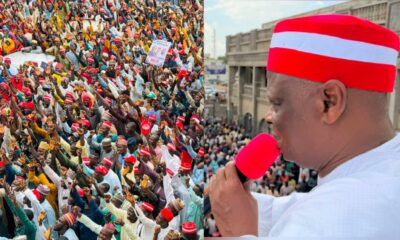
National leader of a faction of the New Nigeria Peoples Party (NNPP), Senator Rabiu Musa Kwankwaso
Rabiu Musa Kwankwaso

Kwankwaso gives real reason Gov Yusuf reinstated Sanusi as Emir of Kano

The Nigeria Nigeria Peoples Party, NNPP, 2023 presidential candidate, Rabiu Kwankwaso, has revealed the real reason behind the reinstallation of Muhammad Sanusi as Emir of Kano by the State government.

Kwankwaso said the reinstatement of Sanusi as Emir is in fulfilment of Governor Abba Yusuf campaign promise to the people of Kano State.

The former Kano State governor said they have no regrets with the governor’s decision to reinstate Sanusi.

Recall that Yusuf reinstated Sanusi of Emir of Kano after ousting Aminu Ado Bayero.

His action was sequel to the abrogation of the 2019 Kano Emirate Law by the state House of Assembly.

The move has plunged the state into bitter tussle for the ancient throne as the dethroned monarch refuses to vacate the palace.

But, featuring on Arise News Prime Time, Kwankwaso said governor Yusuf consulted with relevant stakeholders before the decision to reinstall Sanusi was taken.

READ ALSO:

He said: “It was a campaign issue. Don’t forget that Sanusi Lamido Sanusi was installed in 2014 by our government.

“My Deputy who became governor decided in his wisdom to divide Kano into five emirates. What many people don’t remember is that it was tried by the Rimi government during the Second Republic.

“It was our position, our belief that Kano should continue as one solid traditional institution. That was what we believed in.

“So, during our campaign, the governor went round to tell the people that if they voted for him, Kano would return to being one solid traditional institution, of course with support from the other emirates.

“That is why when he was sworn-in, he started a process of consultation.

“But for one year, the governor carried out due consultations and decided to follow due process through the State House of Assembly and Sanusi was reinstated. People voted for him for several reasons, including making Kano one strong emirate.”

Kwankwaso gives real reason Gov Yusuf reinstated Sanusi as Emir of Kano

Loading

News

Police detain Osun SSG, five others as ₦4.8m, voter cards are recovered

Published

on

Police detain Osun SSG, five others as ₦4.8m, voter cards are recovered
Secretary to the Osun State Government, Teslim Igbalaye

Police detain Osun SSG, five others as ₦4.8m, voter cards are recovered

The Osun State Police Command has detained the Secretary to the State Government, Teslim Igbalaye, alongside five other persons following a police operation at his residence in Osogbo.

Police said the operation was based on intelligence indicating that suspected members of a criminal gang were allegedly hiding at the property.

During the raid, officers reportedly recovered ₦4,810,500 in cash, two Permanent Voter Cards (PVCs), a voter register covering Wards 1 to 15, a Dynabook laptop, a photocopy machine and a printer.

The police said the recovered items had been secured and placed in custody for forensic examination and further investigation.

In a statement issued by the Police Public Relations Officer, Abiodun Ojelabi, the command identified the other persons arrested as Akande Taiwo, Oladele Abiodun, Adeyemo Lukman, Olaoye Muftau and Aderemi Musliu.

According to the police, one of the suspects, Oladele Abiodun, was already on its watchlist in connection with alleged criminal activities.

The command said the recovery of the cash and voter-related materials raised concerns about possible electoral offences, including alleged vote-buying, as political activities intensify ahead of the August 15, 2026, Osun State governorship election.

Police said preliminary findings provided grounds to investigate possible offences under the Electoral Act 2022, including alleged vote-buying, criminal conspiracy and harbouring or concealing a wanted suspect.

The command added that investigators were working to determine the source and intended use of the recovered money, identify all persons connected to the items and establish whether a wider criminal network was involved.

READ ALSO:

“The recovery of the cash and the register containing voters’ details raises serious concerns regarding possible electoral offences and other criminal activities,” the police said.

The command stressed that the investigation was ongoing and that no individual would be treated as above the law because of political affiliation, social status or public office.

It added that anyone found culpable after the investigation would be prosecuted in accordance with the law.

However, the Osun State Government criticised the operation and accused the police of invading the residence of the SSG without obtaining a valid search warrant.

In a statement signed by the Commissioner for Information and Public Enlightenment, Kolapo Alimi, the state government alleged that a combined team of police officers, led by the Deputy Commissioner of Police in charge of Operations, forced its way into the residence and arrested people present at the property.

The government also alleged that the operation was part of coordinated raids and increased police surveillance targeting senior officials in the administration of Governor Ademola Adeleke.

According to the state government, Igbalaye was attending an election stakeholders’ meeting organised by the Independent National Electoral Commission (INEC) when the police operation took place.

The government further claimed that ward officials were holding a meeting within the premises at the time of the raid.

The Osun government described the operation as politically motivated and called on the police to act professionally and impartially as the state approaches the governorship election.

The police, however, maintained that the operation was intelligence-led and linked to an ongoing criminal investigation.

In a subsequent update, the police said those arrested would be screened and that anyone found not to be connected to the investigation would be released.

The incident has heightened political tension in Osun State, where parties have intensified mobilisation ahead of the August 15 governorship election.

The All Progressives Congress (APC) has expressed confidence that it will regain control of the state, while supporters of Governor Adeleke have maintained that the outcome of the election will be decided by voters.

As of the time of filing this report, the police had not announced the conclusion of the investigation or disclosed whether any of the detained persons would be formally charged.

The investigation remains ongoing.

Police detain Osun SSG, five others as ₦4.8m, voter cards are recovered

Loading

Continue Reading

News

US Shuts Down Routine Visa Processing at Abuja Embassy, 24 Other African Missions

Published

on

US Shuts Down Routine Visa Processing at Abuja Embassy, 24 Other African Missions

US Shuts Down Routine Visa Processing at Abuja Embassy, 24 Other African Missions

  • The Trump administration’s restructuring aims to centralise visa services in regional hubs to enhance security and reduce costs.

The United States government has announced that routine visa processing at its embassy in Abuja and 24 other diplomatic missions across Africa will end from August 1, 2026, as part of a major restructuring of its overseas consular operations. The US Department of State said the move is aimed at centralising routine visa services in regional hubs to enhance national security, reduce government spending, and ensure greater consistency in visa screening, vetting and adjudication.

In a statement on the US Department of State website, the department said the reorganisation aligns with President Donald Trump’s administration’s priority of placing America’s interests and security first. “The Department of State is constantly evaluating its overseas operations in order to advance America’s priorities as efficiently and effectively as possible. This includes a visa process that maintains rigorous standards of security screening and vetting and aligns resources and operational capacity with America’s national interests,” the statement read. “The Trump administration has no higher priority than the safety and security of Americans, and the State Department will continue to provide Americans with appropriate consular services and assistance at diplomatic posts around the world.”

READ ALSO:

Besides Abuja, the affected diplomatic posts are located in Asmara (Eritrea), Bamako (Mali), Banjul (Gambia), Brazzaville (Republic of Congo), Bujumbura (Burundi), Conakry (Guinea), Cotonou (Benin), Durban (South Africa), Freetown (Sierra Leone), Gaborone (Botswana), Harare (Zimbabwe), Juba (South Sudan), Libreville (Gabon), Lilongwe (Malawi), Lusaka (Zambia), Maputo (Mozambique), Maseru (Lesotho), Mbabane (Eswatini), N’Djamena (Chad), Niamey (Niger), Nouakchott (Mauritania), Ouagadougou (Burkina Faso), and Windhoek (Namibia). The State Department clarified that the change affects only routine visa processing and does not alter the operational status of the embassies and consulates involved. All affected diplomatic missions will continue to provide consular services, including American Citizen Services (ACS), emergency assistance to US citizens, and carry out their regular diplomatic functions on behalf of the United States. The department further assured travellers that the policy does not invalidate visas that have already been issued.

The realignment applies to most routine visa services, including both nonimmigrant and immigrant visa categories. Nonimmigrant visas affected include B-1/B-2 visitor visasF-1 student visasJ-1 exchange visitor visas, and employment-based categories such as H, L, O, and P visas. Immigrant visa services being realigned include Immediate Relative (IR) visasFamily Preference (FP) visasEmployment-Based (EB) immigrant visasK fiancé(e) visas, adoption cases, Diversity Visa (DV) cases, and follow-to-join asylee and refugee (V92/V93) cases.

Under the new arrangement, applicants in affected countries will be required to access routine visa services through designated regional processing hubs. Routine visa services will continue at US embassies and consulates in Lagos, Abidjan, Accra, Addis Ababa, Cape Town, Dakar, Dar-es-Salaam, Djibouti, Johannesburg, Kampala, Kigali, Kinshasa, Lomé, Luanda, Malabo, Monrovia, Nairobi, Port Louis, Praia and Yaoundé. These designated hubs will continue to process all routine non-immigrant visas, including tourist, business and petition-based visas, as well as immigrant visas. The announcement is expected to impact thousands of Nigerian applicants who currently process US visas in Abuja, forcing them to travel to Lagos or other designated hubs on the continent. Nigeria has one of the highest volumes of US visa applications in Africa, with the US Embassy in Abuja and Consulate in Lagos being the two main processing centres for Nigerian applicants. The State Department advised citizens and residents of affected countries seeking US visas from August 1, 2026, to book appointments and pay required fees at designated processing hubs. The department also noted that similar regional hub arrangements had already been implemented successfully in several African countries and parts of Europe. The State Department further stated that visa suspensions imposed under Presidential Proclamation 10998, visa bond requirements and immigrant visa pauses for certain nationalities would remain in effect. Applicants who already have appointments at affected posts should monitor their email for specific guidance from the department.

US Shuts Down Routine Visa Processing at Abuja Embassy, 24 Other African Missions

Loading

Continue Reading

News

Mutfwang Clarifies Apology to Igbo Community: “My Words Were Twisted”

Published

on

Mutfwang Clarifies Apology to Igbo Community: "My Words Were Twisted"
Governor of Plateau State, Caleb Mutfwang

Mutfwang Clarifies Apology to Igbo Community: “My Words Were Twisted”

  • Governor Caleb Mutfwang insists his remarks were taken out of context, emphasizing reconciliation and Plateau’s legacy of peaceful coexistence

Governor of Plateau State, Caleb Mutfwang, has finally broken his silence over the firestorm of reactions that followed his recent apology to the Igbo community (Ndigbo) over Nigeria’s civil war atrocities. In a detailed statement on Wednesday, the governor firmly declared that his intentions were deliberately taken out of context and misrepresented by critics. The controversy erupted after Mutfwang, during a courtesy visit by Igbo leaders at the Government House in Jos, was quoted as saying: “I apologise to the Igbos so that we can put the past behind us… because our people were deceived into going to war, and we regret it.” The remarks sparked a national debate, drawing both praise from Igbo groups and sharp criticism from some Plateau stakeholders who felt the governor unfairly blamed his own people. Now, through his Director of Press Affairs, Dr. Gyang Bere, the governor has set the record straight.

In a statement released Wednesday, Mutfwang explained that his remarks were never intended to assign blame or diminish the suffering of any ethnic group. Instead, they were rooted in three key pillars: appreciation for the immense contributions of the Igbo community to Plateau State’s growth in commerce, education, healthcare, and industry; reconciliation through encouraging all Nigerians to build bridges of mutual respect and peaceful coexistence; and national unity by reminding citizens of the enduring responsibility to strengthen bonds rather than reopen old wounds. The governor emphasized through his spokesperson that at no point did he seek to diminish the painful experiences of any ethnic group or the historical realities surrounding Nigeria’s Civil War. He noted that the scars of that period remain part of our national history and deserve to be remembered with empathy, honesty and sensitivity. The governor emphasized that his apology to Ndigbo was not an indictment of any tribe but a gesture of solidarity—a reminder that Nigerians must learn from history rather than remain imprisoned by it.

READ ALSO:

Mutfwang took the opportunity to highlight Plateau State’s historic role as a beacon of peaceful coexistence. He traced this tradition back to the post-civil war era, when leaders like JD Gomwalk and Chief Solomon Lar championed policies of inclusion. He specifically invoked General Yakubu Gowon’s “No Victor, No Vanquished” declaration and the 3Rs policy (Reconciliation, Rehabilitation, Reconstruction) , which he described as a globally recognized model for post-war healing. The governor noted that for decades, Plateau State has proudly stood as one of Nigeria’s foremost examples of peaceful coexistence among diverse peoples. He added that successive administrations have sustained this tradition by creating an environment where Nigerians from every region can live, work, worship, invest and flourish. The governor further noted that the Igbo community has leveraged this welcoming environment to make invaluable contributions to the state’s development, and his administration is committed to preserving and strengthening that legacy.

The meeting, however, was not without its political dimensions. During the visit, Igbo leaders from all 17 local government areas of Plateau State formally endorsed Governor Mutfwang for a second term ahead of the 2027 governorship election. Chief Chidi Onah, President-General of the Igbo Community in Plateau State, cited Mutfwang’s inclusive leadership and developmental strides as key reasons for their support. But the discussions also exposed underlying tensions. Community leaders raised unresolved compensation claims over land disputes—a reminder that even in states celebrated for harmony, the relationship between “indigenes” and “settlers” remains delicate.

The governor’s initial comments drew a polarized response. On the one hand, the Izu Umunna Cultural Association (IUCA) hailed Mutfwang’s apology as “courageous,” “healing,” and historic. They noted that the civil war remains “a scar in the psyche of every Igbo man” and that no national leader had previously shown the courage to accept such responsibility. On the other hand, former Sports Minister Solomon Dalung and former Commissioner for Information Dan Manjang criticized the governor, arguing he unfairly placed the burden of the civil war on the people of Plateau State.

Addressing his critics directly, Mutfwang urged Nigerians to resist attempts to inflame ethnic or regional divisions. He stated that at a time when our nation faces significant challenges, Nigerians must resist every attempt to inflame ethnic or regional divisions. Instead, he said, we should draw strength from our shared history, celebrate our diversity and recommit ourselves to building a nation founded on justice, mutual respect and peaceful coexistence. The governor reaffirmed that his administration believes Plateau’s greatest strength lies not in the differences among its people but in their ability to transform diversity into unity and shared prosperity. He concluded that Governor Caleb Mutfwang remains unwavering in his belief that every Nigerian, irrespective of ethnicity, religion or place of origin, deserves dignity, equal opportunity and a genuine sense of belonging. He urged the public to disregard any interpretations that assign unintended meanings to his remarks, describing such distortions as distractions from the broader message of unity and national cohesion.

Mutfwang Clarifies Apology to Igbo Community: “My Words Were Twisted”

Loading

Continue Reading

Trending