

International
Canada, Mexico, China respond to Trump tariff threats
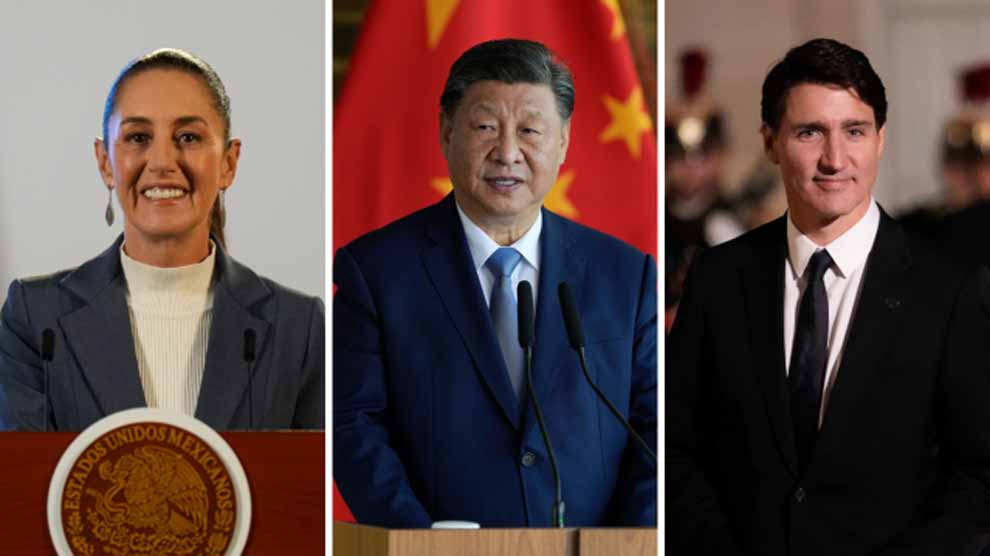
Canada, Mexico, China respond to Trump tariff threats
Officials from Canada, Mexico and China have warned US President-elect Donald Trump’s pledge to impose sweeping tariffs on America’s three largest trading partners could upend the economies of all four countries.
“To one tariff will follow another in response and so on, until we put our common businesses at risk,” Mexico’s President Claudia Sheinbaum said.
Trump vowed on Monday night to introduce 25% tariffs on goods coming from Mexico and Canada and an additional 10% on goods coming from China. He said the duties were a bid to clamp down on drugs and illegal immigration.
Canada’s Prime Minister Justin Trudeau said he spoke to Trump in the hours after the announcement and planned to hold a meeting with Canada’s provincial leaders on Wednesday to discuss a response.
A spokesman for China’s embassy in Washington DC told the BBC: “No-one will win a trade war or a tariff war.”
The international pushback came a day after Trump announced his plans for his first day in office, on 20 January, in a post on his social media website, Truth Social.
Trudeau said his country was prepared to work with the US in “constructive ways”.
“This is a relationship that we know takes a certain amount of working on, and that’s what we’ll do,” Trudeau told reporters.
In a phone call with Trump, Trudeau said the pair discussed trade and border security, with the prime minister pointing out that the number of migrants crossing the Canadian border was much smaller compared with the US-Mexico border.
READ ALSO:
- EFCC to arraign Yahaya Bello today for alleged N110bn fraud
- Court dismisses Sanwo-Olu’s suit to stop EFCC from arresting him after tenure expires
- US University opens 2025 scholarships for international students
Trump’s team declined to confirm the phone call.
But Trump spokesman Steven Cheung added that world leaders had sought to “develop stronger relationships” with Trump “because he represents global peace and stability”.
Mexico’s President Sheinbaum told reporters on Tuesday that neither threats nor tariffs would solve the “migration phenomenon” or drug consumption in the US.
Reading from a letter that she said she would send to Trump, Sheinbaum also warned that Mexico would retaliate by imposing its own taxes on US imports, which would “put common enterprises at risk”.
She said Mexico had taken steps to tackle illegal migration into the US and that “caravans of migrants no longer reach the border”.
The issue of drugs, she added, “is a problem of public health and consumption in your country’s society”.
Sheinbaum, who took office last month, noted that US car manufacturers produce some of their parts in Mexico and Canada.
“If tariffs go up, who will it hurt? General Motors,” she said.
Meanwhile, a spokesman for China’s embassy in Washington, Liu Pengyu, told the BBC that “China-US economic and trade co-operation is mutually beneficial in nature”.
He denied that China allows chemicals used in the manufacture of illegal drugs – including fentanyl – to be smuggled to the US.
“China has responded to US request for verifying clues on certain cases and taken action,” Liu said.
“All these prove that the idea of China knowingly allowing fentanyl precursors to flow into the United States runs completely counter to facts and reality.”
President Joe Biden has left in place the tariffs on China that Trump introduced in his first term, and added a few more of his own.
Currently, a majority of what the two countries sell to each other is subject to tariffs – 66.4% of US imports from China and 58.3% of Chinese imports from the US.
Speaking in the House of Commons in Ottawa, Trudeau told lawmakers that “the idea of going to war with the United States isn’t what anyone wants”.
He called on them to not “panic”, and to work together.
“That is the work we will do seriously, methodically. But without freaking out,” he said.
The leaders of Canadian provinces suggested that they would impose their own tariffs on the US.
“The things we sell to the United States are the things they really need,” Deputy Prime Minister Chrystia Freeland said on Tuesday. “We sell them oil, we sell them electricity, we sell them critical minerals and metals.”
America’s northern neighbour accounted for some $437bn (£347bn) of US imports in 2022, and was the largest market for US exports in the same year, according to US data.
Canada sends about 75% of its total exports to the US.
Doug Ford, the premier of Ontario, Canada’s most populous province, said on Monday the proposed tariff would be “devastating to workers and jobs in both Canada and the US”.
“To compare us to Mexico is the most insulting thing I’ve ever heard,” said Ford.
Ford was echoed by the premiers of Quebec, Saskatchewan and British Columbia, while a post on the X account of Alberta Premier Danielle Smith acknowledged that Trump had “valid concerns related to illegal activities at our shared border”.
The Canadian dollar, the Loonie, has plunged in value since Trump vowed to impose tariffs on Canadian imports come January.
The Canadian dollar dipped below 71 US cents, the lowest level the Loonie has fallen to since May 2020, when Trump threatened to impose tariffs on Canadian goods during his first stint as US president. The Mexican peso fell to its lowest value this year, around 4.8 cents.
Canada, Mexico, China respond to Trump tariff threats
BBC








International
Ninth Body Discovered in South Africa: Nigeria Issues Urgent Safety Alert to Nationals
Ninth Body Discovered in South Africa: Nigeria Issues Urgent Safety Alert to Nationals
Police cordon off Kempton Park and post a $56,000 combined bounty as the Nigerian Consulate warns citizens to exercise heightened vigilance.
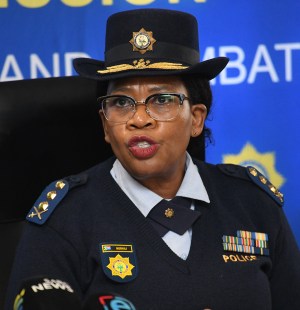
South African police recovered the body of a ninth woman on Thursday along a roadside in Dawn Park, intensifying public alarm and prompting the Nigerian Consulate-General in Johannesburg to issue an emergency safety advisory to its citizens.
In response to the discoveries, law enforcement teams placed Kempton Park in the Ekurhuleni municipality under lockdown and established roadblocks to inspect vehicles and restrict suspect movement.
Deputy Police Chief Tebello Mosikili declared during a press conference that authorities will deploy specialized investigative units to track down those responsible.
To accelerate breakthroughs, police offered a 400,000 rand ($25,000) reward for credible tips, while South Africa’s Democratic Alliance provided an additional $31,000, establishing a combined bounty of $56,000.
Detectives are now evaluating forensic evidence to determine whether one perpetrator committed the murders or whether independent offenders copied earlier attacks.
Meanwhile, the Nigerian Consulate-General urged Nigerian residents, especially women and young people who commute, exercise, or study around Ekurhuleni, to take deliberate personal precautions.
The mission advised community members to travel in groups, stay clear of isolated trails, and share real-time travel details with trusted family members.
Furthermore, diplomatic officials emphasized that safety precautions must not shift the burden of crime prevention onto women, calling on South African authorities to ensure thorough investigations and justice for every victim.
Ninth Body Discovered in South Africa: Nigeria Issues Urgent Safety Alert to Nationals
Health
Fiji Declares National HIV Emergency as Diagnoses Surge Sixteenfold
Fiji Declares National HIV Emergency as Diagnoses Surge Sixteenfold
Authorities launch a multi-agency public health campaign to expand free testing, treatment, and harm-reduction services
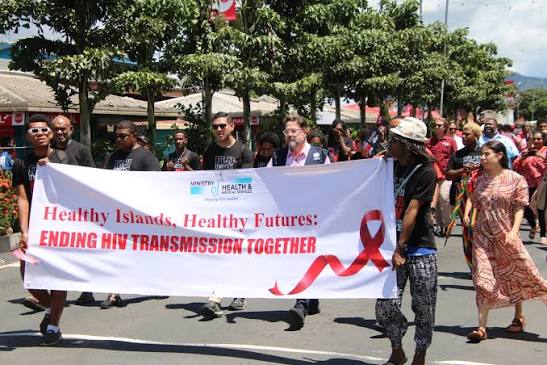
Fiji has announced a nationwide health response to address a significant rise in HIV cases and ensure that all residents can access essential medical care.
On Wednesday, Health Minister Dr. Atonio Lalabalavu shared the emergency declaration, explaining that national agencies are joining forces to provide rapid medical support, expand testing, and protect community well-being across the islands.
Official reports indicate that about one in every 60 adults in Fiji currently lives with HIV, following an increase in new infections over recent years. Health specialists explain that the virus spreads primarily through intimate sexual contact and shared needles among individuals using illicit substances.
Additionally, routine screenings revealed that two out of every 100 expecting mothers carry the virus, highlighting an urgent need for early maternal healthcare to protect newborns from infection.
To safeguard public health, authorities are delivering free daily treatments, distributing protective preventive medications, and setting up clean needle programs to stop infections before they start.
Furthermore, global partners, including Australia, New Zealand, India, and United Nations health bodies are providing financial resources and medical supplies to back the local effort.
By encouraging open community conversations and delivering accessible healthcare without judgment, health workers aim to ensure that everyone receives the care and dignity they deserve.
Fiji Declares National HIV Emergency as Diagnoses Surge Sixteenfold
International
Kim Yo-jong: Only ‘Idiots’ Think North Korea Will Give Up Nuclear Weapons

-

 International2 days ago
Islamic Council Condemns Attempted Attack on Holy City of Mecca
-

 News2 days ago
Keep Politics Out of My Office — Ogbomoso Grand Chief Imam Warns Politicians, Bloggers
-

 metro2 days ago
Niger Mosque Abductions: Terrorists Execute 30 of 500 Captive Muslim Worshippers
-

 Entertainment2 days ago
BREAKING: Olu Jacobs Dies at 84, Atiku Mourns Cultural Icon
-
 metro3 days ago
Fatal NURTW Leadership Clash in Osun Leaves Two Dead; State Orders Park Shut Down
-
 Business1 day ago
Fuel Prices Climb to ₦1,500 per Litre Across Nigeria, Sparking Calls for Urgent Action
-

 News2 days ago
Blue Line Rail, Hospitals Get Boost as Lagos Approves ₦200bn Bond and Budget Reordering
-

 News1 day ago
OAU Investigates Death of Final-Year Student as Police Begin Probe